
LAND RESOURCES DEFINITION OF LAND Land is normally
- Slides: 17
LAND RESOURCES DEFINITION OF LAND Land is normally defined as a physical entity in terms of its topography and spatial nature. Often associated with an economic value, expressed in price per hectare at ownership transfer. Land Use Planning and Management (SST 5602)
LAND RESOURCES A delineable area of the earth’s terrestrial surface Below and above this surface, it hold many kinds of resources : Ø The near surface climate ØThe soils just below the surface and terrain forms DEFINITION OF LAND (FAO, 1995) ØThe near-surface sedimentary layers (minerals) and associated ground-water reserves ØThe surface hydrology (including shallow lakes, rivers, marshes and swamps) ØThe plants that form forests and other vegetation types ØThe animal population ØHuman population Land Use Planning and Management (SST 5602)
LAND RESOURCES 1. PRODUCTION FUNCTION : underpins many life support systems through production of biomass that provides food, fodder, fiber, fuel, timber and other biotic material for human use, either directly or through animal husbandry including aquaculture, and inland coastal fisheries; FUNCTIONS OF LAND 2. BIOTIC ENVIRONMENTAL FUNCTION : Land is the basis of terrestrial biodiversity – it provide biological habitats and gene reserves for plant, animals and microorganisms, above and below the ground. 3. CLIMATE REGULATIVE FUNCTION : land its use are a source and sink of greenhouse gases, and form a codeterminant of the global energy balance – along with reflection, absorption and transformation of the sun’s radioactive energy, and the global hydrological cycle Land Use Planning and Management (SST 5602)
LAND RESOURCES 4. HYDROLOGIC FUNCTION : land regulates the storage and flow of surface and groundwater resources, and influences their quality. 5. STORAGE FUNCTION : land is a storehouse of raw materials and minerals for human use FUNCTIONS OF LAND 6. WASTE AND POLLUTION CONTROL FUNCTION : and absorbs, filters, buffers and transforms many hazardous compounds 7. LIVING SPACE FUNCTION ; land provides the physical basis for human settlements and everything done from there - from industry to sports and recreation Land Use Planning and Management (SST 5602)
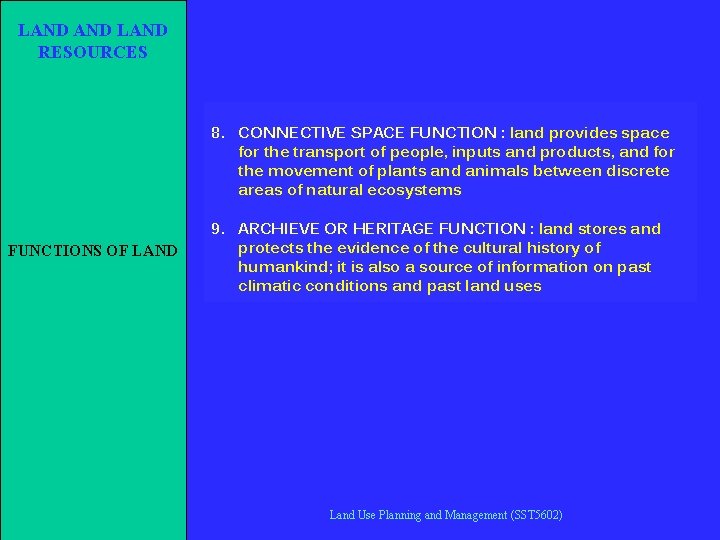
LAND RESOURCES 8. CONNECTIVE SPACE FUNCTION : land provides space for the transport of people, inputs and products, and for the movement of plants and animals between discrete areas of natural ecosystems FUNCTIONS OF LAND 9. ARCHIEVE OR HERITAGE FUNCTION : land stores and protects the evidence of the cultural history of humankind; it is also a source of information on past climatic conditions and past land uses Land Use Planning and Management (SST 5602)
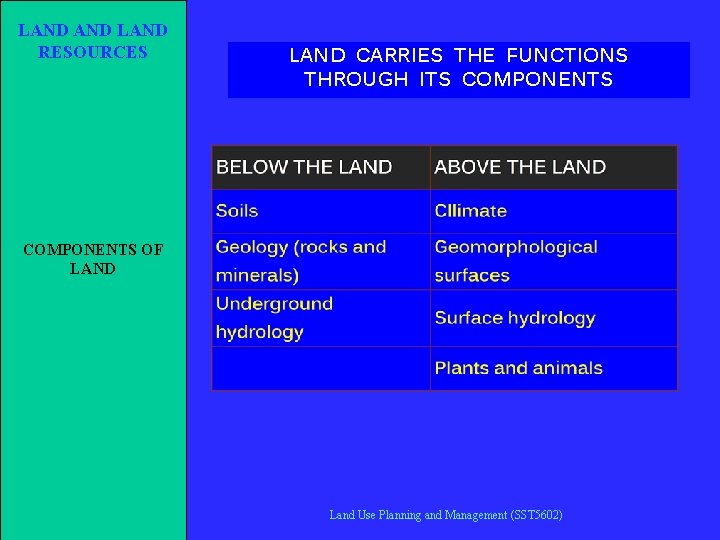
LAND RESOURCES LAND CARRIES THE FUNCTIONS THROUGH ITS COMPONENTS OF LAND Land Use Planning and Management (SST 5602)
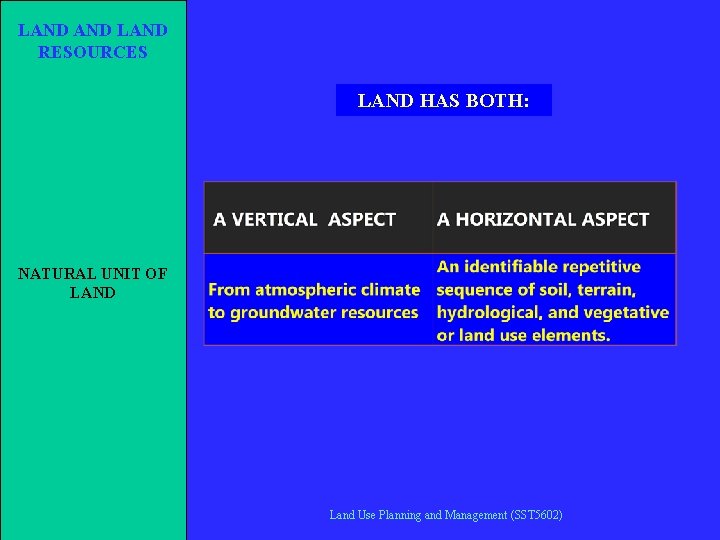
LAND RESOURCES LAND HAS BOTH: NATURAL UNIT OF LAND Land Use Planning and Management (SST 5602)
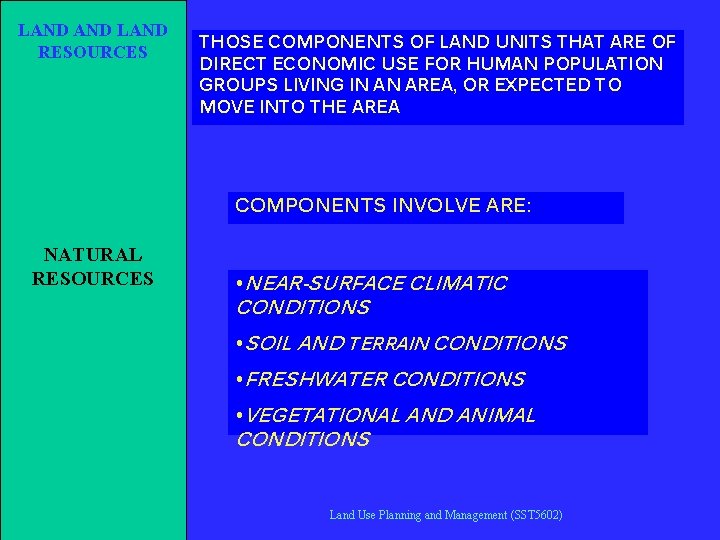
LAND RESOURCES THOSE COMPONENTS OF LAND UNITS THAT ARE OF DIRECT ECONOMIC USE FOR HUMAN POPULATION GROUPS LIVING IN AN AREA, OR EXPECTED TO MOVE INTO THE AREA COMPONENTS INVOLVE ARE: NATURAL RESOURCES • NEAR-SURFACE CLIMATIC CONDITIONS • SOIL AND TERRAIN CONDITIONS • FRESHWATER CONDITIONS • VEGETATIONAL AND ANIMAL CONDITIONS Land Use Planning and Management (SST 5602)
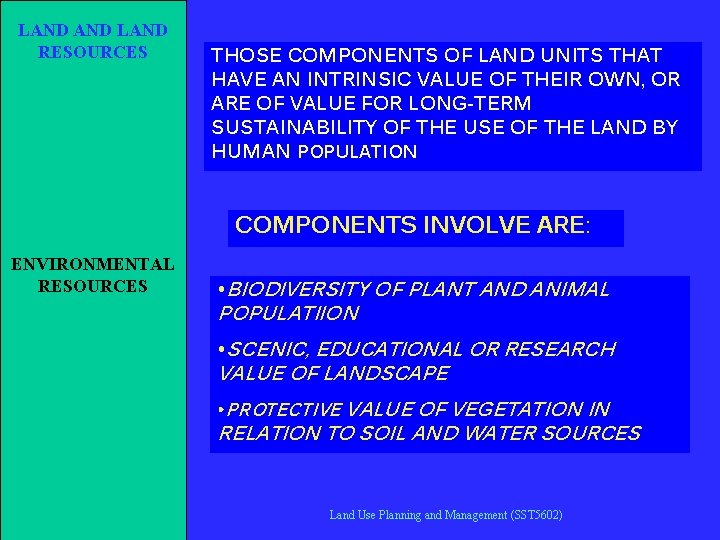
LAND RESOURCES THOSE COMPONENTS OF LAND UNITS THAT HAVE AN INTRINSIC VALUE OF THEIR OWN, OR ARE OF VALUE FOR LONG-TERM SUSTAINABILITY OF THE USE OF THE LAND BY HUMAN POPULATION COMPONENTS INVOLVE ARE: ENVIRONMENTAL RESOURCES • BIODIVERSITY OF PLANT AND ANIMAL POPULATIION • SCENIC, EDUCATIONAL OR RESEARCH VALUE OF LANDSCAPE • PROTECTIVE VALUE OF VEGETATION IN RELATION TO SOIL AND WATER SOURCES Land Use Planning and Management (SST 5602)
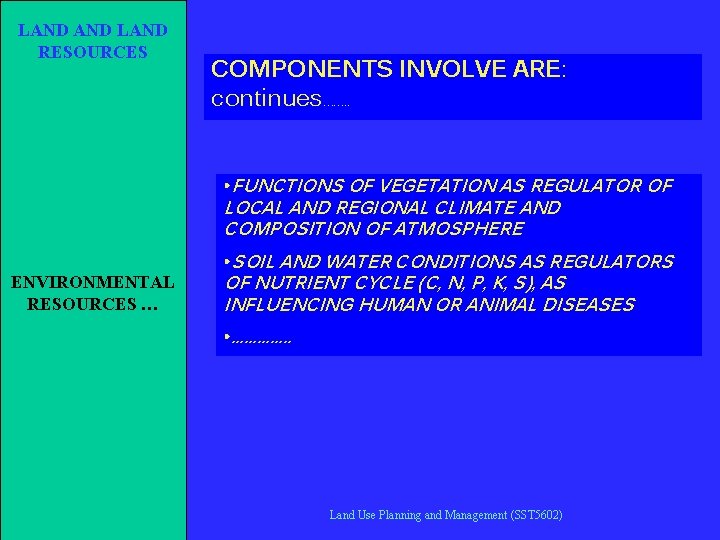
LAND RESOURCES COMPONENTS INVOLVE ARE: continues……. . • FUNCTIONS OF VEGETATION AS REGULATOR OF LOCAL AND REGIONAL CLIMATE AND COMPOSITION OF ATMOSPHERE ENVIRONMENTAL RESOURCES … • SOIL AND WATER CONDITIONS AS REGULATORS OF NUTRIENT CYCLE (C, N, P, K, S), AS INFLUENCING HUMAN OR ANIMAL DISEASES • …………. . Land Use Planning and Management (SST 5602)
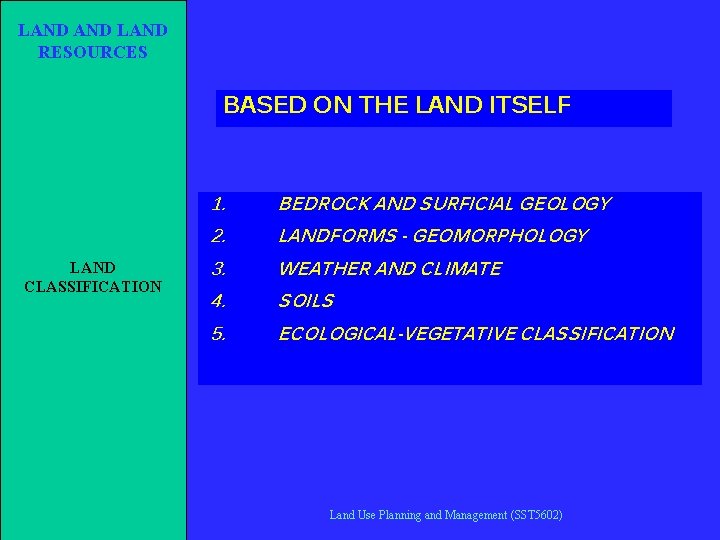
LAND RESOURCES BASED ON THE LAND ITSELF LAND CLASSIFICATION 1. BEDROCK AND SURFICIAL GEOLOGY 2. LANDFORMS - GEOMORPHOLOGY 3. WEATHER AND CLIMATE 4. SOILS 5. ECOLOGICAL-VEGETATIVE CLASSIFICATION Land Use Planning and Management (SST 5602)
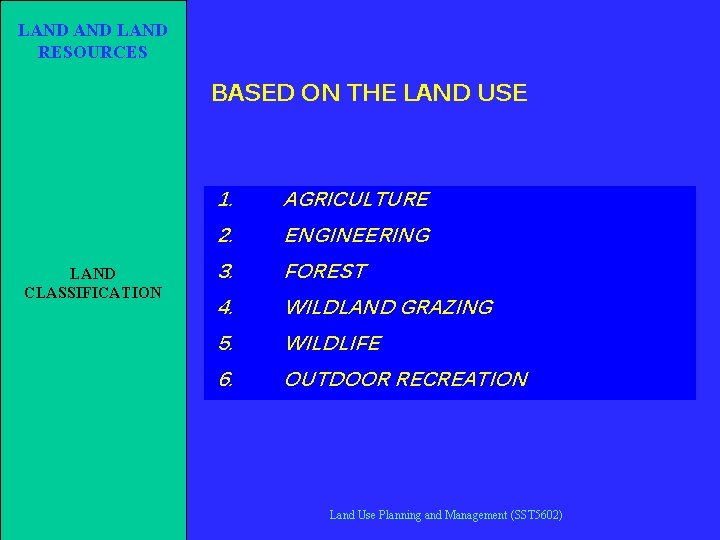
LAND RESOURCES BASED ON THE LAND USE LAND CLASSIFICATION 1. AGRICULTURE 2. ENGINEERING 3. FOREST 4. WILDLAND GRAZING 5. WILDLIFE 6. OUTDOOR RECREATION Land Use Planning and Management (SST 5602)
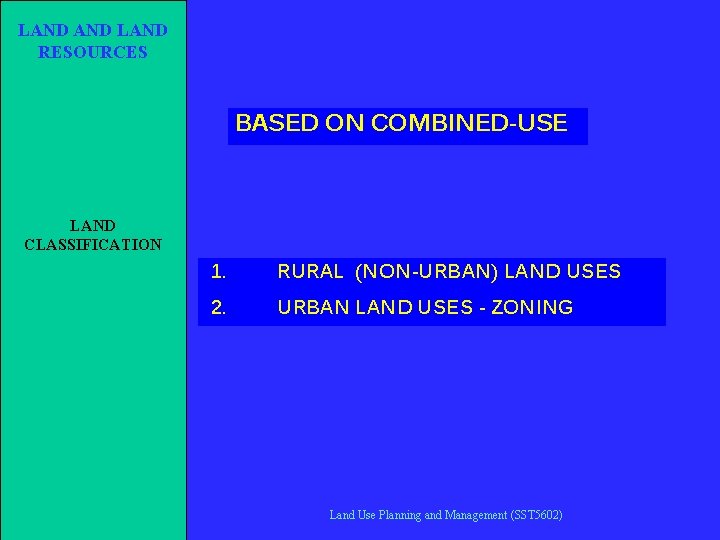
LAND RESOURCES BASED ON COMBINED-USE LAND CLASSIFICATION 1. RURAL (NON-URBAN) LAND USES 2. URBAN LAND USES - ZONING Land Use Planning and Management (SST 5602)
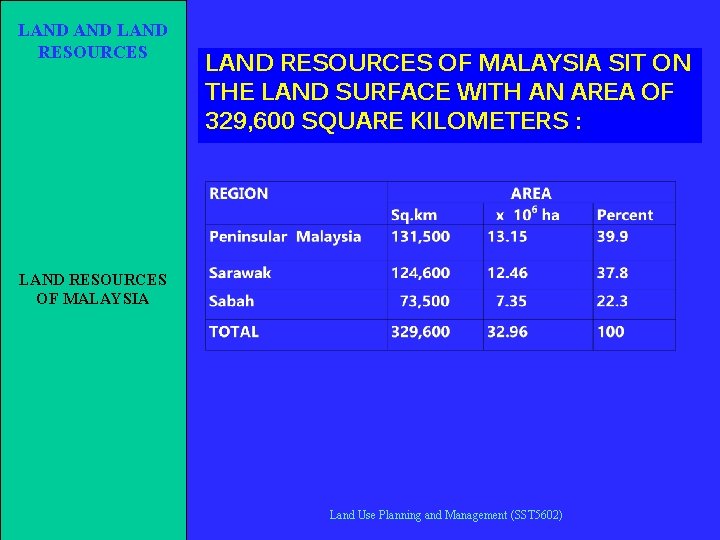
LAND RESOURCES OF MALAYSIA SIT ON THE LAND SURFACE WITH AN AREA OF 329, 600 SQUARE KILOMETERS : LAND RESOURCES OF MALAYSIA Land Use Planning and Management (SST 5602)
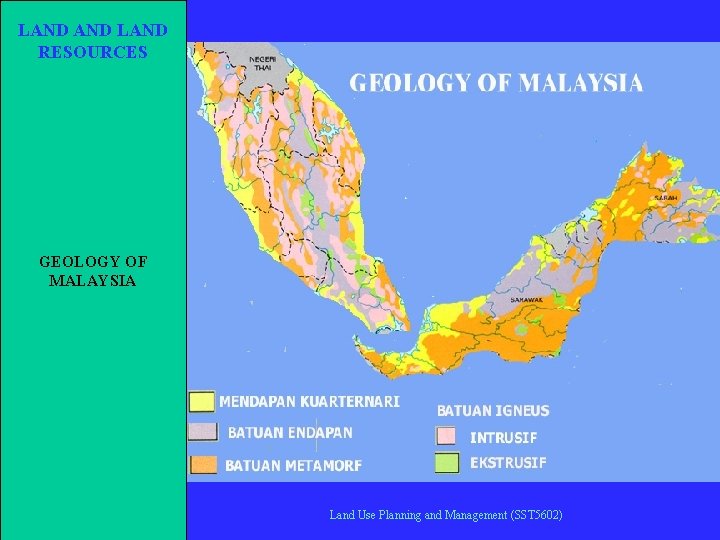
LAND RESOURCES GEOLOGY OF MALAYSIA Land Use Planning and Management (SST 5602)
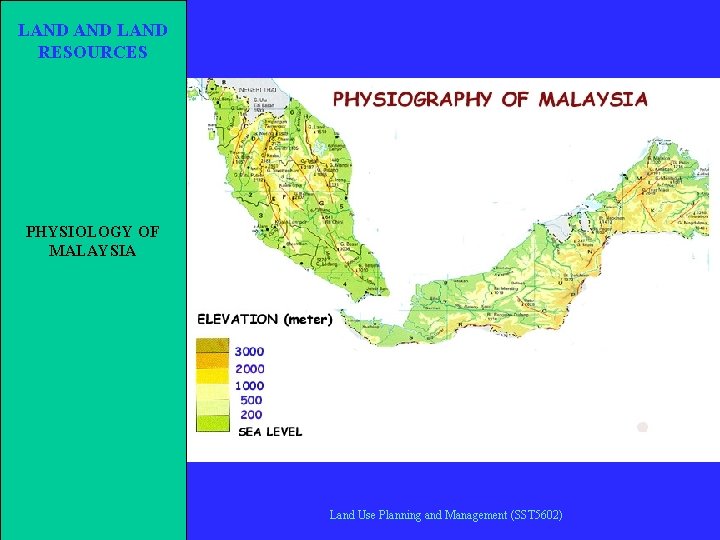
LAND RESOURCES PHYSIOLOGY OF MALAYSIA Land Use Planning and Management (SST 5602)
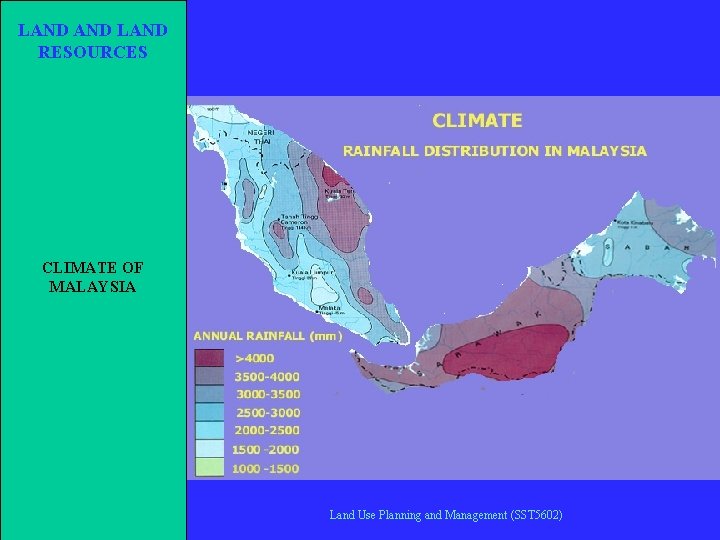
LAND RESOURCES CLIMATE OF MALAYSIA Land Use Planning and Management (SST 5602)