
Land Reform Reflections and Dimensions The environmental dimension

- Slides: 14
Land Reform – Reflections and Dimensions – The environmental dimension Willemien du Plessis Stellenbosch 19 May 2012
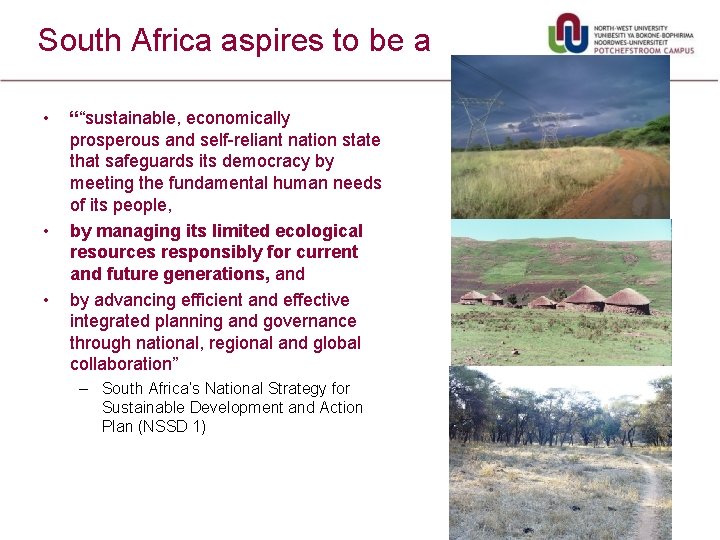
South Africa aspires to be a • • • ““sustainable, economically prosperous and self-reliant nation state that safeguards its democracy by meeting the fundamental human needs of its people, by managing its limited ecological resources responsibly for current and future generations, and by advancing efficient and effective integrated planning and governance through national, regional and global collaboration” – South Africa’s National Strategy for Sustainable Development and Action Plan (NSSD 1)
Section 24 Constitution • • • 24. Everyone has the right to (a) an environment that is not harmful to their health or well-being and (b) to have the environment protected, for the benefit of present and future generations, through reasonable legislative and other measures that – prevent pollution and ecological degradation; – (ii) promote conservation; and – (iii) secure ecologically sustainable development and use of natural – (i) • resources while promoting justifiable economic and social development.
What is the environment? • “environment. ’ means the surroundings within which humans exist and that • are made up of— – (i) the land, water and atmosphere of the earth: – (ii) micro-organisms, plant and animal life: – (iii) any part or combination of (i) and (ii) and the interrelationships among and between them: and – (iv) the physical, chemical, aesthetic and cultural properties and conditions of the foregoing – that influence human health and well-being – S 1 National Environmental Management Act 107 of 1998
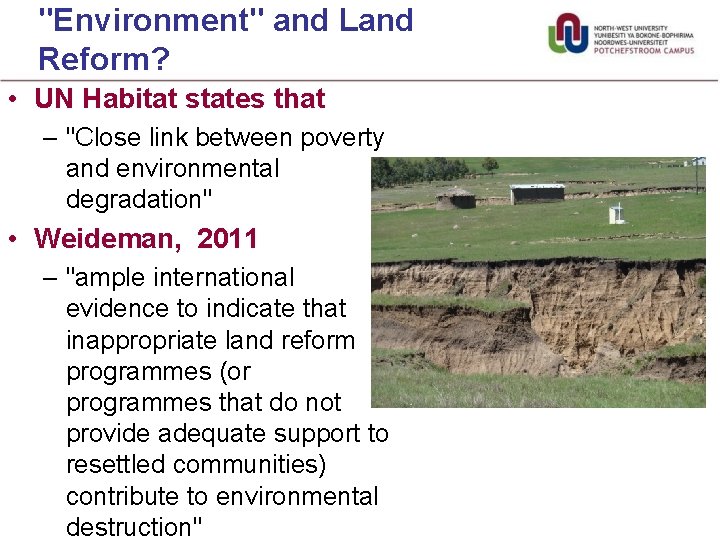
"Environment" and Land Reform? • UN Habitat states that – "Close link between poverty and environmental degradation" • Weideman, 2011 – "ample international evidence to indicate that inappropriate land reform programmes (or programmes that do not provide adequate support to resettled communities) contribute to environmental destruction"
"Environment" and Land Reform? • Phulihlisani Consultants in 2005 after undertaking 4 case studies: Phuhlisani and Developmental Services: Tender bid DLA 05/02/C (2004/05) pp 48 -49: • "Highlighted the social, economic, ecological and institutional complexity of land reform, and • Made it clear that land reform involves much more than transferring a targeted hectarage of land. "
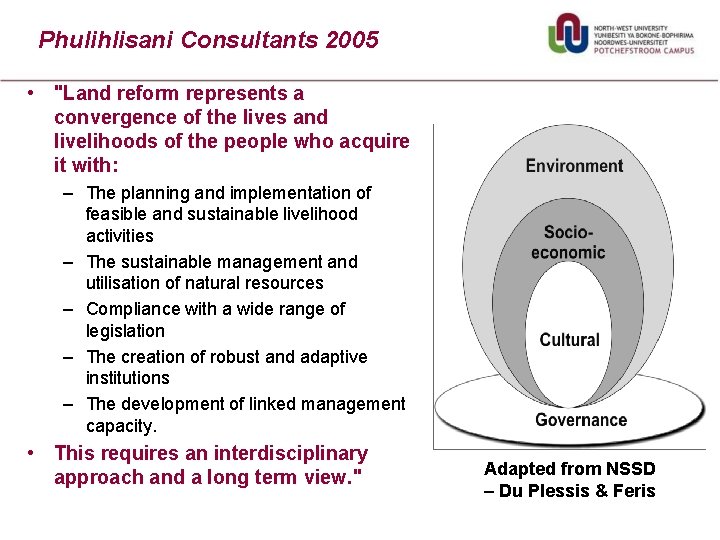
Phulihlisani Consultants 2005 • "Land reform represents a convergence of the lives and livelihoods of the people who acquire it with: – The planning and implementation of feasible and sustainable livelihood activities – The sustainable management and utilisation of natural resources – Compliance with a wide range of legislation – The creation of robust and adaptive institutions – The development of linked management capacity. • This requires an interdisciplinary approach and a long term view. " Adapted from NSSD – Du Plessis & Feris
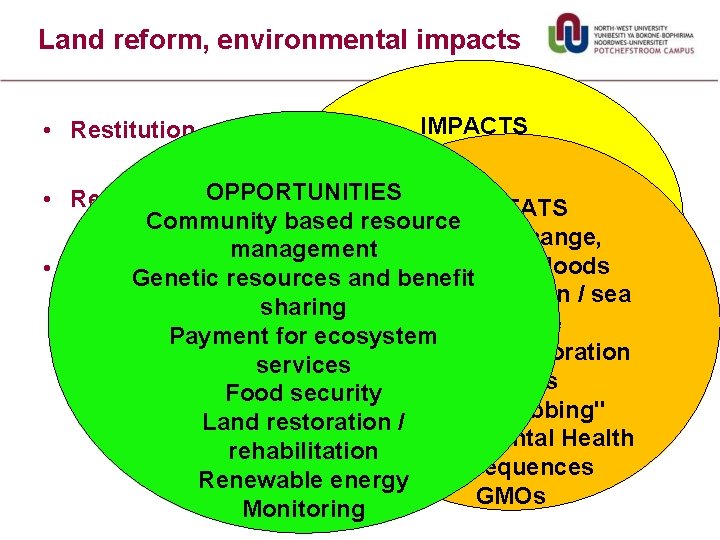
Land reform, environmental impacts IMPACTS Land degradation Water pollution OPPORTUNITIES • Redistribution THREATS Biodiversity loss Community based resource Climate change, management Deforestation Droughts, Floods • Tenure Reform Genetic resources and. Animal benefitdiseases Coastal erosion / sea sharing Alien and invasive level rise Payment for ecosystemspecies Mining & Exploration Erosion services Biofuels Food security "Land grabbing" Land restoration / Environmental Health rehabilitation consequences Renewable energy GMOs Monitoring • Restitution
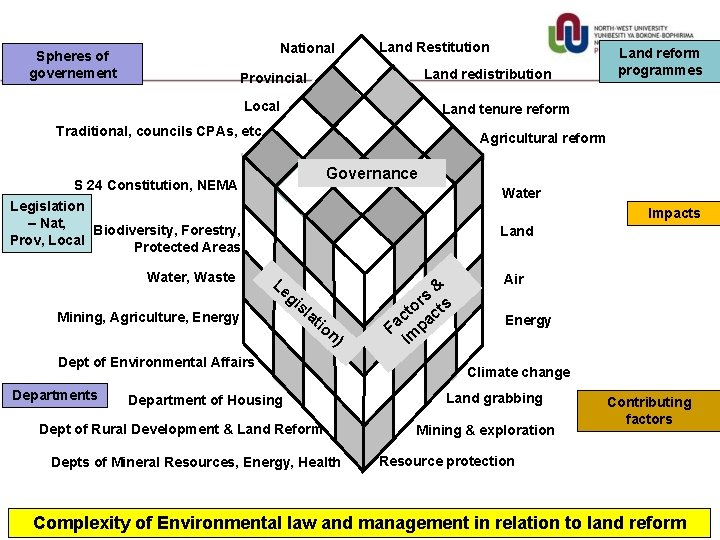
National Spheres of governement Land Restitution Land redistribution Provincial Local Land tenure reform Traditional, councils CPAs, etc Agricultural reform Governance S 24 Constitution, NEMA Water Legislation – Nat, Biodiversity, Forestry, Prov, Local Protected Areas Water, Waste Impacts Land Le Mining, Agriculture, Energy gi sl at io n) Dept of Environmental Affairs Departments Land reform programmes Department of Housing Dept of Rural Development & Land Reform Depts of Mineral Resources, Energy, Health & s r to cts c a Fa mp I Air Energy Climate change Land grabbing Mining & exploration Contributing factors Resource protection Complexity of Environmental law and management in relation to land reform
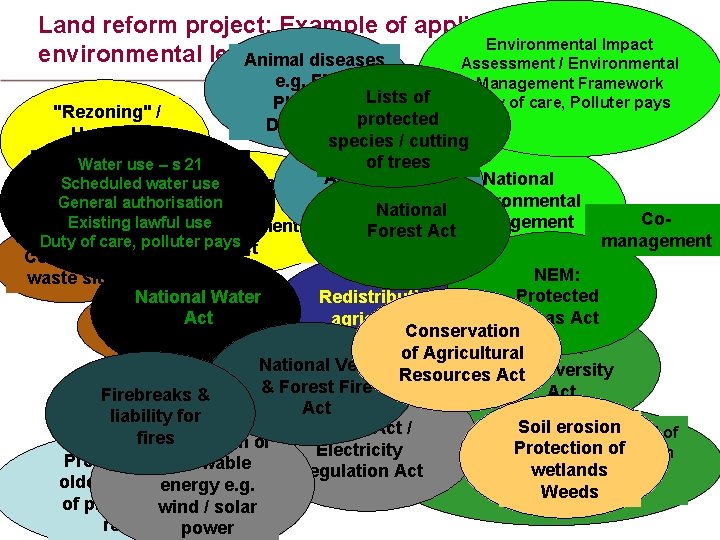
Land reform project: Example of applicable Environmental Impact environmental legislation Animal diseases Assessment / Environmental e. g. FMD, Management Framework Lists of Duty of care, Polluter pays Phakalani "Rezoning" / Declarationprotected Housing species / cutting project / align Animal of Health trees Water use – s 21 with IDP Act / Vetinary National Land Scheduled water Spatial use legislation General authorisation Use National Environmental Co. Existing lawful use Management Forest Act Management management Duty of care, polluter pays Act Communal NEM: waste site Protected National Water Redistribution NEM: Waste Areas Act agricultural Conservation Act project of Agricultural NEM: National Veld Biodiversity Resources Act & Forest Fire Act Firebreaks & Cultural Act. National liability for Heritage Act. Energy Act / Soil erosion Bioregional plans / Removal of fires Introduction of Protection of/ Alien Electricity plants / Benefit sharing Protection of buildings renewable wetlands & Invasive species Regulation Act older than 60 yrs / sense energy e. g. Protected species Weeds of place / archeological wind / solar resourcespower etc
What is in place? • Policy and Guidelines on the Integration of Environmental Planning into Land Reform and Land Development – 2012 Call for revision (prior – seem to be limited implementation) • Animal Veld Management Programme Launch in Limpopo, 17 March 2014 – to improve land use in communal areas thus contributing to improved environmental practices • Community Driven Commercial Forestry, 17 January 2014 • Climate Change Stakeholder Workshops Presentations across the country: June 2013 • National Youth Services Corps - Youth empowerment programme - Environmental training • Rural Disaster Management programmes – Capacity building of rural communities to understand disasters caused by either human or natural activities
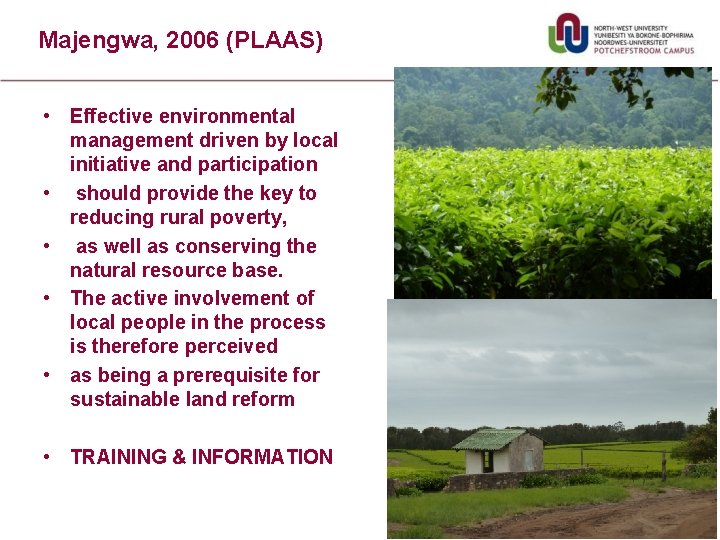
Majengwa, 2006 (PLAAS) • Effective environmental management driven by local initiative and participation • should provide the key to reducing rural poverty, • as well as conserving the natural resource base. • The active involvement of local people in the process is therefore perceived • as being a prerequisite for sustainable land reform • TRAINING & INFORMATION
Need for cooperative governance • • • Chapter 3 of the Constitution Inter-governmental Relations Framework Act Opportunities for cooperation to ensure that land reform projects achieve its aims but within the Goals and outcomes set by government Already see cooperation in plans of government to achieve Sustainable rural livelihoods • • Should not remain a plan on paper The HOW should be addressed and then activities should be MONITORED and regularly EVALUATED RECTIFICATION STEPS should be taken IN TIME – should not wait until a land reform project fails • CONCERTED effort and ASSISTANCE necessary – necessary tools should be in place Need overarching technical cooperative bodies and committees to oversee the processes •
Thank You!