
Land Governance Monitoring structure functions and development stages

- Slides: 15
Land Governance Monitoring: structure, functions, and development stages Klaus Deininger, World Bank Trust Fund "Supporting Transparent Land Governance in Ukraine"
2 Monitoring of Land Governance in Ukraine: Thank Personal Contributions Government of Ukraine: • Maksym Martynyuk, Minagro • Denis Bashlyk, Geocadastre • Monitoring Working Group WB Project Team: • Denys Nizalov • Kateryna Ivinska • Vitaliy Dankevich
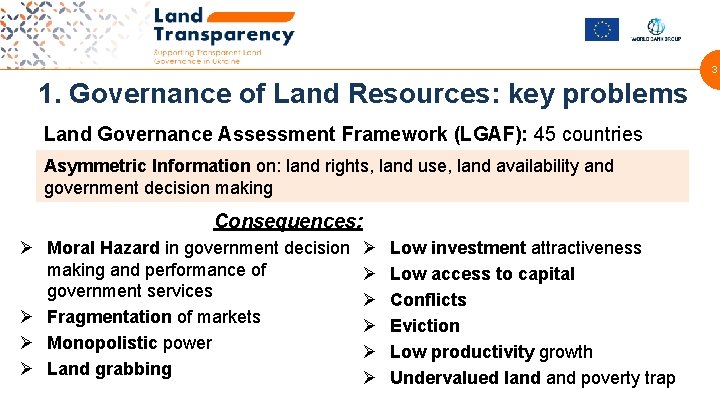
3 1. Governance of Land Resources: key problems Land Governance Assessment Framework (LGAF): 45 countries Asymmetric Information on: land rights, land use, land availability and government decision making Consequences: Ø Moral Hazard in government decision making and performance of government services Ø Fragmentation of markets Ø Monopolistic power Ø Land grabbing Ø Ø Ø Low investment attractiveness Low access to capital Conflicts Eviction Low productivity growth Undervalued land poverty trap
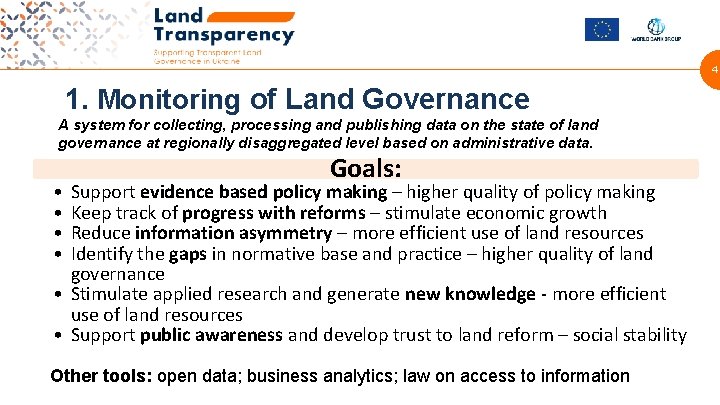
4 1. Monitoring of Land Governance A system for collecting, processing and publishing data on the state of land governance at regionally disaggregated level based on administrative data. • • Goals: Support evidence based policy making – higher quality of policy making Keep track of progress with reforms – stimulate economic growth Reduce information asymmetry – more efficient use of land resources Identify the gaps in normative base and practice – higher quality of land governance • Stimulate applied research and generate new knowledge - more efficient use of land resources • Support public awareness and develop trust to land reform – social stability Other tools: open data; business analytics; law on access to information
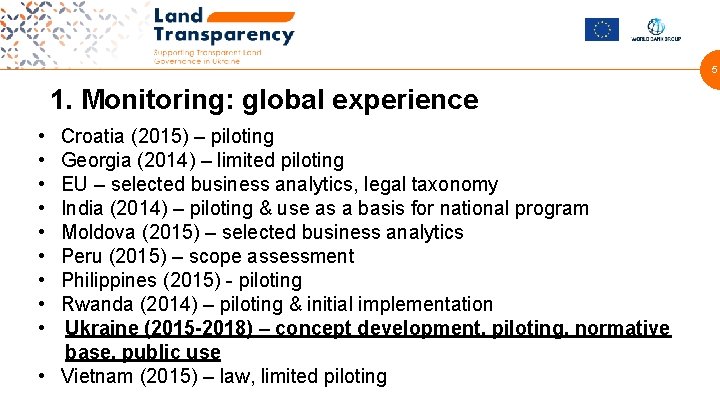
5 1. Monitoring: global experience • • • Croatia (2015) – piloting Georgia (2014) – limited piloting EU – selected business analytics, legal taxonomy India (2014) – piloting & use as a basis for national program Moldova (2015) – selected business analytics Peru (2015) – scope assessment Philippines (2015) - piloting Rwanda (2014) – piloting & initial implementation Ukraine (2015 -2018) – concept development, piloting, normative base, public use • Vietnam (2015) – law, limited piloting
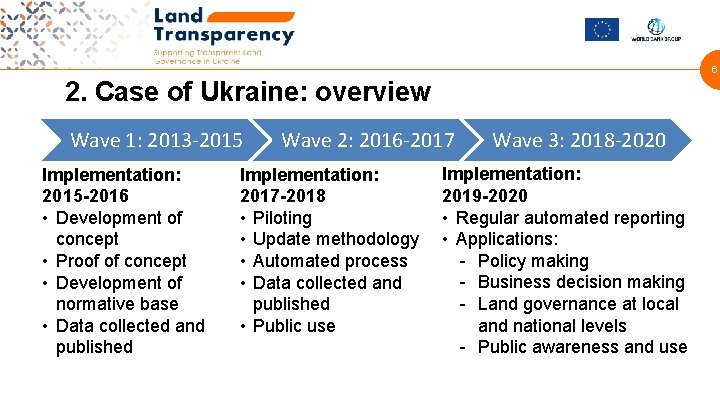
6 2. Case of Ukraine: overview Wave 1: 2013 -2015 Implementation: 2015 -2016 • Development of concept • Proof of concept • Development of normative base • Data collected and published Wave 2: 2016 -2017 Implementation: 2017 -2018 • Piloting • Update methodology • Automated process • Data collected and published • Public use Wave 3: 2018 -2020 Implementation: 2019 -2020 • Regular automated reporting • Applications: - Policy making - Business decision making - Land governance at local and national levels - Public awareness and use
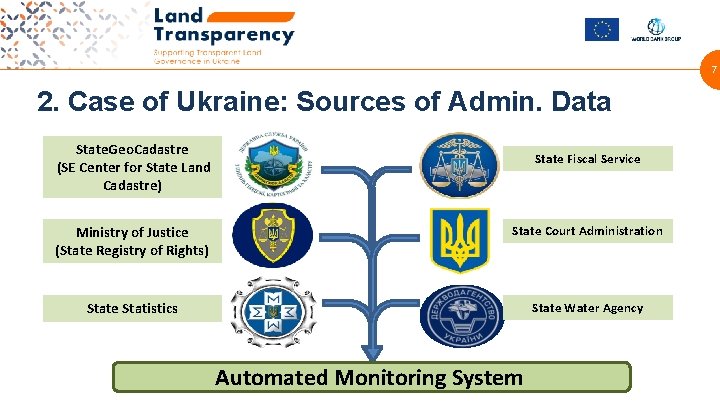
7 2. Case of Ukraine: Sources of Admin. Data State. Geo. Cadastre (SE Center for State Land Cadastre) State Fiscal Service Ministry of Justice (State Registry of Rights) State Court Administration State Statistics State Water Agency Automated Monitoring System
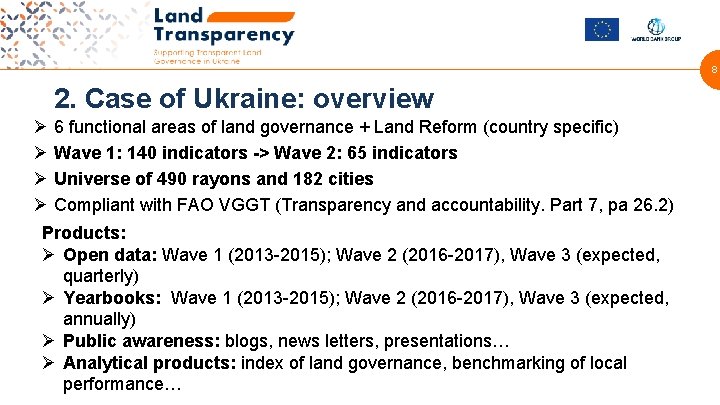
8 2. Case of Ukraine: overview Ø Ø 6 functional areas of land governance + Land Reform (country specific) Wave 1: 140 indicators -> Wave 2: 65 indicators Universe of 490 rayons and 182 cities Compliant with FAO VGGT (Transparency and accountability. Part 7, pa 26. 2) Products: Ø Open data: Wave 1 (2013 -2015); Wave 2 (2016 -2017), Wave 3 (expected, quarterly) Ø Yearbooks: Wave 1 (2013 -2015); Wave 2 (2016 -2017), Wave 3 (expected, annually) Ø Public awareness: blogs, news letters, presentations… Ø Analytical products: index of land governance, benchmarking of local performance…
9 2. Case of Ukraine: Advantages of Admin. Data § Low cost of data collection – Information is collected and stored as a part of regular operations; § Promptness – administrative data requires minimum processing, allows construction and publication of monitoring indicators on a regular base with very short delay after the reporting period; § Regular update of information – the data source entities are keeping their data sets up to date, updates are possible to automate; § Accuracy of information – the data source entities are in charge for having their records accurate and they employ different quality control and back up practices; they are interested to address any known gaps in data. § Feedback and quality improvement
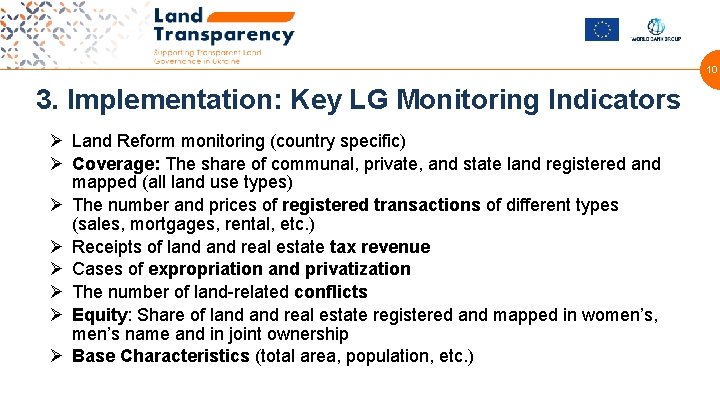
10 3. Implementation: Key LG Monitoring Indicators Ø Land Reform monitoring (country specific) Ø Coverage: The share of communal, private, and state land registered and mapped (all land use types) Ø The number and prices of registered transactions of different types (sales, mortgages, rental, etc. ) Ø Receipts of land real estate tax revenue Ø Cases of expropriation and privatization Ø The number of land-related conflicts Ø Equity: Share of land real estate registered and mapped in women’s, men’s name and in joint ownership Ø Base Characteristics (total area, population, etc. )
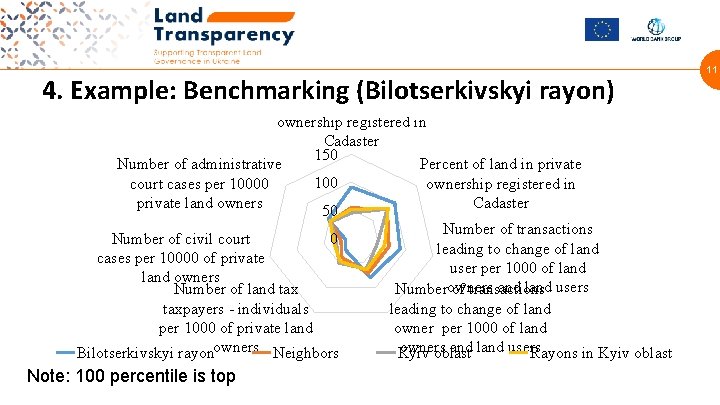
4. Example: Benchmarking (Bilotserkivskyi rayon) Percent of land in state ownership registered in Cadaster 150 Number of administrative Percent of land in private 100 court cases per 10000 ownership registered in private land owners Cadaster 50 0 Number of civil court cases per 10000 of private land owners Number of land taxpayers - individuals per 1000 of private land Bilotserkivskyi rayonowners Neighbors Note: 100 percentile is top Number of transactions leading to change of land user per 1000 of land users Numberowners of transactions leading to change of land owner per 1000 of land owners and land users Kyiv oblast Rayons in Kyiv oblast 11
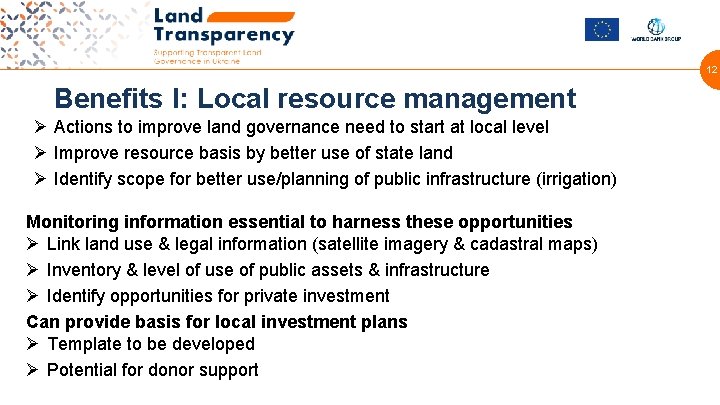
12 Benefits I: Local resource management Ø Actions to improve land governance need to start at local level Ø Improve resource basis by better use of state land Ø Identify scope for better use/planning of public infrastructure (irrigation) Monitoring information essential to harness these opportunities Ø Link land use & legal information (satellite imagery & cadastral maps) Ø Inventory & level of use of public assets & infrastructure Ø Identify opportunities for private investment Can provide basis for local investment plans Ø Template to be developed Ø Potential for donor support
13 Benefits II: Results-based support to land sector Ø Bank moving towards results-based approaches Ø Accelerating private investment in Agriculture as one example Ø Land – related results areas impossible without data Key results areas: Ø Register at least 12 mn. ha of state land & establish boundaries of admin. units Ø Transfer state land to communal ownership & auction use/ownership rights for at least 80, 000 ha via transparent electronic auction Ø Improve scope for protection of rights & market functioning via interoperability of registries, price recording, and clear regulations governing private sector provision & access to land information
14 5. Implications and Challenges 1 Monitoring provides evidence regarding the actual state of land governance in Ukraine at national and local levels. It helps to prevent political speculation regarding land 2 Provides for accountability of local and central government authorities involved with land 3 Improves investment attractiveness of agriculture and rural areas by better transparency of land governance 4 Highlights heterogeneity of land resources and state land governance within the country – land policies and land reform need to accommodate these differences 5 Provides input to international rankings of Ukraine
15