
Land banking mechanism and its effects on city
Land banking mechanism and its effects on city development in China Huang Dingxi
Contents Introduction International experience and practices Development of land banking in China Case study in Guangzhou, China Conclusions

Introduction
Origins of Land Banking Mechanism in Western Countries • Land banking is a mechanism initiated in western countries with over 100 years of history. – Amsterdam, the Netherlands, since 1896 – Stockholm, Sweden since 1904 – Canada since 1950’s – France since 1958 – Pilot projects in U. S. since 1970’s

Definition The acquisition of land ahead of development either by construction companies or by central or local government or their agencies. (Evans 2004) Public or publicly authorized acquisition of land to be held for future use to implement public land policies. (Strong 1979)

Definition Different categories of land banking ◦ Land banking by public sector ◦ Land banking by private companies Related terms ◦ Land bank ◦ Land assembly Correspondent term in Chinese ◦ 土地儲備 (tu di chu bei)

3 steps of land banking 1 Acquisition 2 Holding Western From: Mostly private lands Either built up or open space area Proved as public interest Through: Friendly negotiation Or Compulsory purchase Mechanism For: Various Periods Status: Preservation Or Temporary use Chinese From: Rural collectively owned land Former state -owned enterprises Overdue vacuum sites Through: Compensation or no compensation 3 Disposition Lease to affordable housing Or Sale to local governments Or Sale at market price Or Sale at subsidized price Mechanism For: Various Periods Status: Temporary Use Or Infra structure Construction Public Sale of LUR at market price

International experiences and practices

Land banking authorities The power and responsibility for implementing land banking mechanism in western countries were usually taken by two types of entities: ◦ Special committees ◦ Municipal/county/state owned corporations The power, source of finance and goals of these entities were strictly defined by local or national legislation. (Zhang and Wang 2003)

Objectives of land banking Each land banking project in Europe or America usually had an explicit major objective. ◦ Provision of affordable housing: Sweden ◦ Control urban growth pattern: Netherlands, France ◦ Control land price: Canada, Australia Institution framework for implementation of land banking were built to facilitate the achievement of the major objective. (Strong 1979)

Effects of Land Banking As a mechanism of public intervention in the land development process, land banking affects city development in several aspects beyond the initiate major objective. Flenchner (1974) summarized the effects of land banking practice in western countries as: Control on urban growth pattern Capturing capital gains for public finance Land price regulation

Other proposed functions of land banking In central Europe, to solve the problem of fragmentation of agricultural lands. In Africa, as a way to control social tensions arising from imbalanced distribution of resources, local overpopulation, unemployment and involuntary displacement in the past. (Van. Dijk & Kopeva 2006)
Development of Land banking in China
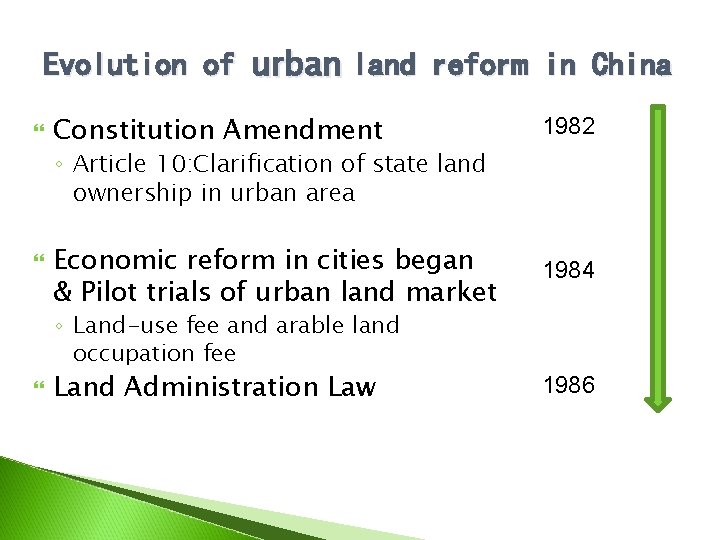
Evolution of urban land reform in China Constitution Amendment 1982 Economic reform in cities began & Pilot trials of urban land market 1984 Land Administration Law 1986 ◦ Article 10: Clarification of state land ownership in urban area ◦ Land-use fee and arable land occupation fee
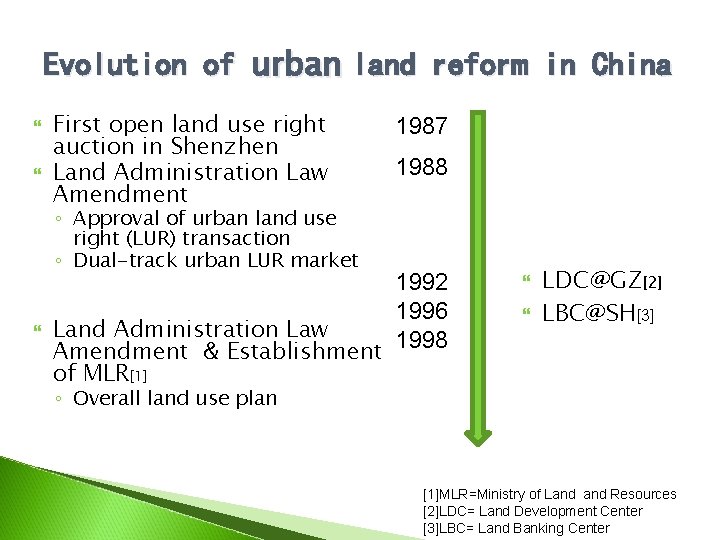
Evolution of urban land reform in China First open land use right auction in Shenzhen Land Administration Law Amendment ◦ Approval of urban land use right (LUR) transaction ◦ Dual-track urban LUR market 1987 1988 1992 1996 Land Administration Law Amendment & Establishment 1998 of MLR[1] LDC@GZ[2] LBC@SH[3] ◦ Overall land use plan [1]MLR=Ministry of Land Resources [2]LDC= Land Development Center [3]LBC= Land Banking Center
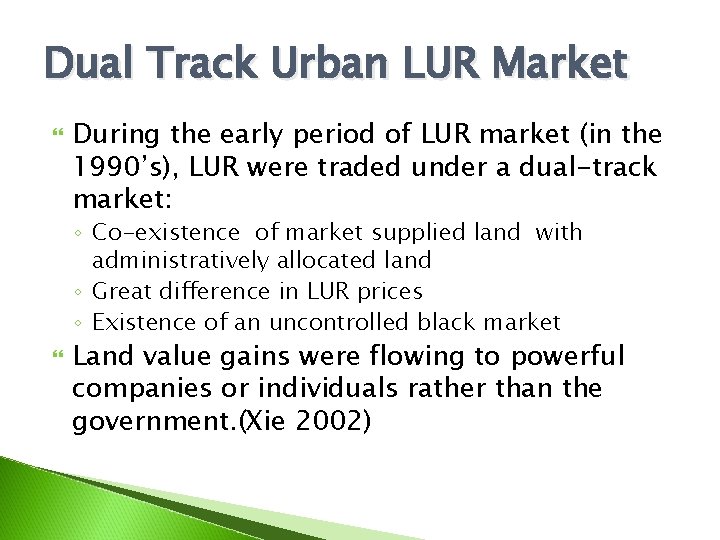
Dual Track Urban LUR Market During the early period of LUR market (in the 1990’s), LUR were traded under a dual-track market: ◦ Co-existence of market supplied land with administratively allocated land ◦ Great difference in LUR prices ◦ Existence of an uncontrolled black market Land value gains were flowing to powerful companies or individuals rather than the government. (Xie 2002)
Development of land banking in Chinese Cities Guangzhou Land Development Centerestablished in 1992 to facilitate comprehensive development of new city center via land banking mechanism. Establishment of Shanghai Land Banking Center in 1996 - recognized as the 1 st city land banking authority in China in most Chinese literature.
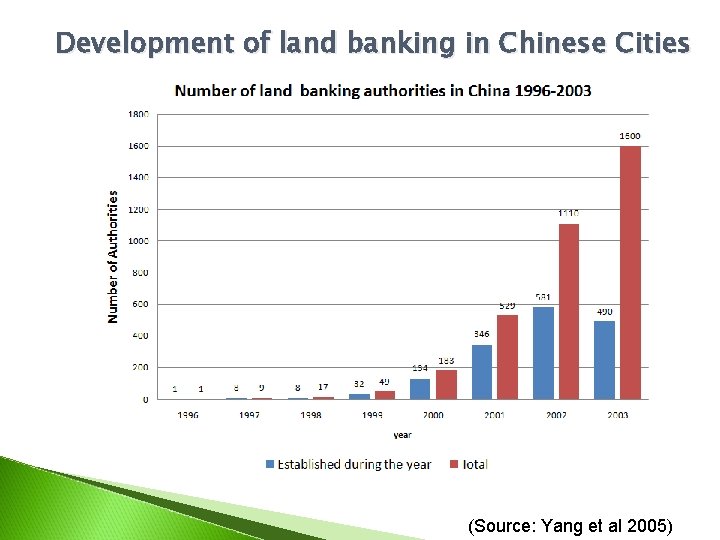
Development of land banking in Chinese Cities (Source: Yang et al 2005)
Development of land banking in Chinese Cities Direct Top- Down promoting forces ◦ Minister of Land Resources highly praised Hangzhou’s land banking experience at a conference of mayors in 1999. (Zhou, 1999) ◦ In 2001, State Council’s Announcement for strengthening state owned assets management (Document No. 15 -2001) recommended “cities with suitable conditions” can implement land banking to “strengthen the ability to adjust the land market”. (State Council, 2001)
Development of land banking in Chinese Cities Central Government’s effort to establish a single-track LUR market ◦ Announcing LUR to use all kinds of land for business use (residential, commercial and tourism ) and industrial use must be sold publicly by bidding, auction and public announcement in since 2002 and 2007 respectively. (MLR, 2002, 2007) City governments are becoming economic interest group preoccupied with local growth in the process of decentralization during economic reform in China. (Zhu 2004; Xu and Yeh 2005)

Research on land banking by Chinese scholars Introduction of different practices. Proposals or solutions for the problems arousing with the implementation of public land banking. ◦ ◦ Quantity and location of land for banking Finance Risk management Institutional structure and legislation
More fundamental issues still need exploring What are land banking mechanism’s possible effects on city development in China? How to define explicit objectives of implementing the land banking mechanism?
Possible effects of land banking on city development in China The similar mechanism as the western practices may lead to similar effects on: ◦ Land price ◦ Revenue of city governments ◦ Urban growth pattern Under the rapid development context of China, land banking may also influence the process of socio-spatial restructuring: ◦ Re-distribution of residential areas of different social classes ◦ Speedy urbanization of the former rural areas affected by land banking ◦ Upgrade of industrial sector when industrial land is no longer free of charge
Case study on land banking in Guangzhou City
Land banking authority Guangzhou land development center established in 1992 under the Guangzhou Land Resource Bureau. Authorized by the municipal government to implement land resumption, acquisition, land banking, and LUR sales

Source and scale of land bank Source of land bank ◦ Resuming state-owned land when the LUR owner Delays development for an overdue period Or no longer exists ◦ Purchase of urban LUR ◦ Acquisition of collectively-owned rural farm land By the end of 2004, the GZLDC was holding a land bank of 2854. 96 hectares.

Spatial Distribution of GZLDC’s land bank at Dec 2004 (source: provided by GDLDC through interview)
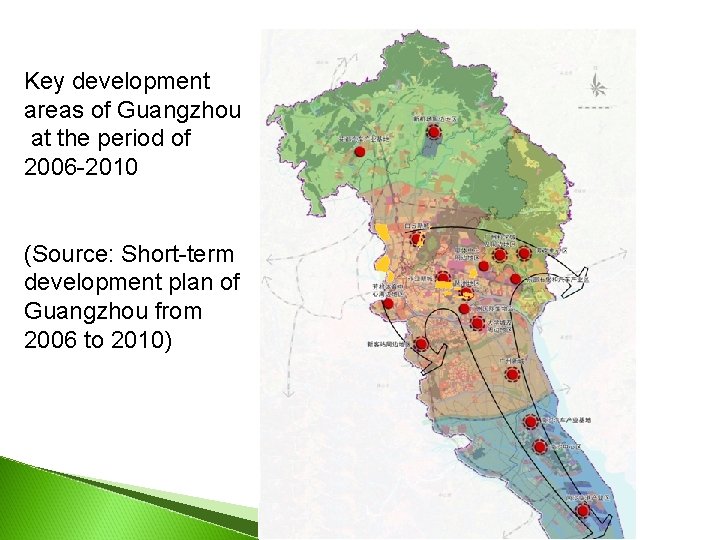
Key development areas of Guangzhou at the period of 2006 -2010 (Source: Short-term development plan of Guangzhou from 2006 to 2010)
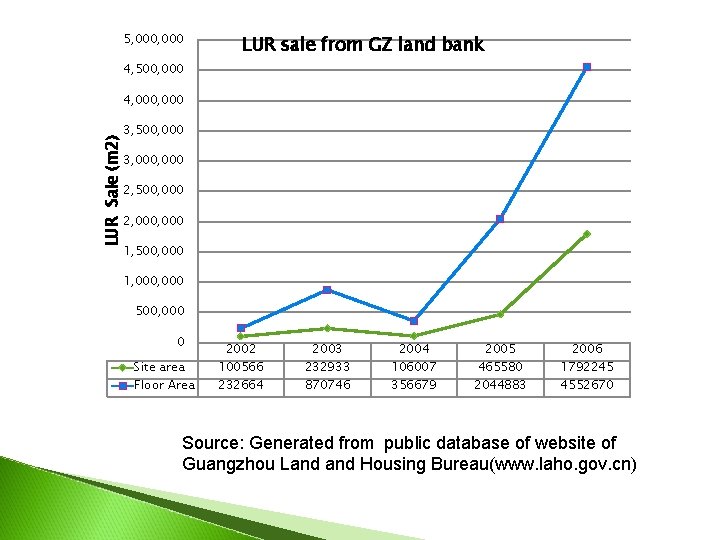
5, 000 LUR sale from GZ land bank 4, 500, 000 4, 000 LUR Sale (m 2) 3, 500, 000 3, 000 2, 500, 000 2, 000 1, 500, 000 1, 000 500, 000 0 Site area Floor Area 2002 100566 232664 2003 232933 870746 2004 106007 356679 2005 465580 2044883 2006 1792245 4552670 Source: Generated from public database of website of Guangzhou Land Housing Bureau(www. laho. gov. cn)
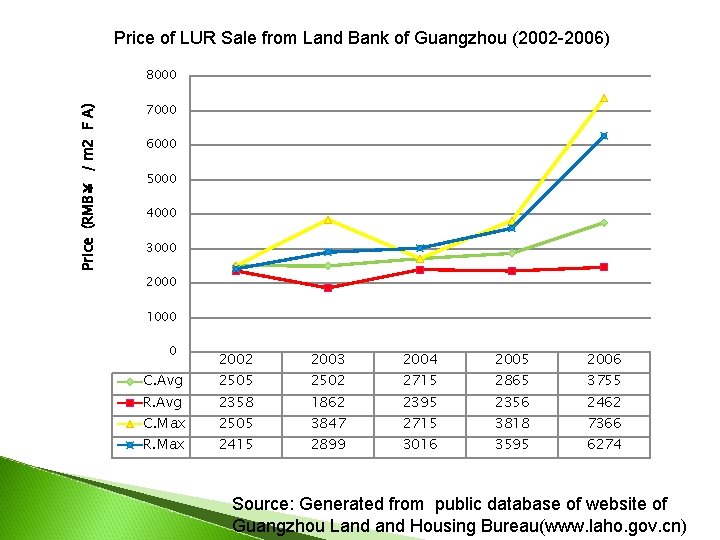
Price of LUR Sale from Land Bank of Guangzhou (2002 -2006) Price (RMB¥ / m 2 F A) 8000 7000 6000 5000 4000 3000 2000 1000 0 C. Avg R. Avg C. Max R. Max 2002 2003 2004 2005 2006 2358 1862 2395 2356 2462 2505 2415 2502 3847 2899 2715 3016 2865 3818 3595 3755 7366 6274 Source: Generated from public database of website of Guangzhou Land Housing Bureau(www. laho. gov. cn)

45. 00 40. 00 35. 00 Billion RMB ¥ 30. 00 25. 00 20. 00 15. 00 10. 00 5. 00 0. 00 Income from L. B. City Fiscal Income Infra Structure Investment 2002 2003 2004 2005 26. 91 30. 05 33. 85 40. 88 0. 55 15. 00 2. 11 14. 60 0. 87 21. 60 2006 5. 63 13. 04 25. 60 25. 30 42. 71 Comparison of land bank income, city fiscal income and infra structure investment of Guangzhou in 2002 -2006 Source: Generated from public database of website of Guangzhou Land Housing Bureau(www. laho. gov. cn)
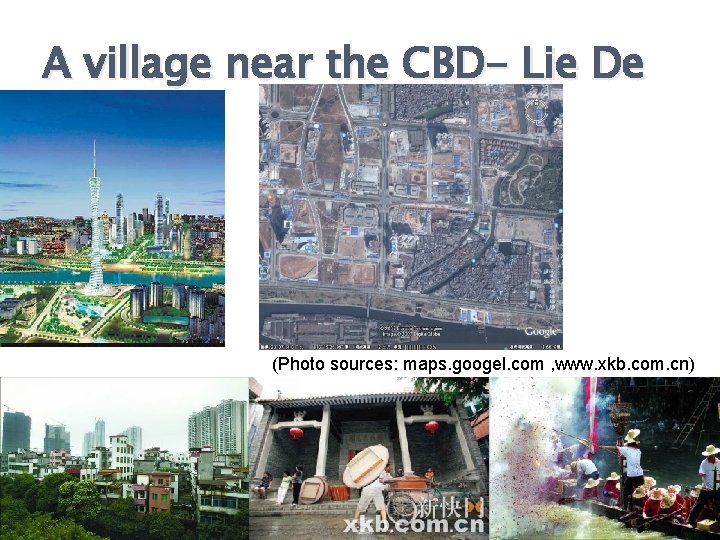
A village near the CBD- Lie De (Photo sources: maps. googel. com , www. xkb. com. cn)
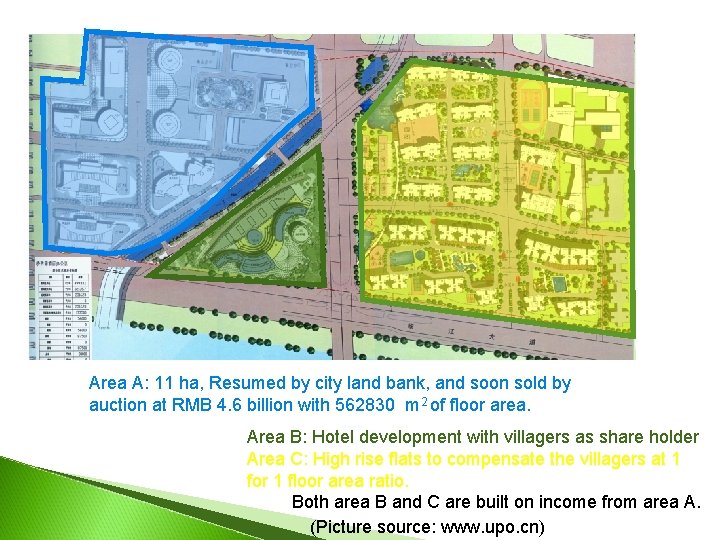
Area A: 11 ha, Resumed by city land bank, and soon sold by auction at RMB 4. 6 billion with 562830 m 2 of floor area. Area B: Hotel development with villagers as share holder Area C: High rise flats to compensate the villagers at 1 for 1 floor area ratio. Both area B and C are built on income from area A. (Picture source: www. upo. cn)

Conclusions
Charateristics of land banking in Chinese Cities Simplified replication of a mechanism due to scarcity of suitable institutions. ◦ Creating a suitable institutional framework for the newly emerging LUR market in China is difficult. However the replication of the land banking mechanism from other cities are of little cost.
Charateristics of land banking in Chinese Cities Administration-oriented operation at city government level ◦ Administrative document at national level was not published until Nov 2007. ◦ Operation is regulated under administrative documents published by city governments.
Charateristics of land banking in Chinese Cities Focusing on land development process rather than the balanced objectives of city development ◦ Promoted and implemented by the land administration system of governments. ◦ Income form LUR sales as direct incentive.

Thank You! Your comments are welcome! Please contact: dxhuang@hkusua. hku. hk
- Slides: 38