
Lambda the Ultimate and Reduction Semantics Corky Cartwright
Lambda the Ultimate and Reduction Semantics Corky Cartwright Department of Computer Science Rice University 1
Motivation for -notation • • • In most functional languages, functions are data values. Origin: calculus 1930’s (Alonzo Church) Often, functions are used only once Examples: arguments to functions like • map, • filter, • fold, and many more "higher-order" functions Sometimes we want to build new functions in the middle of a computation. Local suffices but it is notationally clumsy for this purpose. provides simpler, more concise notation COMP 211, Spring 2009 2
Basic Idea • • • -notation was invented by mathematicians. For example, given f (x) = x 2 + 1 what is f? f is the function that maps x to x 2 + 1 which we might write as x x 2 + 1 The latter avoids naming the function. The notation x. x 2 + 1 evolved instead of x x 2 + 1 In Scheme, we write x. x 2 + 1. (lambda (x) (+ (* x x) 1))) instead of (define (f x) (+ (* x x) 1)) abbreviates (define f (lambda (x) (+ (* x x) 1))) COMP 211, Spring 2009 3
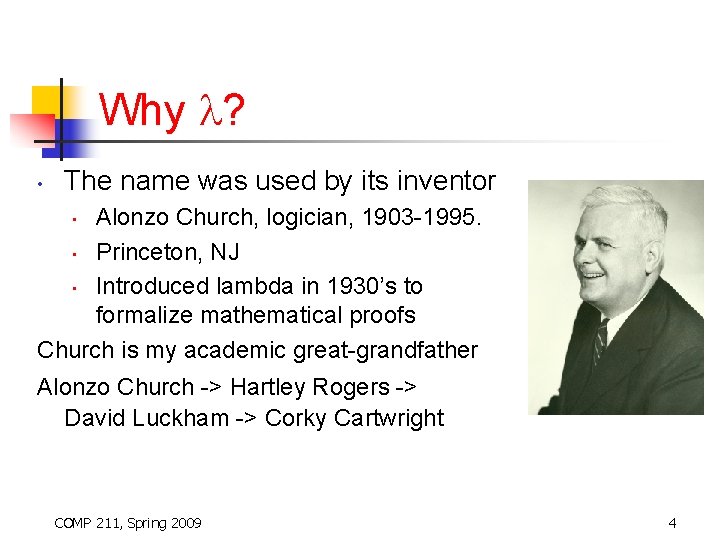
Why ? • The name was used by its inventor Alonzo Church, logician, 1903 -1995. • Princeton, NJ • Introduced lambda in 1930’s to formalize mathematical proofs Church is my academic great-grandfather • Alonzo Church -> Hartley Rogers -> David Luckham -> Corky Cartwright COMP 211, Spring 2009 4
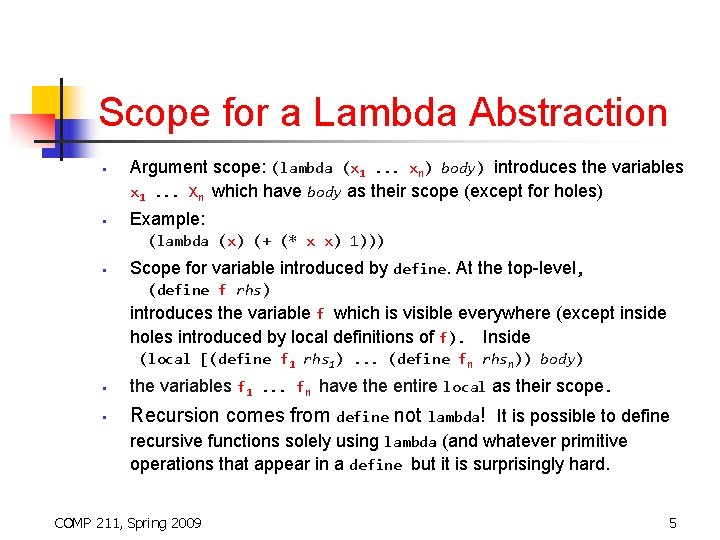
Scope for a Lambda Abstraction • • Argument scope: (lambda (x 1. . . xn) body) introduces the variables x 1. . . Xn which have body as their scope (except for holes) Example: (lambda (x) (+ (* x x) 1))) • Scope for variable introduced by define. At the top-level, (define f rhs) introduces the variable f which is visible everywhere (except inside holes introduced by local definitions of f). Inside (local [(define f 1 rhs 1). . . (define fn rhsn)) body) • the variables f 1. . . fn have the entire local as their scope. • Recursion comes from define not lambda! It is possible to define recursive functions solely using lambda (and whatever primitive operations that appear in a define but it is surprisingly hard. COMP 211, Spring 2009 5
Some PL researchers are crazy about ! Prof. Phil Wadlerb University of Edinburgh COMP 211, Spring 2009 6
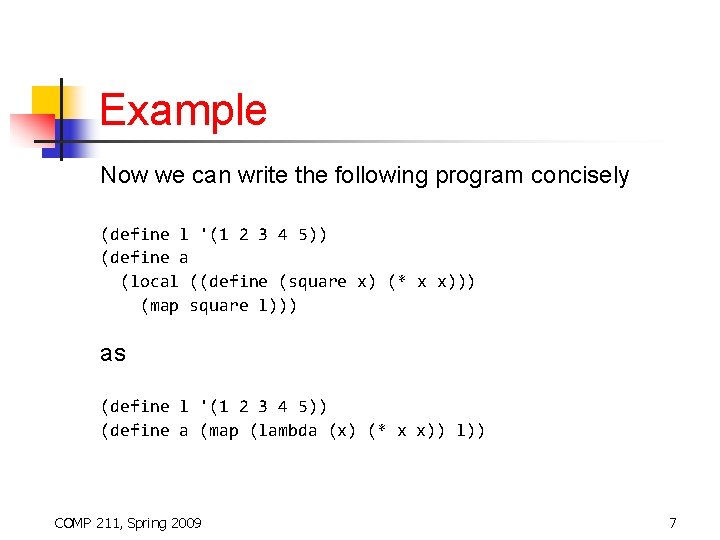
Example Now we can write the following program concisely (define l '(1 2 3 4 5)) (define a (local ((define (square x) (* x x))) (map square l))) as (define l '(1 2 3 4 5)) (define a (map (lambda (x) (* x x)) l)) COMP 211, Spring 2009 7
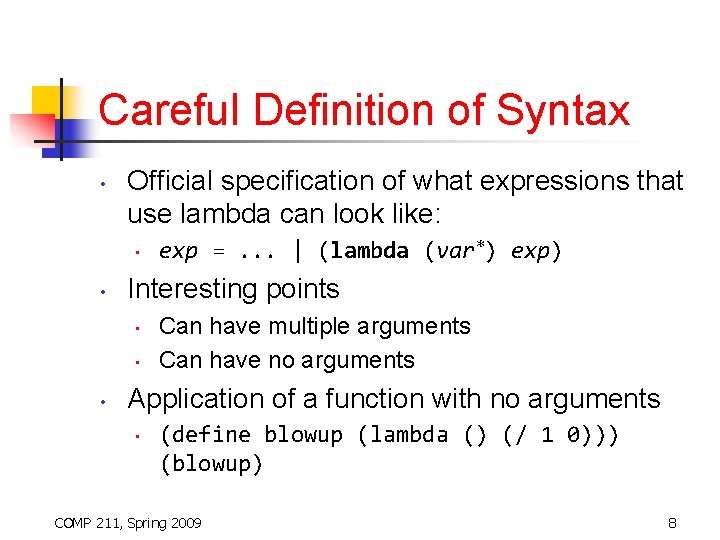
Careful Definition of Syntax • Official specification of what expressions that use lambda can look like: • • Interesting points • • • exp =. . . | (lambda (var*) exp) Can have multiple arguments Can have no arguments Application of a function with no arguments • (define blowup (lambda () (/ 1 0))) (blowup) COMP 211, Spring 2009 8
Reduction Semantics • • Simple Reduction Semantics: Essence of Functional Programming Idea: Evaluation of expressions is a familiar idea from grammar school. • • Grammar school: evaluate parenthesized arithmetic expressions Functional programming: evaluate arbitrary (functional program) text COMP 211, Spring 2009 9
Synopsis • • • Value are values … A value evaluates to itself so we stop evaluation when we reduce our original expression to a value. In most functional languages, always perform leftmost reductions because order matters COMP 211, Spring 2009 10
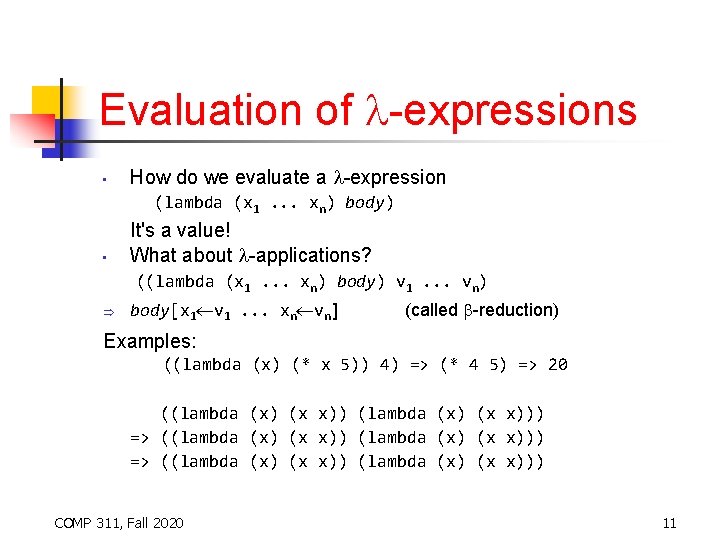
Evaluation of -expressions • How do we evaluate a -expression (lambda (x 1. . . xn) body) • It's a value! What about -applications? ((lambda (x 1. . . xn) body) v 1. . . vn) Þ body[x 1 v 1. . . xn vn] (called -reduction) Examples: ((lambda (x) (* x 5)) 4) => (* 4 5) => 20 ((lambda (x) (x x))) => ((lambda (x) (x x))) COMP 311, Fall 2020 11
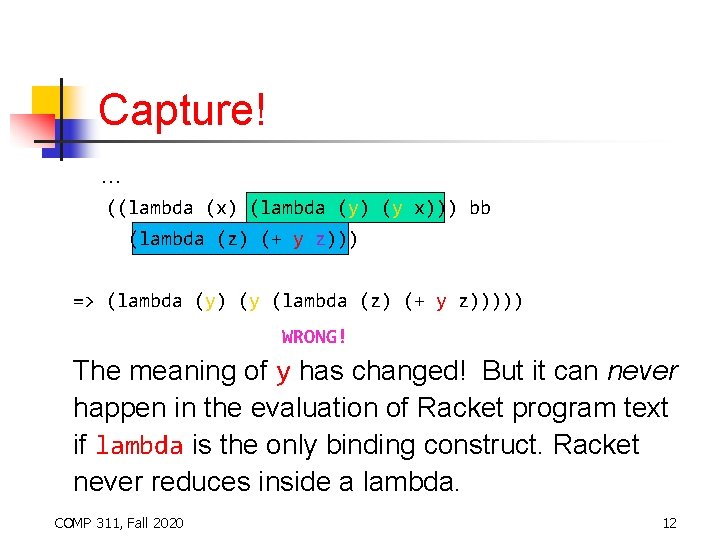
Capture! … ((lambda (x) (lambda (y) (y x))) bb (lambda (z) (+ y z))) => (lambda (y) (y (lambda (z) (+ y z))))) WRONG! The meaning of y has changed! But it can never happen in the evaluation of Racket program text if lambda is the only binding construct. Racket never reduces inside a lambda. COMP 311, Fall 2020 12
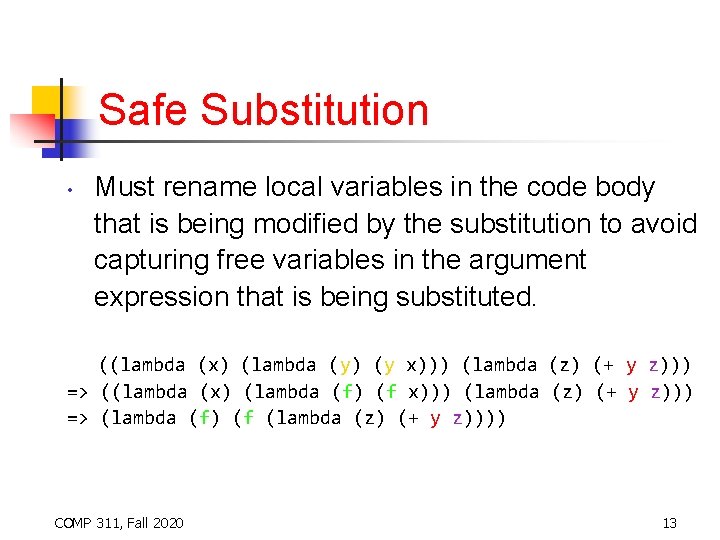
Safe Substitution • Must rename local variables in the code body that is being modified by the substitution to avoid capturing free variables in the argument expression that is being substituted. ((lambda (x) (lambda (y) (y x))) (lambda (z) (+ y z))) => ((lambda (x) (lambda (f) (f x))) (lambda (z) (+ y z))) => (lambda (f) (f (lambda (z) (+ y z)))) COMP 311, Fall 2020 13
Comprehensive Reduction Rules • The document Lawsof. Eval. pdf is a comprehensive description of the reduction semantics of functional Racket. You need to understand it in detail. We will briefly review it now. COMP 311, Fall 2020 14
- Slides: 14