
Lambda Calculus PDCS 2 alpharenaming beta reduction eta

Lambda Calculus (PDCS 2) alpha-renaming, beta reduction, eta conversion, applicative and normal evaluation orders, Church. Rosser theorem, combinators, booleans Carlos Varela Rennselaer Polytechnic Institute September 6, 2019 C. Varela 1

Mathematical Functions Take the mathematical function: f(x) = x 2 Assume f is a function that maps integers to integers: Function f: Z Z Domain Range We apply the function f to numbers in its domain to obtain a number in its range, e. g. : f(-2) = 4 C. Varela 2

Function Composition Given the mathematical functions: f(x) = x 2 , g(x) = x+1 f g is the composition of f and g: f g (x) = f(g(x)) f g (x) = f(g(x)) = f(x+1) = (x+1)2 = x 2 + 2 x + 1 g f (x) = g(f(x)) = g(x 2) = x 2 + 1 Function composition is therefore not commutative. Function composition is a (higher-order) function, in this example, with the following type: : (Z Z) x (Z Z) C. Varela 3
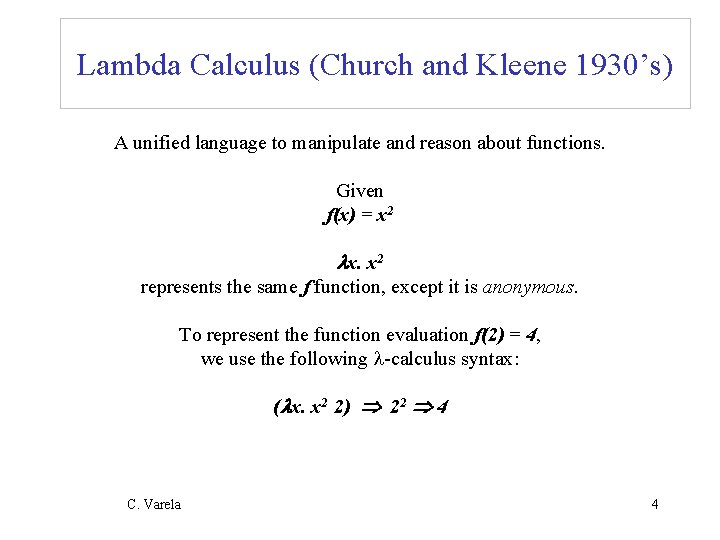
Lambda Calculus (Church and Kleene 1930’s) A unified language to manipulate and reason about functions. Given f(x) = x 2 x. x 2 represents the same f function, except it is anonymous. To represent the function evaluation f(2) = 4, we use the following -calculus syntax: ( x. x 2 2) 22 4 C. Varela 4

Lambda Calculus Syntax and Semantics The syntax of a -calculus expression is as follows: e : : = | | v v. e (e e) variable functional abstraction function application The semantics of a -calculus expression is called beta-reduction: ( x. E M) E{M/x} where we alpha-rename the lambda abstraction E if necessary to avoid capturing free variables in M. C. Varela 5
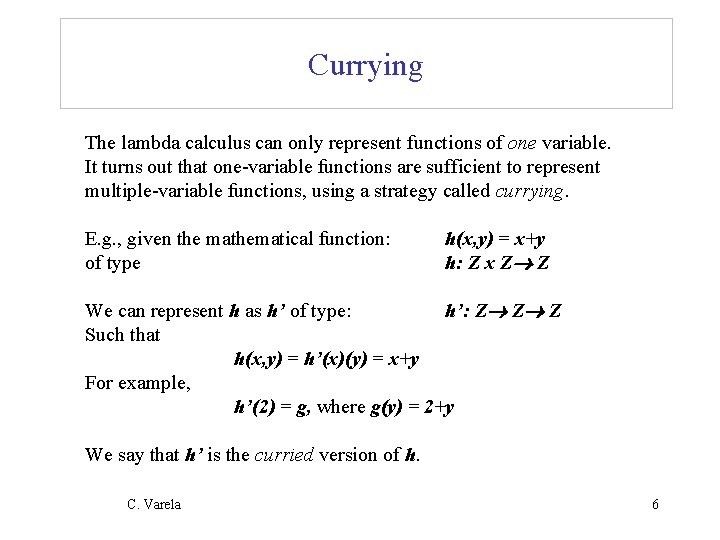
Currying The lambda calculus can only represent functions of one variable. It turns out that one-variable functions are sufficient to represent multiple-variable functions, using a strategy called currying. E. g. , given the mathematical function: of type h(x, y) = x+y h: Z x Z Z We can represent h as h’ of type: h’: Z Z Z Such that h(x, y) = h’(x)(y) = x+y For example, h’(2) = g, where g(y) = 2+y We say that h’ is the curried version of h. C. Varela 6

Function Composition in Lambda Calculus S: I: x. (s x) x. (i x) (Square) (Increment) C: f. g. x. (f (g x)) (Function Composition) Recall semantics rule: ((C S) I) ( x. E M) E{M/x} (( f. g. x. (f (g x)) x. (s x)) x. (i x)) ( g. x. (s x) (g x)) x. (i x)) x. (s x) ( x. (i x) x)) x. (s x) (i x)) x. (s (i x)) C. Varela 7
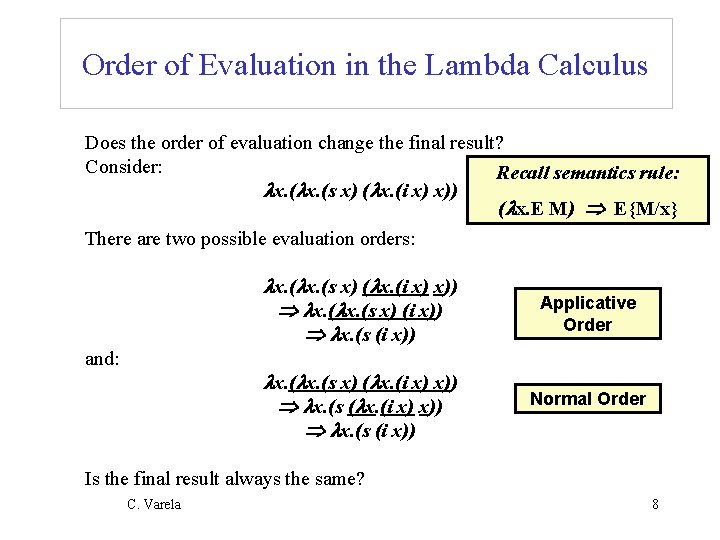
Order of Evaluation in the Lambda Calculus Does the order of evaluation change the final result? Consider: Recall semantics rule: x. (s x) ( x. (i x) x)) ( x. E M) E{M/x} There are two possible evaluation orders: and: x. (s x) ( x. (i x) x)) x. (s x) (i x)) x. (s (i x)) Applicative Order x. (s x) ( x. (i x) x)) x. (s (i x)) Normal Order Is the final result always the same? C. Varela 8
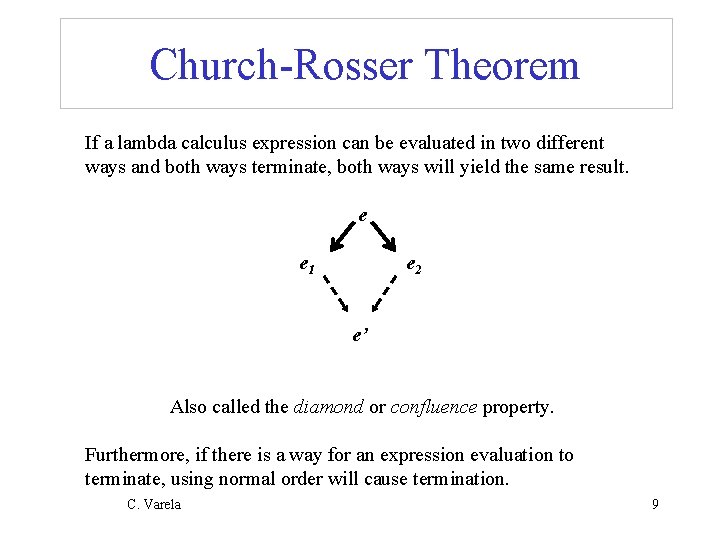
Church-Rosser Theorem If a lambda calculus expression can be evaluated in two different ways and both ways terminate, both ways will yield the same result. e e 1 e 2 e’ Also called the diamond or confluence property. Furthermore, if there is a way for an expression evaluation to terminate, using normal order will cause termination. C. Varela 9
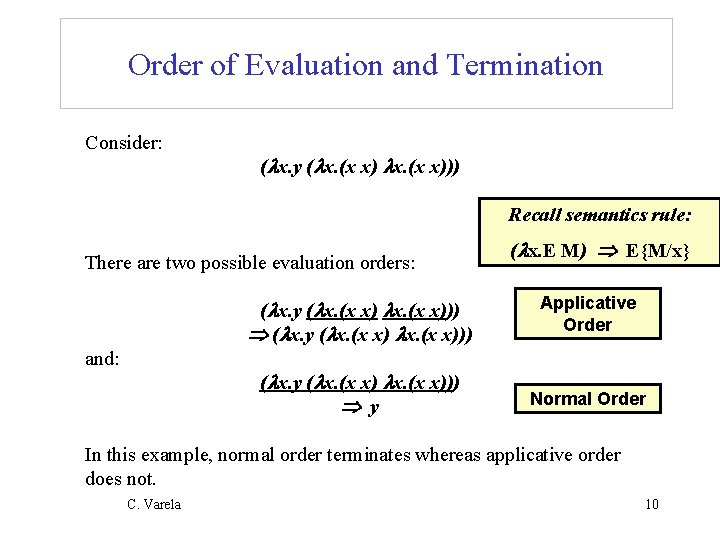
Order of Evaluation and Termination Consider: ( x. y ( x. (x x))) Recall semantics rule: There are two possible evaluation orders: and: ( x. E M) E{M/x} ( x. y ( x. (x x))) Applicative Order ( x. y ( x. (x x))) y Normal Order In this example, normal order terminates whereas applicative order does not. C. Varela 10
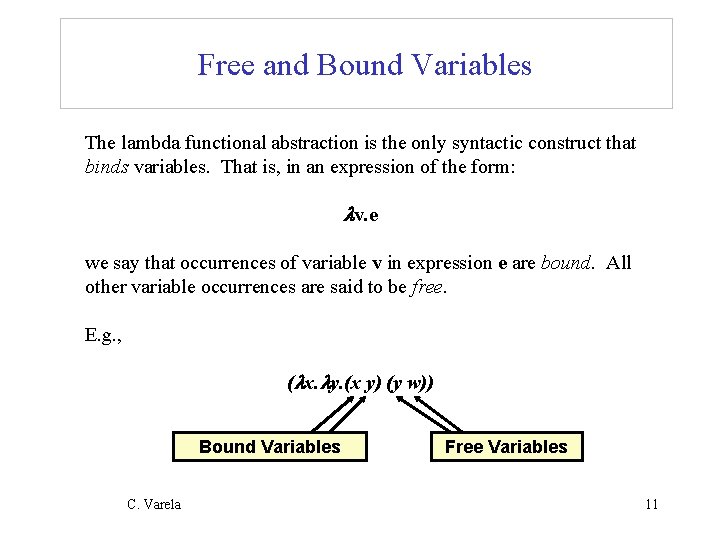
Free and Bound Variables The lambda functional abstraction is the only syntactic construct that binds variables. That is, in an expression of the form: v. e we say that occurrences of variable v in expression e are bound. All other variable occurrences are said to be free. E. g. , ( x. y. (x y) (y w)) Bound Variables C. Varela Free Variables 11

Why -renaming? Alpha renaming is used to prevent capturing free occurrences of variables when reducing a lambda calculus expression, e. g. , ( x. y. (x y) (y w)) Þ y. ((y w) y) This reduction erroneously captures the free occurrence of y. A correct reduction first renames y to z, (or any other fresh variable) e. g. , ( x. y. (x y) (y w)) ( x. z. (x z) (y w)) z. ((y w) z) where y remains free. C. Varela 12
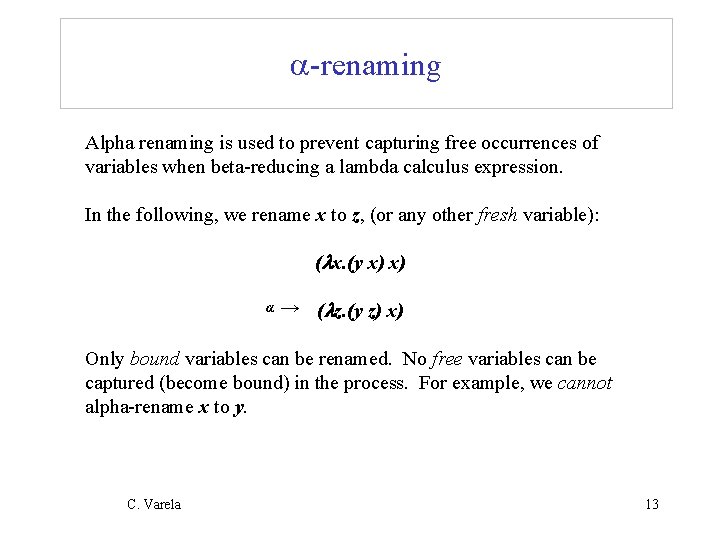
-renaming Alpha renaming is used to prevent capturing free occurrences of variables when beta-reducing a lambda calculus expression. In the following, we rename x to z, (or any other fresh variable): ( x. (y x) x) α → ( z. (y z) x) Only bound variables can be renamed. No free variables can be captured (become bound) in the process. For example, we cannot alpha-rename x to y. C. Varela 13

b-reduction ( x. E M) b →E{M/x} Beta-reduction may require alpha renaming to prevent capturing free variable occurrences. For example: ( x. y. (x y) (y w)) α → ( x. z. (x z) (y w)) b → z. ((y w) z) Where the free y remains free. C. Varela 14

h-conversion x. (E x) h →E if x is not free in E. For example: ( x. y. (x y) (y w)) α → ( x. z. (x z) (y w)) b → z. ((y w) z) h→ C. Varela (y w) 15

Combinators A lambda calculus expression with no free variables is called a combinator. For example: I: App: C: L: Cur: Seq: ASeq: x. x f. x. (f x) f. g. x. (f (g x)) ( x. (x x)) f. x. y. ((f x) y) x. y. ( z. y x) x. y. (y x) (Identity) (Application) (Composition) (Loop) (Currying) (Sequencing--normal order) (Sequencing--applicative order) where y denotes a thunk, i. e. , a lambda abstraction wrapping the second expression to evaluate. The meaning of a combinator is always the same independently of its context. C. Varela 16
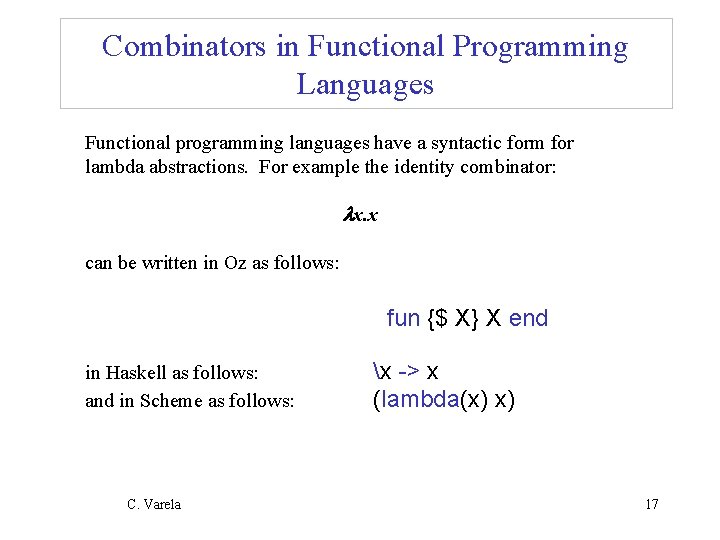
Combinators in Functional Programming Languages Functional programming languages have a syntactic form for lambda abstractions. For example the identity combinator: x. x can be written in Oz as follows: fun {$ X} X end in Haskell as follows: and in Scheme as follows: C. Varela x -> x (lambda(x) x) 17

Currying Combinator in Oz The currying combinator can be written in Oz as follows: fun {$ F} fun {$ X} fun {$ Y} {F X Y} end end It takes a function of two arguments, F, and returns its curried version, e. g. , {{{Curry Plus} 2} 3} 5 C. Varela 18

Booleans and Branching (if) in Calculus |true|: |false|: x. y. x x. y. y (False) |if|: b. t. e. ((b t) e) (If) (True) Recall semantics rule: (((if true) a) b) ( x. E M) E{M/x} ((( b. t. e. ((b t) e) x. y. x) a) b) (( t. e. (( x. y. x t) e) a) b) ( e. (( x. y. x a) e) b) (( x. y. x a) b) Þ ( y. a b) Þa C. Varela 19
Exercises 1. 2. 3. 4. 5. PDCS Exercise 2. 11. 1 (page 31). PDCS Exercise 2. 11. 2 (page 31). PDCS Exercise 2. 11. 5 (page 31). PDCS Exercise 2. 11. 6 (page 31). Define Compose in Haskell. Demonstrate the use of curried Compose using an example. 6. PDCS Exercise 2. 11. 7 (page 31). 7. PDCS Exercise 2. 11. 9 (page 31). 8. PDCS Exercise 2. 11. 12 (page 31). Test your representation of booleans in Haskell. C. Varela 20
- Slides: 20