
LAL Test The Limulus Amebocyte Lysate LAL test
LAL Test : The Limulus Amebocyte Lysate (LAL) test is a simple and reliable biochemical test for the detection and quantification of Gram-negative bacterial endotoxin (pyrogen). - LAL test is referenced in major pharmacopeias internationally. - Since 1973 LAL has proved to be sensitive indicator for proving the presence of endotoxins (Pyrogen).
- LAL test is used as end product testing method for endotoxins in human and animal injectable drug products and is recognized by Regulatory Authorities and Pharmaceutical Industries as faster, more economical and yielding sensitive & accurate results. Application of the LAL Test : Lysate is applied in Two ways : 1. An enzymatic reaction which makes use of the formation of a Gel Clot in the presence of Endotoxin Qualitative Assay.
2. An enzymatic reaction which changes a colorless substrate in to a colored product in the presence of Endotoxin i. e Quantitative Chromogenic Assay. (A) Positive Control Endotoxin : Both assays require the use of Standardized Positive Endotoxin controls. - Standardization of lysate to the positive control is essential for reliability of test. - Reference Standard Endotoxin known as EC -5 has been developed by U. S. P and FDA to standardize all Endotoxin testing in pharmaceutical industry.
- The Potency of this standard is expressed in Endotoxin units /ml (EU/ml). - All producers of LAL kits standardized their products to EC-5. - Endotoxin limits in the USP are referenced to EC-5. (B) Test Procedure and Validation : - LAL test validation and routine Endotoxin quantitative testing requires standard, simple equipment. - An FDA licensed reagent should be used and the chosen test(Gel or Chromogenic) must be validated.
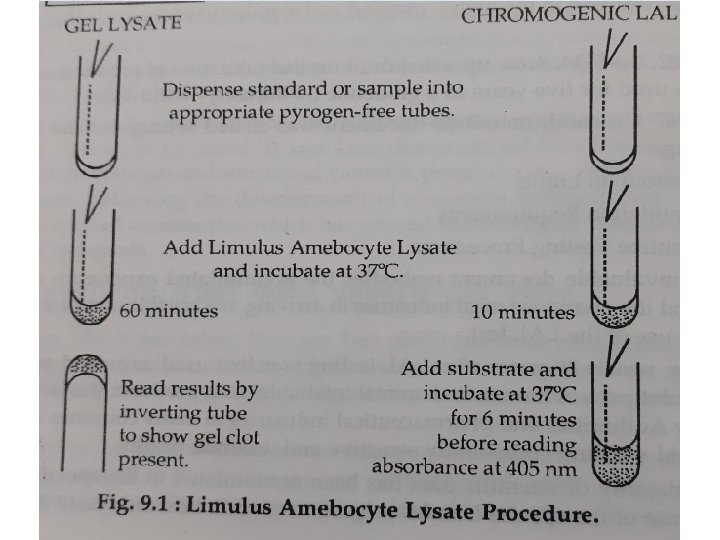
- Lysate reagent is added to Product or Endotoxin Control and allowed to incubate at 37 °c for one hour for the Gel and Ten minutes for the Chromogenic Test. - Gel tests are read visually immediately after incubation, while Chromogenic Tests are incubated further Six minutes with chromogenic substrate before reading taken on spectrophotometer. (Fig. )
Bio. Safety - The concept of safety has evolved from the days of industrial revolution. - Biosafety is also in consideration in Fermentation Biotechnology. - Fermentation Biotechnology is the application of biological systems to technical and industrial processes. - This involved the integration of biology, including molecular biology, genetics, microbiology, cell biology and biochemistry with chemical and process engineering.
Biosafety consideration of Biotechnology are associated with three properties of microorganisms : 1. the potential of few strains to cause disease. 2. the potential for undetected genotypic or phenotypic changes to alter a tested and approved process and, 3. the ubiquity of organism that can contaminate the system.
• Unlikely dangerous human and animal pathogens will be used in very large scale fermentation. - the industrial use of plant pathogen is also increasing. - The aerosol dissemination of fungal spores, bacteria and viruses that are pathogenic for plants has been described. - Inadvertent release of a pathogen in a area where there are susceptible host is of concern.
- Efforts to prevent the escape of these organisms to the environment are of economic consequences. • In continuous fermentations , the content of the bioreactor may be maintained for several days. - This could involve many thousands of generations. - With natural mutation rates as high as 1 in 10⁵ and with additional chance of contamination from outside the system, the potential for generic change is significant.
- Contaminant that entered could directly inhibit or interfere with the biocatalyst (enzyme, cell or m. o) or could destroy the catalyst or destroy the product by using it as energy source. - Contamination also introduce substances that are difficult to separate from the product, thereby rendering the product instable.
- Phenotypic change is a response to a changed environment and is maintained only while new conditions persist, such change should be prevented by the close process control used to maintain efficiency during fermentation.
• In practice, an industrial fermentation process is extremely unlikely to become contaminated with highly pathogenic m. o; because the environment inside the fermenter is so different from the human body that pathogenicity confers no advantage upon the organism. - steps are to be taken to prevent the introduction of environmental microorganisms and disrupt the system.
Steps taken to protect the workers are also as equal as to protect the system. - whenever there is a significant potential for introducing undesirable organisms in to the bioreactor, there is an equal opportunity for organisms to escape in to the environment. - therefore appropriate examination of various stages involved in manupulating organisms in a process and carry out practices that minimize or eliminate contamination of personnel, product and the environment. -

• Biological Safety in laboratories is achieved by : 1. Standard laboratory practices and 2. Containment strategies - Standard laboratory practices that are generally used in microbial laboratories is the basic principle of containment. - These practices include aseptic techniques and good knowledge of biology of the experimental organisms. - All personnel involved in RDNA research must be adequately trained.
- Containment may be defined as a combination of laboratory procedures, a laboratory equipments and installations and host-vector system design to minimize accidental release of organisms during laboratory operations, their dissemination and survival in the environment and accidental infection of laboratory workers and a person outside the laboratory. - Containment may be either (1) Physical or (2) Biological
• Physical Containment : - consist of the use of special laboratory design, containment equipments and special operational procedures to restrict the number of organisms accidentally released during normal laboratory operations and to prevent laboratory workers. - Physical Containment is grouped in to four categories. BL 1(Biosafety level 1), BL 2, BL 3, and BL 4

- BL 1 is applicable to nonpathogenic organisms. BL 1 is suitable for work with m. o. of minimal potential hazard to laboratory workers and the environment. - BL 2 is suitable for work with organisms having moderate potential hazard to personnel and the environment. - BL 3 is applicable to clinical, diognostic, teaching or production facilities in which work is done on m. o, indigenous or exotic Which may cause serious or lethal disease as a result of exposure by the inhalation route.
- BL 4 is appropriate for m. o that are likely to cause serious or lethal human disease for which preventive or therapeutic interventions are not usually available. • Biological containment : - Specifically aims at making the genetic changes in GMOs that reduce the hazard from these organisms when they are accidentally or deliberately released in to the environment.
- biological containment is based on the vector(plasmid, organelle or virus)used for the construction of RDNA, and the host(bacterial, plant, animal cell) in which the vector is propagated in the laboratory.
Introduction to IPR and patenting Introduction : - Patents are one form of intellectual property. - Intellectual property is a subset of personal property that also includes trademarks and copyrights and trade secrets. - Patents are valuable assets that can be exploited commercially.
They can be bought and sold , licensed for royalties, and as bargaining chips when engaging in business deals. - Patents can increase the value of a business to investors. - Patent portfolio may enable a start-up company to obtain the capital required to bring a nascent product to market. - Patents provide an exclusive right, preventing others from practicing the invention. -
Intellectual Property Rights (IPR) : - Ownership and Rights on the property of concern are protected by certain laws and legislations. - IPR can be protected by means of copy rights, trade secrets and trademarks. - Creators can be given right to prevent others from using their inventions, designs or other creations and in order to use them, creators can negotiate payment in return. These are “Intellectual Property Rights”.
Intellectual property can be divided in to two : –Industrial Property –Copyright Industrial Property : Divided in to two main areas : Characterized as the protection of distinctive signs, in particular Trademarks (which distinguish the goods or services of one undertaking from those of other undertaking) and geographical indications (which indentify a good as originating in a place).
- Protection of such distinctive signs aims to stimulate and ensure fair competition and to protect consumers to make informed choices between various goods and services. • Other types of industrial property are protected primarily to stimulate innovation, design, and the creation of technology. Purpose is to provide protection for the results of investment in the development of new technology.

• Copyright : The rights of authors of literary and artistic works such as books and other writtings, musical compositions, paintings, sculpture, computer programs and films are protected by copyright for a minimum period of 50 years after the death of the author. - The main purpose of protection of copyright and related right is to encourage and reward creative work.
- Slides: 26