
Lal Bahadur Shastri National Academy of Administration Enterprise
Lal Bahadur Shastri National Academy of Administration Enterprise Architecture
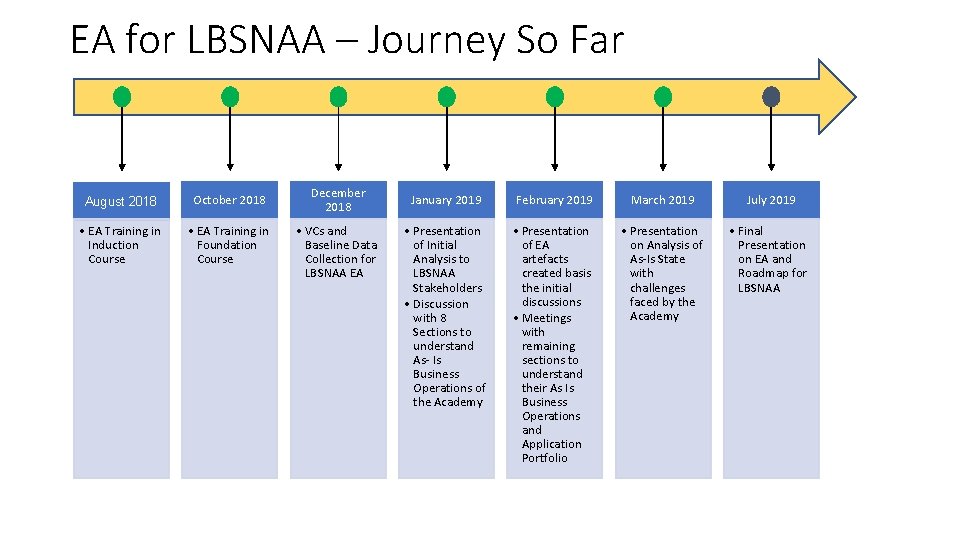
EA for LBSNAA – Journey So Far August 2018 October 2018 • EA Training in Induction Course • EA Training in Foundation Course December 2018 • VCs and Baseline Data Collection for LBSNAA EA January 2019 February 2019 March 2019 July 2019 • Presentation of Initial Analysis to LBSNAA Stakeholders • Discussion with 8 Sections to understand As- Is Business Operations of the Academy • Presentation of EA artefacts created basis the initial discussions • Meetings with remaining sections to understand their As Is Business Operations and Application Portfolio • Presentation on Analysis of As-Is State with challenges faced by the Academy • Final Presentation on EA and Roadmap for LBSNAA
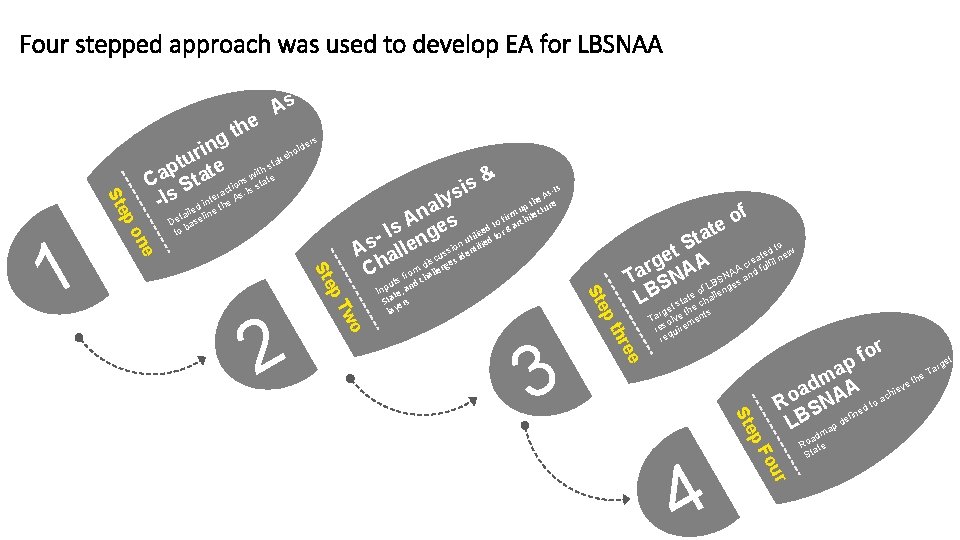
Four stepped approach was used to develop EA for LBSNAA he t g ep St rs e n old i r eh k tu te sta th p i w Ca Sta actions-Is state -Is ed interthe As sis l e tai lin De base to e on t a t to t. S ted new a e rg AA NAA acrned fulfil a T SN f LBSnges LB state ochalle t e rge th ts Ta olve men res uire req or f p ee thr ep ep St 3 f o e St o Tw 2 & -Is As e th re up ectu m fir hit to 8 arc d r ze tili ed fo u i n f sio nti us s ide c dis nge romchalle f uts nd Inp te, a Sta ers lay aly n A es s I - eng s A all Ch ep St 1 As ur Fo 4 ma d a AA o achieve o R SN fined t LB dmap de a Ro te Sta rg Ta the et
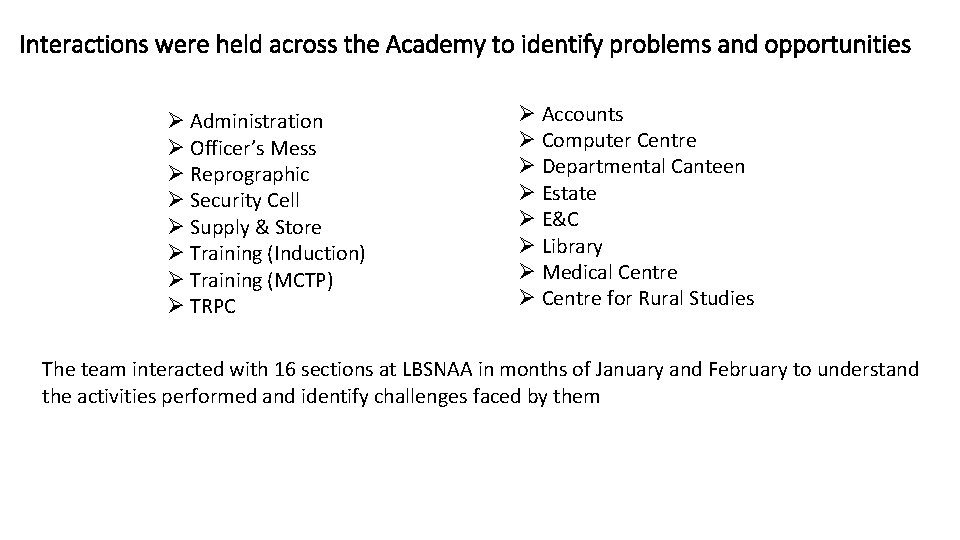
Interactions were held across the Academy to identify problems and opportunities Ø Administration Ø Officer’s Mess Ø Reprographic Ø Security Cell Ø Supply & Store Ø Training (Induction) Ø Training (MCTP) Ø TRPC Ø Accounts Ø Computer Centre Ø Departmental Canteen Ø Estate Ø E&C Ø Library Ø Medical Centre Ø Centre for Rural Studies The team interacted with 16 sections at LBSNAA in months of January and February to understand the activities performed and identify challenges faced by them
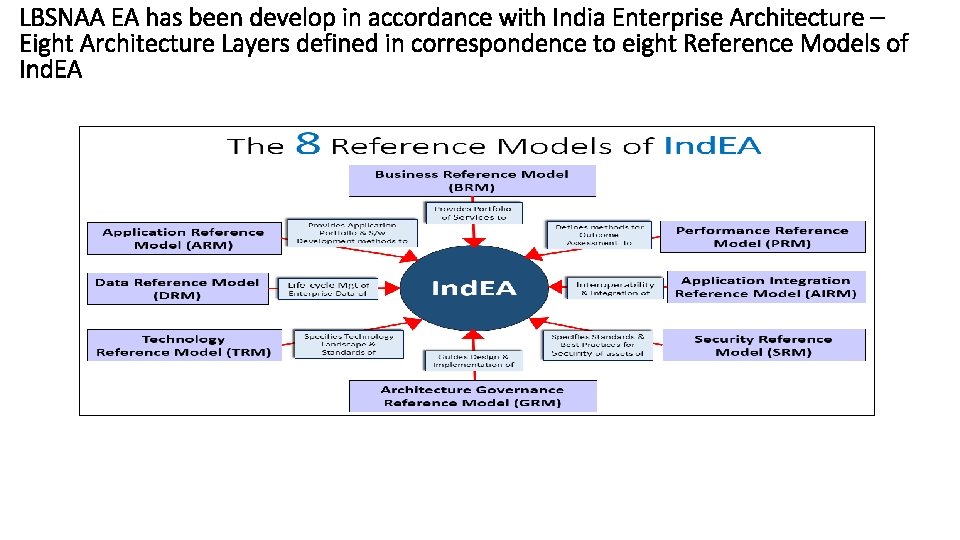
LBSNAA EA has been develop in accordance with India Enterprise Architecture – Eight Architecture Layers defined in correspondence to eight Reference Models of Ind. EA
LBSNAA Enterprise Architecture Each Architecture Layer has been described in terms of As-Is Architecture, Challenges in As-Is, To-Be Architecture, & Transition Principles
Business Architecture is one of the most important elements of an Enterprise Architecture, and defines the enterprise in terms of its Vision, Mission, Objectives, Organization Structure, and Business Capabilities/Processes.
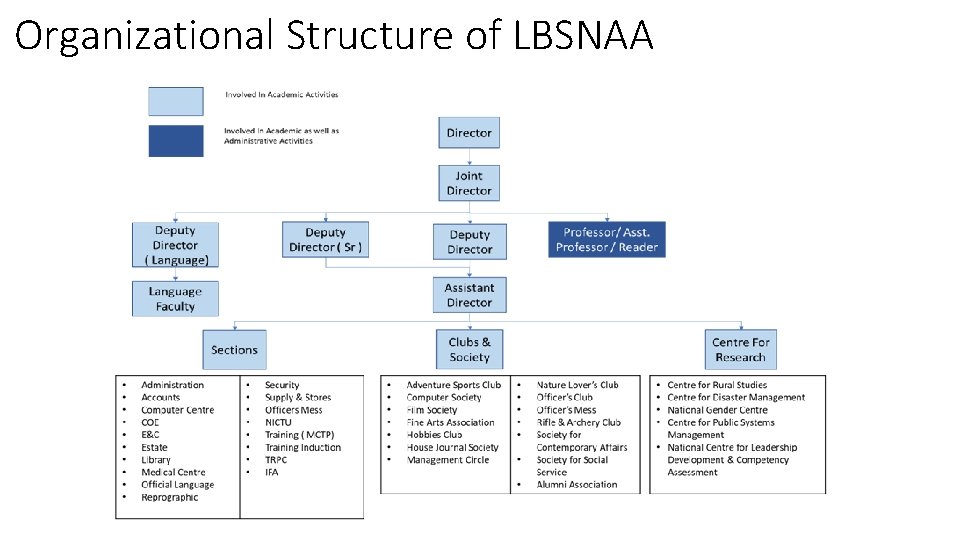
Organizational Structure of LBSNAA
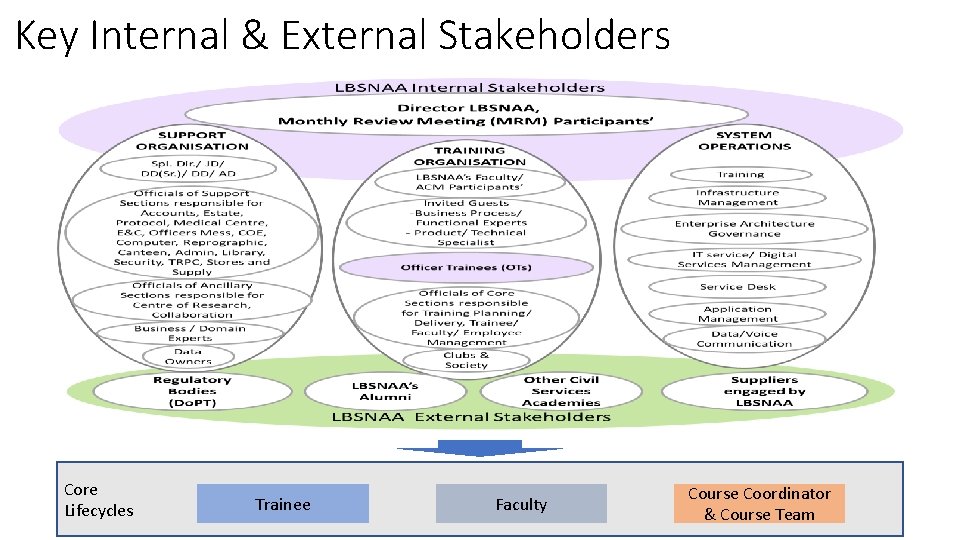
Key Internal & External Stakeholders Core Lifecycles Trainee Faculty Course Coordinator & Course Team
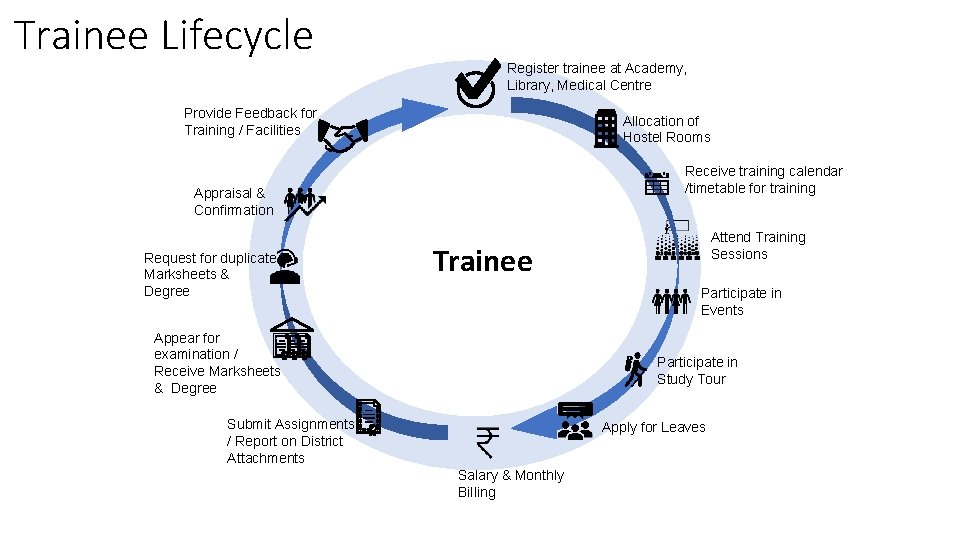
Trainee Lifecycle Register trainee at Academy, Library, Medical Centre Provide Feedback for Training / Facilities Allocation of Hostel Rooms Receive training calendar /timetable for training Appraisal & Confirmation Request for duplicate Marksheets & Degree Attend Training Sessions Trainee Participate in Events Appear for examination / Receive Marksheets & Degree Participate in Study Tour Submit Assignments / Report on District Attachments Apply for Leaves Salary & Monthly Billing
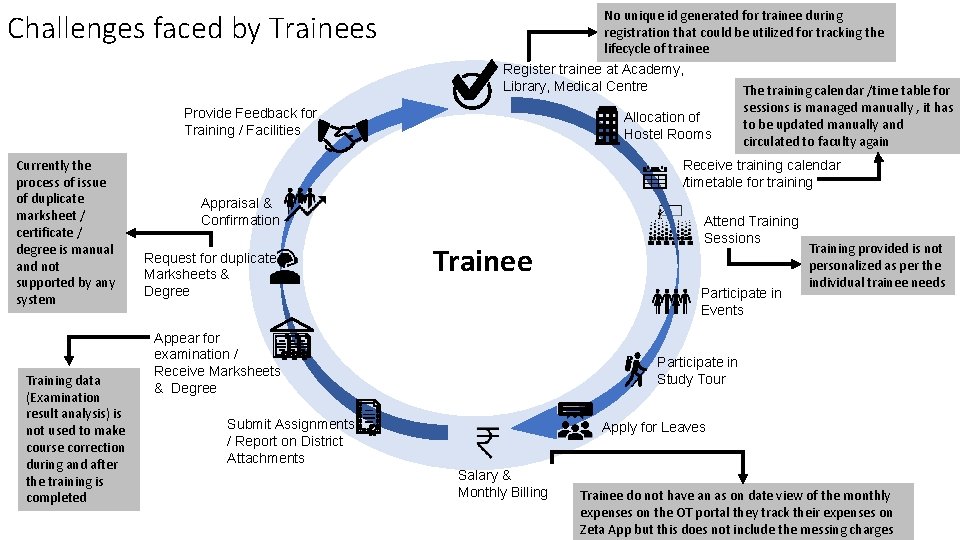
Challenges faced by Trainees Provide Feedback for Training / Facilities Currently the process of issue of duplicate marksheet / certificate / degree is manual and not supported by any system Training data (Examination result analysis) is not used to make course correction during and after the training is completed No unique id generated for trainee during registration that could be utilized for tracking the lifecycle of trainee Register trainee at Academy, Library, Medical Centre The training calendar /time table for sessions is managed manually , it has Allocation of to be updated manually and Hostel Rooms circulated to faculty again Receive training calendar /timetable for training Appraisal & Confirmation Request for duplicate Marksheets & Degree Trainee Attend Training Sessions Participate in Events Appear for examination / Receive Marksheets & Degree Training provided is not personalized as per the individual trainee needs Participate in Study Tour Submit Assignments / Report on District Attachments Apply for Leaves Salary & Monthly Billing Trainee do not have an as on date view of the monthly expenses on the OT portal they track their expenses on Zeta App but this does not include the messing charges
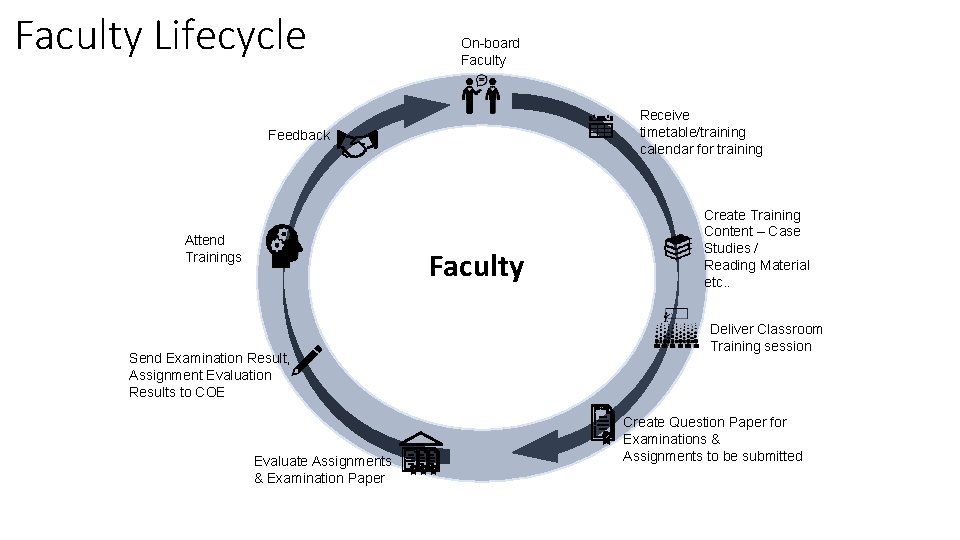
Faculty Lifecycle On-board Faculty Receive timetable/training calendar for training Feedback Attend Trainings Faculty Send Examination Result, Assignment Evaluation Results to COE Evaluate Assignments & Examination Paper Create Training Content – Case Studies / Reading Material etc. . Deliver Classroom Training session Create Question Paper for Examinations & Assignments to be submitted
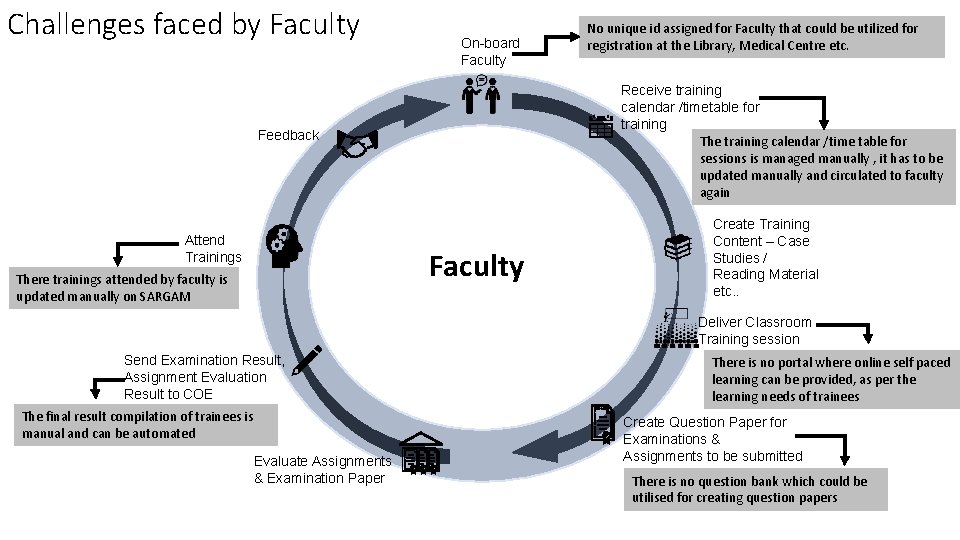
Challenges faced by Faculty On-board Faculty Receive training calendar /timetable for training The training calendar /time table for sessions is managed manually , it has to be updated manually and circulated to faculty again Feedback Attend Trainings Faculty There trainings attended by faculty is updated manually on SARGAM No unique id assigned for Faculty that could be utilized for registration at the Library, Medical Centre etc. Create Training Content – Case Studies / Reading Material etc. . Deliver Classroom Training session Send Examination Result, Assignment Evaluation Result to COE The final result compilation of trainees is manual and can be automated Evaluate Assignments & Examination Paper There is no portal where online self paced learning can be provided, as per the learning needs of trainees Create Question Paper for Examinations & Assignments to be submitted There is no question bank which could be utilised for creating question papers
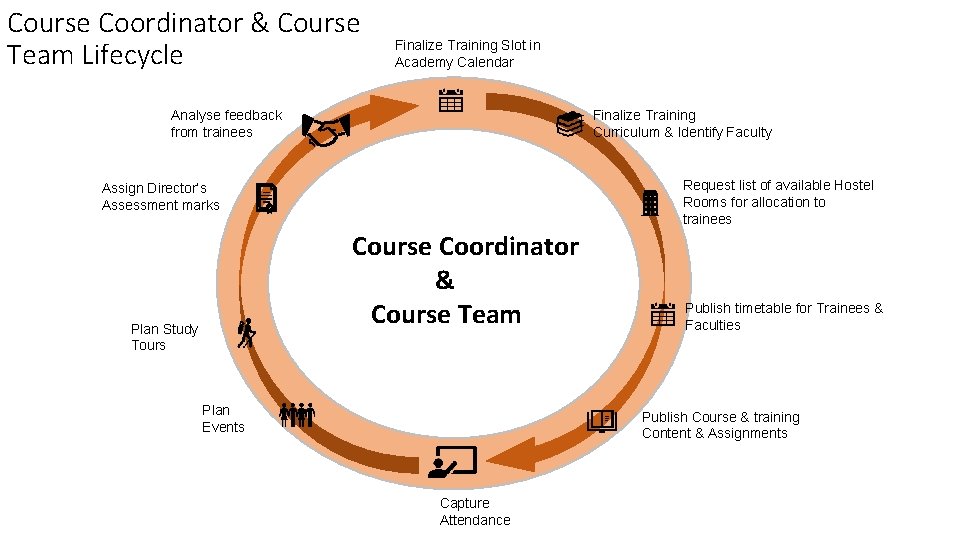
Course Coordinator & Course Team Lifecycle Finalize Training Slot in Academy Calendar Analyse feedback from trainees Finalize Training Curriculum & Identify Faculty Request list of available Hostel Rooms for allocation to trainees Assign Director’s Assessment marks Course Coordinator & Course Team Plan Study Tours Plan Events Publish timetable for Trainees & Faculties Publish Course & training Content & Assignments Capture Attendance
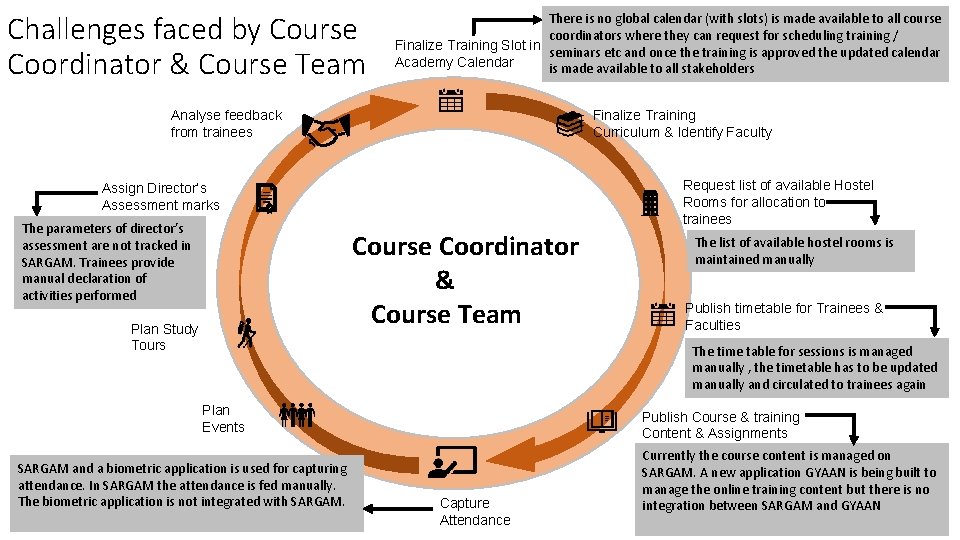
Challenges faced by Course Coordinator & Course Team There is no global calendar (with slots) is made available to all course coordinators where they can request for scheduling training / Finalize Training Slot in seminars etc and once the training is approved the updated calendar Academy Calendar is made available to all stakeholders Analyse feedback from trainees Finalize Training Curriculum & Identify Faculty Request list of available Hostel Rooms for allocation to trainees Assign Director’s Assessment marks The parameters of director’s assessment are not tracked in SARGAM. Trainees provide manual declaration of activities performed Course Coordinator & Course Team Plan Study Tours The list of available hostel rooms is maintained manually Publish timetable for Trainees & Faculties The time table for sessions is managed manually , the timetable has to be updated manually and circulated to trainees again Plan Events SARGAM and a biometric application is used for capturing attendance. In SARGAM the attendance is fed manually. The biometric application is not integrated with SARGAM. Publish Course & training Content & Assignments Capture Attendance Currently the course content is managed on SARGAM. A new application GYAAN is being built to manage the online training content but there is no integration between SARGAM and GYAAN
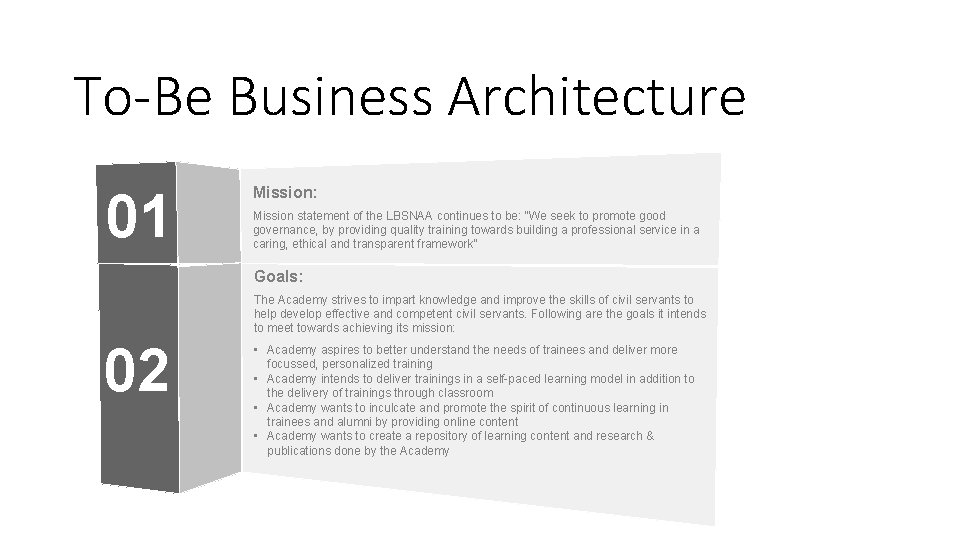
To-Be Business Architecture 01 Mission: Mission statement of the LBSNAA continues to be: “We seek to promote good governance, by providing quality training towards building a professional service in a caring, ethical and transparent framework” Goals: The Academy strives to impart knowledge and improve the skills of civil servants to help develop effective and competent civil servants. Following are the goals it intends to meet towards achieving its mission: 02 • Academy aspires to better understand the needs of trainees and deliver more focussed, personalized training • Academy intends to deliver trainings in a self-paced learning model in addition to the delivery of trainings through classroom • Academy wants to inculcate and promote the spirit of continuous learning in trainees and alumni by providing online content • Academy wants to create a repository of learning content and research & publications done by the Academy
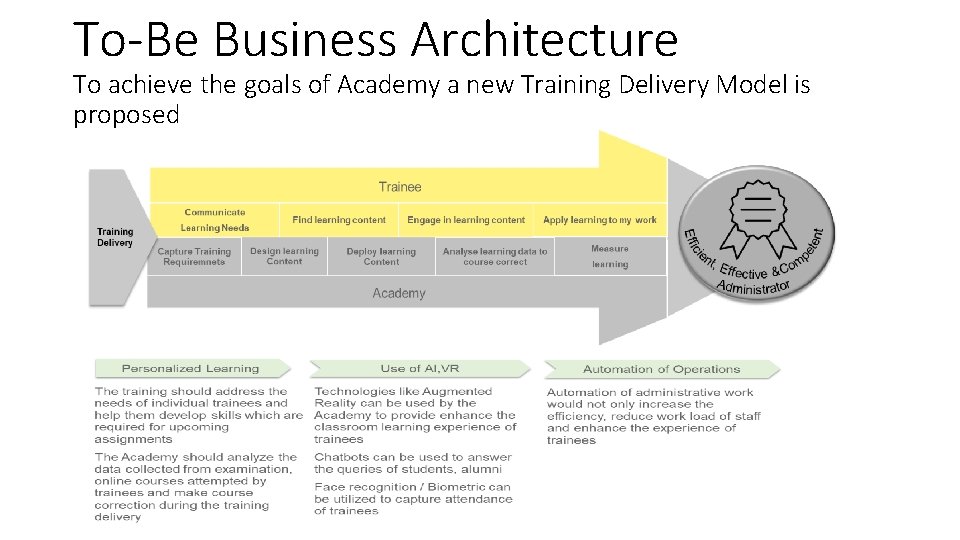
To-Be Business Architecture To achieve the goals of Academy a new Training Delivery Model is proposed
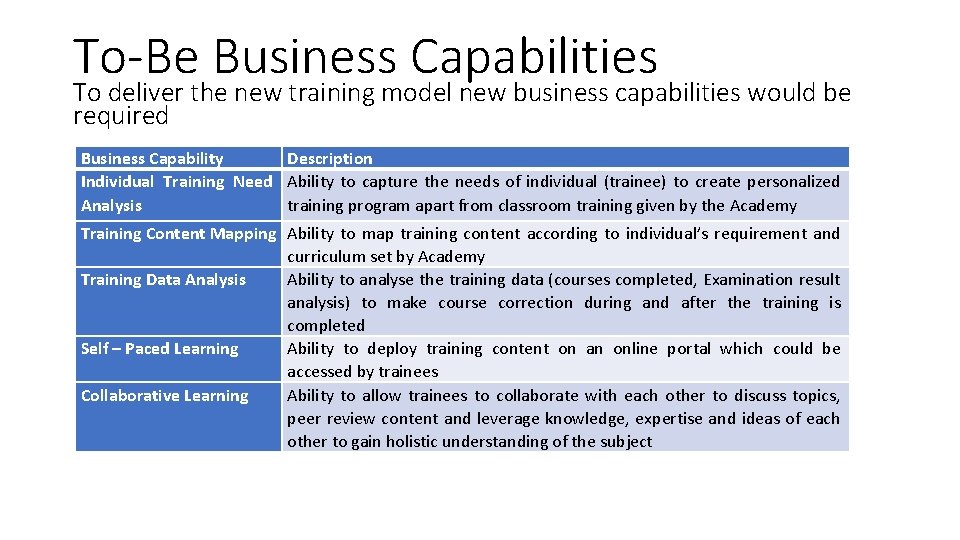
To-Be Business Capabilities To deliver the new training model new business capabilities would be required Business Capability Description Individual Training Need Ability to capture the needs of individual (trainee) to create personalized Analysis training program apart from classroom training given by the Academy Training Content Mapping Ability to map training content according to individual’s requirement and curriculum set by Academy Training Data Analysis Ability to analyse the training data (courses completed, Examination result analysis) to make course correction during and after the training is completed Self – Paced Learning Ability to deploy training content on an online portal which could be accessed by trainees Collaborative Learning Ability to allow trainees to collaborate with each other to discuss topics, peer review content and leverage knowledge, expertise and ideas of each other to gain holistic understanding of the subject
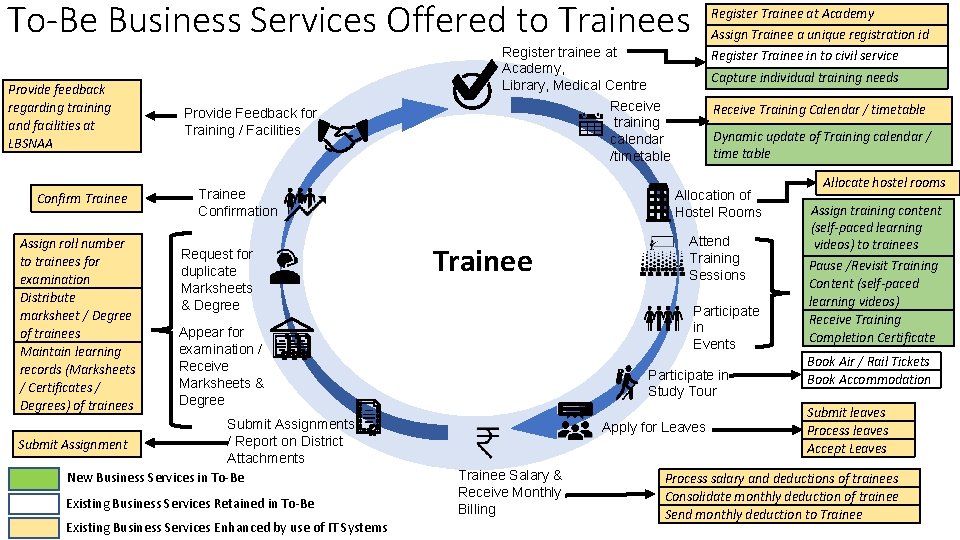
To-Be Business Services Offered to Trainees Provide feedback regarding training and facilities at LBSNAA Confirm Trainee Assign roll number to trainees for examination Distribute marksheet / Degree of trainees Maintain learning records (Marksheets / Certificates / Degrees) of trainees Provide Feedback for Training / Facilities Existing Business Services Retained in To-Be Existing Business Services Enhanced by use of IT Systems Register Trainee in to civil service Capture individual training needs Receive Training Calendar / timetable Dynamic update of Training calendar / time table Allocation of Hostel Rooms Trainee Attend Training Sessions Participate in Events Appear for examination / Receive Marksheets & Degree Submit Assignments / Report on District Submit Assignment Attachments New Business Services in To-Be Assign Trainee a unique registration id Register trainee at Academy, Library, Medical Centre Receive training calendar /timetable Trainee Confirmation Request for duplicate Marksheets & Degree Register Trainee at Academy Participate in Study Tour Apply for Leaves Trainee Salary & Receive Monthly Billing Allocate hostel rooms Assign training content (self-paced learning videos) to trainees Pause /Revisit Training Content (self-paced learning videos) Receive Training Completion Certificate Book Air / Rail Tickets Book Accommodation Submit leaves Process leaves Accept Leaves Process salary and deductions of trainees Consolidate monthly deduction of trainee Send monthly deduction to Trainee
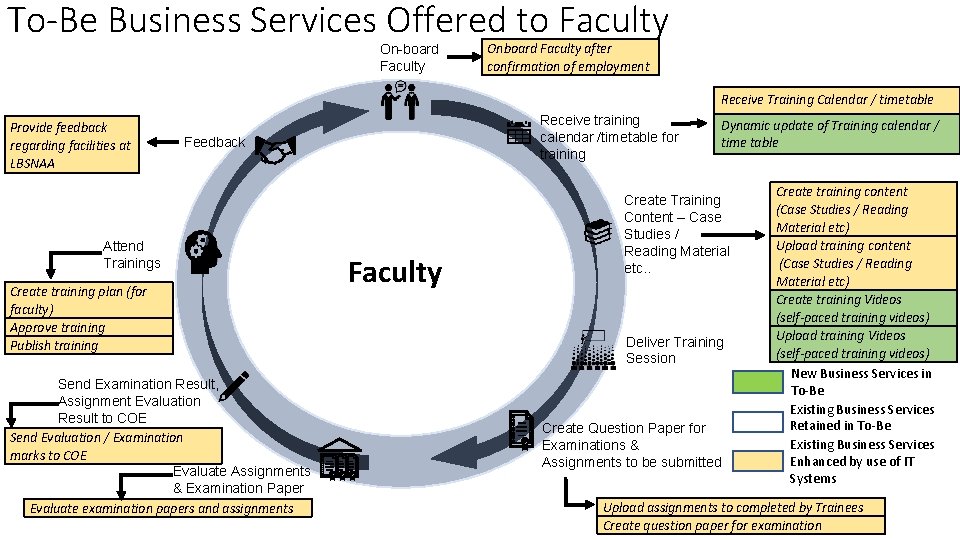
To-Be Business Services Offered to Faculty On-board Faculty Onboard Faculty after confirmation of employment Receive Training Calendar / timetable Provide feedback regarding facilities at LBSNAA Receive training calendar /timetable for training Feedback Attend Trainings Create training plan (for faculty) Approve training Publish training Send Examination Result, Assignment Evaluation Result to COE Send Evaluation / Examination marks to COE Evaluate Assignments & Examination Paper Evaluate examination papers and assignments Faculty Dynamic update of Training calendar / time table Create Training Content – Case Studies / Reading Material etc. . Deliver Training Session Create Question Paper for Examinations & Assignments to be submitted Create training content (Case Studies / Reading Material etc) Upload training content (Case Studies / Reading Material etc) Create training Videos (self-paced training videos) Upload training Videos (self-paced training videos) New Business Services in To-Be Existing Business Services Retained in To-Be Existing Business Services Enhanced by use of IT Systems Upload assignments to completed by Trainees Create question paper for examination
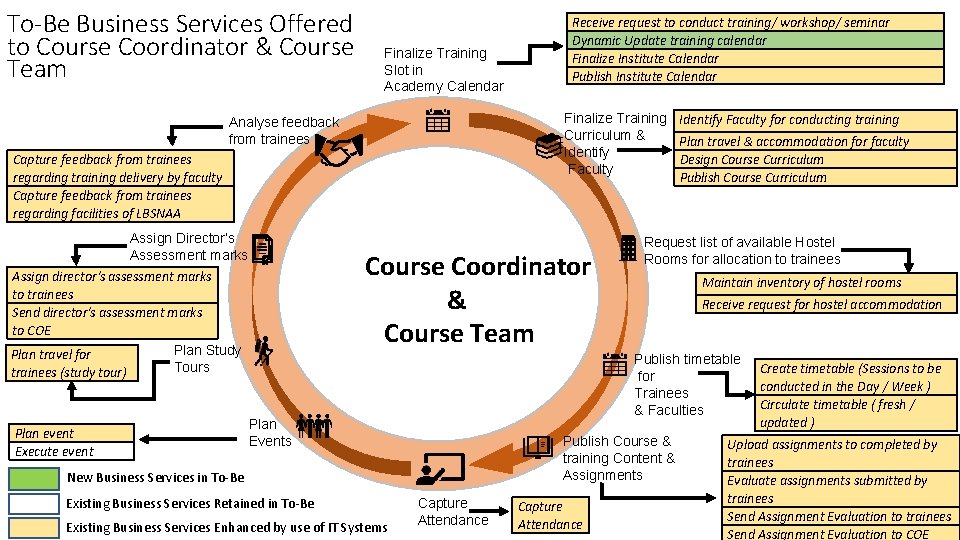
To-Be Business Services Offered to Course Coordinator & Course Team Finalize Training Slot in Academy Calendar Finalize Training Identify Faculty for conducting training Curriculum & Plan travel & accommodation for faculty Identify Design Course Curriculum Faculty Publish Course Curriculum Analyse feedback from trainees Capture feedback from trainees regarding training delivery by faculty Capture feedback from trainees regarding facilities of LBSNAA Assign Director’s Assessment marks Assign director's assessment marks to trainees Send director's assessment marks to COE Plan Study Plan travel for Tours trainees (study tour) Plan event Execute event Receive request to conduct training/ workshop/ seminar Dynamic Update training calendar Finalize Institute Calendar Publish Institute Calendar Course Coordinator & Course Team Receive request for hostel accommodation Publish Course & training Content & Assignments New Business Services in To-Be Existing Business Services Enhanced by use of IT Systems Maintain inventory of hostel rooms Publish timetable for Trainees & Faculties Plan Events Existing Business Services Retained in To-Be Request list of available Hostel Rooms for allocation to trainees Capture Attendance Create timetable (Sessions to be conducted in the Day / Week ) Circulate timetable ( fresh / updated ) Upload assignments to completed by trainees Evaluate assignments submitted by trainees Send Assignment Evaluation to COE
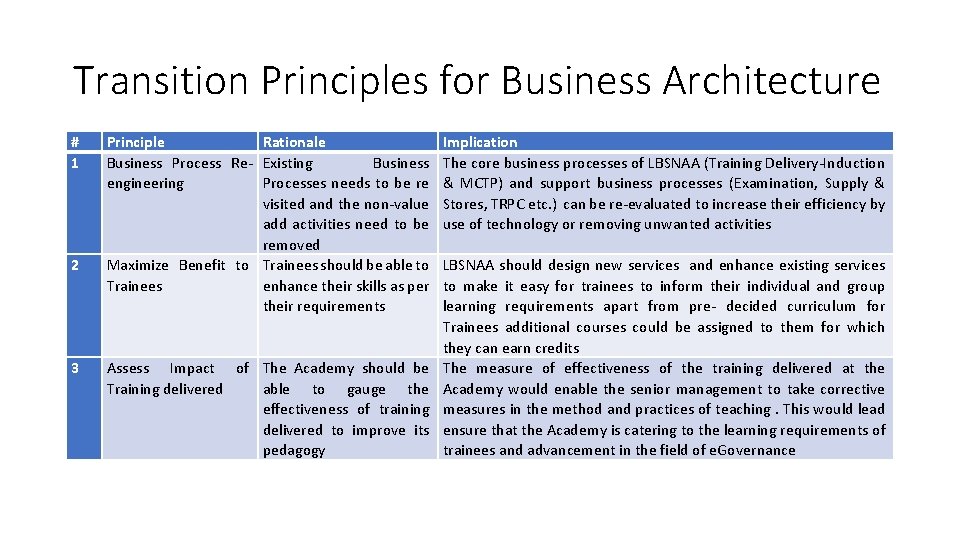
Transition Principles for Business Architecture # 1 2 3 Principle Rationale Business Process Re- Existing Business engineering Processes needs to be re visited and the non-value add activities need to be removed Maximize Benefit to Trainees should be able to Trainees enhance their skills as per their requirements Assess Impact of The Academy should be Training delivered able to gauge the effectiveness of training delivered to improve its pedagogy Implication The core business processes of LBSNAA (Training Delivery-Induction & MCTP) and support business processes (Examination, Supply & Stores, TRPC etc. ) can be re-evaluated to increase their efficiency by use of technology or removing unwanted activities LBSNAA should design new services and enhance existing services to make it easy for trainees to inform their individual and group learning requirements apart from pre- decided curriculum for Trainees additional courses could be assigned to them for which they can earn credits The measure of effectiveness of the training delivered at the Academy would enable the senior management to take corrective measures in the method and practices of teaching. This would lead ensure that the Academy is catering to the learning requirements of trainees and advancement in the field of e. Governance
Performance Architecture describes the parameters (Key Performance Indicators – KPIs) on which the Academy can judge its performance. It will enable LBSNAA to analyse the activities to identify growth and improvement opportunities
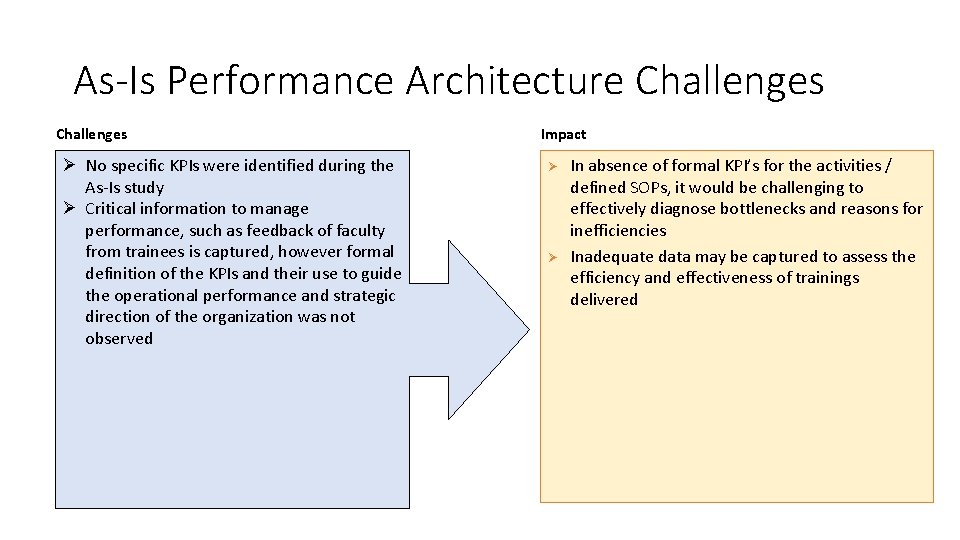
As-Is Performance Architecture Challenges Ø No specific KPIs were identified during the As-Is study Ø Critical information to manage performance, such as feedback of faculty from trainees is captured, however formal definition of the KPIs and their use to guide the operational performance and strategic direction of the organization was not observed Impact Ø Ø In absence of formal KPI’s for the activities / defined SOPs, it would be challenging to effectively diagnose bottlenecks and reasons for inefficiencies Inadequate data may be captured to assess the efficiency and effectiveness of trainings delivered
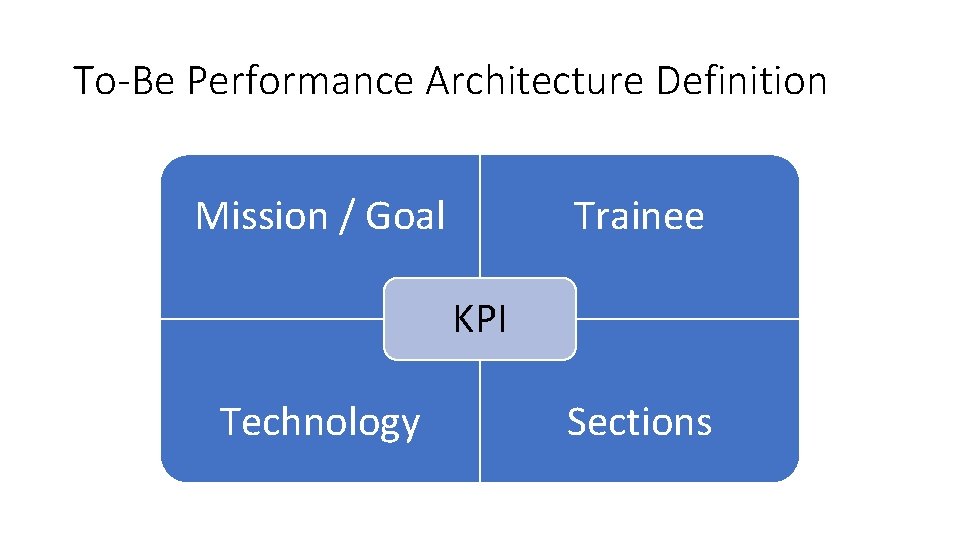
To-Be Performance Architecture Definition Trainee Mission / Goal KPI Technology Sections
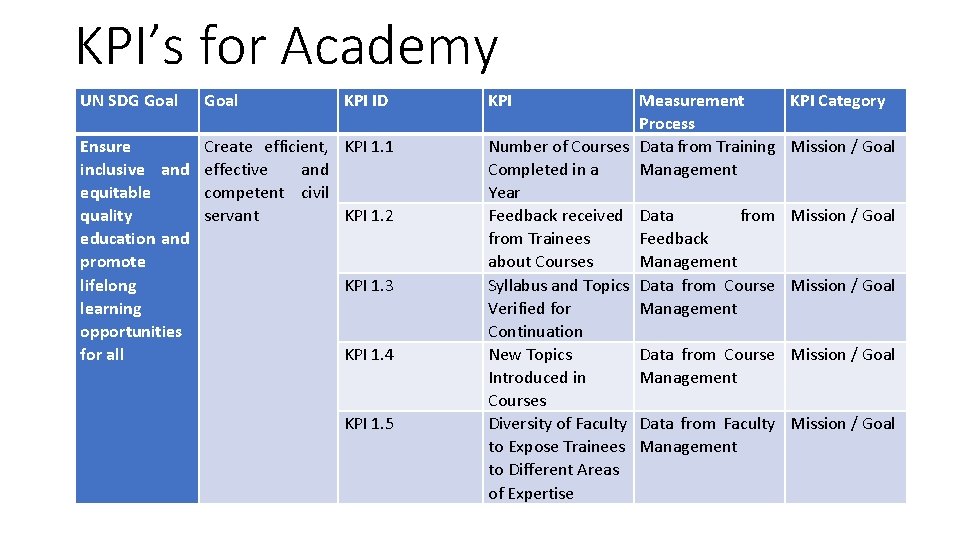
KPI’s for Academy UN SDG Goal KPI ID Ensure inclusive and equitable quality education and promote lifelong learning opportunities for all Create efficient, KPI 1. 1 effective and competent civil servant KPI 1. 2 KPI 1. 3 KPI 1. 4 KPI 1. 5 KPI Measurement KPI Category Process Number of Courses Data from Training Mission / Goal Completed in a Management Year Feedback received Data from Mission / Goal from Trainees Feedback about Courses Management Syllabus and Topics Data from Course Mission / Goal Verified for Management Continuation New Topics Data from Course Mission / Goal Introduced in Management Courses Diversity of Faculty Data from Faculty Mission / Goal to Expose Trainees Management to Different Areas of Expertise
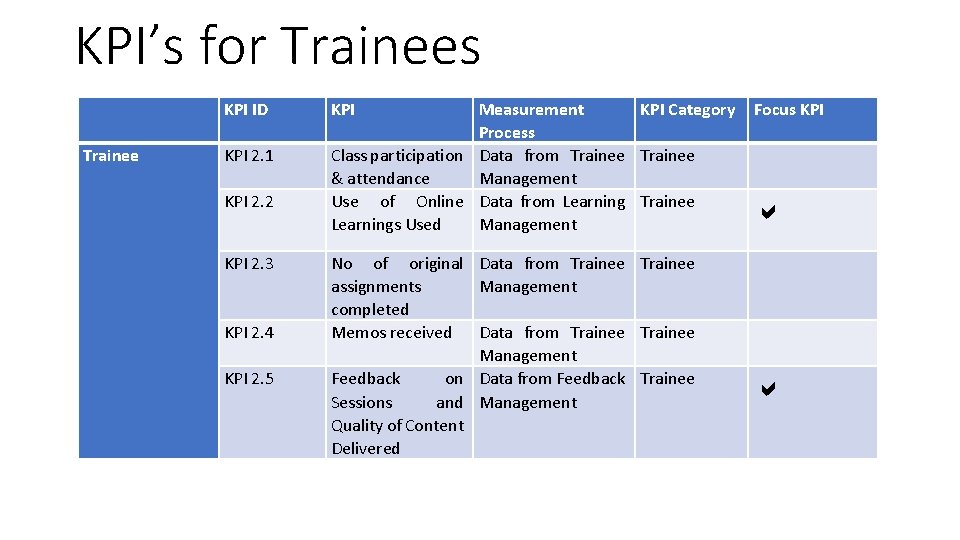
KPI’s for Trainees KPI ID Trainee KPI 2. 1 KPI 2. 2 KPI 2. 3 KPI 2. 4 KPI 2. 5 KPI Measurement KPI Category Focus KPI Process Class participation Data from Trainee & attendance Management Use of Online Data from Learning Trainee Learnings Used Management a No of original Data from Trainee assignments Management completed Memos received Data from Trainee Management Feedback on Data from Feedback Trainee Sessions and Management Quality of Content Delivered a
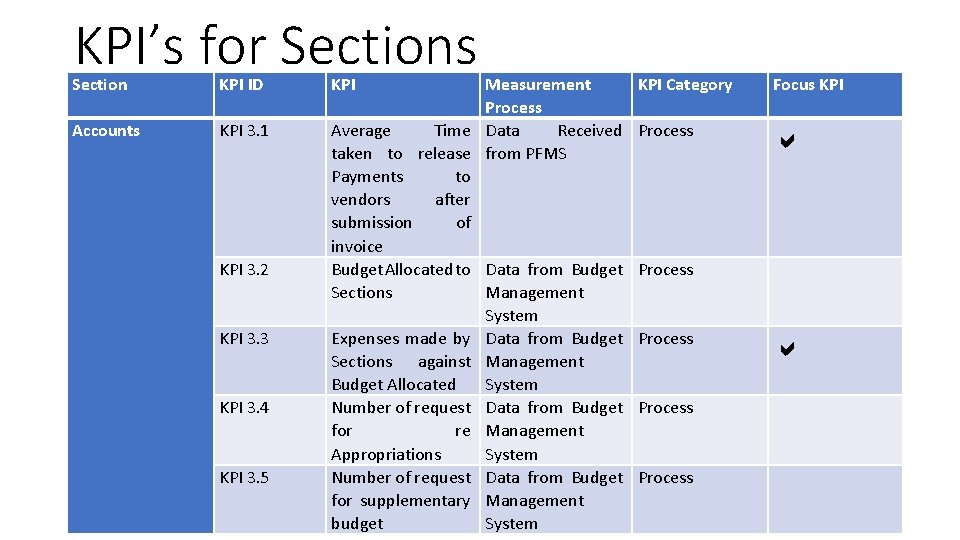
KPI’s for Sections Section KPI ID Accounts KPI 3. 1 KPI 3. 2 KPI 3. 3 KPI 3. 4 KPI 3. 5 KPI Measurement KPI Category Process Average Time Data Received Process taken to release from PFMS Payments to vendors after submission of invoice Budget Allocated to Data from Budget Process Sections Management System Expenses made by Data from Budget Process Sections against Management Budget Allocated System Number of request Data from Budget Process for re Management Appropriations System Number of request Data from Budget Process for supplementary Management budget System Focus KPI a a
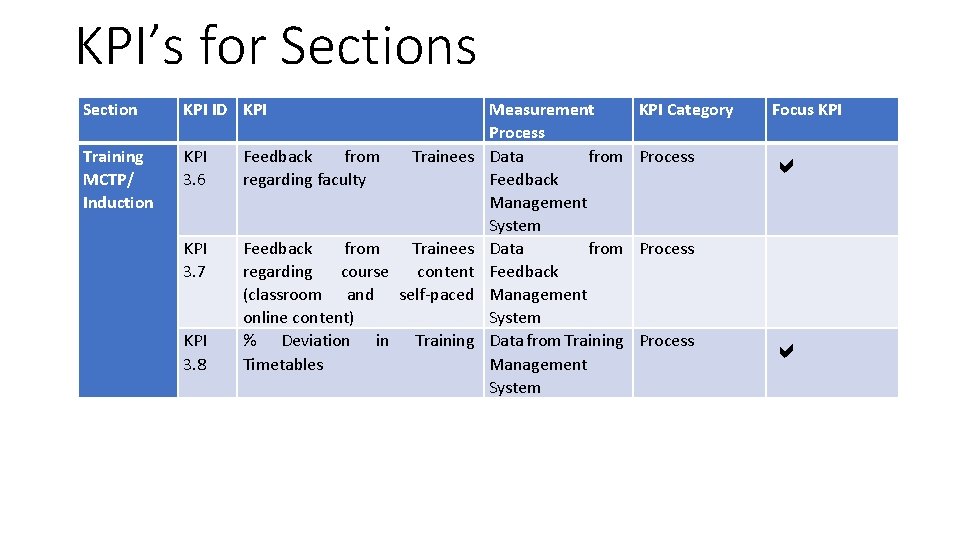
KPI’s for Sections Section KPI ID KPI Training MCTP/ Induction KPI 3. 6 Feedback from regarding faculty KPI 3. 7 Feedback from Trainees regarding course content (classroom and self-paced online content) % Deviation in Training Timetables KPI 3. 8 Trainees Measurement Process Data from Feedback Management System Data from Training Management System KPI Category Focus KPI Process a
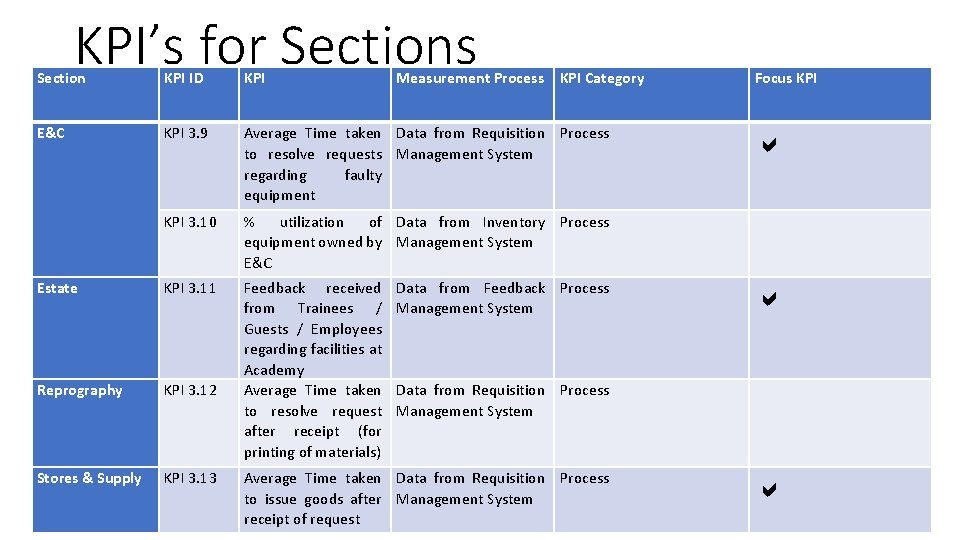
KPI’s for Sections Section KPI ID KPI Measurement Process KPI Category E&C KPI 3. 9 Average Time taken Data from Requisition Process to resolve requests Management System regarding faulty equipment KPI 3. 10 % utilization of Data from Inventory Process equipment owned by Management System E&C Estate KPI 3. 11 Reprography KPI 3. 12 Feedback received from Trainees / Guests / Employees regarding facilities at Academy Average Time taken to resolve request after receipt (for printing of materials) Stores & Supply KPI 3. 13 Data from Feedback Process Management System Focus KPI a a Data from Requisition Process Management System Average Time taken Data from Requisition Process to issue goods after Management System receipt of request a
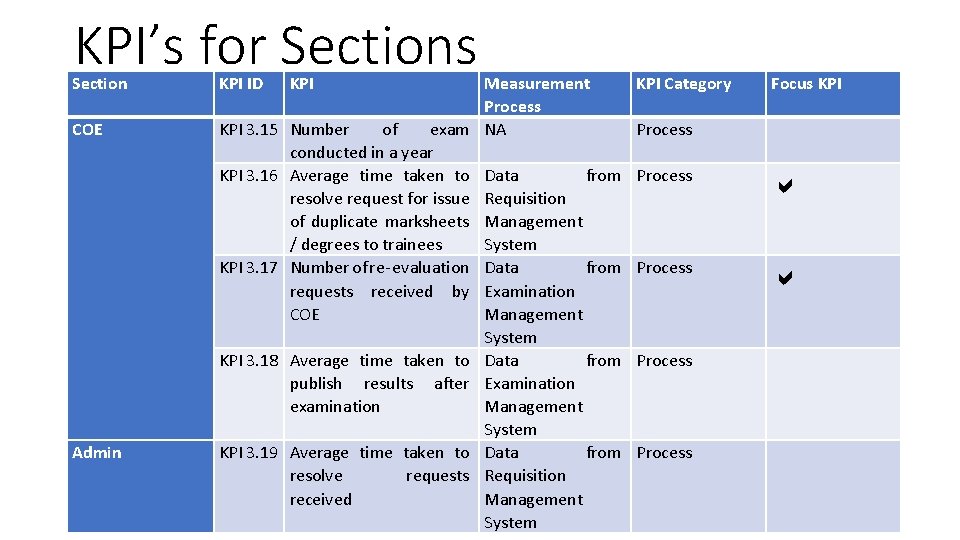
KPI’s for Sections Section KPI ID COE KPI 3. 15 KPI 3. 16 KPI 3. 17 KPI 3. 18 Admin KPI 3. 19 KPI Measurement Process Number of exam NA conducted in a year Average time taken to Data from resolve request for issue Requisition of duplicate marksheets Management / degrees to trainees System Number of re- evaluation Data from requests received by Examination COE Management System Average time taken to Data from publish results after Examination examination Management System Average time taken to Data from resolve requests Requisition received Management System KPI Category Focus KPI Process a Process
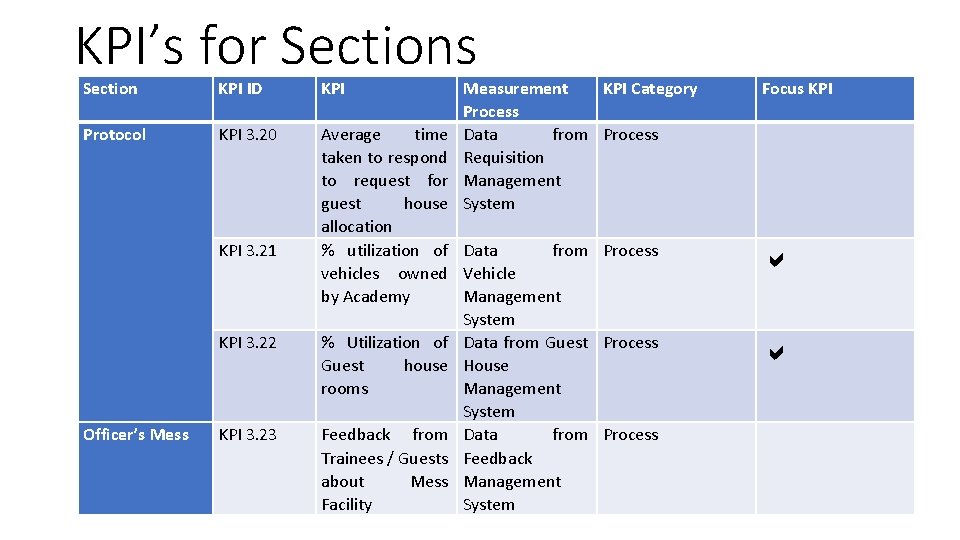
KPI’s for Sections Section KPI ID KPI Protocol KPI 3. 20 Average time taken to respond to request for guest house allocation % utilization of Data from Process vehicles owned Vehicle by Academy Management System % Utilization of Data from Guest Process Guest house House rooms Management System Feedback from Data from Process Trainees / Guests Feedback about Mess Management Facility System KPI 3. 21 KPI 3. 22 Officer’s Mess KPI 3. 23 Measurement KPI Category Process Data from Process Requisition Management System Focus KPI a a
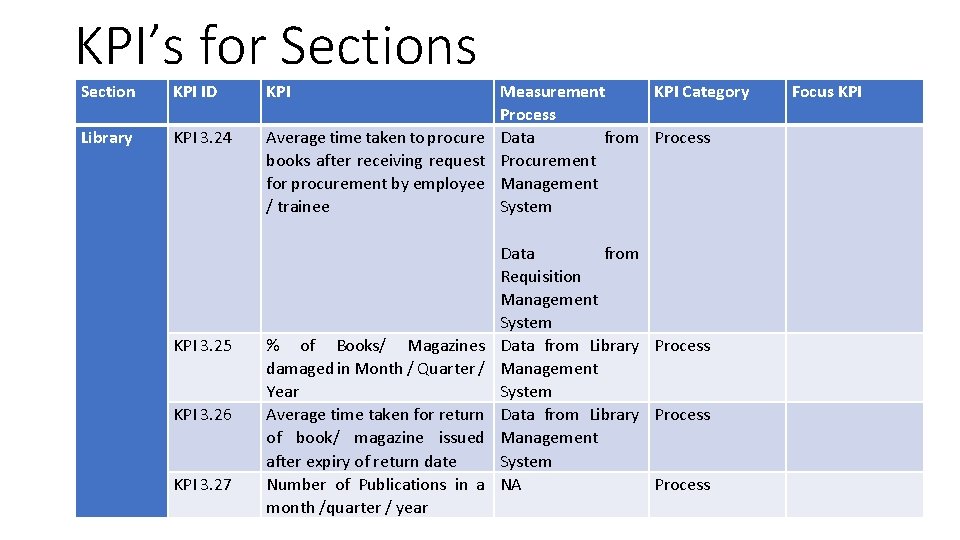
KPI’s for Sections Section KPI ID KPI Library KPI 3. 24 Average time taken to procure books after receiving request for procurement by employee / trainee KPI 3. 25 % of Books/ Magazines damaged in Month / Quarter / Year Average time taken for return of book/ magazine issued after expiry of return date Number of Publications in a month /quarter / year KPI 3. 26 KPI 3. 27 Measurement Process Data from Procurement Management System Data from Requisition Management System Data from Library Management System NA KPI Category Process Focus KPI
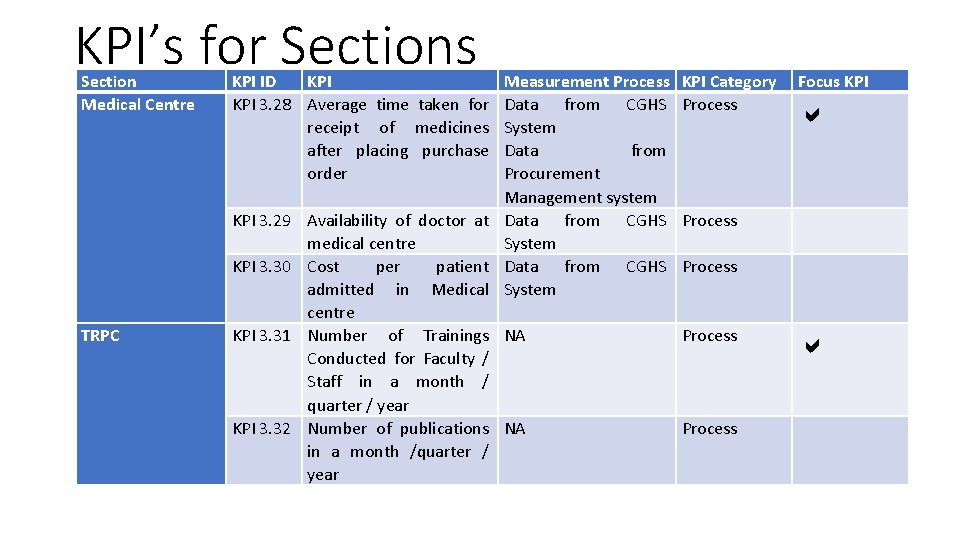
KPI’s for Sections Section Medical Centre KPI ID KPI 3. 28 Average time taken for receipt of medicines after placing purchase order KPI Category Focus KPI Process KPI 3. 29 Process KPI 3. 30 TRPC KPI 3. 31 KPI 3. 32 Measurement Process Data from CGHS System Data from Procurement Management system Availability of doctor at Data from CGHS medical centre System Cost per patient Data from CGHS admitted in Medical System centre Number of Trainings NA Conducted for Faculty / Staff in a month / quarter / year Number of publications NA in a month /quarter / year a Process a
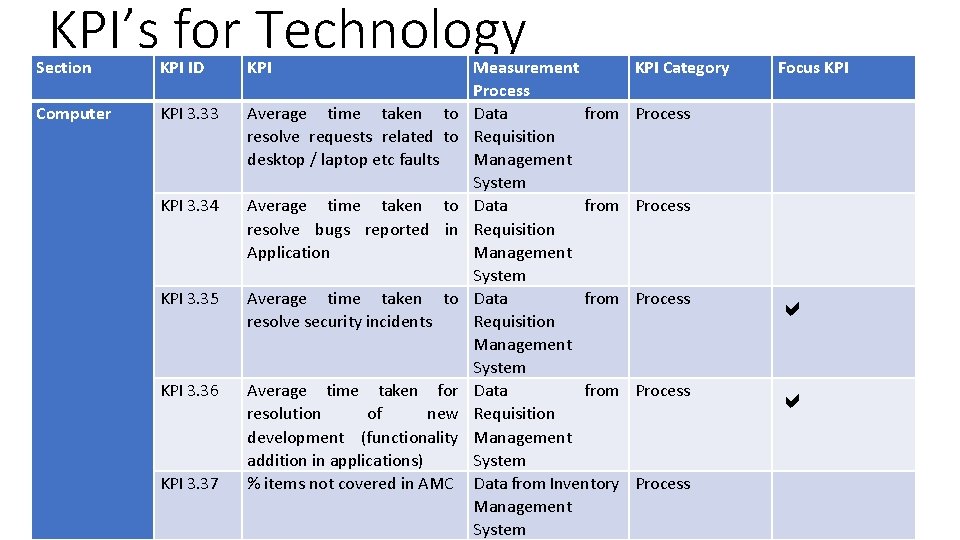
KPI’s for Technology Section KPI ID KPI Computer KPI 3. 33 Average time taken to resolve requests related to desktop / laptop etc faults KPI 3. 34 Average time taken to resolve bugs reported in Application KPI 3. 35 Average time taken to resolve security incidents KPI 3. 36 Average time taken for resolution of new development (functionality addition in applications) % items not covered in AMC KPI 3. 37 Measurement Process Data from Requisition Management System Data from Inventory Management System KPI Category Focus KPI Process a Process
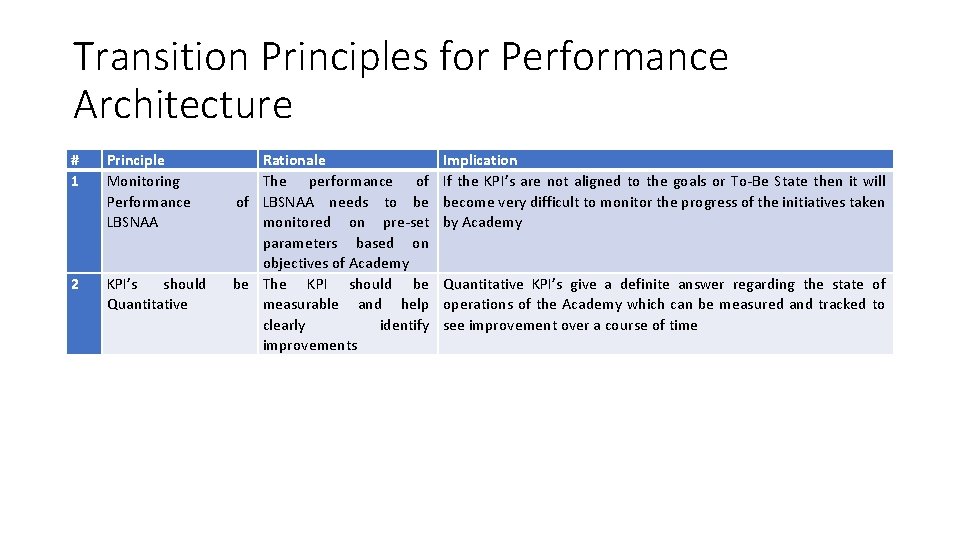
Transition Principles for Performance Architecture # 1 Principle Monitoring Performance LBSNAA 2 KPI’s should Quantitative Rationale The performance of of LBSNAA needs to be monitored on pre-set parameters based on objectives of Academy be The KPI should be measurable and help clearly identify improvements Implication If the KPI’s are not aligned to the goals or To-Be State then it will become very difficult to monitor the progress of the initiatives taken by Academy Quantitative KPI’s give a definite answer regarding the state of operations of the Academy which can be measured and tracked to see improvement over a course of time
Data Architecture describes the information required to carry out the activities of the Academy. It first describes the broad data subject areas for which information is required, and then each data subject area is defined in terms of information required
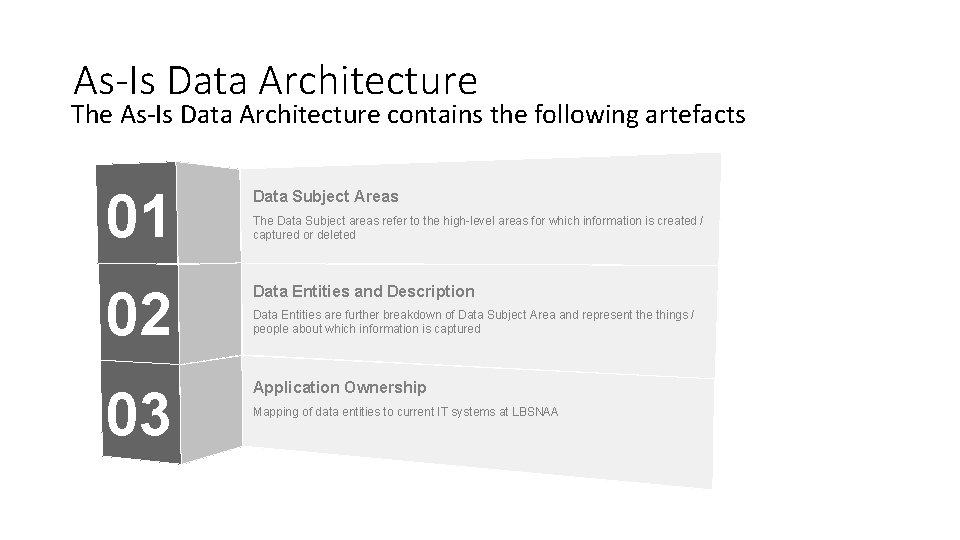
As-Is Data Architecture The As-Is Data Architecture contains the following artefacts 01 Data Subject Areas 02 Data Entities and Description 03 Application Ownership The Data Subject areas refer to the high-level areas for which information is created / captured or deleted Data Entities are further breakdown of Data Subject Area and represent the things / people about which information is captured Mapping of data entities to current IT systems at LBSNAA
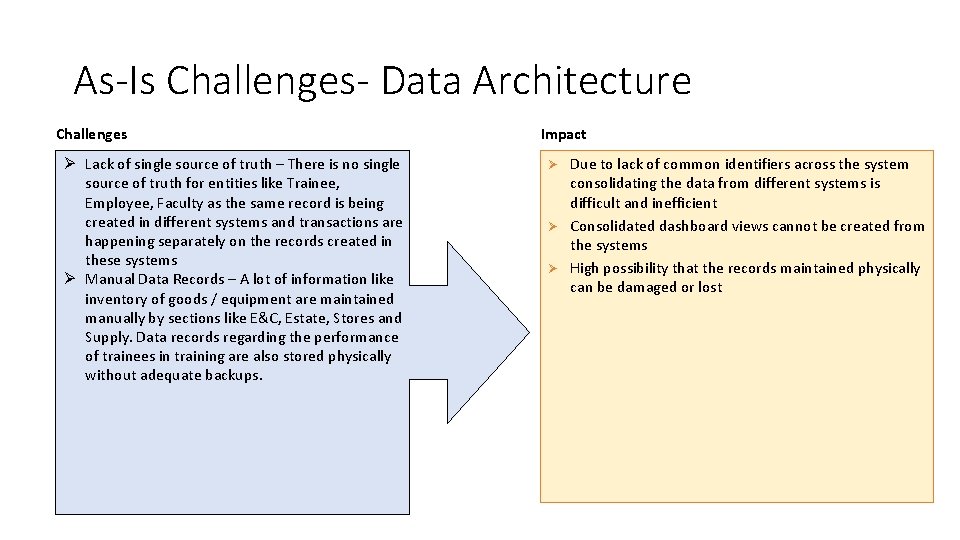
As-Is Challenges- Data Architecture Challenges Ø Lack of single source of truth – There is no single source of truth for entities like Trainee, Employee, Faculty as the same record is being created in different systems and transactions are happening separately on the records created in these systems Ø Manual Data Records – A lot of information like inventory of goods / equipment are maintained manually by sections like E&C, Estate, Stores and Supply. Data records regarding the performance of trainees in training are also stored physically without adequate backups. Impact Ø Ø Ø Due to lack of common identifiers across the system consolidating the data from different systems is difficult and inefficient Consolidated dashboard views cannot be created from the systems High possibility that the records maintained physically can be damaged or lost
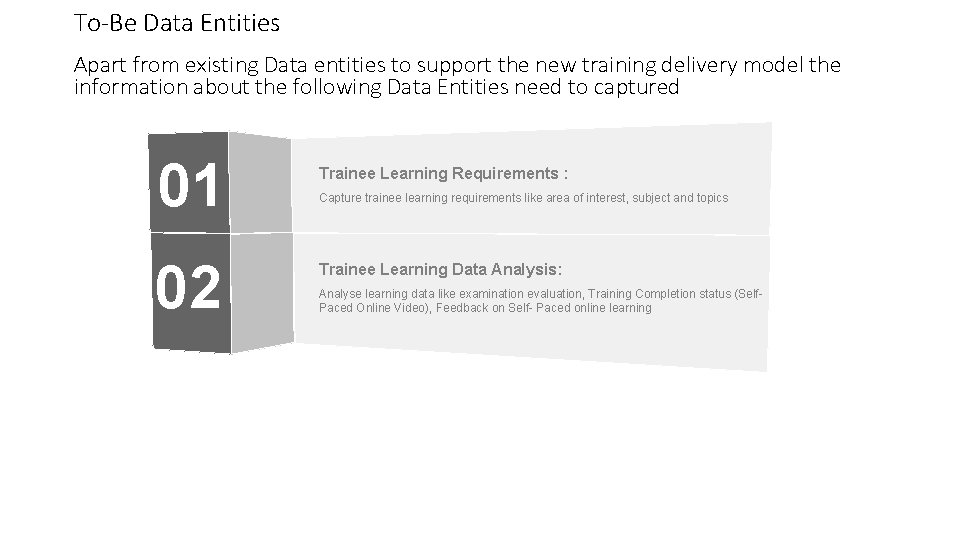
To-Be Data Entities Apart from existing Data entities to support the new training delivery model the information about the following Data Entities need to captured 01 02 Trainee Learning Requirements : Capture trainee learning requirements like area of interest, subject and topics Trainee Learning Data Analysis: Analyse learning data like examination evaluation, Training Completion status (Self. Paced Online Video), Feedback on Self- Paced online learning
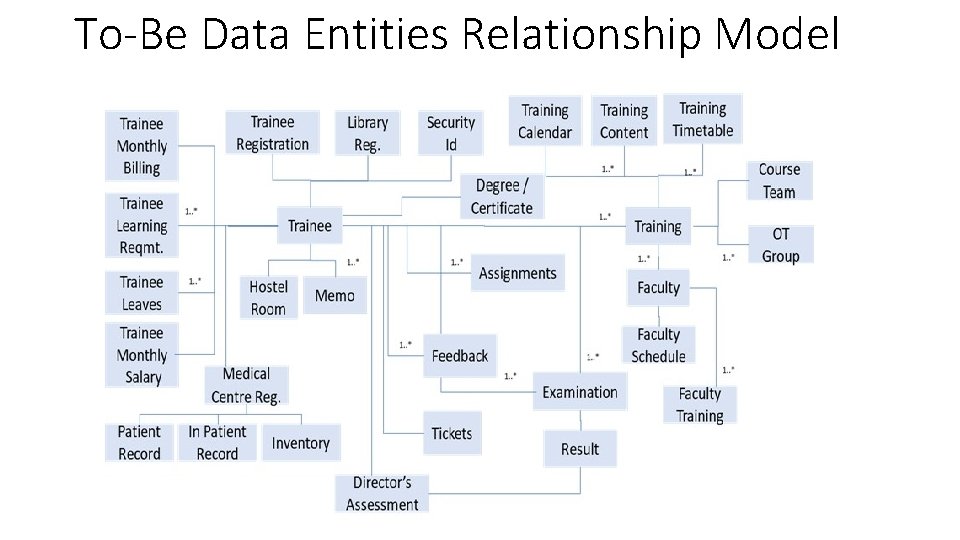
To-Be Data Entities Relationship Model
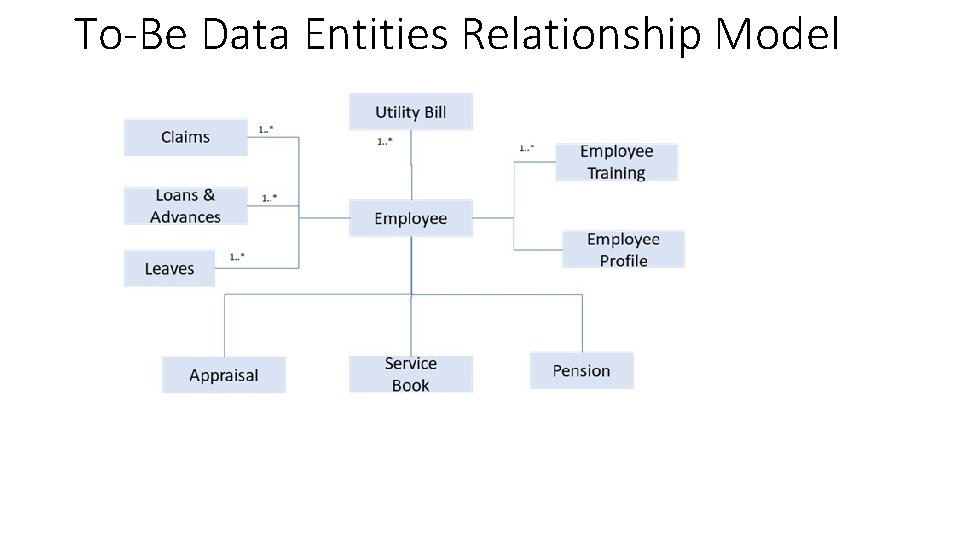
To-Be Data Entities Relationship Model
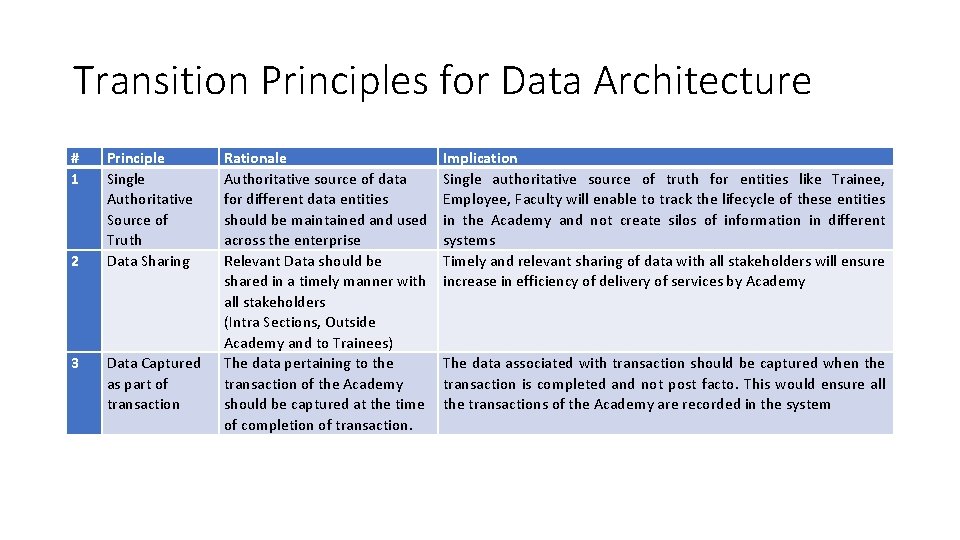
Transition Principles for Data Architecture # 1 2 3 Principle Single Authoritative Source of Truth Data Sharing Data Captured as part of transaction Rationale Authoritative source of data for different data entities should be maintained and used across the enterprise Relevant Data should be shared in a timely manner with all stakeholders (Intra Sections, Outside Academy and to Trainees) The data pertaining to the transaction of the Academy should be captured at the time of completion of transaction. Implication Single authoritative source of truth for entities like Trainee, Employee, Faculty will enable to track the lifecycle of these entities in the Academy and not create silos of information in different systems Timely and relevant sharing of data with all stakeholders will ensure increase in efficiency of delivery of services by Academy The data associated with transaction should be captured when the transaction is completed and not post facto. This would ensure all the transactions of the Academy are recorded in the system
Application Architecture The Application architecture describes the application landscape of LBSNAA, and the capabilities of applications at LBSNAA.
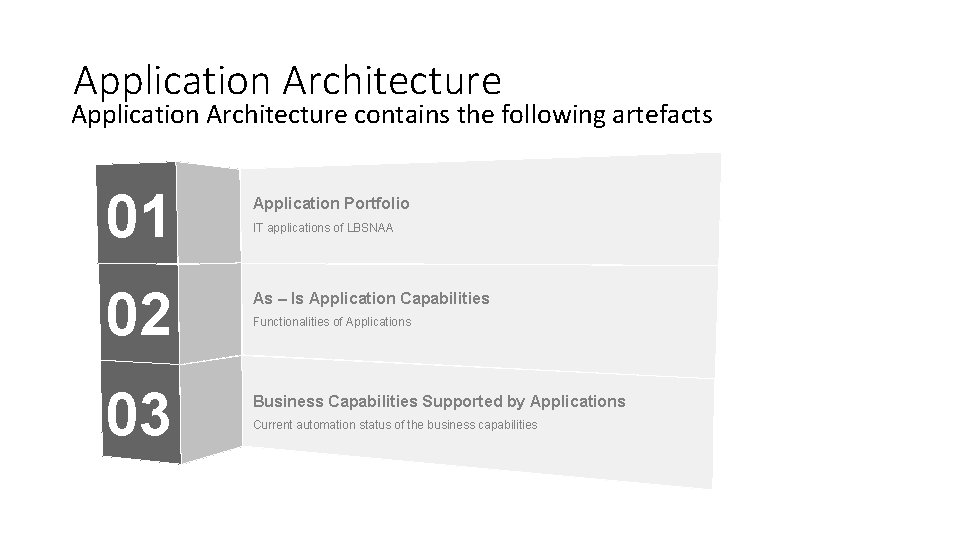
Application Architecture contains the following artefacts 01 02 03 Application Portfolio IT applications of LBSNAA As – Is Application Capabilities Functionalities of Applications Business Capabilities Supported by Applications Current automation status of the business capabilities
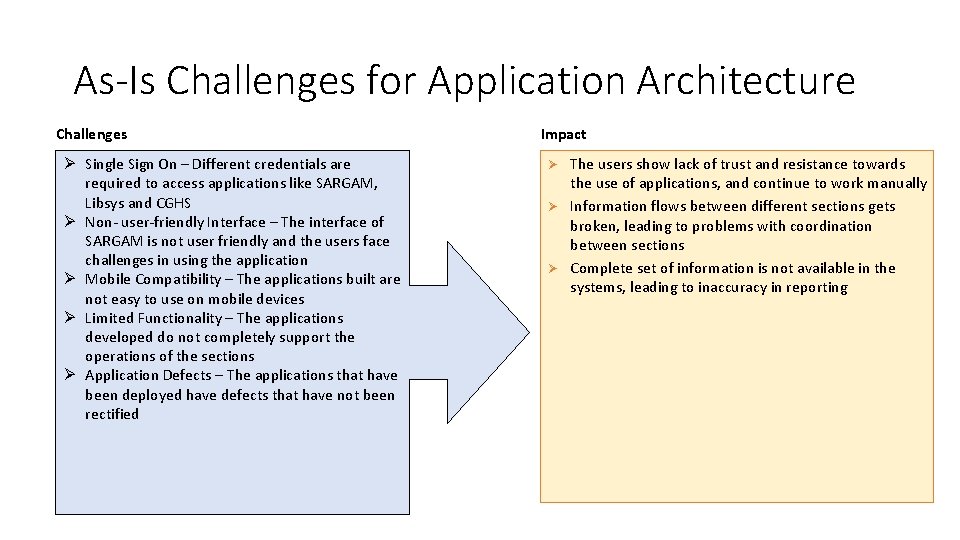
As-Is Challenges for Application Architecture Challenges Ø Single Sign On – Different credentials are required to access applications like SARGAM, Libsys and CGHS Ø Non- user-friendly Interface – The interface of SARGAM is not user friendly and the users face challenges in using the application Ø Mobile Compatibility – The applications built are not easy to use on mobile devices Ø Limited Functionality – The applications developed do not completely support the operations of the sections Ø Application Defects – The applications that have been deployed have defects that have not been rectified Impact Ø Ø Ø The users show lack of trust and resistance towards the use of applications, and continue to work manually Information flows between different sections gets broken, leading to problems with coordination between sections Complete set of information is not available in the systems, leading to inaccuracy in reporting
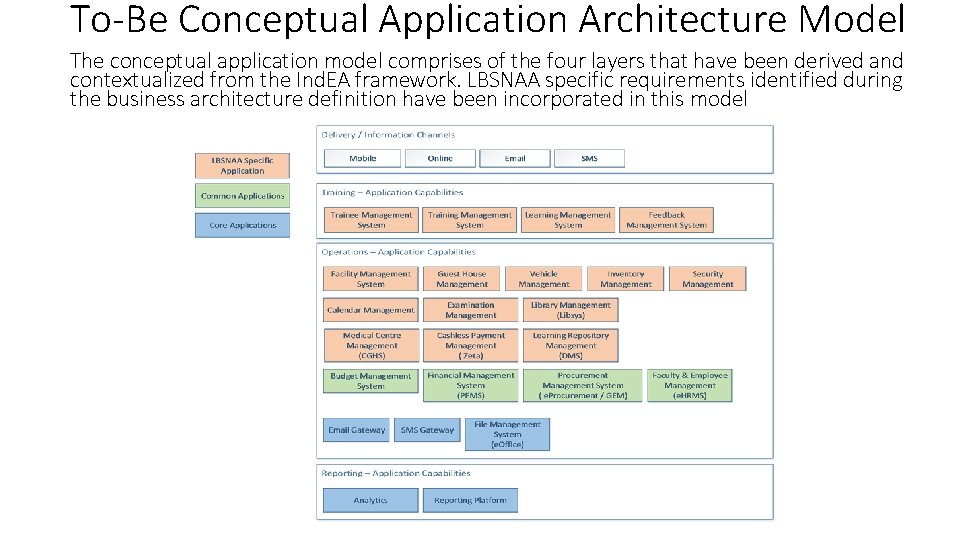
To-Be Conceptual Application Architecture Model The conceptual application model comprises of the four layers that have been derived and contextualized from the Ind. EA framework. LBSNAA specific requirements identified during the business architecture definition have been incorporated in this model
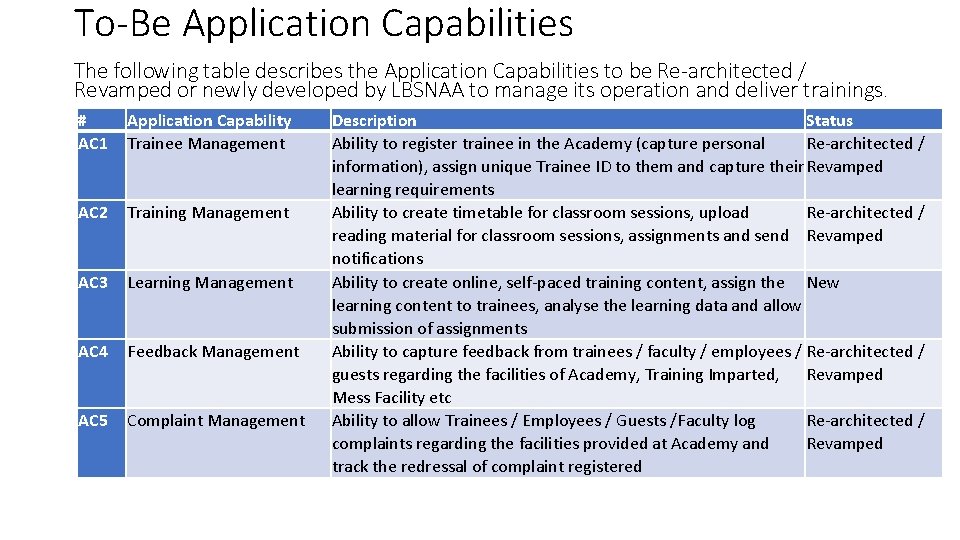
To-Be Application Capabilities The following table describes the Application Capabilities to be Re-architected / Revamped or newly developed by LBSNAA to manage its operation and deliver trainings. # AC 1 Application Capability Trainee Management AC 2 Training Management AC 3 Learning Management AC 4 Feedback Management AC 5 Complaint Management Description Status Ability to register trainee in the Academy (capture personal Re-architected / information), assign unique Trainee ID to them and capture their Revamped learning requirements Ability to create timetable for classroom sessions, upload Re-architected / reading material for classroom sessions, assignments and send Revamped notifications Ability to create online, self-paced training content, assign the New learning content to trainees, analyse the learning data and allow submission of assignments Ability to capture feedback from trainees / faculty / employees / Re-architected / guests regarding the facilities of Academy, Training Imparted, Revamped Mess Facility etc Ability to allow Trainees / Employees / Guests /Faculty log Re-architected / complaints regarding the facilities provided at Academy and Revamped track the redressal of complaint registered
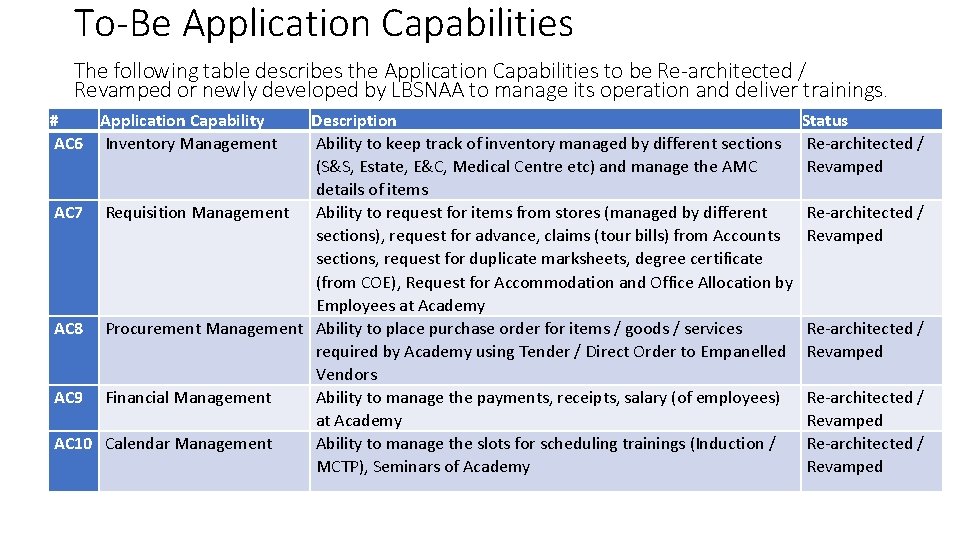
To-Be Application Capabilities The following table describes the Application Capabilities to be Re-architected / Revamped or newly developed by LBSNAA to manage its operation and deliver trainings. # Application Capability AC 6 Inventory Management Description Status Ability to keep track of inventory managed by different sections Re-architected / (S&S, Estate, E&C, Medical Centre etc) and manage the AMC Revamped details of items AC 7 Requisition Management Ability to request for items from stores (managed by different Re-architected / sections), request for advance, claims (tour bills) from Accounts Revamped sections, request for duplicate marksheets, degree certificate (from COE), Request for Accommodation and Office Allocation by Employees at Academy AC 8 Procurement Management Ability to place purchase order for items / goods / services Re-architected / required by Academy using Tender / Direct Order to Empanelled Revamped Vendors AC 9 Financial Management Ability to manage the payments, receipts, salary (of employees) Re-architected / at Academy Revamped AC 10 Calendar Management Ability to manage the slots for scheduling trainings (Induction / Re-architected / MCTP), Seminars of Academy Revamped
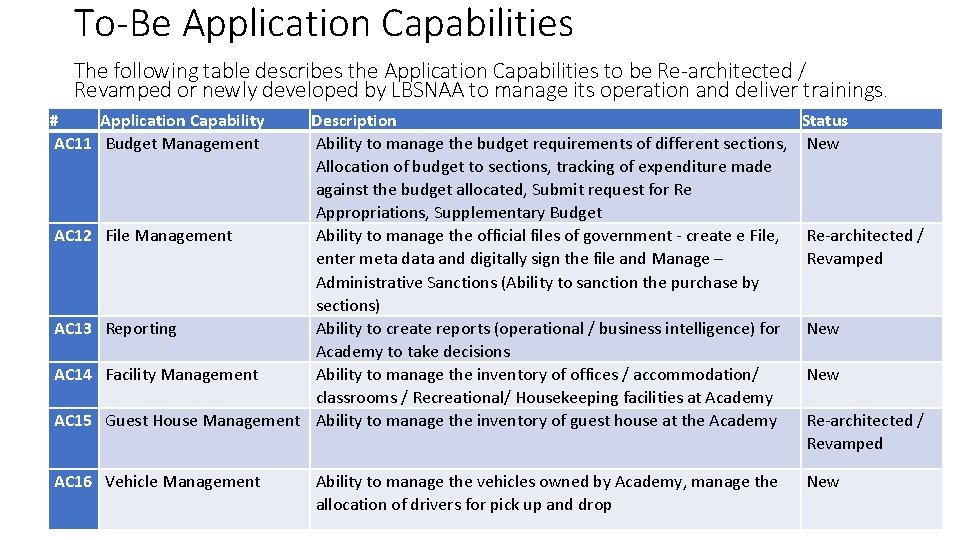
To-Be Application Capabilities The following table describes the Application Capabilities to be Re-architected / Revamped or newly developed by LBSNAA to manage its operation and deliver trainings. # Application Capability AC 11 Budget Management Status New AC 12 Re-architected / Revamped AC 13 AC 14 AC 15 Description Ability to manage the budget requirements of different sections, Allocation of budget to sections, tracking of expenditure made against the budget allocated, Submit request for Re Appropriations, Supplementary Budget File Management Ability to manage the official files of government - create e File, enter meta data and digitally sign the file and Manage – Administrative Sanctions (Ability to sanction the purchase by sections) Reporting Ability to create reports (operational / business intelligence) for Academy to take decisions Facility Management Ability to manage the inventory of offices / accommodation/ classrooms / Recreational/ Housekeeping facilities at Academy Guest House Management Ability to manage the inventory of guest house at the Academy AC 16 Vehicle Management Ability to manage the vehicles owned by Academy, manage the allocation of drivers for pick up and drop New Re-architected / Revamped New
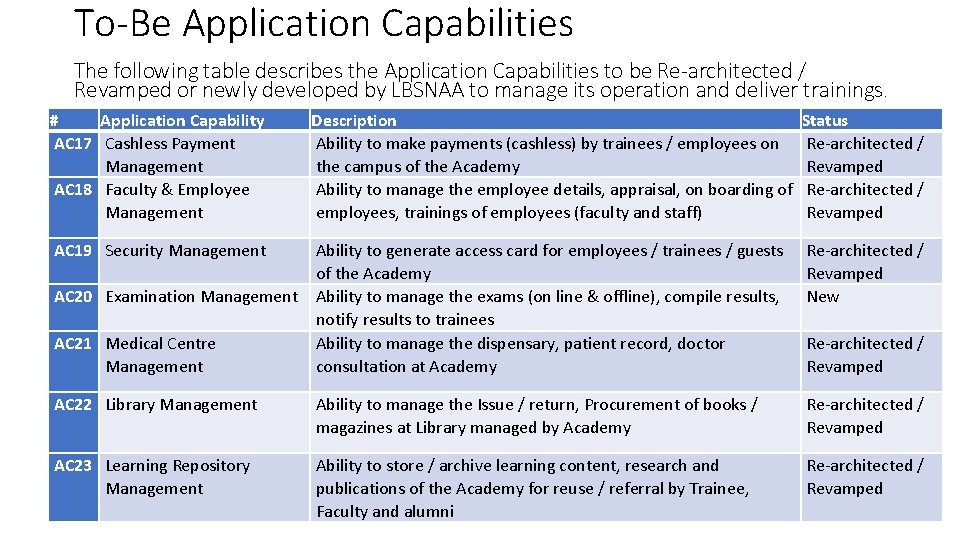
To-Be Application Capabilities The following table describes the Application Capabilities to be Re-architected / Revamped or newly developed by LBSNAA to manage its operation and deliver trainings. # Application Capability AC 17 Cashless Payment Management AC 18 Faculty & Employee Management Description Status Ability to make payments (cashless) by trainees / employees on Re-architected / the campus of the Academy Revamped Ability to manage the employee details, appraisal, on boarding of Re-architected / employees, trainings of employees (faculty and staff) Revamped AC 19 Security Management Ability to generate access card for employees / trainees / guests of the Academy AC 20 Examination Management Ability to manage the exams (on line & offline), compile results, notify results to trainees AC 21 Medical Centre Ability to manage the dispensary, patient record, doctor Management consultation at Academy Re-architected / Revamped New AC 22 Library Management Ability to manage the Issue / return, Procurement of books / magazines at Library managed by Academy Re-architected / Revamped AC 23 Learning Repository Management Ability to store / archive learning content, research and publications of the Academy for reuse / referral by Trainee, Faculty and alumni Re-architected / Revamped
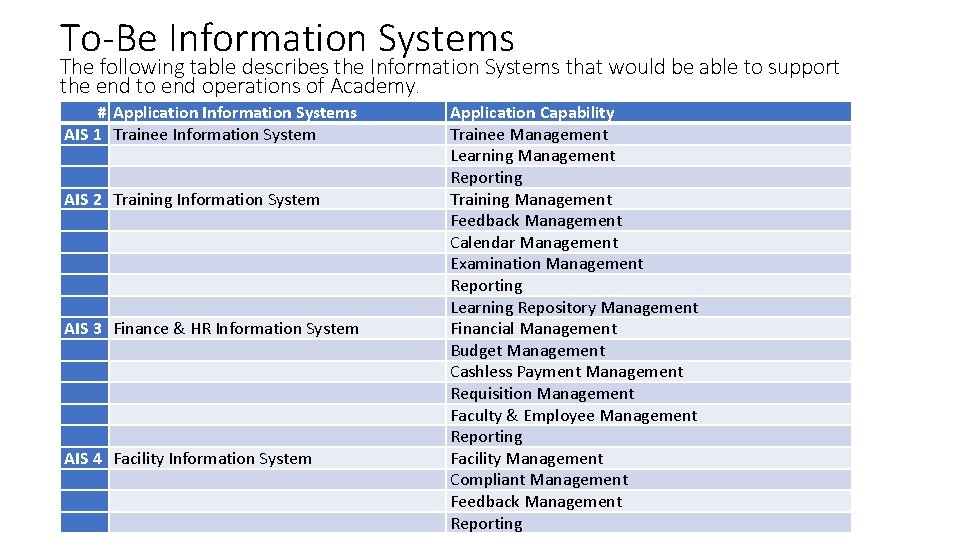
To-Be Information Systems The following table describes the Information Systems that would be able to support the end to end operations of Academy. # AIS 1 AIS 2 Application Information Systems Trainee Information System Training Information System AIS 3 AIS 4 Finance & HR Information System Facility Information System Application Capability Trainee Management Learning Management Reporting Training Management Feedback Management Calendar Management Examination Management Reporting Learning Repository Management Financial Management Budget Management Cashless Payment Management Requisition Management Faculty & Employee Management Reporting Facility Management Compliant Management Feedback Management Reporting
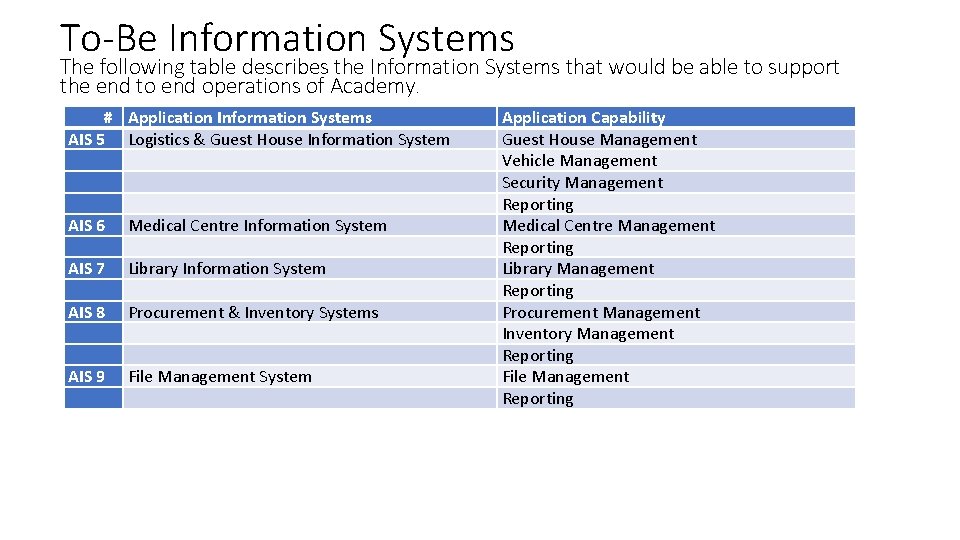
To-Be Information Systems The following table describes the Information Systems that would be able to support the end to end operations of Academy. # AIS 5 AIS 6 AIS 7 AIS 8 AIS 9 Application Information Systems Logistics & Guest House Information System Medical Centre Information System Library Information System Procurement & Inventory Systems File Management System Application Capability Guest House Management Vehicle Management Security Management Reporting Medical Centre Management Reporting Library Management Reporting Procurement Management Inventory Management Reporting File Management Reporting
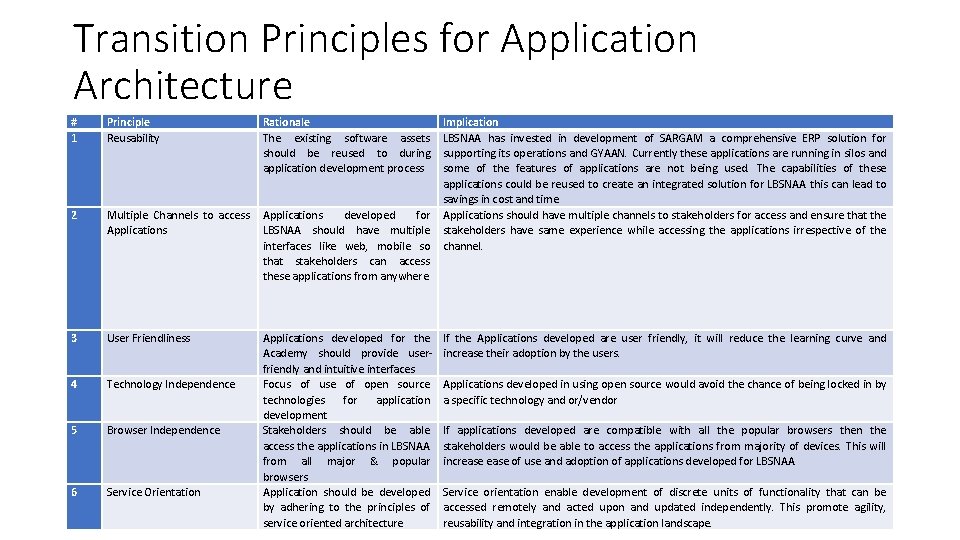
Transition Principles for Application Architecture # 1 Principle Reusability Rationale The existing software assets should be reused to during application development process 2 Multiple Channels to access Applications developed for Applications LBSNAA should have multiple interfaces like web, mobile so that stakeholders can access these applications from anywhere 3 User Friendliness 4 Technology Independence 5 Browser Independence 6 Service Orientation Applications developed for the Academy should provide userfriendly and intuitive interfaces Focus of use of open source technologies for application development Stakeholders should be able access the applications in LBSNAA from all major & popular browsers Application should be developed by adhering to the principles of service oriented architecture Implication LBSNAA has invested in development of SARGAM a comprehensive ERP solution for supporting its operations and GYAAN. Currently these applications are running in silos and some of the features of applications are not being used. The capabilities of these applications could be reused to create an integrated solution for LBSNAA this can lead to savings in cost and time Applications should have multiple channels to stakeholders for access and ensure that the stakeholders have same experience while accessing the applications irrespective of the channel. If the Applications developed are user friendly, it will reduce the learning curve and increase their adoption by the users. Applications developed in using open source would avoid the chance of being locked in by a specific technology and or/vendor If applications developed are compatible with all the popular browsers then the stakeholders would be able to access the applications from majority of devices. This will increase of use and adoption of applications developed for LBSNAA Service orientation enable development of discrete units of functionality that can be accessed remotely and acted upon and updated independently. This promote agility, reusability and integration in the application landscape.
Application Integration Architecture describes the information exchanged between applications and the mechanism used for integration
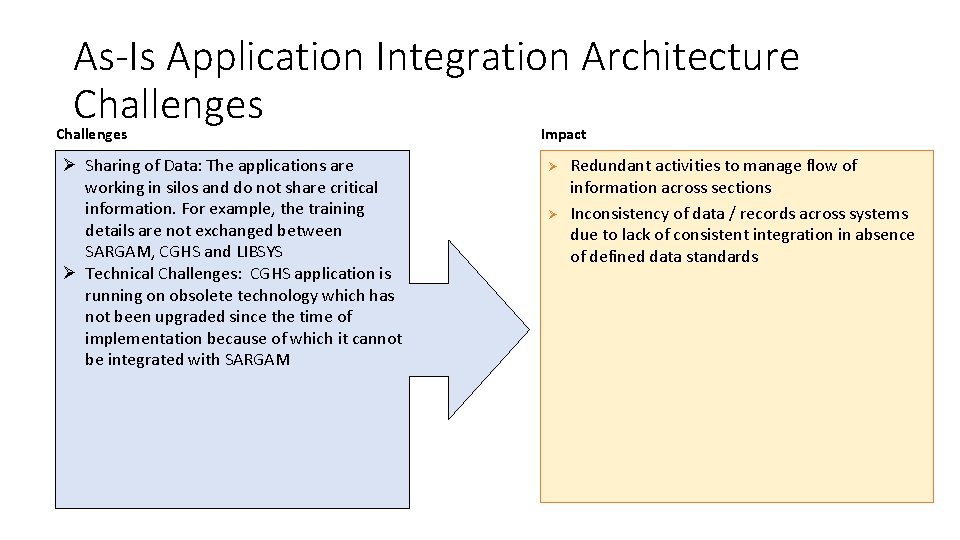
As-Is Application Integration Architecture Challenges Ø Sharing of Data: The applications are working in silos and do not share critical information. For example, the training details are not exchanged between SARGAM, CGHS and LIBSYS Ø Technical Challenges: CGHS application is running on obsolete technology which has not been upgraded since the time of implementation because of which it cannot be integrated with SARGAM Impact Ø Ø Redundant activities to manage flow of information across sections Inconsistency of data / records across systems due to lack of consistent integration in absence of defined data standards
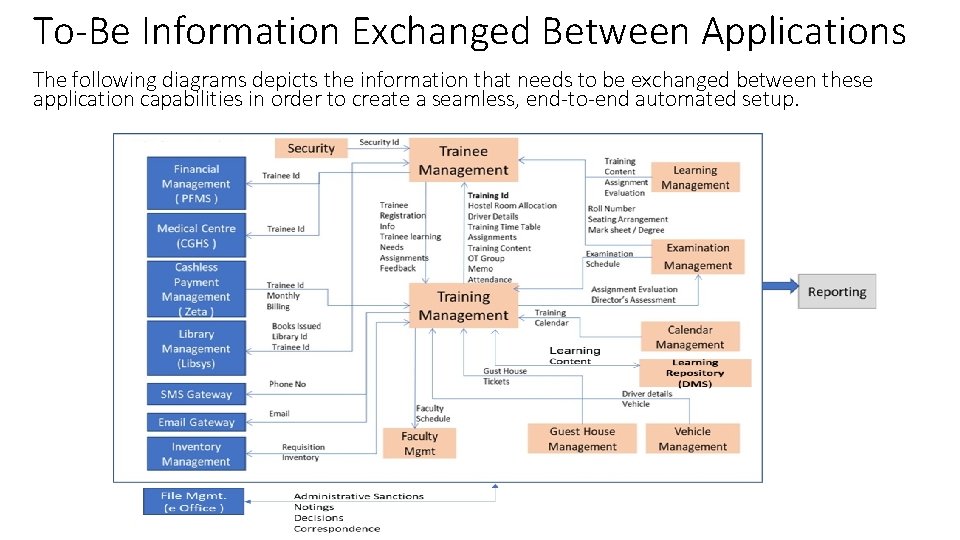
To-Be Information Exchanged Between Applications The following diagrams depicts the information that needs to be exchanged between these application capabilities in order to create a seamless, end-to-end automated setup.
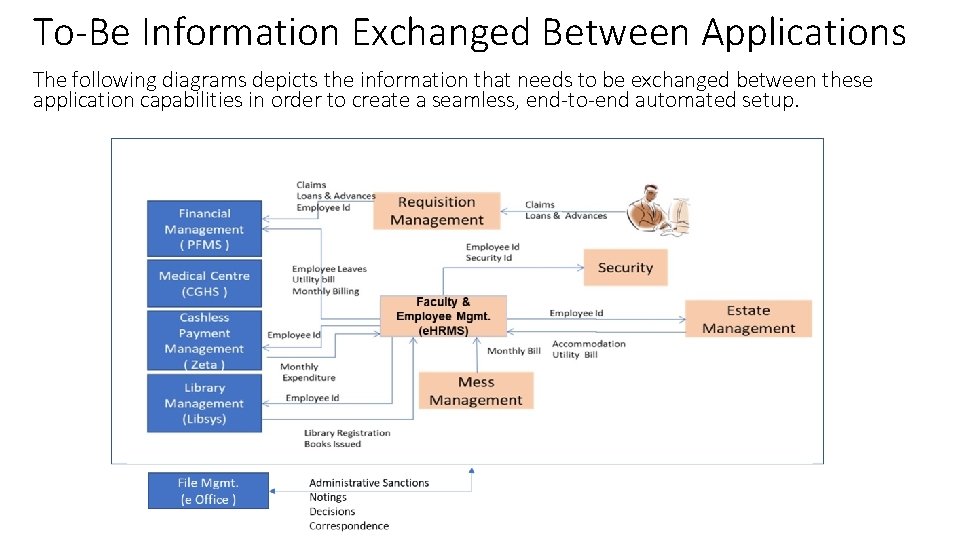
To-Be Information Exchanged Between Applications The following diagrams depicts the information that needs to be exchanged between these application capabilities in order to create a seamless, end-to-end automated setup.
To-Be Integration Mechanism The proposed integration mechanism between Applications is as follows 1. Use of Web Services: Web service is a standardized way or medium to propagate communication between the client and server applications. SOAP-based and RESTful are two set of specifications that could be utilized to develop web services. 2. Use of Micro Services: Each application can be deployed as a Microservices tackles the problem of complexity by decomposing application into a set of manageable services which are much faster to develop, and much easier to understand maintain. 3. Metadata, Data & Interoperability Standards: Metadata and Data Standards define accepted ways of representation, format, definition, structuring, tagging, transmission, manipulation, and use of data in the organization, and enable reliable recording of information and are fundamental to efficient sharing and exchange of information. Metadata & Data Standards prescribed by Government of India should be adhered to by the Academy’s systems. In addition, Interoperability Framework for e-Governance (IFEG) and Technical Standards for Interoperability for E-Governance in India must also be adhered to by Academy’s applications. These are available on http: //egovstandards. gov. in.
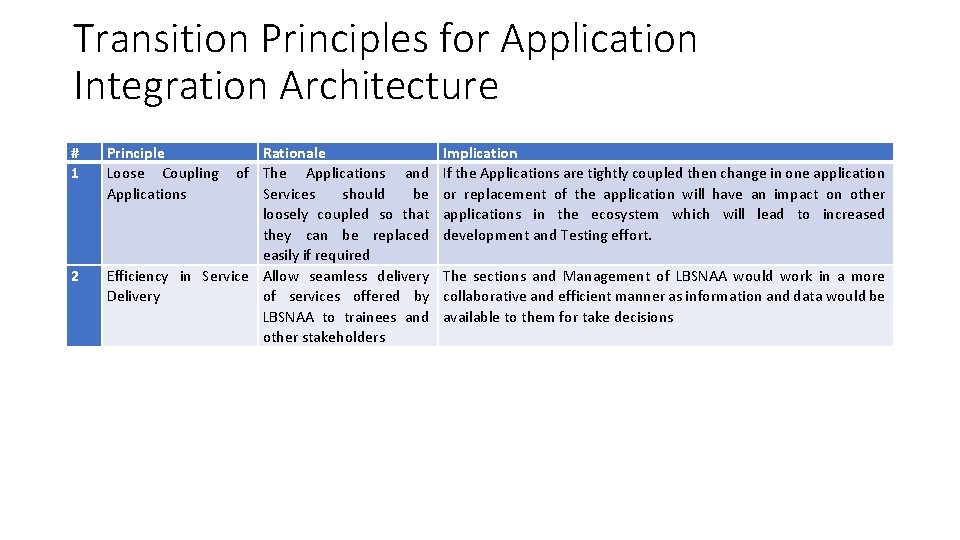
Transition Principles for Application Integration Architecture # 1 2 Principle Rationale Loose Coupling of The Applications and Applications Services should be loosely coupled so that they can be replaced easily if required Efficiency in Service Allow seamless delivery Delivery of services offered by LBSNAA to trainees and other stakeholders Implication If the Applications are tightly coupled then change in one application or replacement of the application will have an impact on other applications in the ecosystem which will lead to increased development and Testing effort. The sections and Management of LBSNAA would work in a more collaborative and efficient manner as information and data would be available to them for take decisions

Technology Architecture The Technology Architecture lays the foundation of ICT components and standards used for building the Applications which will support the Business Landscape
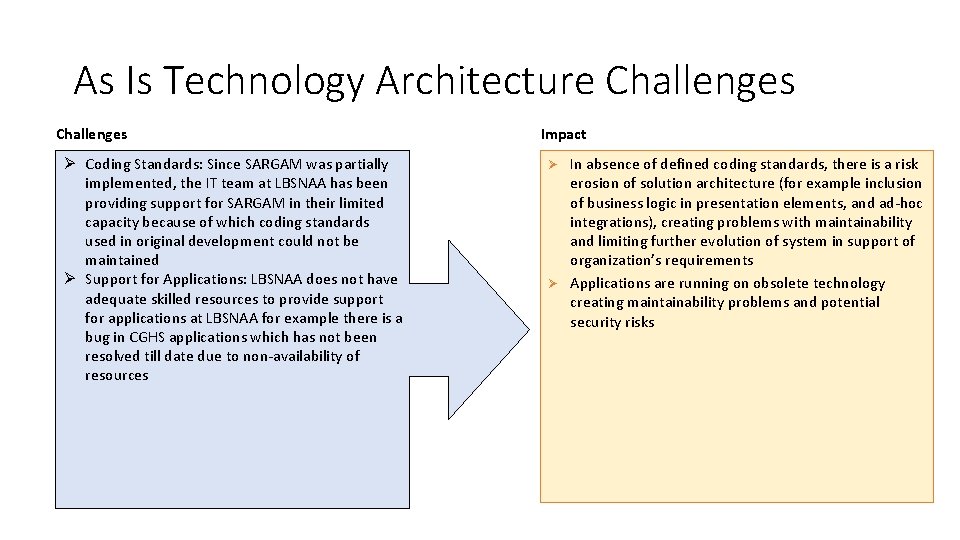
As Is Technology Architecture Challenges Ø Coding Standards: Since SARGAM was partially implemented, the IT team at LBSNAA has been providing support for SARGAM in their limited capacity because of which coding standards used in original development could not be maintained Ø Support for Applications: LBSNAA does not have adequate skilled resources to provide support for applications at LBSNAA for example there is a bug in CGHS applications which has not been resolved till date due to non-availability of resources Impact Ø Ø In absence of defined coding standards, there is a risk erosion of solution architecture (for example inclusion of business logic in presentation elements, and ad-hoc integrations), creating problems with maintainability and limiting further evolution of system in support of organization’s requirements Applications are running on obsolete technology creating maintainability problems and potential security risks
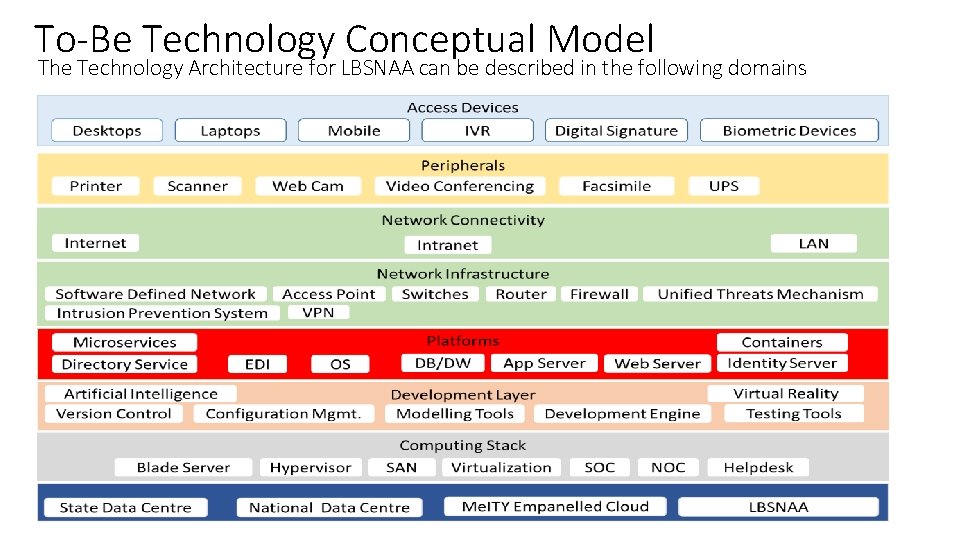
To-Be Technology Conceptual Model The Technology Architecture for LBSNAA can be described in the following domains
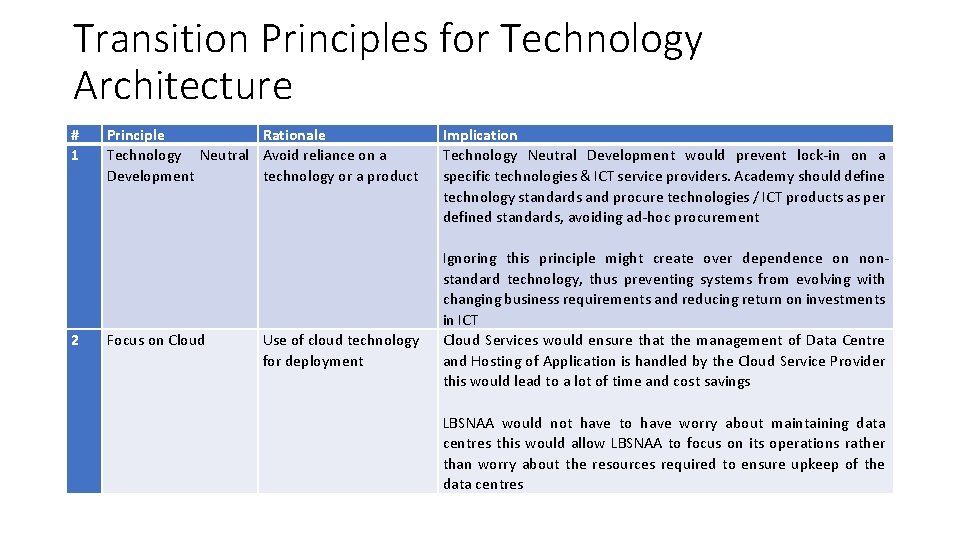
Transition Principles for Technology Architecture # 1 Principle Rationale Technology Neutral Avoid reliance on a Development technology or a product 2 Focus on Cloud Use of cloud technology for deployment Implication Technology Neutral Development would prevent lock-in on a specific technologies & ICT service providers. Academy should define technology standards and procure technologies / ICT products as per defined standards, avoiding ad-hoc procurement Ignoring this principle might create over dependence on nonstandard technology, thus preventing systems from evolving with changing business requirements and reducing return on investments in ICT Cloud Services would ensure that the management of Data Centre and Hosting of Application is handled by the Cloud Service Provider this would lead to a lot of time and cost savings LBSNAA would not have to have worry about maintaining data centres this would allow LBSNAA to focus on its operations rather than worry about the resources required to ensure upkeep of the data centres
Security Architecture Describes the security capabilities and mechanisms to prevent loss or theft of data
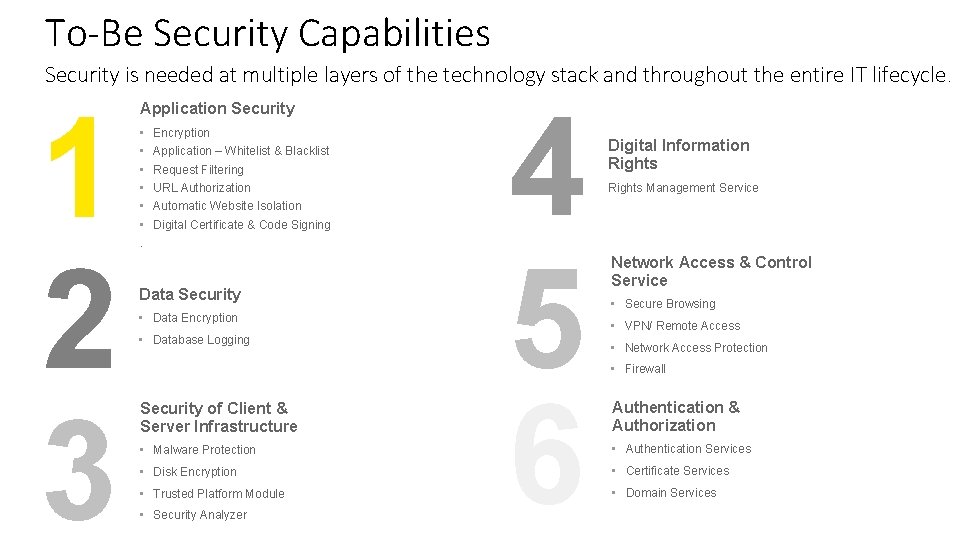
To-Be Security Capabilities Security is needed at multiple layers of the technology stack and throughout the entire IT lifecycle. 1 2 3 Application Security • • • . Encryption Application – Whitelist & Blacklist Request Filtering URL Authorization Automatic Website Isolation Digital Certificate & Code Signing Data Security • Data Encryption • Database Logging Security of Client & Server Infrastructure • Malware Protection • Disk Encryption • Trusted Platform Module • Security Analyzer 4 5 6 Digital Information Rights Management Service Network Access & Control Service • Secure Browsing • VPN/ Remote Access • Network Access Protection • Firewall Authentication & Authorization • Authentication Services • Certificate Services • Domain Services
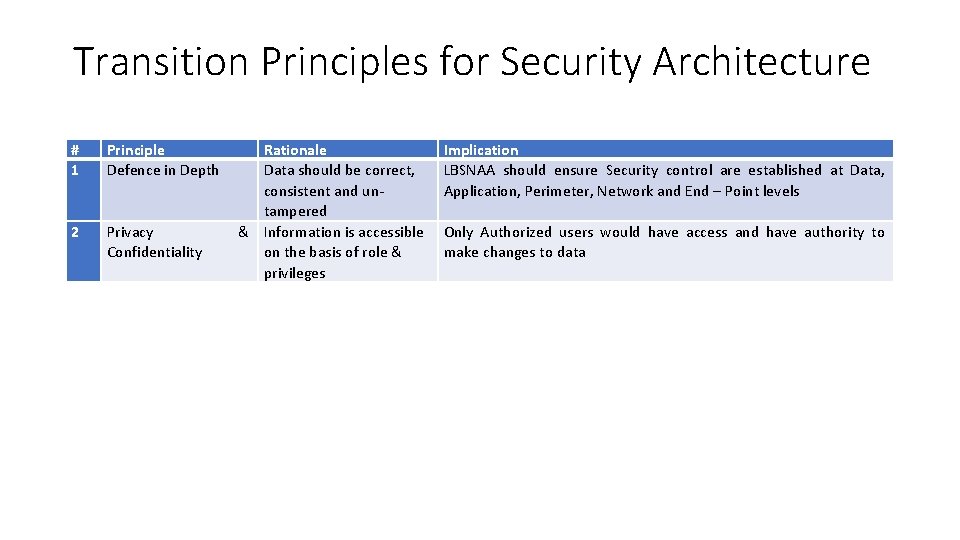
Transition Principles for Security Architecture # 1 Principle Defence in Depth 2 Privacy Confidentiality Rationale Data should be correct, consistent and untampered & Information is accessible on the basis of role & privileges Implication LBSNAA should ensure Security control are established at Data, Application, Perimeter, Network and End – Point levels Only Authorized users would have access and have authority to make changes to data
Governance Architecture The mechanism and procedures to manage changes to architecture
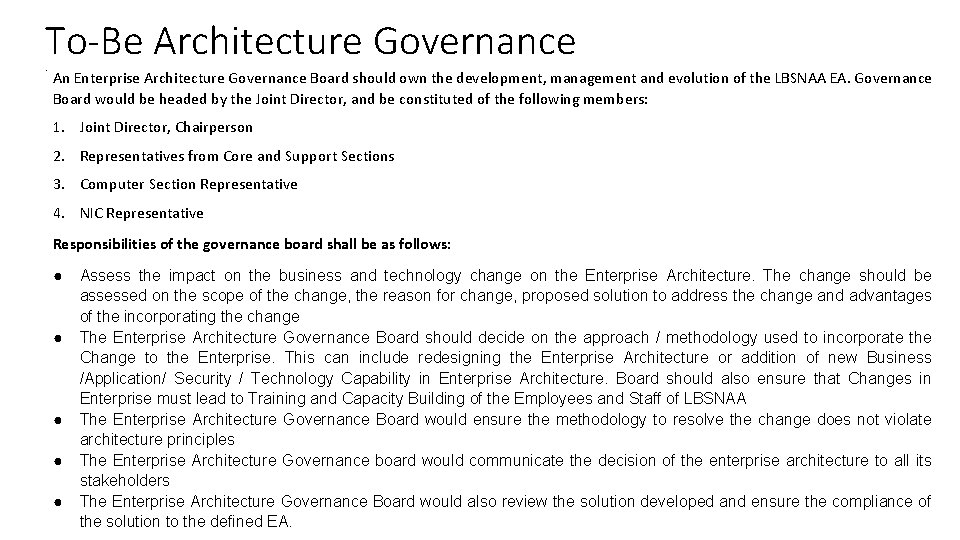
To-Be Architecture Governance. An Enterprise Architecture Governance Board should own the development, management and evolution of the LBSNAA EA. Governance Board would be headed by the Joint Director, and be constituted of the following members: 1. Joint Director, Chairperson 2. Representatives from Core and Support Sections 3. Computer Section Representative 4. NIC Representative Responsibilities of the governance board shall be as follows: ● ● ● Assess the impact on the business and technology change on the Enterprise Architecture. The change should be assessed on the scope of the change, the reason for change, proposed solution to address the change and advantages of the incorporating the change The Enterprise Architecture Governance Board should decide on the approach / methodology used to incorporate the Change to the Enterprise. This can include redesigning the Enterprise Architecture or addition of new Business /Application/ Security / Technology Capability in Enterprise Architecture. Board should also ensure that Changes in Enterprise must lead to Training and Capacity Building of the Employees and Staff of LBSNAA The Enterprise Architecture Governance Board would ensure the methodology to resolve the change does not violate architecture principles The Enterprise Architecture Governance board would communicate the decision of the enterprise architecture to all its stakeholders The Enterprise Architecture Governance Board would also review the solution developed and ensure the compliance of the solution to the defined EA.
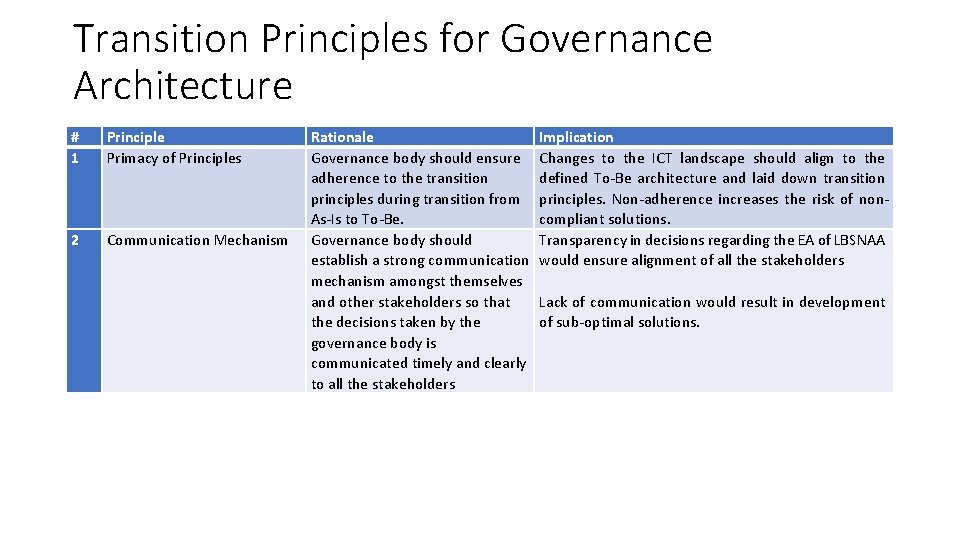
Transition Principles for Governance Architecture # 1 Principle Primacy of Principles 2 Communication Mechanism Rationale Governance body should ensure adherence to the transition principles during transition from As-Is to To-Be. Governance body should establish a strong communication mechanism amongst themselves and other stakeholders so that the decisions taken by the governance body is communicated timely and clearly to all the stakeholders Implication Changes to the ICT landscape should align to the defined To-Be architecture and laid down transition principles. Non-adherence increases the risk of noncompliant solutions. Transparency in decisions regarding the EA of LBSNAA would ensure alignment of all the stakeholders Lack of communication would result in development of sub-optimal solutions.

Roadmap of initiatives is here forth proposed to guide the Academy in undertaking the transformation journey.
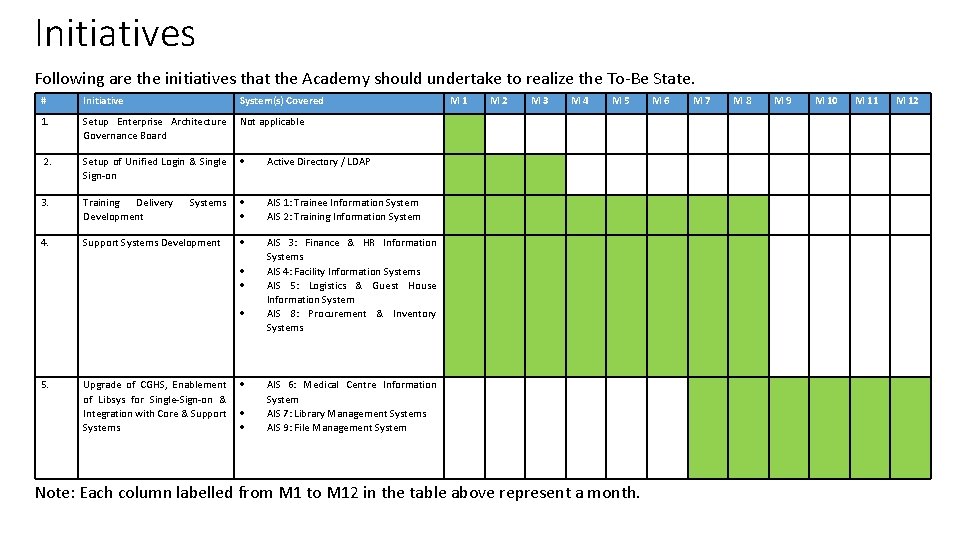
Initiatives Following are the initiatives that the Academy should undertake to realize the To-Be State. # Initiative 1. System(s) Covered M 1 M 2 M 3 M 4 M 5 M 6 M 7 M 8 M 9 M 10 M 11 M 12 Setup Enterprise Architecture Not applicable Governance Board 2. Setup of Unified Login & Single Sign-on Active Directory / LDAP 3. Training Delivery Development AIS 1: Trainee Information System AIS 2: Training Information System 4. Support Systems Development AIS 3: Finance & HR Information Systems AIS 4: Facility Information Systems AIS 5: Logistics & Guest House Information System AIS 8: Procurement & Inventory Systems AIS 6: Medical Centre Information System AIS 7: Library Management Systems AIS 9: File Management System Systems 5. Upgrade of CGHS, Enablement of Libsys for Single-Sign-on & Integration with Core & Support Systems Note: Each column labelled from M 1 to M 12 in the table above represent a month.
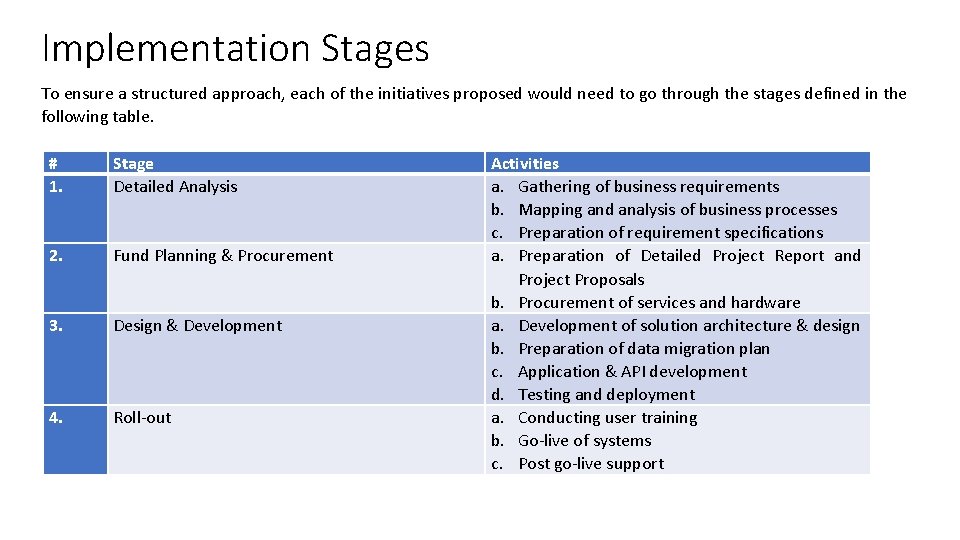
Implementation Stages To ensure a structured approach, each of the initiatives proposed would need to go through the stages defined in the following table. # 1. Stage Detailed Analysis 2. Fund Planning & Procurement 3. Design & Development 4. Roll-out Activities a. Gathering of business requirements b. Mapping and analysis of business processes c. Preparation of requirement specifications a. Preparation of Detailed Project Report and Project Proposals b. Procurement of services and hardware a. Development of solution architecture & design b. Preparation of data migration plan c. Application & API development d. Testing and deployment a. Conducting user training b. Go-live of systems c. Post go-live support

Thank you
- Slides: 74