
Lake Sediment Analysis at Heron Haven Nature Center
- Slides: 1
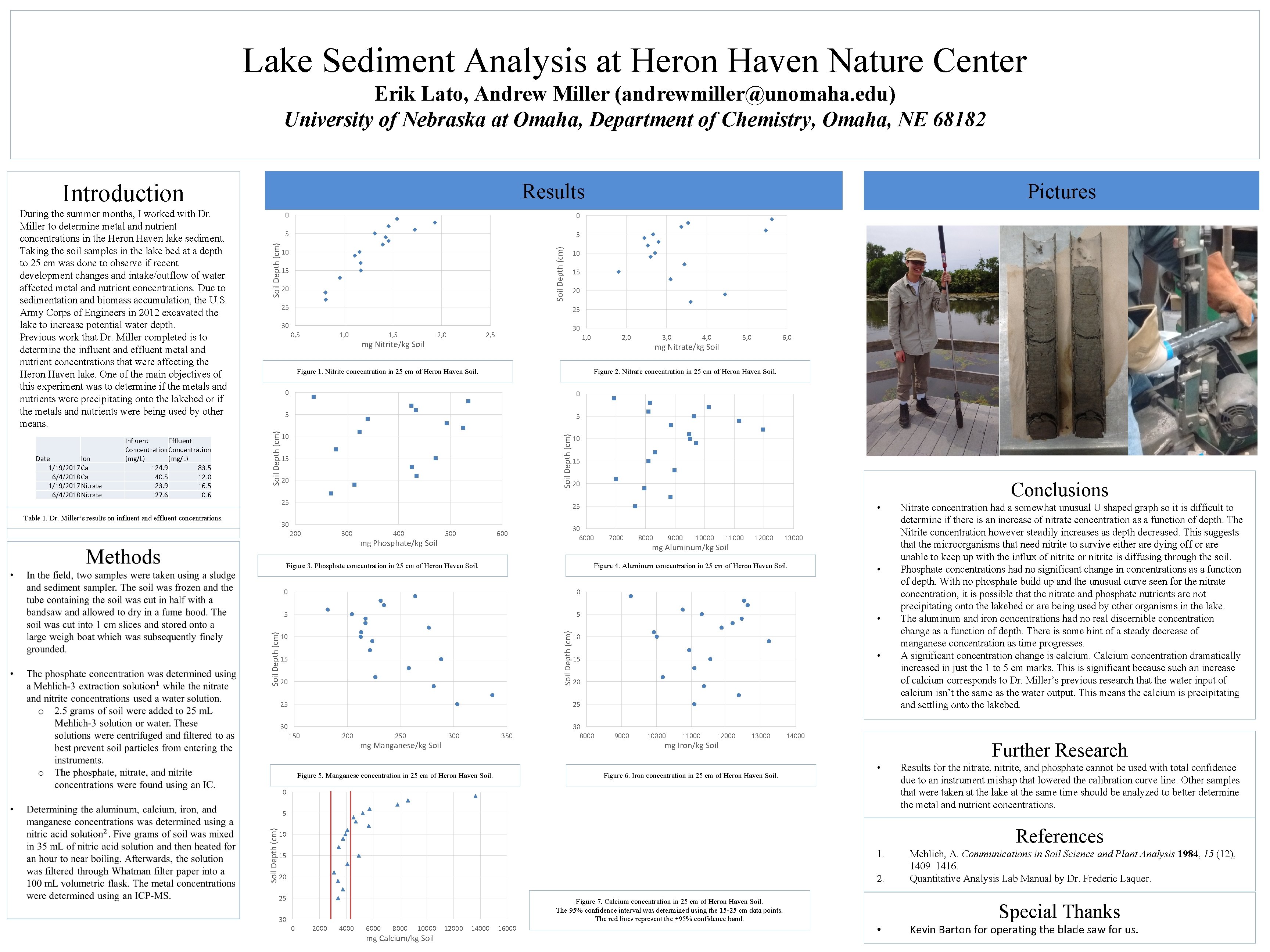
Lake Sediment Analysis at Heron Haven Nature Center Erik Lato, Andrew Miller (andrewmiller@unomaha. edu) University of Nebraska at Omaha, Department of Chemistry, Omaha, NE 68182 5 5 Soil Depth (cm) 0 10 15 20 25 25 30 30 1, 5 mg Nitrite/kg Soil 2, 0 2, 5 1, 0 Figure 1. Nitrite concentration in 25 cm of Heron Haven Soil. 0 0 5 5 Soil Depth (cm) 10 15 20 25 Table 1. Dr. Miller’s results on influent and effluent concentrations. 3, 0 4, 0 5, 0 mg Nitrate/kg Soil 6, 0 10 15 Conclusions 20 • 25 30 200 300 400 mg Phosphate/kg Soil 500 600 30 6000 Figure 3. Phosphate concentration in 25 cm of Heron Haven Soil Depth (cm) 2, 0 Figure 2. Nitrate concentration in 25 cm of Heron Haven Soil. 0 0 5 5 10 15 20 30 8000 mg Manganese/kg Soil 300 10000 11000 mg Aluminum/kg Soil 12000 13000 350 Figure 5. Manganese concentration in 25 cm of Heron Haven Soil. • • • 20 30 250 9000 15 25 200 8000 10 25 150 7000 Figure 4. Aluminum concentration in 25 cm of Heron Haven Soil Depth (cm) Date Ion 1/19/2017 Ca 6/4/2018 Ca 1/19/2017 Nitrate 6/4/2018 Nitrate Influent Effluent Concentration (mg/L) 124. 9 83. 5 40. 5 12. 0 23. 9 16. 5 27. 6 0 0, 5 Soil Depth (cm) During the summer months, I worked with Dr. Miller to determine metal and nutrient concentrations in the Heron Haven lake sediment. Taking the soil samples in the lake bed at a depth to 25 cm was done to observe if recent development changes and intake/outflow of water affected metal and nutrient concentrations. Due to sedimentation and biomass accumulation, the U. S. Army Corps of Engineers in 2012 excavated the lake to increase potential water depth. Previous work that Dr. Miller completed is to determine the influent and effluent metal and nutrient concentrations that were affecting the Heron Haven lake. One of the main objectives of this experiment was to determine if the metals and nutrients were precipitating onto the lakebed or if the metals and nutrients were being used by other means. Pictures Results Introduction 9000 10000 11000 12000 mg Iron/kg Soil 13000 Figure 6. Iron concentration in 25 cm of Heron Haven Soil. 14000 Further Research • 0 5 Soil Depth (cm) Nitrate concentration had a somewhat unusual U shaped graph so it is difficult to determine if there is an increase of nitrate concentration as a function of depth. The Nitrite concentration however steadily increases as depth decreased. This suggests that the microorganisms that need nitrite to survive either are dying off or are unable to keep up with the influx of nitrite or nitrite is diffusing through the soil. Phosphate concentrations had no significant change in concentrations as a function of depth. With no phosphate build up and the unusual curve seen for the nitrate concentration, it is possible that the nitrate and phosphate nutrients are not precipitating onto the lakebed or are being used by other organisms in the lake. The aluminum and iron concentrations had no real discernible concentration change as a function of depth. There is some hint of a steady decrease of manganese concentration as time progresses. A significant concentration change is calcium. Calcium concentration dramatically increased in just the 1 to 5 cm marks. This is significant because such an increase of calcium corresponds to Dr. Miller’s previous research that the water input of calcium isn’t the same as the water output. This means the calcium is precipitating and settling onto the lakebed. Results for the nitrate, nitrite, and phosphate cannot be used with total confidence due to an instrument mishap that lowered the calibration curve line. Other samples that were taken at the lake at the same time should be analyzed to better determine the metal and nutrient concentrations. References 10 15 1. 20 2. 25 Figure 7. Calcium concentration in 25 cm of Heron Haven Soil. The 95% confidence interval was determined using the 15 -25 cm data points. The red lines represent the ± 95% confidence band. 30 0 2000 4000 6000 8000 10000 mg Calcium/kg Soil 12000 14000 16000 Mehlich, A. Communications in Soil Science and Plant Analysis 1984, 15 (12), 1409– 1416. Quantitative Analysis Lab Manual by Dr. Frederic Laquer. Special Thanks • Kevin Barton for operating the blade saw for us.