
Lagrange and Water Filling algorithm Speaker KuanChou Lee

![Graduate Institute of Communication Engineering, NTU Reference [1] J. G. Proakis, Digital Communications, 4](https://slidetodoc.com/presentation_image/308d2992a3534613ce9afd0e14b893b7/image-15.jpg "Graduate Institute of Communication Engineering, NTU Reference [1] J. G. Proakis, Digital Communications, 4")
- Slides: 15
Lagrange and Water Filling algorithm Speaker : Kuan-Chou Lee Date : 2012/8/20
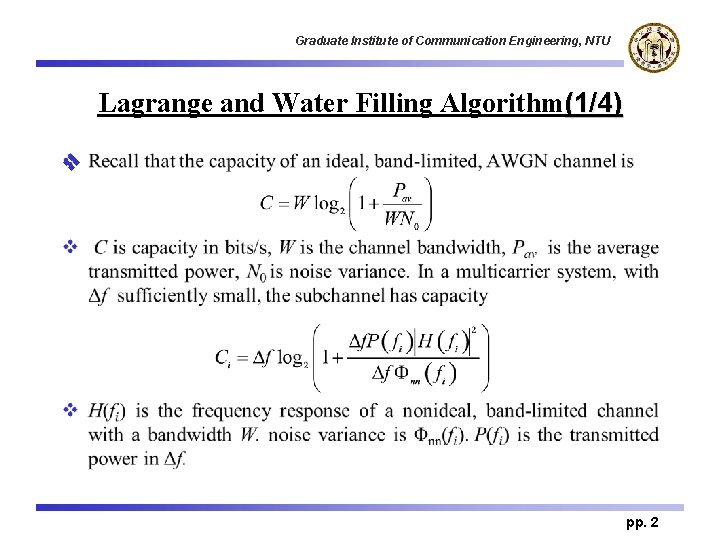
Graduate Institute of Communication Engineering, NTU Lagrange and Water Filling Algorithm(1/4) v pp. 2
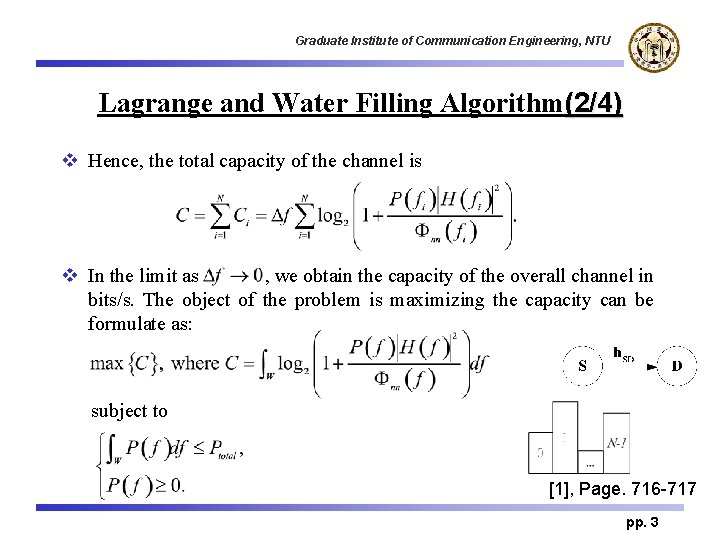
Graduate Institute of Communication Engineering, NTU Lagrange and Water Filling Algorithm(2/4) v Hence, the total capacity of the channel is v In the limit as , we obtain the capacity of the overall channel in bits/s. The object of the problem is maximizing the capacity can be formulate as: subject to [1], Page. 716 -717 pp. 3
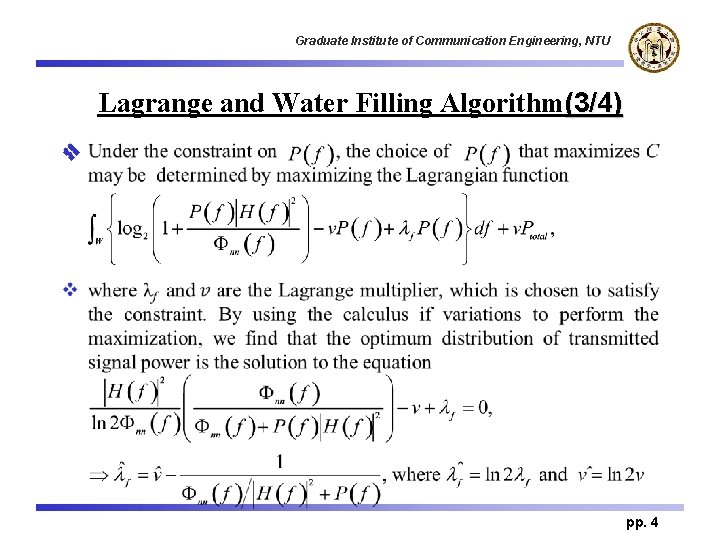
Graduate Institute of Communication Engineering, NTU Lagrange and Water Filling Algorithm(3/4) v pp. 4
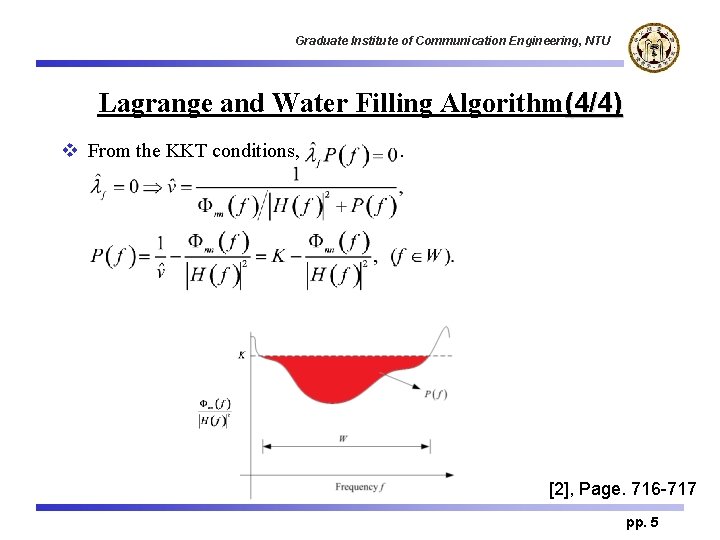
Graduate Institute of Communication Engineering, NTU Lagrange and Water Filling Algorithm(4/4) v From the KKT conditions, . [2], Page. 716 -717 pp. 5
Graduate Institute of Communication Engineering, NTU On the Optimal Power Allocation for Nonregenerative OFDM Relay Links I. –Hammerstrom and A. –Wittneben, “On the optimal power allocation for nonregenerative OFDM relay links, ” in Proc. IEEE ICC, pp. 4463 – 4468, Jun. 2006. WIRELESS Communication LAB
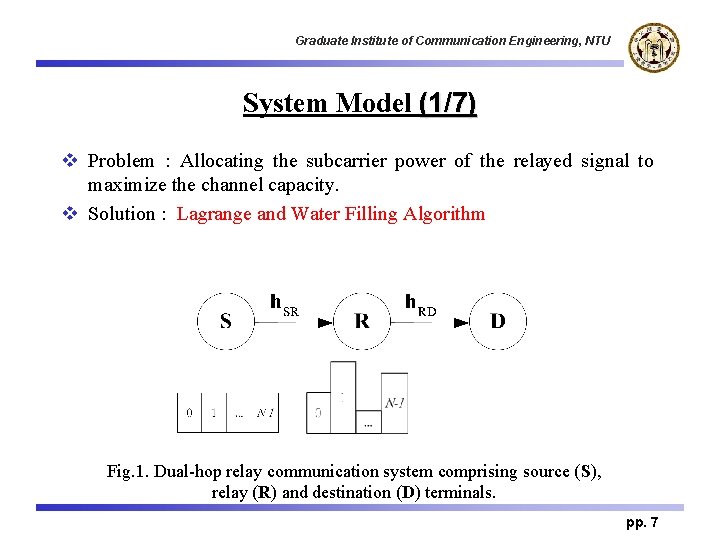
Graduate Institute of Communication Engineering, NTU System Model (1/7) v Problem : Allocating the subcarrier power of the relayed signal to maximize the channel capacity. v Solution : Lagrange and Water Filling Algorithm Fig. 1. Dual-hop relay communication system comprising source (S), relay (R) and destination (D) terminals. pp. 7
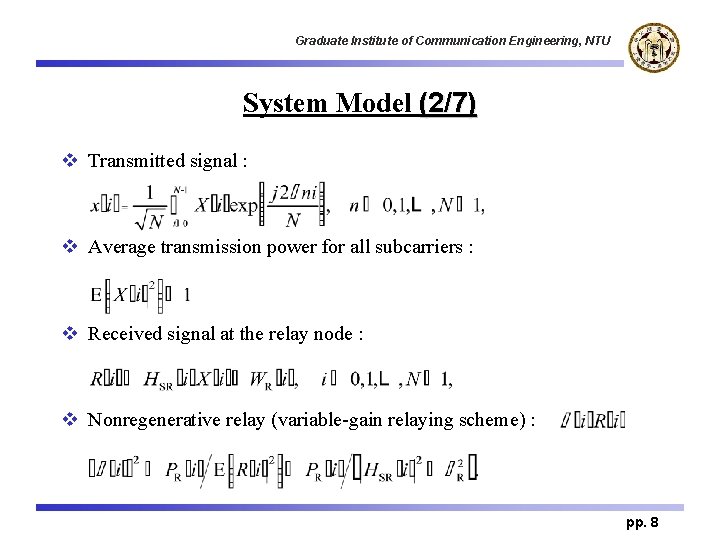
Graduate Institute of Communication Engineering, NTU System Model (2/7) v Transmitted signal : v Average transmission power for all subcarriers : v Received signal at the relay node : v Nonregenerative relay (variable-gain relaying scheme) : pp. 8
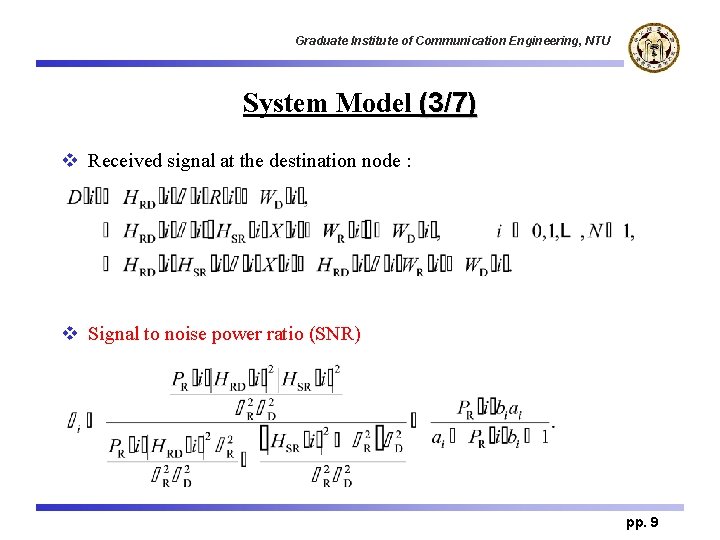
Graduate Institute of Communication Engineering, NTU System Model (3/7) v Received signal at the destination node : v Signal to noise power ratio (SNR) pp. 9
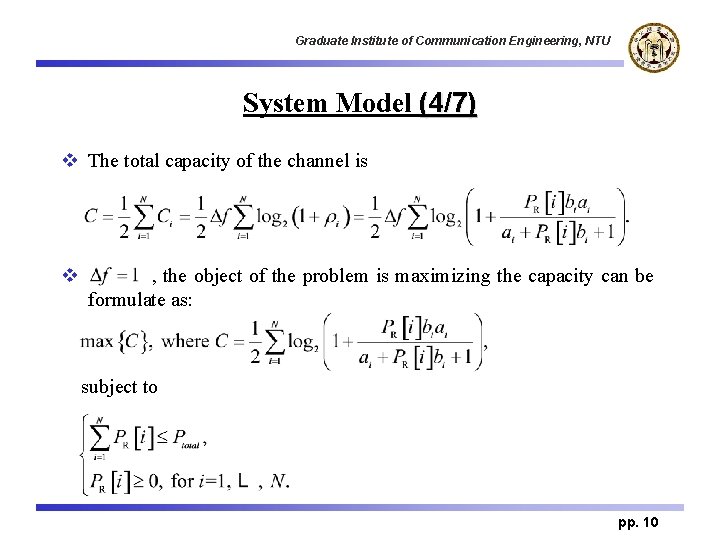
Graduate Institute of Communication Engineering, NTU System Model (4/7) v The total capacity of the channel is v , the object of the problem is maximizing the capacity can be formulate as: subject to pp. 10
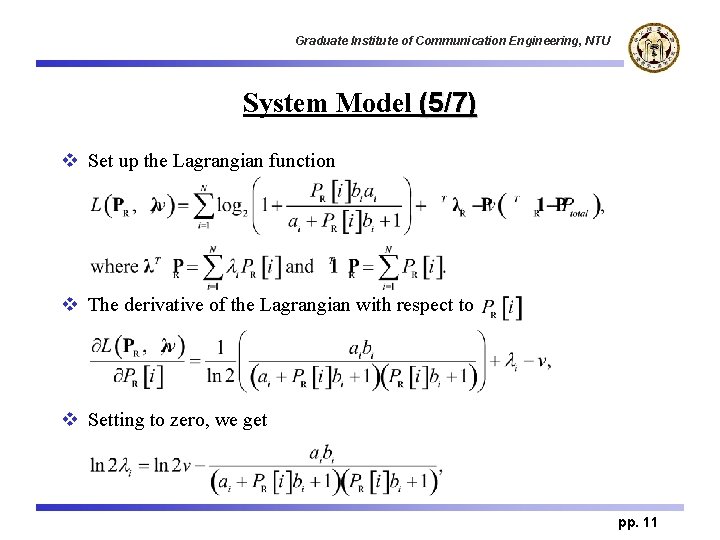
Graduate Institute of Communication Engineering, NTU System Model (5/7) v Set up the Lagrangian function v The derivative of the Lagrangian with respect to v Setting to zero, we get pp. 11
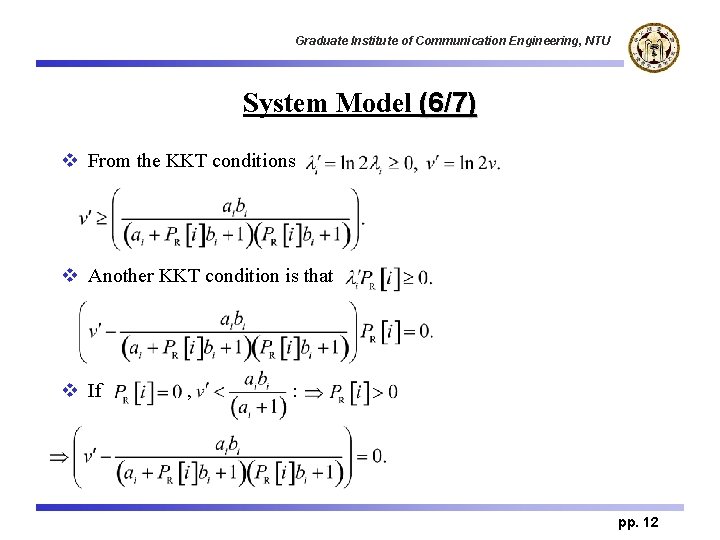
Graduate Institute of Communication Engineering, NTU System Model (6/7) v From the KKT conditions v Another KKT condition is that v If , : pp. 12
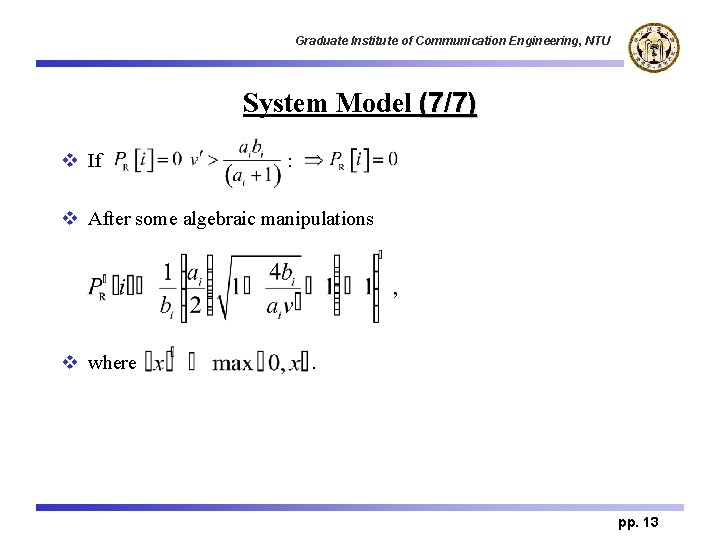
Graduate Institute of Communication Engineering, NTU System Model (7/7) v If : v After some algebraic manipulations v where . pp. 13
Graduate Institute of Communication Engineering, NTU Conclusion v The objective function (Maximize Capacity? Minimize total Power or bit error rate? ) v Constraint (Power, Resource) v Lagrange function (Derivation) v Solve the optimization problem v (i. e. , Obtain the power allocation among the subcarrier) pp. 14
Graduate Institute of Communication Engineering, NTU Reference [1] J. G. Proakis, Digital Communications, 4 rd ed. New York: Mc. Graw. Hill, 2001. [2] I. –Hammerstrom and A. -Wittneben, “On the optimal power allocation for nonregenerative OFDM relay links, ” IEEE ICC , pp. 4463 -4468, Jun. 2006. pp. 15