
Lag Routing Method within HECHMS Hydrologic Engineering Center
- Slides: 9
Lag Routing Method within HEC-HMS Hydrologic Engineering Center 1
Objectives • Introduce the Lag routing method • Present an example • Discuss common parameter estimation and calibration techniques • Present advantages and disadvantages Hydrologic Engineering Center 2
Lag Method • Only represents translation • No attenuation effects Hydrologic Engineering Center 3
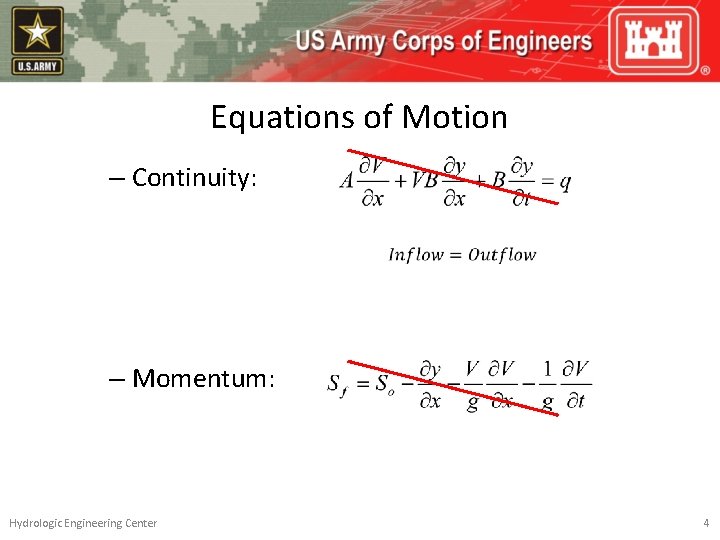
Equations of Motion – Continuity: – Momentum: Hydrologic Engineering Center 4
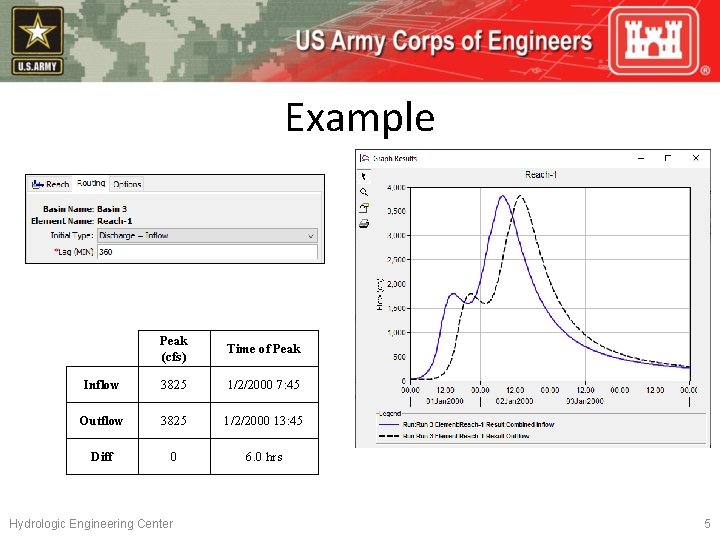
Example Peak (cfs) Time of Peak Inflow 3825 1/2/2000 7: 45 Outflow 3825 1/2/2000 13: 45 Diff 0 6. 0 hrs Hydrologic Engineering Center 5
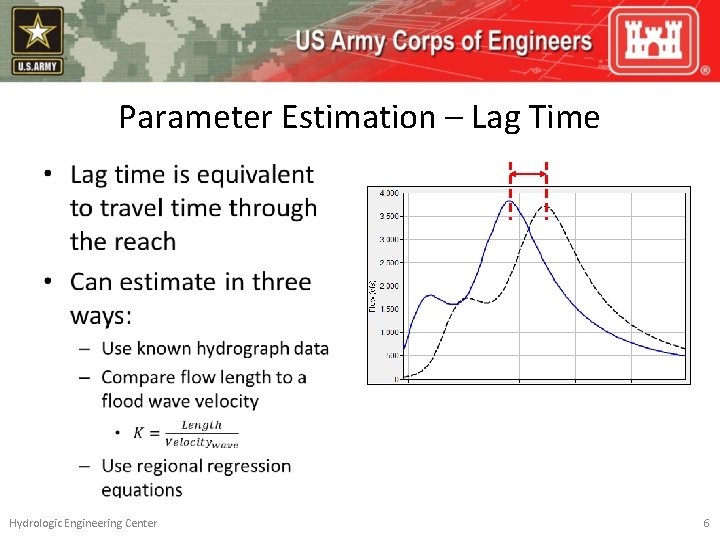
Parameter Estimation – Lag Time Hydrologic Engineering Center 6
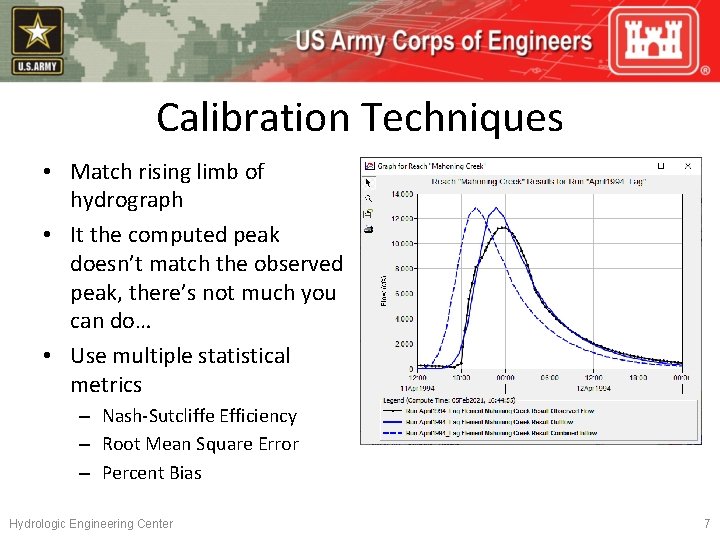
Calibration Techniques • Match rising limb of hydrograph • It the computed peak doesn’t match the observed peak, there’s not much you can do… • Use multiple statistical metrics – Nash-Sutcliffe Efficiency – Root Mean Square Error – Percent Bias Hydrologic Engineering Center 7
Advantages • Simple, parsimonious method. Disadvantages • • Hydrologic Engineering Center Method may be too simple; no attenuation effects are simulated by this method. Parameters cannot be estimated using measurable channel characteristics. Only appropriate for use in streams that experience no attenuation. Cannot simulate backwater effects or impacts of hydraulic structures. 8
Review • Lag method is the simplest routing method within HEC-HMS • Primary advantage (simplicity) is also its primary disadvantage • Next lecture will focus on Muskingum routing method within HEC-HMS Hydrologic Engineering Center 9