
Ladders to Literacy Phonics Approach 20091021 1 Phonics
- Slides: 45
Ladders to Literacy— Phonics Approach 張芳琪 國立嘉義大學外國語言學系 2009/10/21 1
Phonics Approach Some general ideas 2
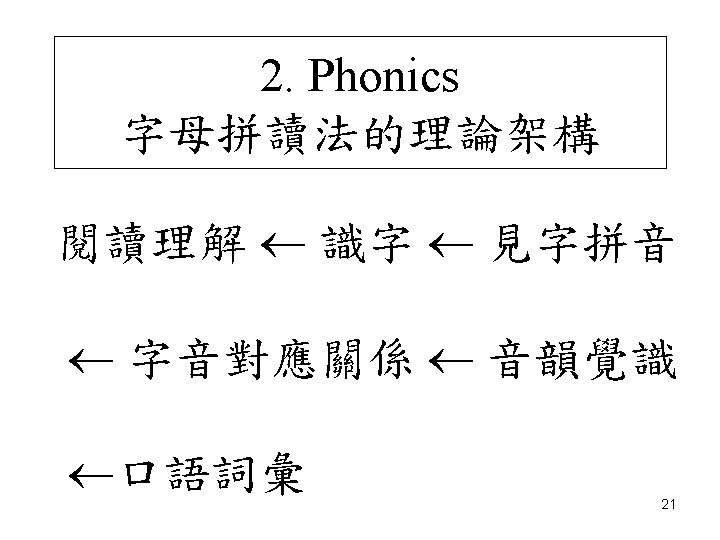
Phonics Approach for Reading Phonics, two meanings 1. An approach, for teaching reading 2. (We say, “Based on the Phonics Approach… 3. 2. The letter-sound relationships 4. (We say, “Teach phonics…. ”) 3
Stages of Reading Development Stage 0: Birth to Age 6 Prereading: 1. Develop knowledge of print 2. Recognize a few letters, words, and environmental print signs 4
Stages of Reading Development Stage 1: Grades 1 through 2 Initial reading or decoding: 1. Develop the understanding of the alphabetic principle 2. Begin to decode words 5
Stages of Reading Development Stage 3: Grades 2 through 3 Confirmation, fluency: 1. Develop strategies to decode words and make meaning from text 2. Recognize many words by sight 3. Sound out words they don’t recognize by sight 6
Stages of Reading Development Stage 3: Grades 4 through 8 Learning the new: Use reading more as a way to obtain information and learn about the values, attitudes, and insights of authors. 7
Stages of Reading Development Stage 4: Throughout High Schools (Grades 9 -12) (beyond our scope of phonics) Stage 5: Throughout College and Beyond (beyond our scope of phonics) 8
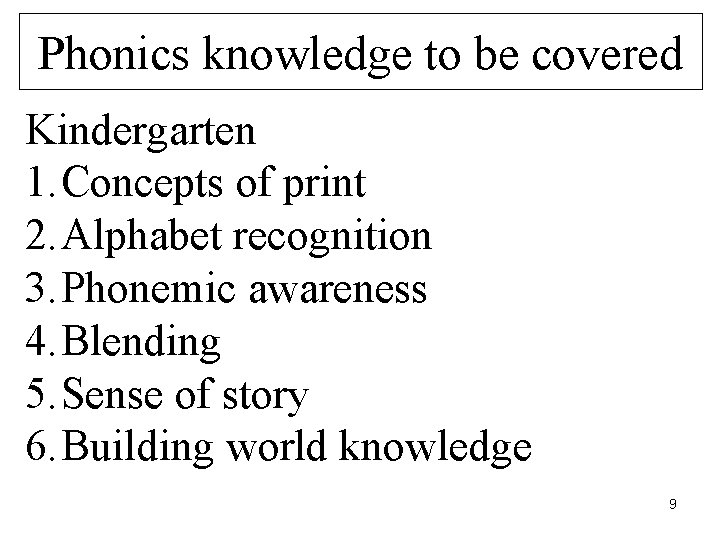
Phonics knowledge to be covered Kindergarten 1. Concepts of print 2. Alphabet recognition 3. Phonemic awareness 4. Blending 5. Sense of story 6. Building world knowledge 9
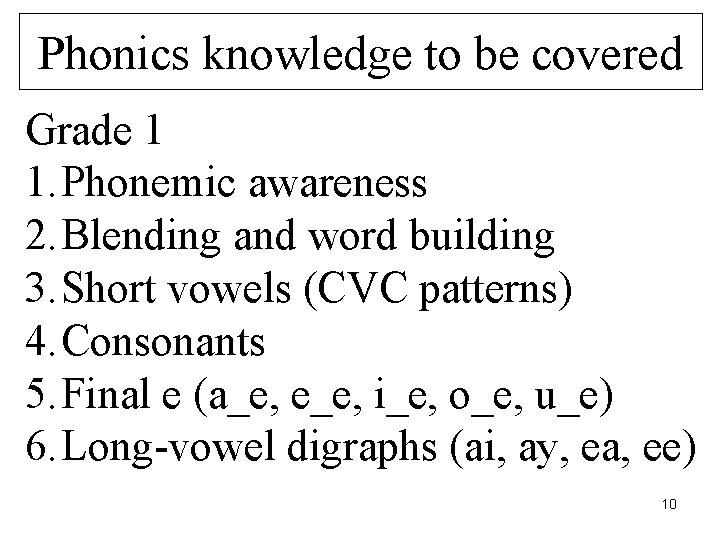
Phonics knowledge to be covered Grade 1 1. Phonemic awareness 2. Blending and word building 3. Short vowels (CVC patterns) 4. Consonants 5. Final e (a_e, e_e, i_e, o_e, u_e) 6. Long-vowel digraphs (ai, ay, ea, ee) 10
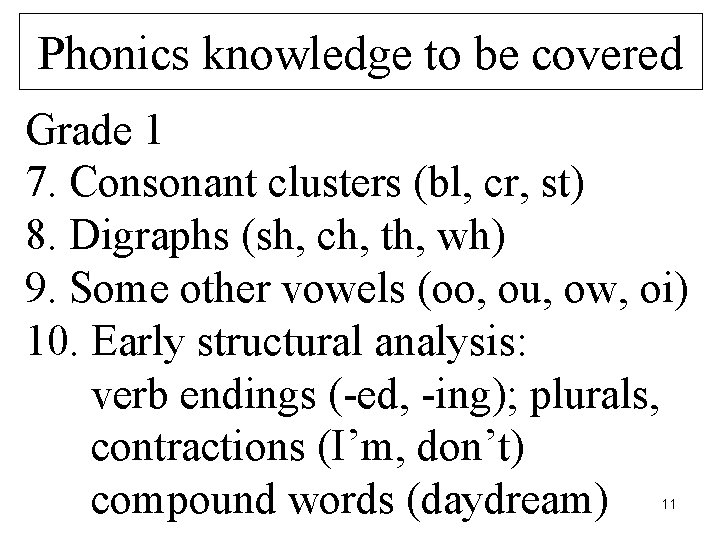
Phonics knowledge to be covered Grade 1 7. Consonant clusters (bl, cr, st) 8. Digraphs (sh, ch, th, wh) 9. Some other vowels (oo, ou, ow, oi) 10. Early structural analysis: verb endings (-ed, -ing); plurals, contractions (I’m, don’t) compound words (daydream) 11
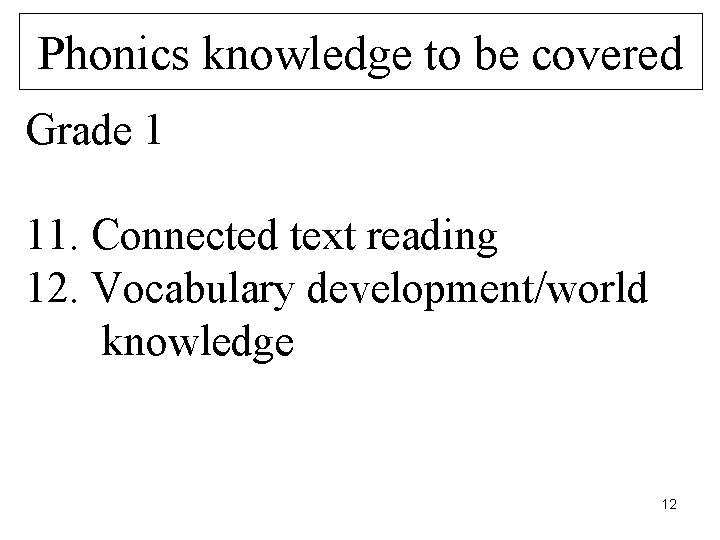
Phonics knowledge to be covered Grade 1 11. Connected text reading 12. Vocabulary development/world knowledge 12
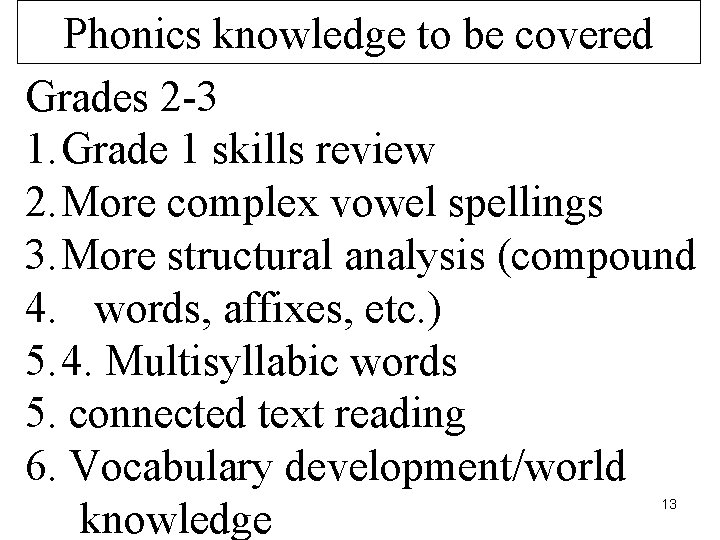
Phonics knowledge to be covered Grades 2 -3 1. Grade 1 skills review 2. More complex vowel spellings 3. More structural analysis (compound 4. words, affixes, etc. ) 5. 4. Multisyllabic words 5. connected text reading 6. Vocabulary development/world knowledge 13
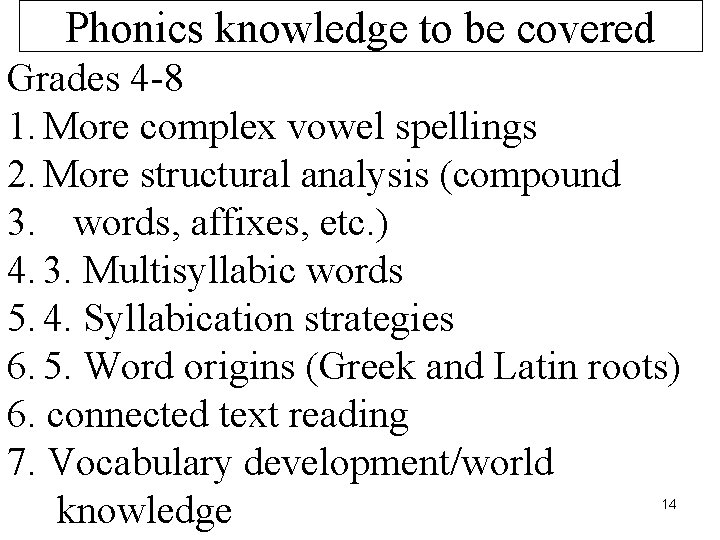
Phonics knowledge to be covered Grades 4 -8 1. More complex vowel spellings 2. More structural analysis (compound 3. words, affixes, etc. ) 4. 3. Multisyllabic words 5. 4. Syllabication strategies 6. 5. Word origins (Greek and Latin roots) 6. connected text reading 7. Vocabulary development/world knowledge 14
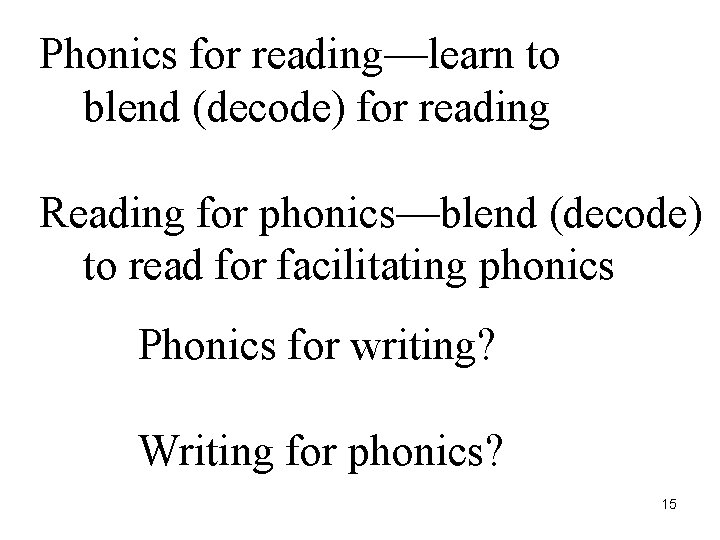
Phonics for reading—learn to blend (decode) for reading Reading for phonics—blend (decode) to read for facilitating phonics Phonics for writing? Writing for phonics? 15
Our Workshop on Phonics 16
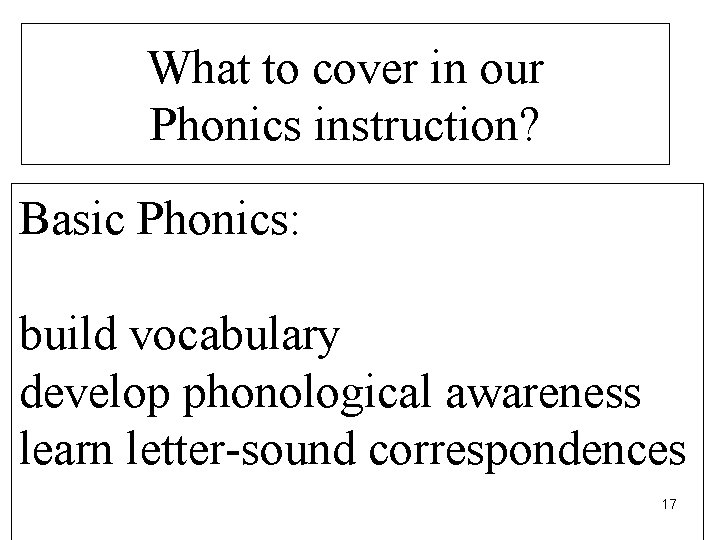
What to cover in our Phonics instruction? Basic Phonics: build vocabulary develop phonological awareness learn letter-sound correspondences 17
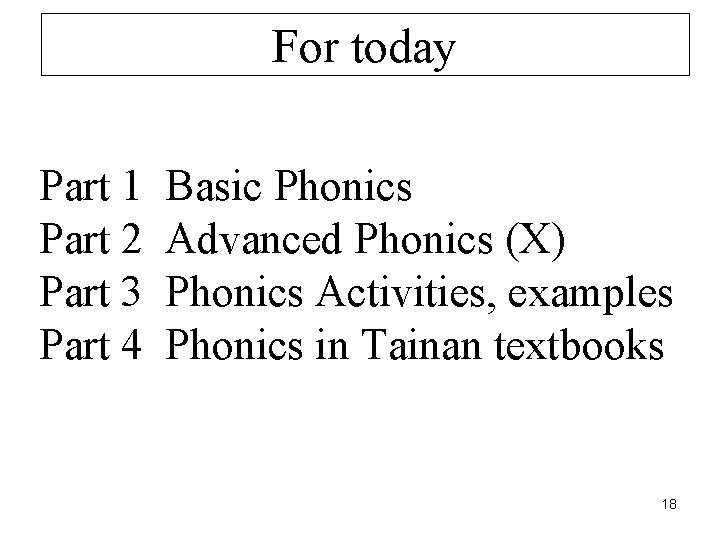
For today Part 1 Part 2 Part 3 Part 4 Basic Phonics Advanced Phonics (X) Phonics Activities, examples Phonics in Tainan textbooks 18
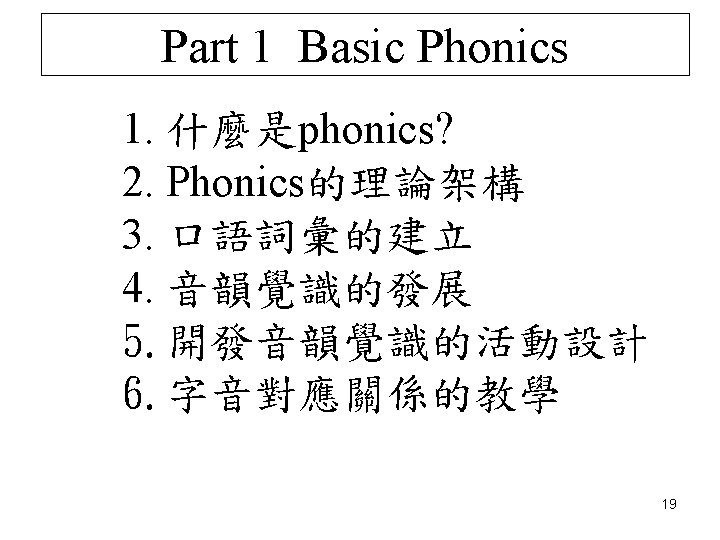
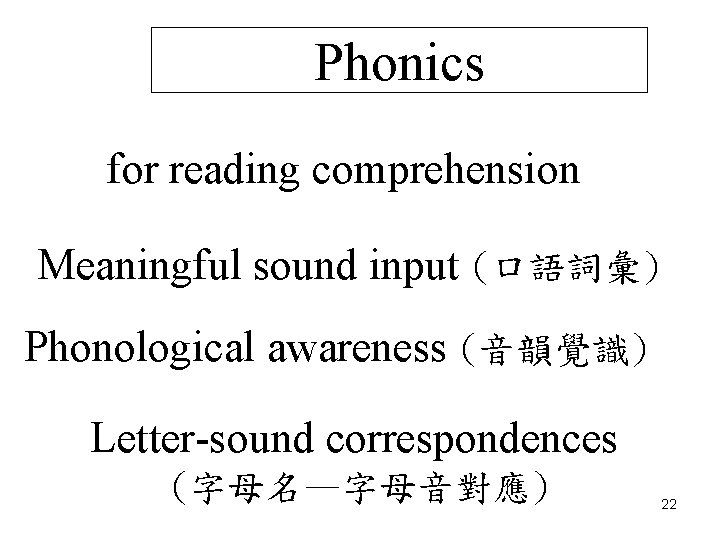
Phonics for reading comprehension Meaningful sound input (口語詞彙) Phonological awareness (音韻覺識) Letter-sound correspondences (字母名—字母音對應) 22
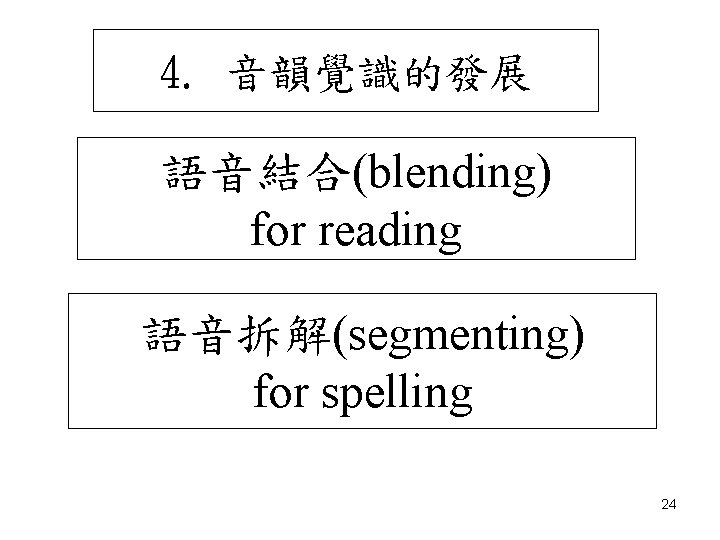
4. 音韻覺識的發展 語音結合(blending) for reading 語音拆解(segmenting) for spelling 24
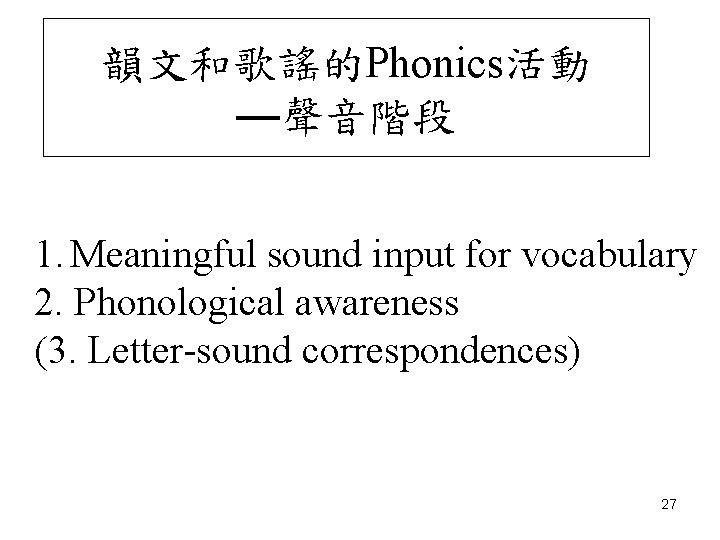
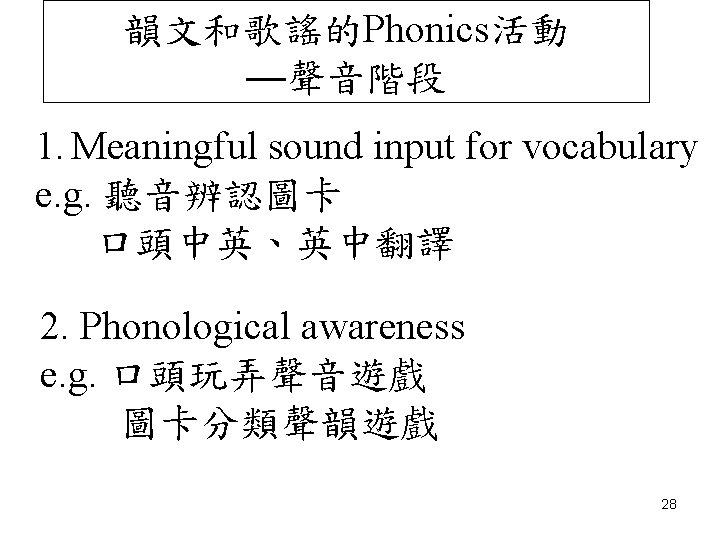
韻文和歌謠的Phonics活動 —聲音階段 1. Meaningful sound input for vocabulary 2. Phonological awareness (3. Letter-sound correspondences) 27
6. 字母名-字母音對應關係 (letter-sound correspondences) 29
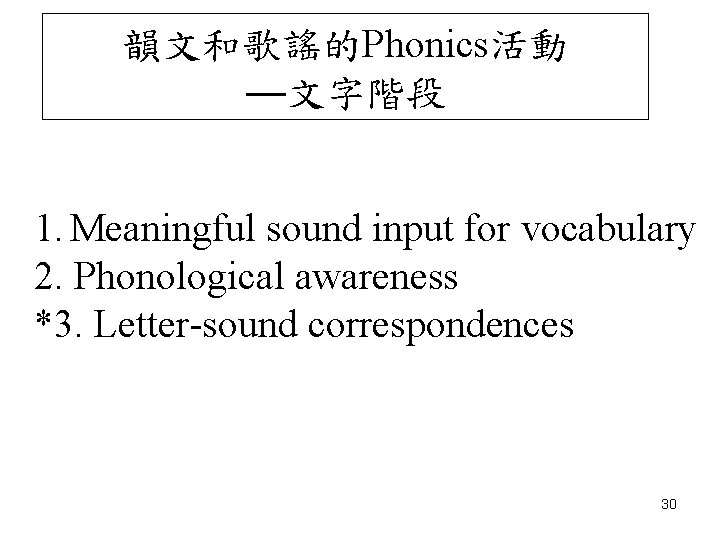
韻文和歌謠的Phonics活動 —文字階段 1. Meaningful sound input for vocabulary 2. Phonological awareness *3. Letter-sound correspondences 30
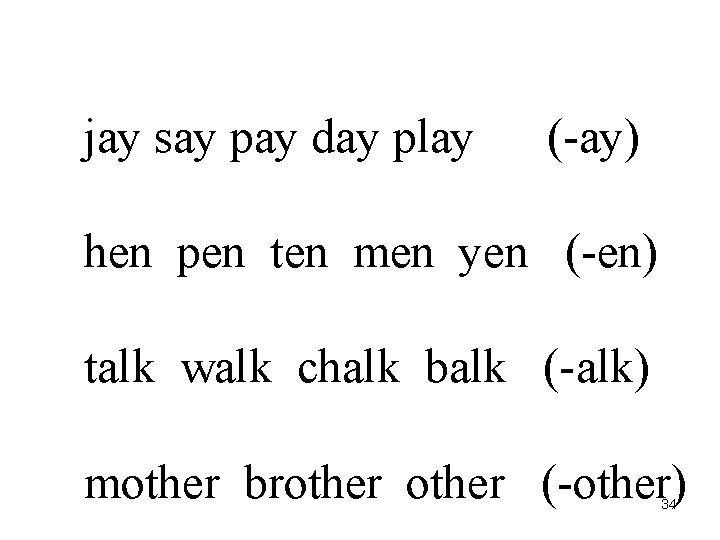
jay say pay day play (-ay) hen pen ten men yen (-en) talk walk chalk balk (-alk) mother brother (-other) 34
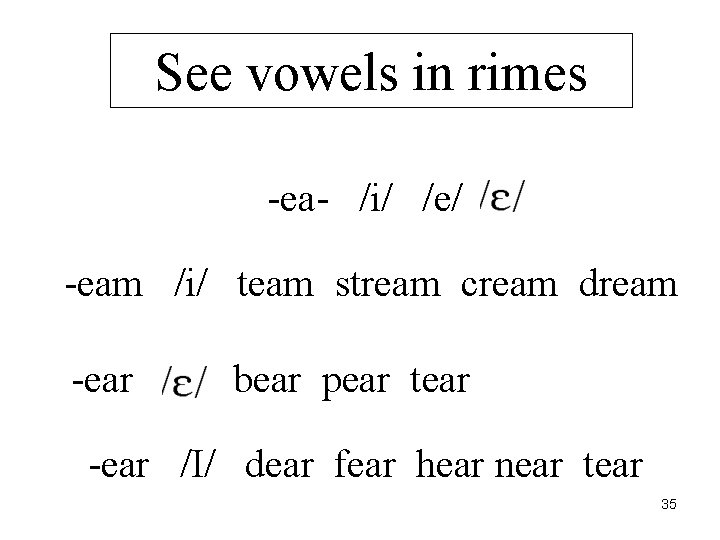
See vowels in rimes -ea- /i/ /e/ -eam /i/ team stream cream dream -ear bear pear tear -ear /I/ dear fear hear near tear 35
Part 3 Phonics activities, examples 1. A textbook on the alphabet 2. A workbook on phonics 3. Writing activities for phonics 37
3. Writing Activities (facilitating phonics) 38
孩童的拼字發展過程 Prephonic Spelling Children experiment with prephonic spelling when they use writing such as letters, numbers and other symbols to represent written language as they explore the relationships between written and spoken words. 39
Prephonic Spelling Sometimes a word is represented with a picture, and sometimes with letter-like symbols. There may be the beginning of directionality from left to right. 40
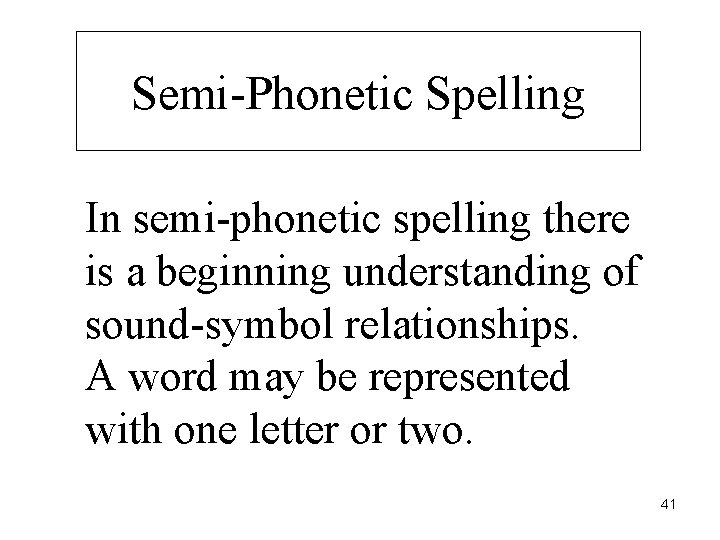
Semi-Phonetic Spelling In semi-phonetic spelling there is a beginning understanding of sound-symbol relationships. A word may be represented with one letter or two. 41
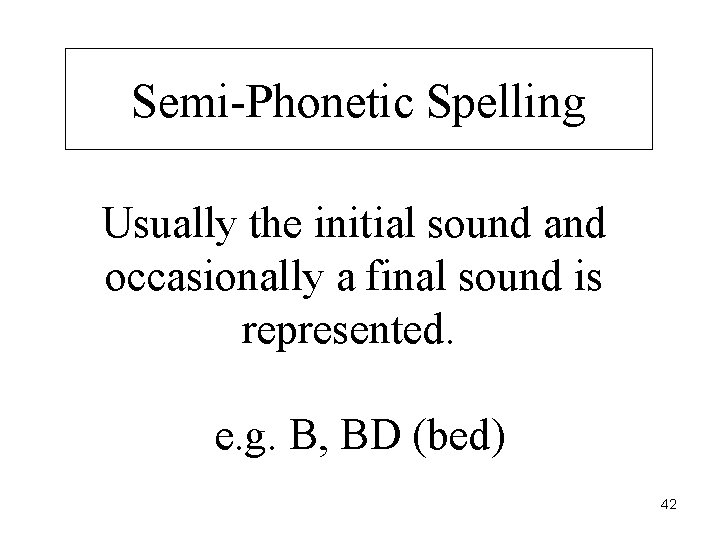
Semi-Phonetic Spelling Usually the initial sound and occasionally a final sound is represented. e. g. B, BD (bed) 42
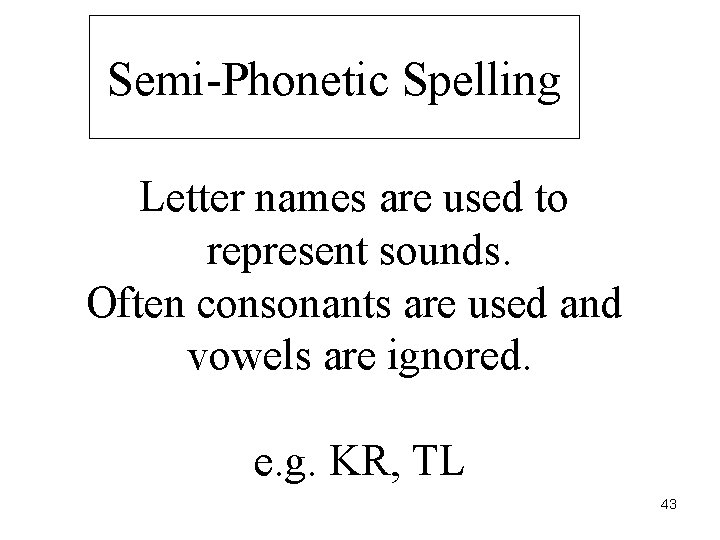
Semi-Phonetic Spelling Letter names are used to represent sounds. Often consonants are used and vowels are ignored. e. g. KR, TL 43
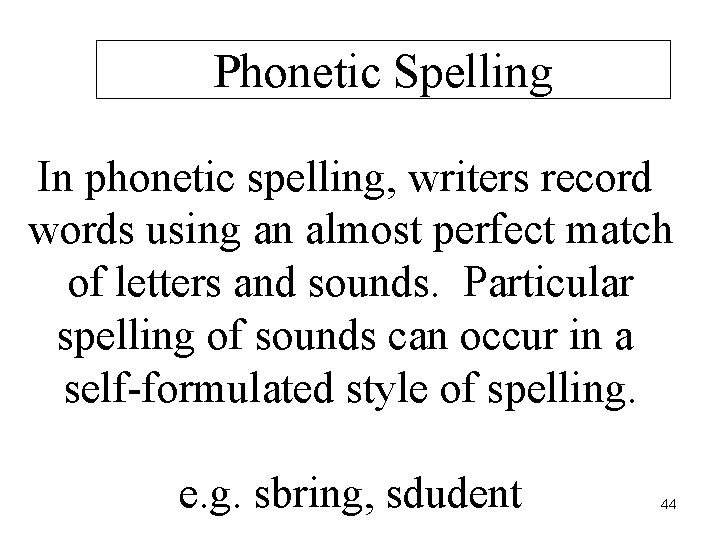
Phonetic Spelling In phonetic spelling, writers record words using an almost perfect match of letters and sounds. Particular spelling of sounds can occur in a self-formulated style of spelling. e. g. sbring, sdudent 44
Other phonic activities Activity 1: Picky Nicky Activity 2: Scan your materials Activity 3: Scan your textbook Part 4 Phonics in Tainan Textbooks 45