
Ladder SafetyPortables Disclaimer This training material presents very
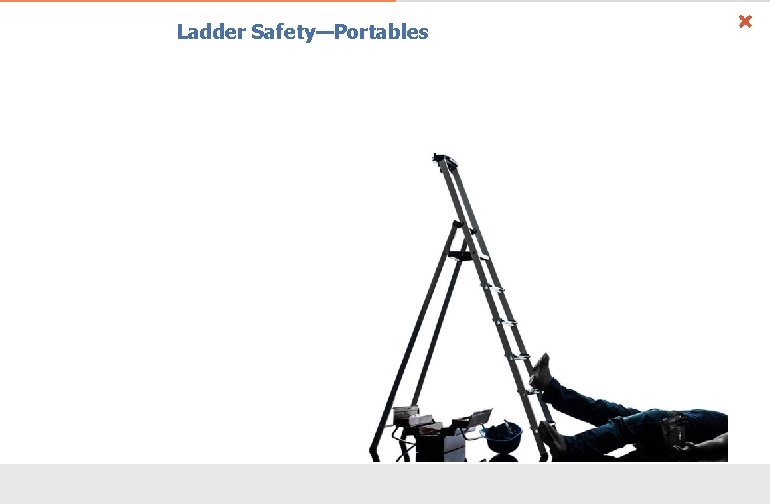
Ladder Safety—Portables

Disclaimer • This training material presents very important, pertinent information. It should not be assumed, however, that this program satisfies every legal requirement of every state. Some states require the training be developed and delivered by an individual with specific training and experience. • This training is AWARENESS LEVEL and does not authorize any person to perform work or validate their level of competency; it must be supplemented with operation and process-specific assessments and training, as well as management oversight, to assure that all training is understood and followed. • Your organization must do an evaluation of all exposures and applicable codes and regulations. In addition, establish proper controls, training, and protective measures to effectively control exposures and assure compliance. • This program is neither a determination that the conditions and practices of your organization are safe, nor a warranty that reliance upon this program will prevent accidents and losses or satisfy local, state, or federal regulations.

Ladder Safety— Portables Learning Objectives • Hazards associated with ladder use • How to select the correct ladder for the task • The difference between working on a stepladder and an extension ladder • Proper maintenance • Storage procedures
Ladder Safety— Portables Course Outline 1. Introduction to Ladder Safety 2. Part 1: Planning and Preparation 3. Part 2: Ladder Selection 4. Part 3: Inspection and Maintenance 5. Part 4: Safe Work Procedures 6. Summary
Ladder Safety— Portables Introduction to Ladder Safety What you need to know: 1. Common hazards 2. Common causes of injuries 3. Four steps for preventing accidents
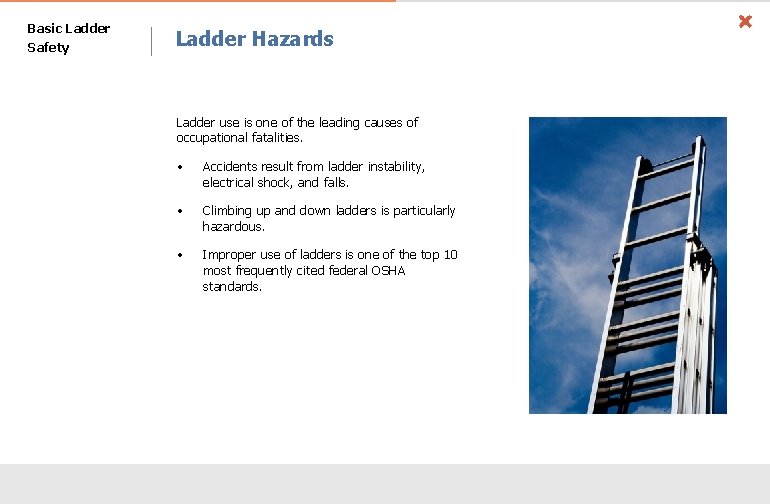
Basic Ladder Safety Ladder Hazards Ladder use is one of the leading causes of occupational fatalities. • Accidents result from ladder instability, electrical shock, and falls. • Climbing up and down ladders is particularly hazardous. • Improper use of ladders is one of the top 10 most frequently cited federal OSHA standards.
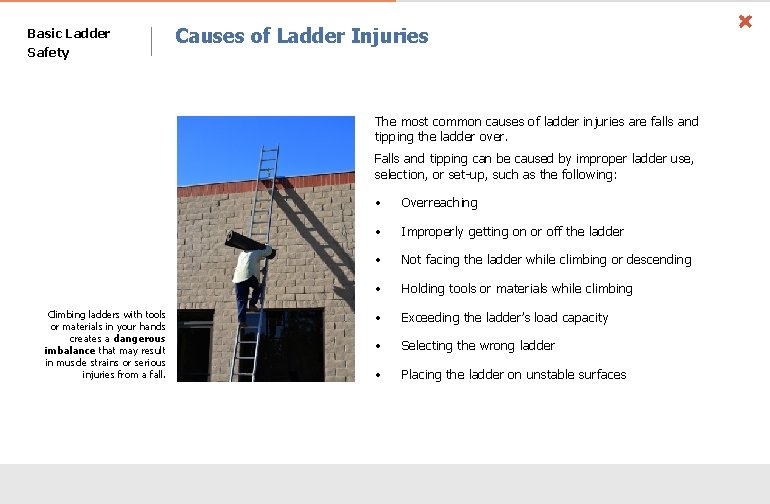
Basic Ladder Safety Causes of Ladder Injuries The most common causes of ladder injuries are falls and tipping the ladder over. Falls and tipping can be caused by improper ladder use, selection, or set-up, such as the following: Climbing ladders with tools or materials in your hands creates a dangerous imbalance that may result in muscle strains or serious injuries from a fall. • Overreaching • Improperly getting on or off the ladder • Not facing the ladder while climbing or descending • Holding tools or materials while climbing • Exceeding the ladder’s load capacity • Selecting the wrong ladder • Placing the ladder on unstable surfaces

Basic Ladder Safety Causes of Ladder Injuries Other factors increase the risk of injury: • Insufficient training on safe use • Improper electrical contact • Slippery substances on ladder rungs • Ladder movement while climbing
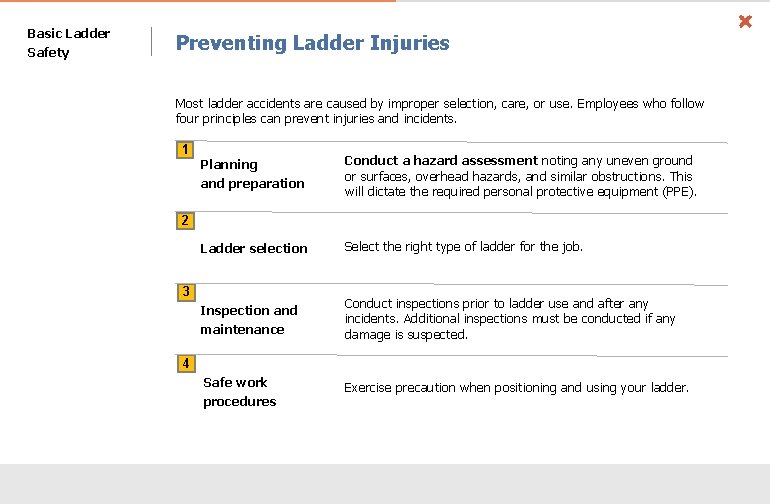
Basic Ladder Safety Preventing Ladder Injuries Most ladder accidents are caused by improper selection, care, or use. Employees who follow four principles can prevent injuries and incidents. 1 Planning and preparation Conduct a hazard assessment noting any uneven ground or surfaces, overhead hazards, and similar obstructions. This will dictate the required personal protective equipment (PPE). Ladder selection Select the right type of ladder for the job. Inspection and maintenance Conduct inspections prior to ladder use and after any incidents. Additional inspections must be conducted if any damage is suspected. Safe work procedures Exercise precaution when positioning and using your ladder. 2 3 4
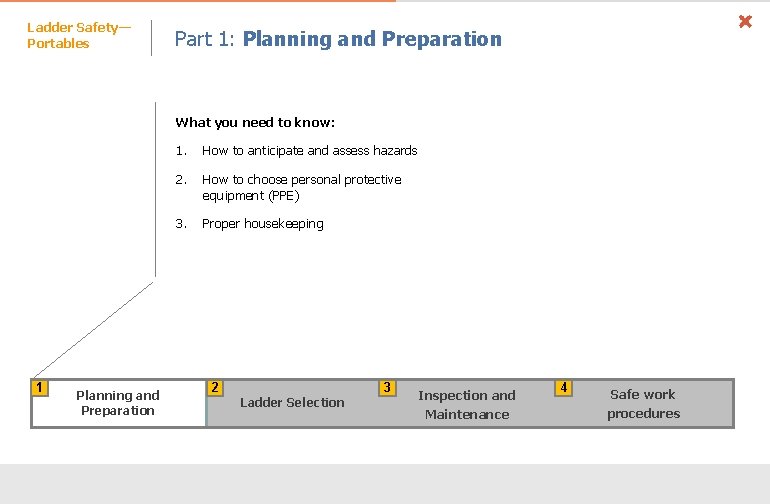
Ladder Safety— Portables Part 1: Planning and Preparation What you need to know: 1 Planning and Preparation 1. How to anticipate and assess hazards 2. How to choose personal protective equipment (PPE) 3. Proper housekeeping 2 Ladder Selection 3 Inspection and Maintenance 4 Safe work procedures
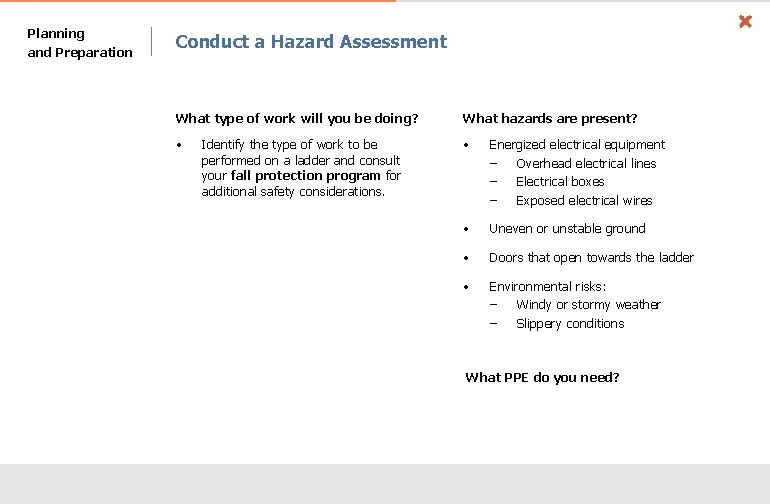
Planning and Preparation Conduct a Hazard Assessment What type of work will you be doing? What hazards are present? • • Energized electrical equipment ‒ Overhead electrical lines ‒ Electrical boxes ‒ Exposed electrical wires • Uneven or unstable ground • Doors that open towards the ladder • Environmental risks: ‒ Windy or stormy weather ‒ Slippery conditions Identify the type of work to be performed on a ladder and consult your fall protection program for additional safety considerations. What PPE do you need?

Planning and Preparation Choose Appropriate PPE • Conduct a hazard assessment to determine personal protective equipment (PPE). • Choose supportive footwear with arch support and non-slip soles. • Use safety glasses with side shields for overhead work. • Wear a hard hat appropriate for the hazards, such as overhead electrical lines or side impact hazards. • Read and follow all manufacturer instructions, markings, labels, and warnings. • Follow your fall protection program for working at heights. Additional requirements and PPE may be required.
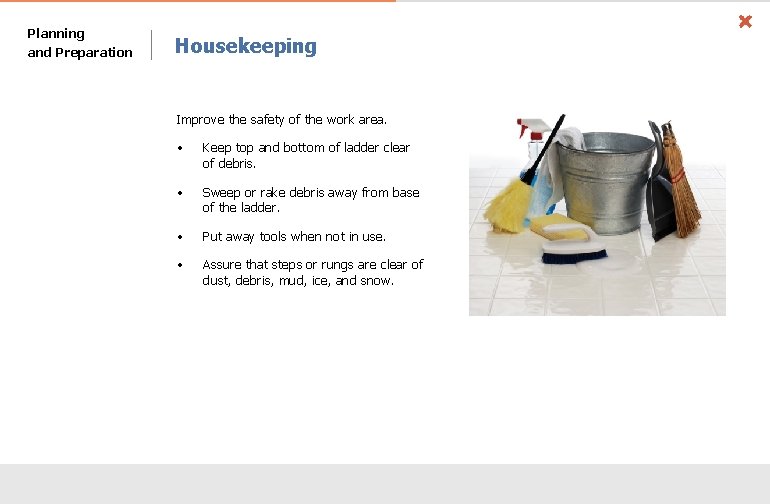
Planning and Preparation Housekeeping Improve the safety of the work area. • Keep top and bottom of ladder clear of debris. • Sweep or rake debris away from base of the ladder. • Put away tools when not in use. • Assure that steps or rungs are clear of dust, debris, mud, ice, and snow.
Ladder Safety— Portables Part 2: Ladder Selection What you need to know: 1 Planning and Preparation 1. The general types of portable ladders 2. How to choose a ladder for the weight load 2 Ladder Selection 3 Inspection and Maintenance 4 Safe work procedures
Ladder Selection Types of Ladders Portable ladders are the most common ladder type. Characteristics: • Portable ladders can be easily moved or carried. • They are intended for temporary use. • Some of them do not require a structure for support. Categories: • Self-supporting • Non-self-supporting • Multi-purpose
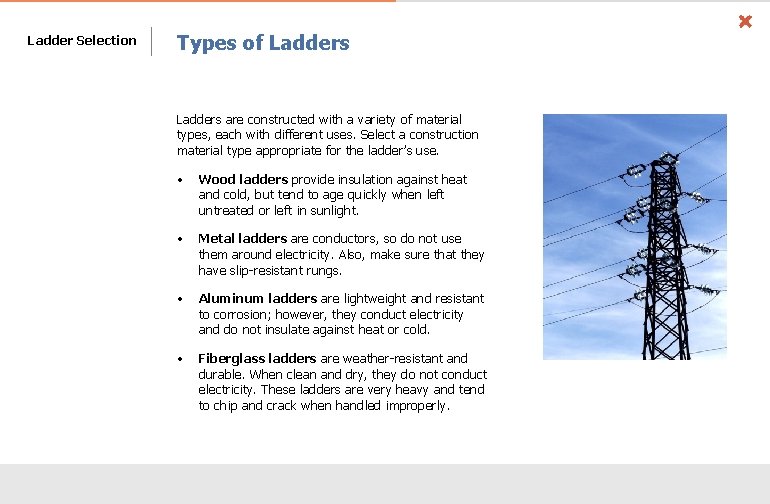
Ladder Selection Types of Ladders are constructed with a variety of material types, each with different uses. Select a construction material type appropriate for the ladder’s use. • Wood ladders provide insulation against heat and cold, but tend to age quickly when left untreated or left in sunlight. • Metal ladders are conductors, so do not use them around electricity. Also, make sure that they have slip-resistant rungs. • Aluminum ladders are lightweight and resistant to corrosion; however, they conduct electricity and do not insulate against heat or cold. • Fiberglass ladders are weather-resistant and durable. When clean and dry, they do not conduct electricity. These ladders are very heavy and tend to chip and crack when handled improperly.
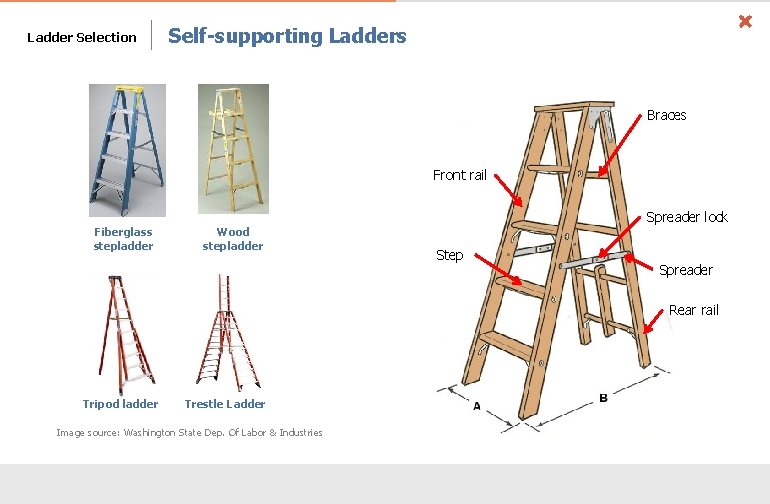
Ladder Selection Self-supporting Ladders Braces Front rail Fiberglass stepladder Wood stepladder Spreader lock Step Spreader Rear rail Tripod ladder Trestle Ladder Image source: Washington State Dep. Of Labor & Industries
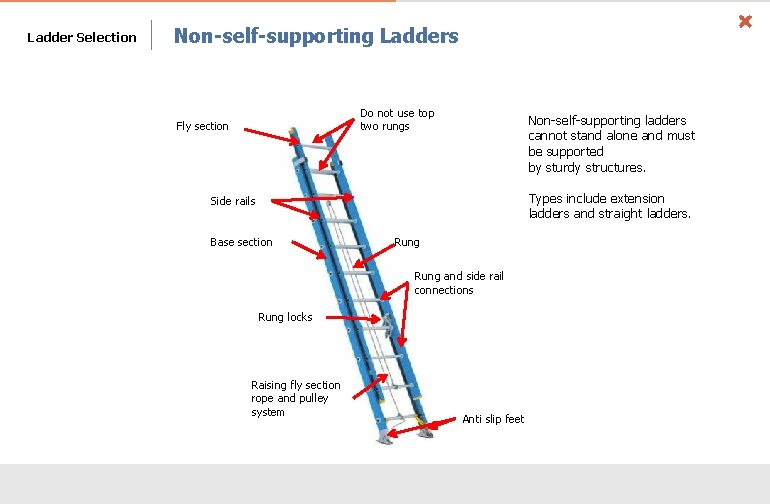
Ladder Selection Non-self-supporting Ladders Do not use top two rungs Fly section Non-self-supporting ladders cannot stand alone and must be supported by sturdy structures. Types include extension ladders and straight ladders. Side rails Base section Rung and side rail connections Rung locks Raising fly section rope and pulley system Anti slip feet
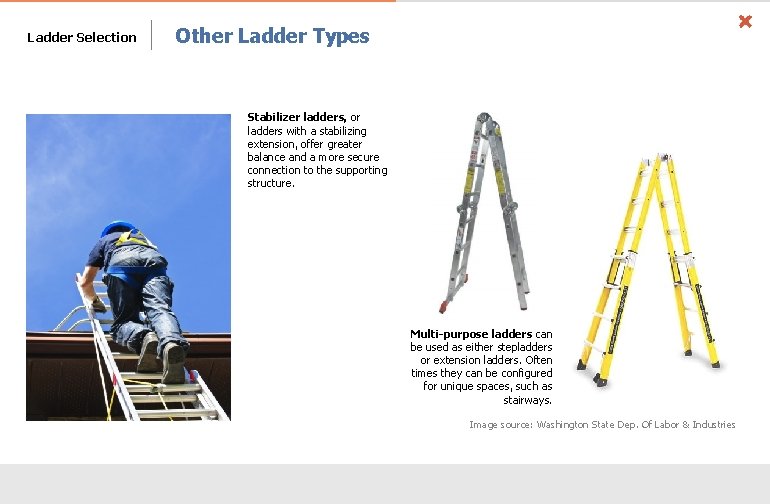
Ladder Selection Other Ladder Types Stabilizer ladders, or ladders with a stabilizing extension, offer greater balance and a more secure connection to the supporting structure. Multi-purpose ladders can be used as either stepladders or extension ladders. Often times they can be configured for unique spaces, such as stairways. Image source: Washington State Dep. Of Labor & Industries
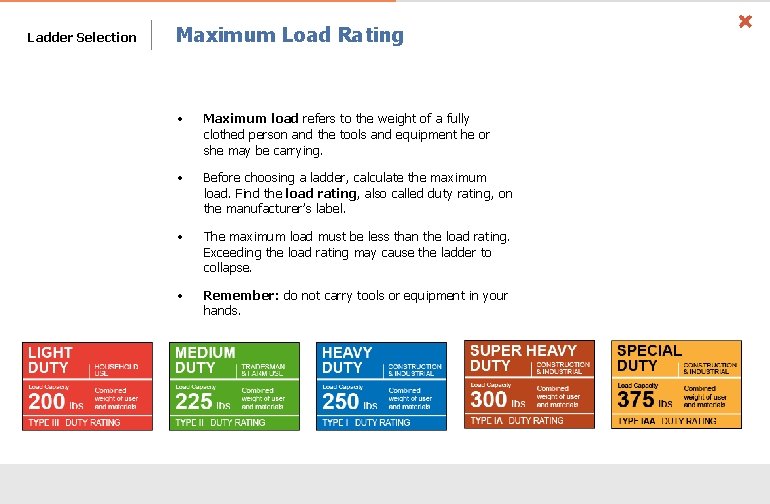
Ladder Selection Maximum Load Rating • Maximum load refers to the weight of a fully clothed person and the tools and equipment he or she may be carrying. • Before choosing a ladder, calculate the maximum load. Find the load rating, also called duty rating, on the manufacturer’s label. • The maximum load must be less than the load rating. Exceeding the load rating may cause the ladder to collapse. • Remember: do not carry tools or equipment in your hands.
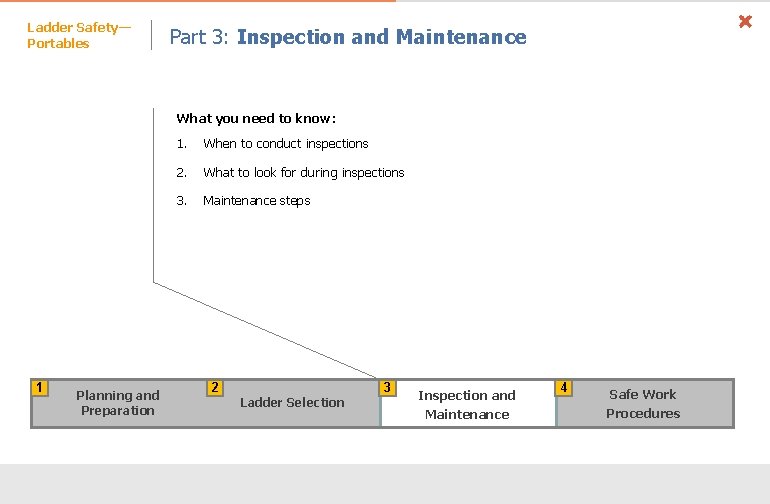
Ladder Safety— Portables Part 3: Inspection and Maintenance What you need to know: 1 Planning and Preparation 1. When to conduct inspections 2. What to look for during inspections 3. Maintenance steps 2 Ladder Selection 3 Inspection and Maintenance 4 Safe Work Procedures
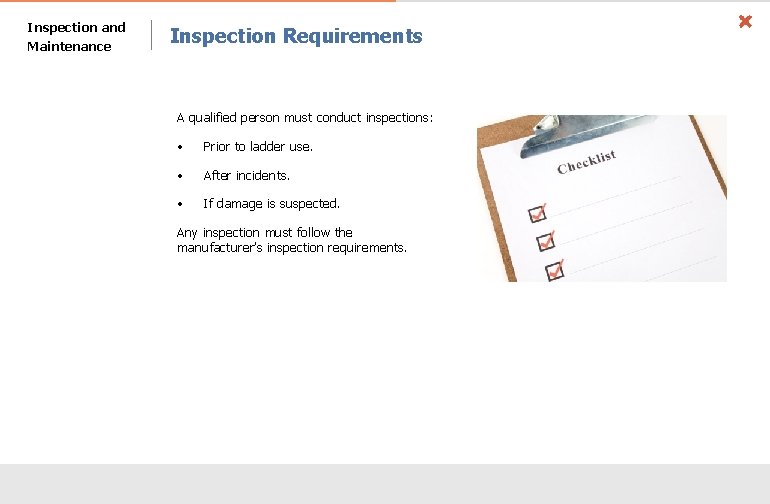
Inspection and Maintenance Inspection Requirements A qualified person must conduct inspections: • Prior to ladder use. • After incidents. • If damage is suspected. Any inspection must follow the manufacturer’s inspection requirements.
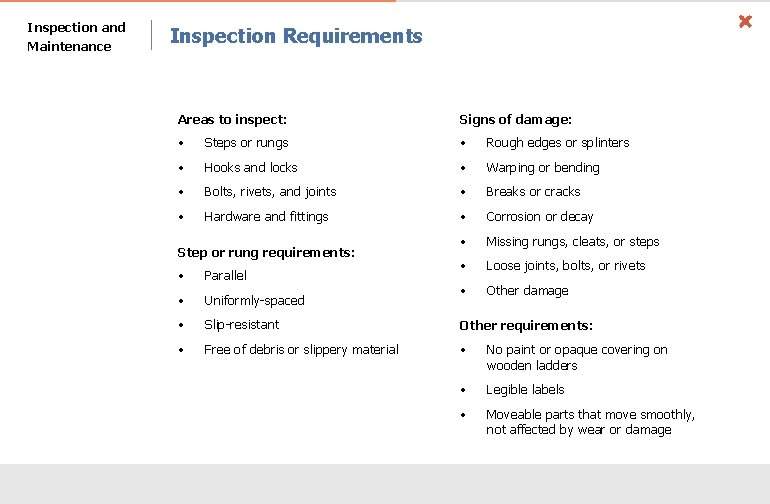
Inspection and Maintenance Inspection Requirements Areas to inspect: Signs of damage: • Steps or rungs • Rough edges or splinters • Hooks and locks • Warping or bending • Bolts, rivets, and joints • Breaks or cracks • Hardware and fittings • Corrosion or decay • Missing rungs, cleats, or steps • Loose joints, bolts, or rivets • Other damage Step or rung requirements: • Parallel • Uniformly-spaced • Slip-resistant Other requirements: • Free of debris or slippery material • No paint or opaque covering on wooden ladders • Legible labels • Moveable parts that move smoothly, not affected by wear or damage
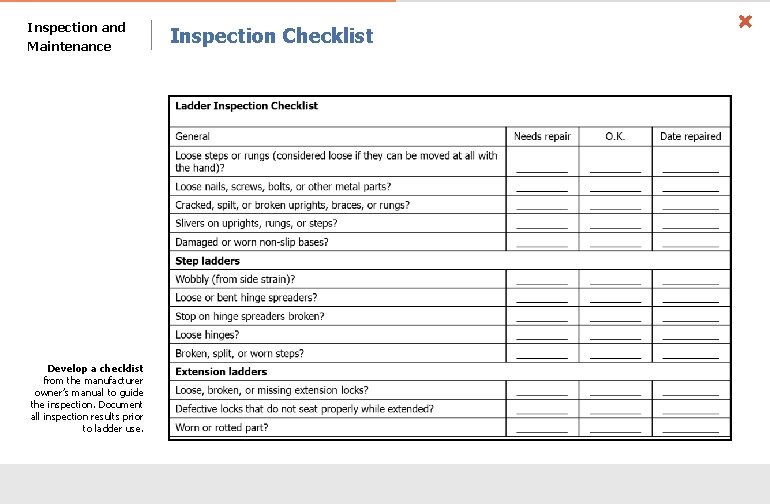
Inspection and Maintenance Develop a checklist from the manufacturer owner’s manual to guide the inspection. Document all inspection results prior to ladder use. Inspection Checklist

Inspection and Maintenance Ladder Maintenance If you find problems during the inspection, take action. • Problems requiring corrective action include: ‒ Broken rungs or railings. ‒ Signs of corrosion. ‒ Loose rivets or fastenings. ‒ Unsafe wear and tear. • Remove unsafe equipment from service. • Clearly label unsafe equipment. • Discard ladders that cannot be restored. • Replace worn or frayed ropes on extension ladders.
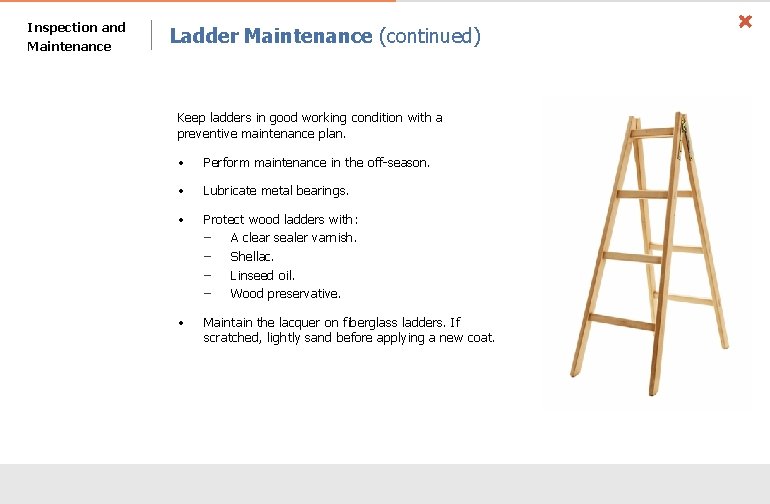
Inspection and Maintenance Ladder Maintenance (continued) Keep ladders in good working condition with a preventive maintenance plan. • Perform maintenance in the off-season. • Lubricate metal bearings. • Protect wood ladders with: ‒ A clear sealer varnish. ‒ Shellac. ‒ Linseed oil. ‒ Wood preservative. • Maintain the lacquer on fiberglass ladders. If scratched, lightly sand before applying a new coat.
Ladder Safety— Portables Part 4: Safe Work Procedures What you need to know: 1 Planning and Preparation 1. Guidelines for ladder placement 2. Steps for securing the ladder and surrounding work area 3. Proper and improper ladder use 4. Guidelines for transporting and storing ladders 2 Ladder Selection 3 Inspection and Maintenance 4 Safe work procedures
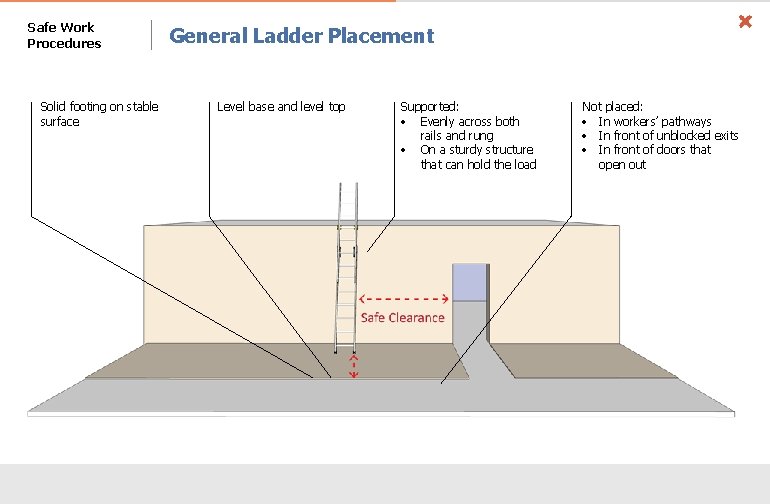
Safe Work Procedures Solid footing on stable surface General Ladder Placement Level base and level top Supported: • Evenly across both rails and rung • On a sturdy structure that can hold the load Not placed: • In workers’ pathways • In front of unblocked exits • In front of doors that open out
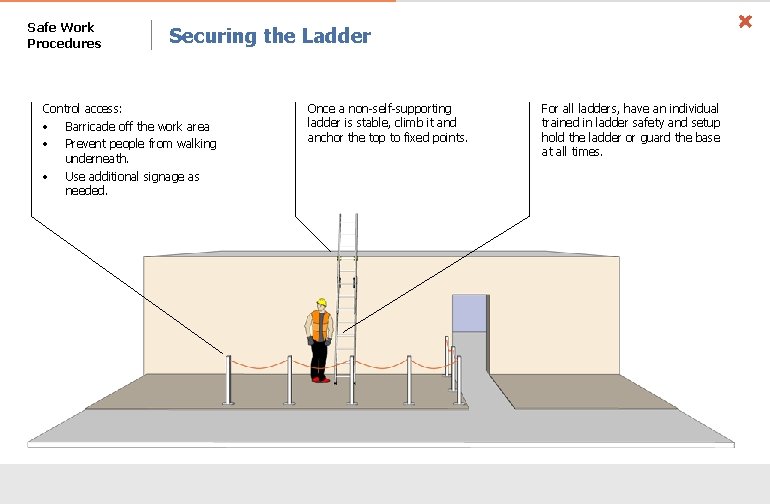
Safe Work Procedures Securing the Ladder Control access: • Barricade off the work area • Prevent people from walking underneath. • Use additional signage as needed. Once a non-self-supporting ladder is stable, climb it and anchor the top to fixed points. For all ladders, have an individual trained in ladder safety and setup hold the ladder or guard the base at all times.
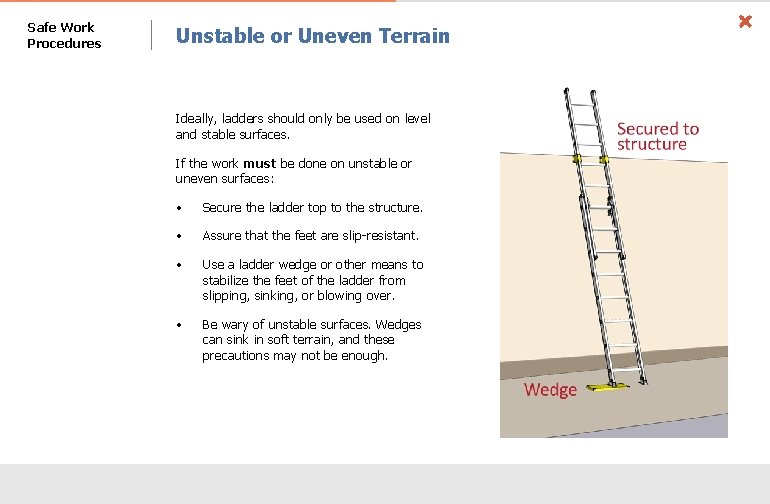
Safe Work Procedures Unstable or Uneven Terrain Ideally, ladders should only be used on level and stable surfaces. If the work must be done on unstable or uneven surfaces: • Secure the ladder top to the structure. • Assure that the feet are slip-resistant. • Use a ladder wedge or other means to stabilize the feet of the ladder from slipping, sinking, or blowing over. • Be wary of unstable surfaces. Wedges can sink in soft terrain, and these precautions may not be enough.
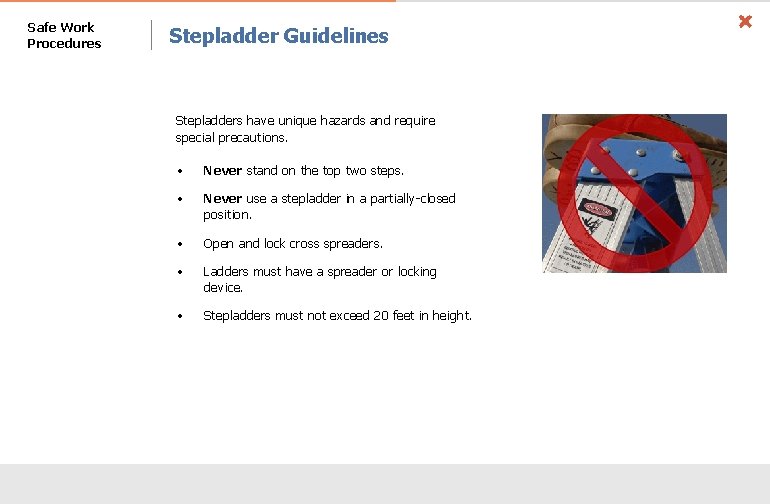
Safe Work Procedures Stepladder Guidelines Stepladders have unique hazards and require special precautions. • Never stand on the top two steps. • Never use a stepladder in a partially-closed position. • Open and lock cross spreaders. • Ladders must have a spreader or locking device. • Stepladders must not exceed 20 feet in height.
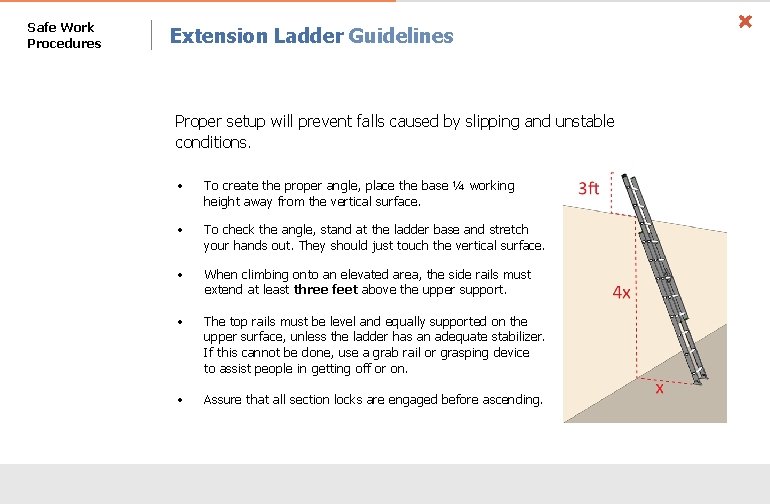
Safe Work Procedures Extension Ladder Guidelines Proper setup will prevent falls caused by slipping and unstable conditions. • To create the proper angle, place the base ¼ working height away from the vertical surface. • To check the angle, stand at the ladder base and stretch your hands out. They should just touch the vertical surface. • When climbing onto an elevated area, the side rails must extend at least three feet above the upper support. • The top rails must be level and equally supported on the upper surface, unless the ladder has an adequate stabilizer. If this cannot be done, use a grab rail or grasping device to assist people in getting off or on. • Assure that all section locks are engaged before ascending.

Safe Work Procedures Extension Ladder Height Requirements Suggested length: • Single ladder or single section: <30 ft • Two-section ladder: <48 ft • Ladder longer than two sections: <60 ft To assure load-bearing strength, ladder sections must have a specified overlap that is secured by stops. Overlap Requirements Ladder length Overlap length 0 – 36 feet 36 – 48 feet 48 – 60 feet 5 feet
Safe Work Procedures Proper Work Practices • Only use ladders for their designed purpose. • Only one person is allowed on the ladder at a time. • At higher levels, secure yourself to the ladder with safety belt or positioning strap. • Do not use ladders when you are ill, tired, or taking medication that impairs alertness or coordination. • On stepladders, do not step on cross bracings, unless the ladder has steps on both sides. • On extension ladders, do not stand on the top three rungs. • Do not move a ladder with a person on it.
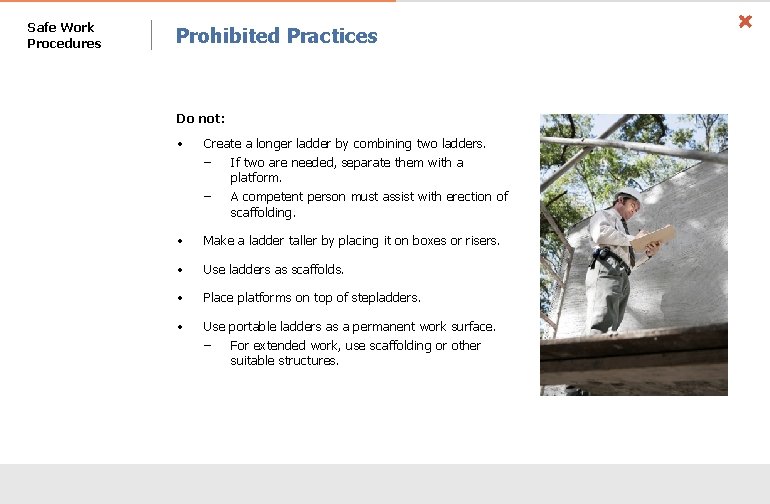
Safe Work Procedures Prohibited Practices Do not: • Create a longer ladder by combining two ladders. ‒ If two are needed, separate them with a platform. ‒ A competent person must assist with erection of scaffolding. • Make a ladder taller by placing it on boxes or risers. • Use ladders as scaffolds. • Place platforms on top of stepladders. • Use portable ladders as a permanent work surface. ‒ For extended work, use scaffolding or other suitable structures.
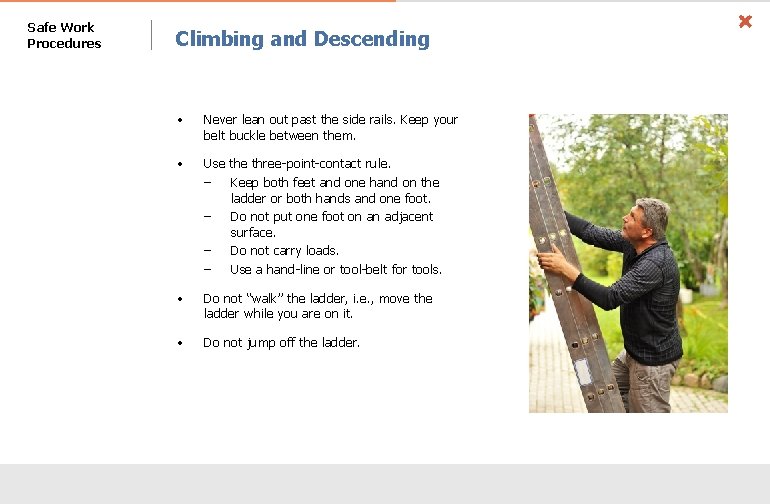
Safe Work Procedures Climbing and Descending • Never lean out past the side rails. Keep your belt buckle between them. • Use three-point-contact rule. – Keep both feet and one hand on the ladder or both hands and one foot. – Do not put one foot on an adjacent surface. – Do not carry loads. – Use a hand-line or tool-belt for tools. • Do not “walk” the ladder, i. e. , move the ladder while you are on it. • Do not jump off the ladder.
Safe Work Procedures Transportation and Storage Use caution while transporting and storing ladders. • Prior to lifting the ladder, clear the path of travel and set points. • Lift with your legs, not your back. • If alone, lift the ladder from the middle. • Get help if needed. • Store ladders where they are protected from damage, such as away from direct sunlight and water. • When storing ladders vertically, hang them near the top rung. • For horizontal storage, provide hooks every six feet and near both ends.
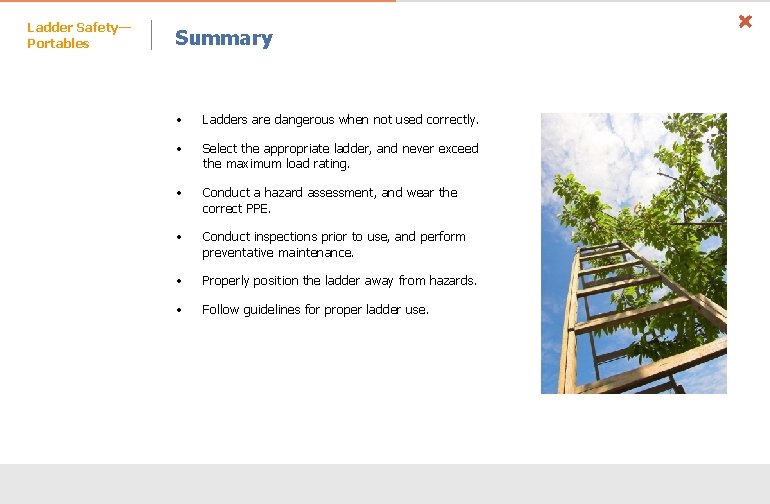
Ladder Safety— Portables Summary • Ladders are dangerous when not used correctly. • Select the appropriate ladder, and never exceed the maximum load rating. • Conduct a hazard assessment, and wear the correct PPE. • Conduct inspections prior to use, and perform preventative maintenance. • Properly position the ladder away from hazards. • Follow guidelines for proper ladder use.
- Slides: 38