
Labrador Sea freshening linked to Beaufort Gyre freshwater
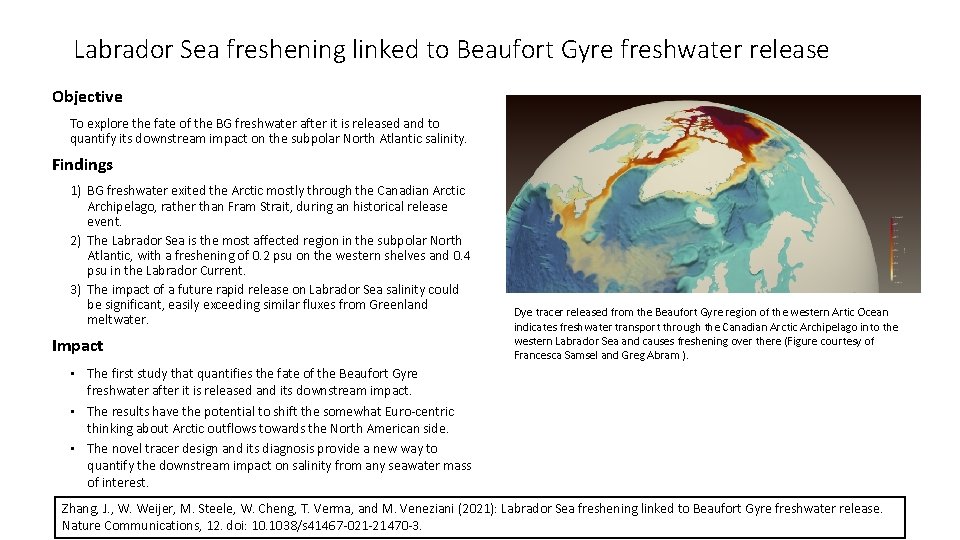
Labrador Sea freshening linked to Beaufort Gyre freshwater release Objective To explore the fate of the BG freshwater after it is released and to quantify its downstream impact on the subpolar North Atlantic salinity. Findings 1) BG freshwater exited the Arctic mostly through the Canadian Arctic Archipelago, rather than Fram Strait, during an historical release event. 2) The Labrador Sea is the most affected region in the subpolar North Atlantic, with a freshening of 0. 2 psu on the western shelves and 0. 4 psu in the Labrador Current. 3) The impact of a future rapid release on Labrador Sea salinity could be significant, easily exceeding similar fluxes from Greenland meltwater. Impact Dye tracer released from the Beaufort Gyre region of the western Artic Ocean indicates freshwater transport through the Canadian Arctic Archipelago into the western Labrador Sea and causes freshening over there (Figure courtesy of Francesca Samsel and Greg Abram ). • The first study that quantifies the fate of the Beaufort Gyre freshwater after it is released and its downstream impact. • The results have the potential to shift the somewhat Euro-centric thinking about Arctic outflows towards the North American side. • The novel tracer design and its diagnosis provide a new way to quantify the downstream impact on salinity from any seawater mass of interest. Zhang, J. , W. Weijer, M. Steele, W. Cheng, T. Verma, and M. Veneziani (2021): Labrador Sea freshening linked to Beaufort Gyre freshwater release. Nature Communications, 12. doi: 10. 1038/s 41467 -021 -21470 -3.
- Slides: 1