
Labour Statistics Sources and Uses Deborah Sunter May
Labour Statistics: Sources and Uses Deborah Sunter May, 2002 Labour Statistics Division, Statistics Canada CAPDU/Ontario DLI Training
Labour Statistics l. A brief outline of the main sources and uses l Access to data: micro and aggregate l International data sets
The Importance of the labour market l The labour market plays a central role in the household, business and government sectors of the economy: » Major source of income (during employment and in retirement) at the aggregate, household and personal level » Major factor of production and growth (productivity) » Major distributive mechanism (employment, unemployment, hours of work, wage rates and taxes)
Labour Statistics: key economic indicators » Input to monetary policy – tight labour market and increasing wages could signal inflationary pressures and provoke an increase in interest rates » Input to economic and social policy and programs – Job creation programs – Training programs » Employment insurance benefits – Unemployment rates by region used to determine eligibility and duration of benefits » Input to System of National Accounts – Labour Income (GDP)
Conceptual frameworks for labour market data l System of National Accounts » boundaries of economic activity » labour income » productivity l International Labour Organization » standards for measuring employment, unemployment and underemployment

framework of labour market
Cross-sectional sources of labour market data l Labour Force Survey (monthly) l Survey of Employment, Payrolls and Hours (monthly) l Employment Insurance Statistics (monthly) l Census (every five years)

Overview of the LFS l l l Monthly household sample survey Multi-stage area sample Sample size of 53, 000 households across country (110, 000 LFS interviews per month) Households in the sample for 6 months First interview is usually done face to face, interviews 2 -6 by telephone (from RO CATI sites) Proxy responses are accepted
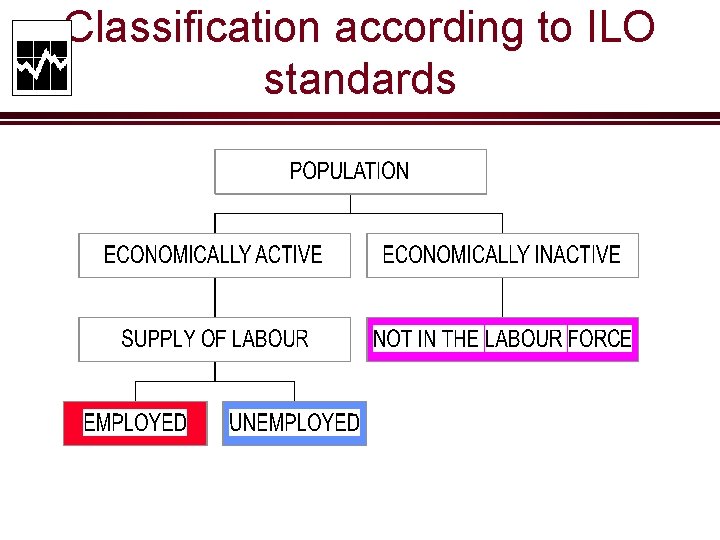
Classification according to ILO standards
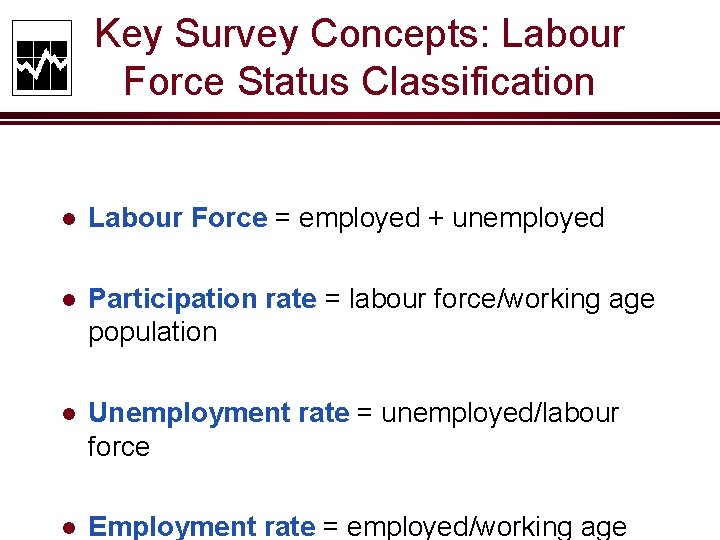
Key Survey Concepts: Labour Force Status Classification l Labour Force = employed + unemployed l Participation rate = labour force/working age population l Unemployment rate = unemployed/labour force l Employment rate = employed/working age
Defining Unemployment l Not employed in reference week and available for work and either: » looked for work in last four weeks, or » has job to start in next four weeks, or » on temporary layoff (has recall date or firm indication of recall to same job)
Other Important Labour Market Indicators from the LFS l l l l l Age, Sex, Marital status, Family structure, Education and School attendance Distribution of work (hours) Involuntary part-time (underemployment) Industry, Occupation, Class of worker (paid employee vs. self-employed) Wages, union coverage, job security (type of temporary job) Worker turnover (new hires and permanent separations) Duration of unemployment and reason for job loss Retirement age Supplementary measures of unemployment
Employment Insurance Statistics l Administrative data from HRDC on: » number of beneficiaries (by type) » benefits paid » new claims
Relationship between LFS and Employment Insurance l Unemployment rates by region are used by Employment Insurance program to: » determine the number of hours a person must work to become eligible for benefits » determine the period for which benefits can be collected
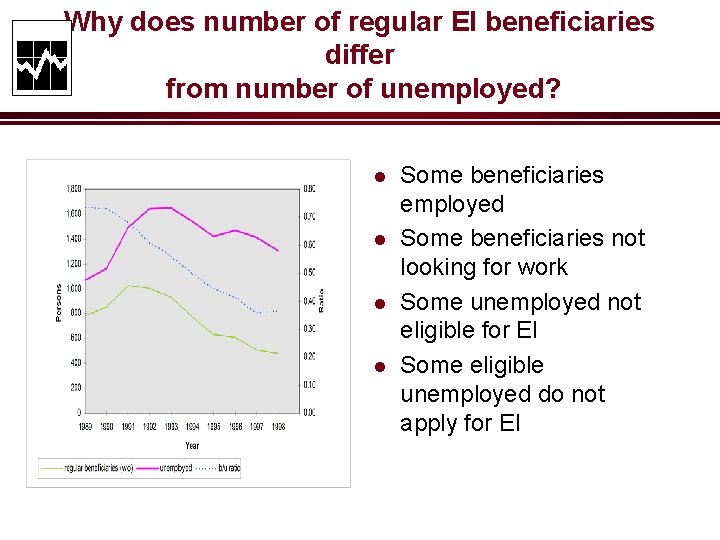
Why does number of regular EI beneficiaries differ from number of unemployed? l l Some beneficiaries employed Some beneficiaries not looking for work Some unemployed not eligible for EI Some eligible unemployed do not apply for EI
Survey of Employment, Payrolls and Hours: Objectives l To measure monthly levels and movements in payroll employment by detailed industry l To produce estimates of employee earnings » average hourly earnings » average weekly earnings
SEPH: Methodology l Administrative data » Revenue Canada payroll deduction forms » Census of PD accounts (almost one million) – payroll employment, monthly payroll l Business Payroll Survey » 11, 000 establishments from Statistics Canada register of businesses – types of employees, types of payment, hours paid
SEPH Variables: by detailed industry, province and employment size l l Payroll jobs – salaried, hourly, other Average weekly earnings – salaried, hourly, other Average weekly hours – salaried, hourly Average hourly earnings – hourly paid employees
SEPH: Main uses l l Calculation of Labour Income estimates in National Accounts Monitor inflationary pressures Determination of wage increases in contracts and settlements Monitor trends in payroll employment and earnings for detailed industries (used in monthly GDP)
Census labour market data l l l Census conducted every five years 1/5 households get “long form” Included in long form are labour market questions on: » labour force status in census week (employed, hours of work, unemployed, not in labour force) » occupation, industry, and class of worker in current or most recent job held in last 16 months (experienced labour force)
Census: other relevant variables l l l l l Ethnicity Aboriginal status (on and off reserve) Language of work Educational attainment and major field of study Disability Immigration status and date Income by source in previous year Family level information Unpaid work (child, eldercare and house/yard work)
Census: strengths 20% sample of entire country l Best source of data on: l » small groups » small areas » detailed classifications
Other relevant cross-sectional surveys l Skills, returns to education, training » National Graduate Surveys » International Literacy Survey » Adult Education and training Surveys Aboriginal Peoples Survey (1991, 2001) l Participation and Activity Limitation Surveys (1986, 1991, 2001) l General Social Surveys: l » Work, Education and Retirement (1989,
Labour market dynamics l Longitudinal data to measure flows, events, outcomes, causal factors: » Survey of Labour and Income Dynamics » Workplace and Employees Survey » Youth in Transitions Survey » Longitudinal Survey of Immigrants
Survey of Labour and Income Dynamics (SLID) Objectives • Measure the changes over time in economic well-being of people and households and the factors influencing these changes • Provide time series and dynamic information on family and personal income by source (eg. extent of low income, movement into and out of low income)
SLID Design Highlights l Sub-sample of respondents rotating out of the LFS Detailed Labour market and income data together A wide variety of additional “explanatory” variables Family make-up and changes are key l Timeframe l l l
SLID Content l l Over 1000 variables Database organised into logically related groups of variables Data from all waves are contained on the same file Each new data file incorporates information from past files
How SLID content is organised Person is at core l l For each person, four broad categories of variables: l labour l income and wealth l education l personal characteristics Each broad category further subdivided. .
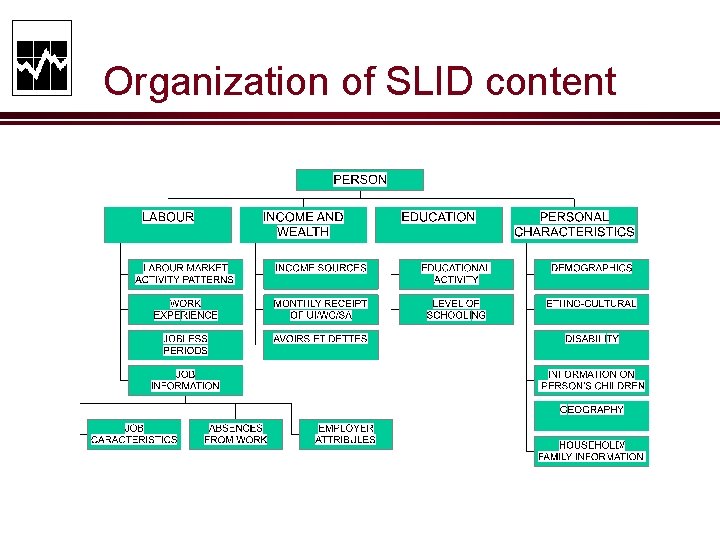
Organization of SLID content
SLID research: Employment and Unemployment Dynamics Examples Ø- To what extent are long spells of unemployment experienced by the same individuals? Ø- Why do people withdraw from the labour market Ø- What precedes a transition into selfemployment?
SLID Research: Life-cycle labour market transitions Examples Ø- Transitions from school to work Ø- Transitions from work to retirement Ø- Work absences taken to raise children Ø- What are typical life-cycle patterns in Canada today? Ø- What are the subsequent activities of high school drop-outs, and what precedes a return to school?
SLID Research: Job Quality Examples Ø- Wage differences between men and women Ø- Job benefits Ø- Underemployment Ø- Career change Ø- Career advancement and earnings Ø- Job polarization, e. g. , in terms of wages and hours worked
SLID Research: Family Economic Mobility Examples ØHow stable is family income? Ø- What proportion of families experience a significant improvement or deterioration in income between two points in time? Ø- What are the determinants of these changes? Ø- How important are changes in family composition (divorce, remarriage) in explaining a change in financial well-being?
SLID Research: Dynamics of Low Income Examples Ø- Identifying the existence or otherwise of a “persistently poor” sub-population, and associated characteristics Ø- Studying flows into and out of low income in relation to government transfer programs and taxation
SLID research: Life events and family changes Example ã What are the family’s economic circumstances preceding a marriage break-up, and what are they for each spouse and any children following a separation?
SLID Research: Education advancement and combining school and work Examples ØFinancial well-being, or family responsibilities, of people pursuing postsecondary education ØTo what degree do high school or postsecondary students combine work and school ØWhat is the labour market involvement of high school drop-outs and what precedes a return to school
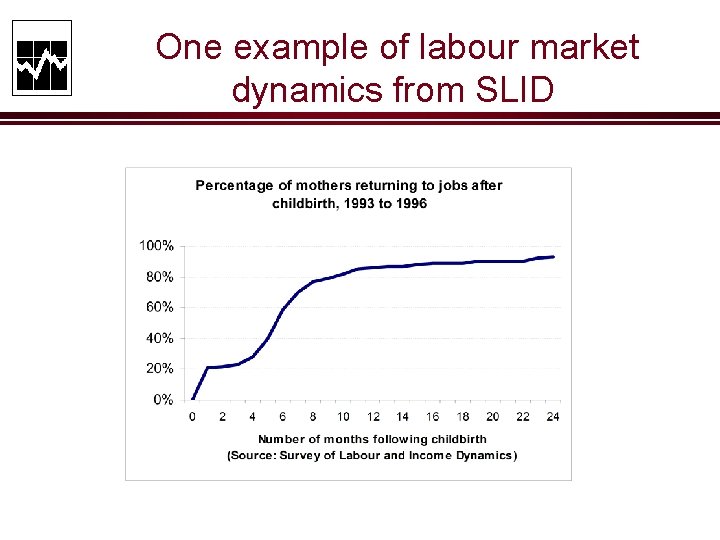
One example of labour market dynamics from SLID
WES - Objectives l An ongoing survey that links events occurring in workplaces with worker outcomes, and worker characteristics with workplace outcomes l Understand changes in the workplace in the context of global competition, technological changes and the drive to improve human capital
WES - Design l Two linked longitudinal surveys » Sample of 7, 000 employers – selected from Business Register – followed for up to six years – interviewed at workplace » Sample of 25, 000 employees – followed for two years – interviewed from a CATI site
WES - Uses l l Evaluate business and employment strategies and their impact on productivity and profitability Better understand how technology and training affect work, pay and job security Monitor change in workplace practices Design policies and programs based on evidence from survey
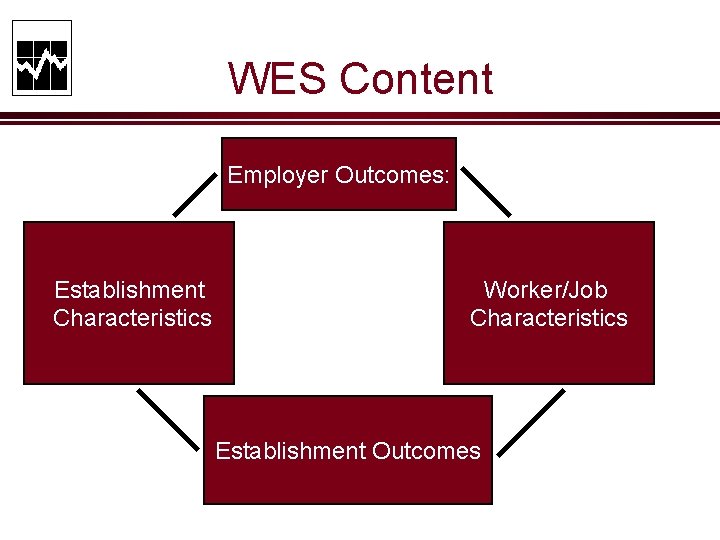
WES Content Employer Outcomes: Establishment Characteristics Worker/Job Characteristics Establishment Outcomes
WES Establishment characteristics l l l size, industry revenues and expenditures subjective measures of productivity, profitability type of market in which firm competes unionization employees types (full/part-time, casual) technology implemented business strategies compensation schemes training provisions organizational change
WES Employee/job characteristics l l l Age/sex Education Occupation, management responsibilities Work history, tenure Family characteristics Unionization Use of technology Participation in decision making Wage and fringe benefits Work schedule/arrangements Training taken
Recent analytical releases from WES Information Technology Adopters: Characteristics and Activities of Their Workers Human Resource Practices: Employer and Employee Perspectives on the Nature of Work The Quest for Workers: A New Portrait of Job Vacancies in Canada Workplace Computer Technology Implementation: Effects on Training and Employment
Other relevant longitudinal data sets l Skills, returns to education, training » Youth in transition survey l Immigration » IMDB (Immigration data base) – links immigration and tax records from 1980 on – address need for data on performance and impact of immigration policies and programs » LSIC (Longitudinal survey of Immigrants to Canada) l Work and Health » Canadian Community Health Survey – work and stress
Non STC labour data l Worker Health and Safety » The Association of Workers Compensation Boards of Canada: » www. AWCBC. ORG – statistics on number of Accepted Timeloss Injuries and Fatalities by Province, through time.
Labour data from Labour Canada l Work stoppages – employer, location and union – issues – number of workers – start date – end date l Wage Settlements – Industry and employer – Number of employees – First year adjustment – Duration and expiry date
Access to labour market data l Analytical articles (Perspectives on labour and income, CEO, Canadian Social Trends, Education Quarterly etc. ) Public Use Microdata files l Research Data Centres l Remote Access l Deemed employee status l Aggregate data l » CANSIM, publications, CD ROMs
LFS Products and services Labour Force Information (Cat. 71 -001 -PPB), monthly l Perspectives on Labour and Income (Cat. 75001) l Historical Labour Force Statistics (CD-ROM 71 F 0004 XCB) l CANSIM l Custom requests ($) l Public Use Microdata files (DLI) For more information on LFS, SEPH, WES and l
SLID Data Products Ø Ø Public-use microdata files (75 M 0001 GPE) Internal microdata files Standard tables on CD-ROM (75 M 0001 XCB) International equivalence file (http: //wwwluman. cornell. edu/pam/gsoep/equivfil. htm) For more information on SLID data products, contact the Client Services Section at
Labour Data in Research Data Centres Example of data sets available: · National Population Health Survey (NPHS) · National Longitudinal Survey of Children and Youth (NLSCY) · Survey of Labour and Income Dynamics (SLID) · Workplace and Employee Survey (WES): 1999 Employee file · Youth in Transition Survey (YITS)
International Sources of Labour Statistics l ILO (International Labour Organization) » KILM CD ROM l OECD (Organization for Economic Cooperation and Development) » Labour Market Statistics on CD-ROM l BLS (Bureau of Labour Statistics, USA)
ILO: KILM CD ROM l 20 key indicators of the labour market » LF participation rates, employment rates, inactivity rates » Employment by sector and class of worker » Part-time workers, time-related underemployment, annual hours worked person » Unemployment, youth unemployment, Long-term unemployment, Unemployment by educational attainment » Educational attainment and illiteracy » Occupation wage and earnings indices, hourly compensation costs » Labour productivity and unit labour costs
OECD Labour Market Statistics l On-line and CD-ROM » » » » » annual hours of work Earnings distribution for Full-time workers by gender Minimum wage series Compensation and wage reates taxation of wages public expenditures on labour market programmes gross and net UI benefits replacement rates strictness of employment protection legislation trade union density and collective bargaining coverage
BLS: Foreign Labor Statistics l On-line (no charge) » CPI » Real GDP per capita and per worker » Hourly compensation » Comparative unemployment rates
International Statistics: issues l Use: » provides “natural experiment” to explore factors underlying different labour market behaviours and outcome » provides performance benchmarks l Issues: » Comparability of statistics » Important institutional and cultural differences must be taken into account
- Slides: 56