
Labour Relations N 6 Module 1 The labour

Labour Relations N 6

Module 1: The labour relations system TERMINOLOGY A system usually consists of the following parts or components: • The groups of people who are involved; • The processes that take place within the system; • The legal framework/rules that ensure that the system runs smoothly. www. futuremanagers. com

Module 1: The labour relations system (continued) THE LABOUR RELATIONS SYSTEM www. futuremanagers. com
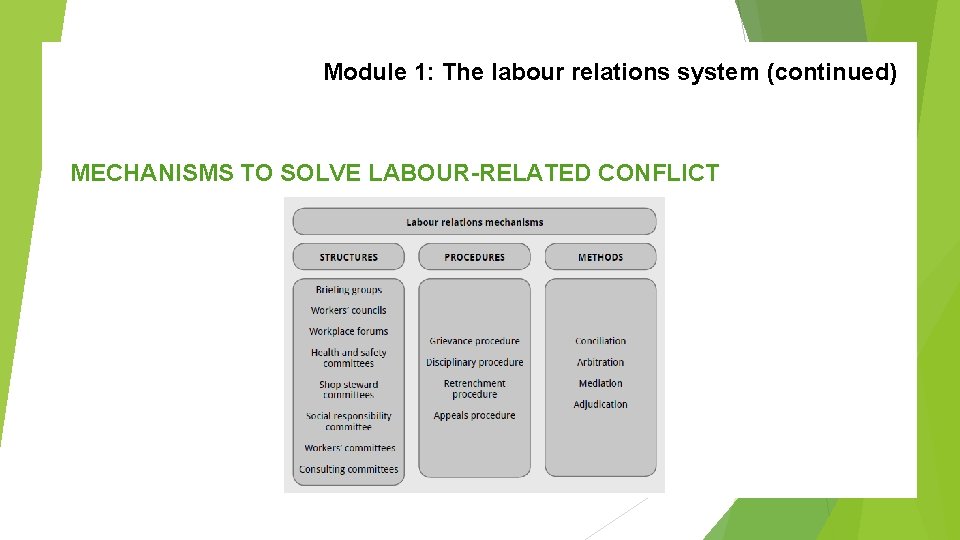
Module 1: The labour relations system (continued) MECHANISMS TO SOLVE LABOUR-RELATED CONFLICT www. futuremanagers. com
Module 1: The labour relations system (continued) AGREEMENTS The purpose of collective bargaining is to reach an agreement. Agreements are usually concluded after: • Constructive negotiations have been concluded. • Final offers have been tabled. • Draft agreements have been formulated. • Feedback has been received on a draft agreement. • Draft agreement is signed as the final agreement. www. futuremanagers. com
Module 2: Handling conflict TERMINOLOGY Conflict: A long-standing struggle between people as a result of different ideas, interests, needs or demands. www. futuremanagers. com
Module 2: Handling conflict (continued) PERSONAL CONFLICT VERSUS CONFLICT IN THE WORKPLACE • Examples are rivalries, jealousies, role definitions, and struggles for power and favour, mutual dislike or personality clash. • Caused by the opposition of needs, values and interests between people. • Comes about when aspirations/goals/needs, etc. cannot be achieved simultaneously, or a difference of opinion exists. • Results in avoidance of other people/individuals, denial and slander, gossip and other socially disruptive tactics. www. futuremanagers. com
Module 2: Handling conflict (continued) CAUSES OF CONFLICT IN THE WORKPLACE • Scarce or limited resources within an organisation. • Different needs (aspirations), goals, attitudes and interests between employer and employee. • Different attitudes to work between employer and employee. • Differences in style between individuals and leadership. • Different values and perceptions between individuals. • Role conflict between employer and employee. www. futuremanagers. com
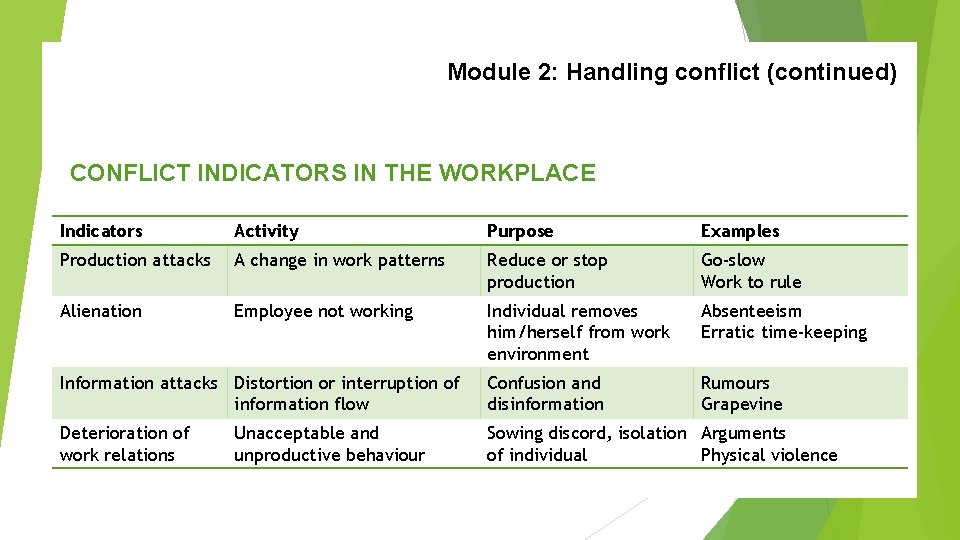
Module 2: Handling conflict (continued) CONFLICT INDICATORS IN THE WORKPLACE Indicators Activity Purpose Examples Production attacks A change in work patterns Reduce or stop production Go-slow Work to rule Alienation Employee not working Individual removes him/herself from work environment Absenteeism Erratic time-keeping Information attacks Distortion or interruption of information flow Confusion and disinformation Rumours Grapevine Deterioration of work relations Sowing discord, isolation Arguments of individual Physical violence www. futuremanagers. com Unacceptable and unproductive behaviour
Module 2: Handling conflict (continued) IMPORTANCE OF SOLVING CONFLICT IN THE WORKPLACE • Conflict behaviour can have many negative results, and it is therefore important to solve conflict in the workplace. • Time and energy is diverted from the main issue, namely work. • Decisions may be delayed while engaging in conflict. • Deadlocks are created during decision-making when conflict is present. • There is interference with the listening process during conflict. • Outbursts of anger that disrupt work happen during conflict. www. futuremanagers. com
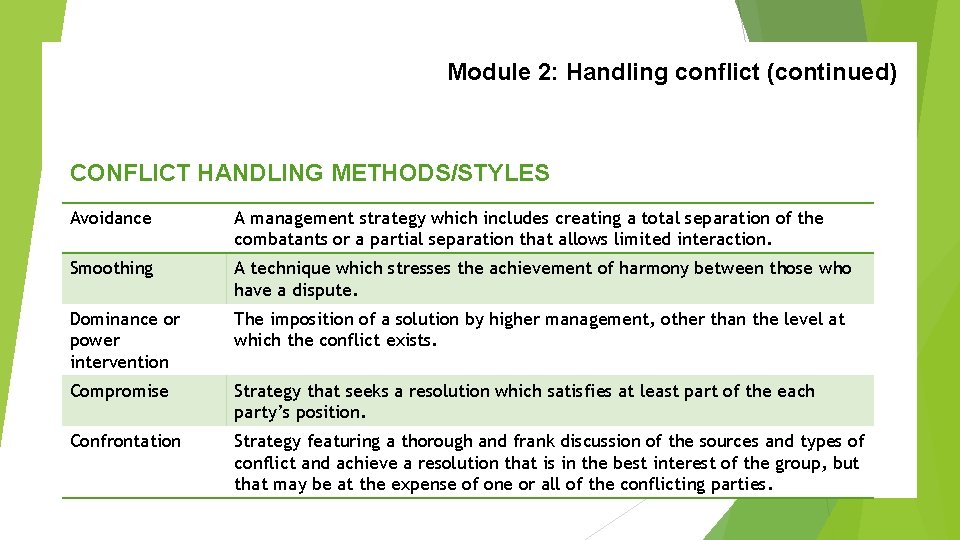
Module 2: Handling conflict (continued) CONFLICT HANDLING METHODS/STYLES Avoidance A management strategy which includes creating a total separation of the combatants or a partial separation that allows limited interaction. Smoothing A technique which stresses the achievement of harmony between those who have a dispute. Dominance or power intervention The imposition of a solution by higher management, other than the level at which the conflict exists. Compromise Strategy that seeks a resolution which satisfies at least part of the each party’s position. Confrontation Strategy featuring a thorough and frank discussion of the sources and types of conflict and achieve a resolution that is in the best interest of the group, but that may be at the expense of one or all of the conflicting parties. www. futuremanagers. com
Module 3: Collective bargaining DEFINITION OF COLLECTIVE BARGAINING Collective bargaining is a process, made necessary by a conflict between two parties. The two parties are dependant on one another and have a common interest. The process aims to achieve a balance between the two parties especially in the area of power. www. futuremanagers. com
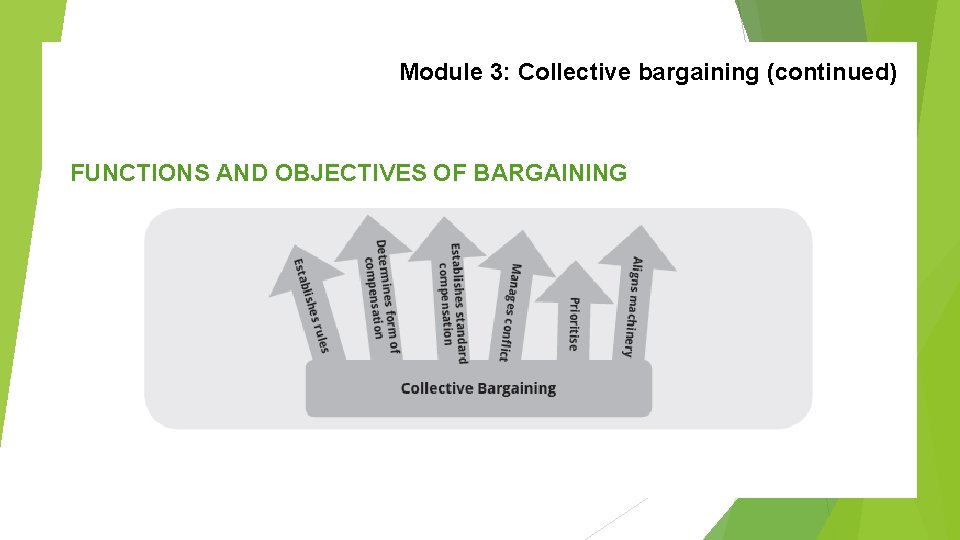
Module 3: Collective bargaining (continued) FUNCTIONS AND OBJECTIVES OF BARGAINING www. futuremanagers. com
Module 3: Collective bargaining (continued) EXTERNAL ENVIRONMENTAL FACTORS/CONTEXT External factors/context are: • The economy. • Politics. • Technological innovations/developments. • Social influences (including demographic changes and the media). • Legal environment (including public policy). www. futuremanagers. com
Module 3: Collective bargaining (continued) TYPES/STYLES OF BARGAINING Various types or styles of collective bargaining can be identified. There are four styles of collective bargaining, namely: • Distributive bargaining; • Integrative bargaining; • Attitudinal structuring; and • Intra-organisational bargaining. www. futuremanagers. com
Module 3: Collective bargaining (continued) BARGAINING STRUCTURES There are two very different types of bargaining structures. When using the word “structure”, a stable and permanent process is described, not a physical type of house or building. The two structures are called: • Centralised bargaining structure. • Decentralised bargaining structure. www. futuremanagers. com
Module 3: Collective bargaining (continued) NECESSITY FOR RECOGNITION A recognition agreement is the first type of agreement to be reached between parties during negotiation. A recognition agreement is usually negotiated between a single employer and a single union. A union will approach an employer if it wishes to engage in collective bargaining with the employer. Before this can take place, however, the employer will have to recognise the union formally and thereby establish the relationship. www. futuremanagers. com
Module 3: Collective bargaining (continued) FACTORS/REQUIREMENT FOR RECOGNITION • Sufficient representation (numbers); • Registration; • Power of union; • Level of conflict; and • Influence of employees. www. futuremanagers. com
Module 3: Collective bargaining (continued) RESULTS/OUTCOMES OF COLLECTIVE BARGAINING • Establishes a legal relationship between parties. • Sets guidelines for all those bound by the agreement. • Establishes consistent application of agreement. • Prevents misinterpretation of issues agreed upon. • Regulates conduct of employers and employees bound by the agreement. • Establishes terms and conditions of relationship. • Provides dispute resolution procedure. www. futuremanagers. com
Module 3: Collective bargaining (continued) BARGAINING COUNCILS A Bargaining Council will come into existence, when more than one employer or more than one union wishes to enter into negotiations collectively with one another. www. futuremanagers. com
Module 4: Dispute and dispute resolution INTRODUCTION Problems and issues between an employer and employee(s) do not always lead to disputes, and can be settled in a friendly yet formal manner. When a problem or an issue is not resolved, however, it could lead to work stoppages of some sort and eventually result in the relationship between the employer and employee(s) being damaged or destroyed altogether. www. futuremanagers. com
Module 4: Dispute and dispute resolution (continued) DEFINITION OF A DISPUTE A dispute is a continuous disagreement between the employer on the one hand the employees and their trade unions on the other hand on a matter of common interest which is work related, or any processes and structures established to maintain the relationship. www. futuremanagers. com
Module 4: Dispute and dispute resolution (continued) TYPES OF DISPUTE Two types of disputes exist, namely: • Dispute of right; and • Dispute of interest. www. futuremanagers. com
Module 4: Dispute and dispute resolution (continued) AIMS OF DISPUTE SETTLEMENT PROCEDURES Aims of dispute include: • To protect the public interest. • To protect economic activity. • Maintain industrial peace. • To minimise or eradicate the use of industrial action. • To gather information regarding the dispute. • To calm parties down before industrial action is started. www. futuremanagers. com
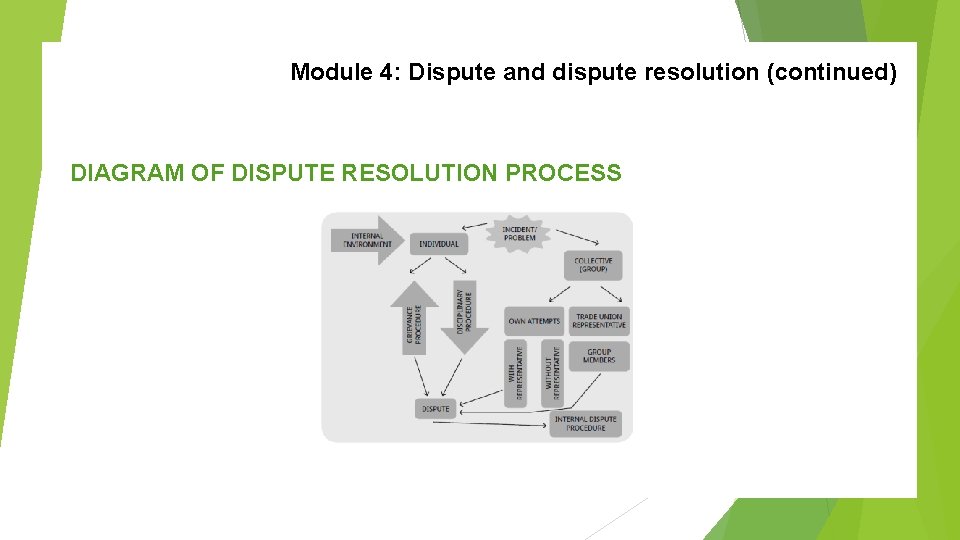
Module 4: Dispute and dispute resolution (continued) DIAGRAM OF DISPUTE RESOLUTION PROCESS www. futuremanagers. com
Module 4: Dispute and dispute resolution (continued) METHODS OF DISPUTE RESOLUTION Whichever method of dispute resolution is followed; affidavits, documents and testimony from both parties and witnesses must be gathered. The cause and the seriousness of the dispute must be determined and alternatives to solving the problem must be identified. If no agreement seems possible, new approaches and perspectives have to be drawn up; and in the situation where conflict is so extreme and no further negotiation seems possible, a third party must be involved. www. futuremanagers. com
Module 4: Dispute and dispute resolution (continued) DISPUTE RESOLUTION METHODS/PROCEDURES • Internal procedures; • Third party assistance during private dispute resolution; • Dispute resolution procedures established by legislation. www. futuremanagers. com
Module 4: Dispute and dispute resolution (continued) ROLE-PLAYERS IN DISPUTE RESOLUTION The role of the negotiator is to help parties resolve disputes. He/she must assist the parties to identify alternatives, clarify misunderstandings and to reach an agreed-upon agreement. Mediators facilitate discussions and communication between parties so that a settlement can be reached which will solve the differences. An arbitrator reviews testimony and evidence of the parties to a dispute and delivers a decision that may include an award of money. www. futuremanagers. com
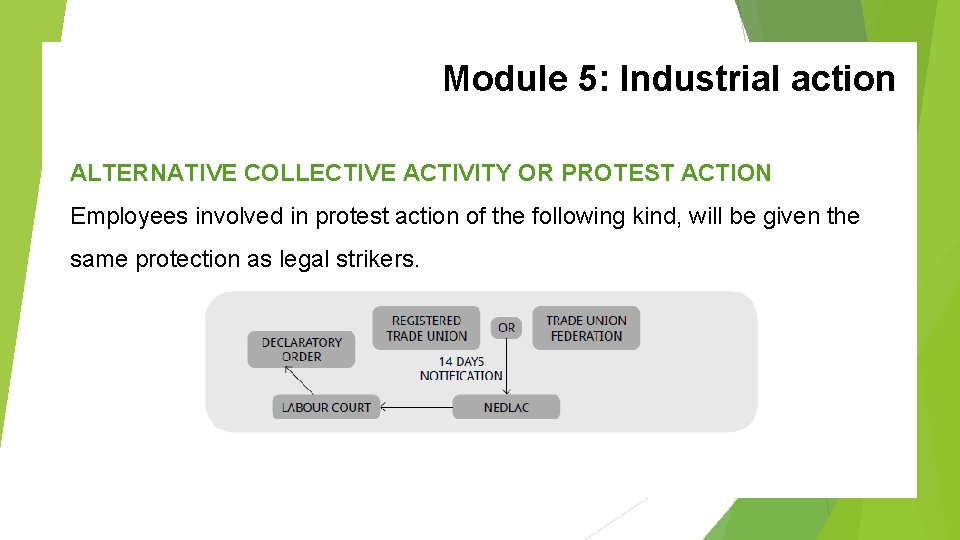
Module 5: Industrial action ALTERNATIVE COLLECTIVE ACTIVITY OR PROTEST ACTION Employees involved in protest action of the following kind, will be given the same protection as legal strikers. www. futuremanagers. com
Module 5: Industrial action (continued) SLOWDOWNS There are two types of slowdowns: • Go-slow; and • Work-to-rule. www. futuremanagers. com
Module 5: Industrial action (continued) PRODUCT/SERVICE BOYCOTT It is action that is undertaken by the consumers of a product/service and not the employees. The consumers of a product/ service will be persuaded not to buy or use the product or service. It is a form of consumer activism undertaken for social or political reasons; or to raise awareness in the public eye. www. futuremanagers. com
Module 5: Industrial action (continued) LOCKOUTS BY THE EMPLOYER An employer may withhold labour reactively from employees if they do not agree with proposals or demands. This could also take place where the employer fears damage to equipment and infrastructure as a result of violence. Lockouts are not frequent. www. futuremanagers. com
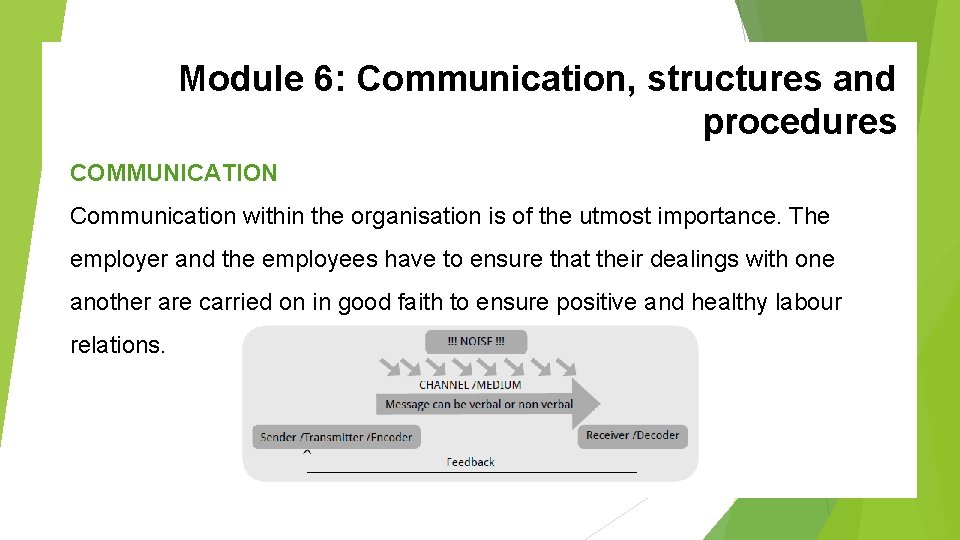
Module 6: Communication, structures and procedures COMMUNICATION Communication within the organisation is of the utmost importance. The employer and the employees have to ensure that their dealings with one another are carried on in good faith to ensure positive and healthy labour relations. www. futuremanagers. com
Module 6: Communication, structures and procedures (continued) STRUCTURES The reasons why organisational structures are effective are: • In information lies power and plant-level committee structures will deliver and permeate information. • Plant-level committees provide an opportunity for face-to-face vertical communication between management and the employees. • Downward communication ensures information flow and explanations in the format and language that employees can understand. www. futuremanagers. com
Module 6: Communication, structures and procedures (continued) PROCEDURES A grievance occurs when an unhappiness or dissatisfaction regarding a situation is made known in a formal way by an employee. The unhappiness is in connection with an employee’s work, workplace conditions or treatment at work which the employee regards as unfair or unjust. www. futuremanagers. com
- Slides: 35