
Labour market integration of immigrants and their children
Labour market integration of immigrants and their children Key findings from the OECD country studies and related work Thomas Liebig International Migration Division Directorate for Employment, Labour and Social Affairs, OECD Cedefop, Thessaloniki, 29 September 2011
Overview I. Introduction II. Key findings III. Good practices for the labour market inclusion of immigrants and their children

The OECD reviews on the labour market integration of immigrants and their children Ø Country reviews for 11 OECD countries ( « Jobs for immigrants » (Vol. 1 and 2, Vol. 3 forthcoming)) Ø Taking a human capital perspective Ø How do the skills and experience of immigrants compare with those of the nativeborn? Ø Are the skills of immigrants « equivalent » to those of the native-born who have the same formal qualification levels – and does this matter? Ø What means are available to immigrants to « transmit » / « communicate » their skills and experience to employers? Ø Native-born children of immigrants (“second generation”) Ø Growing presence in the labour market in many OECD countries Ø Expectance of outcomes that are at least similar to those of the children of natives with the same socio-economic background Ø “Benchmark” for labour market integration Ø Employment rate as the key integration indicator – not only for labour market integration
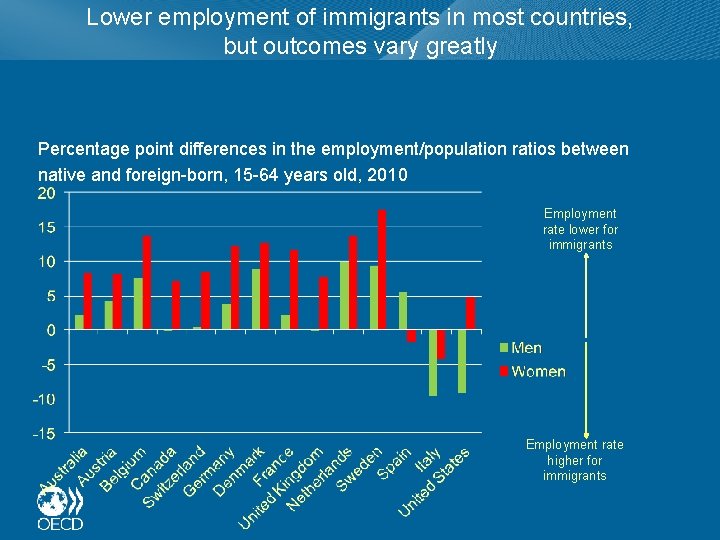
Lower employment of immigrants in most countries, but outcomes vary greatly Percentage point differences in the employment/population ratios between native and foreign-born, 15 -64 years old, 2010 Employment rate lower for immigrants Employment rate higher for immigrants
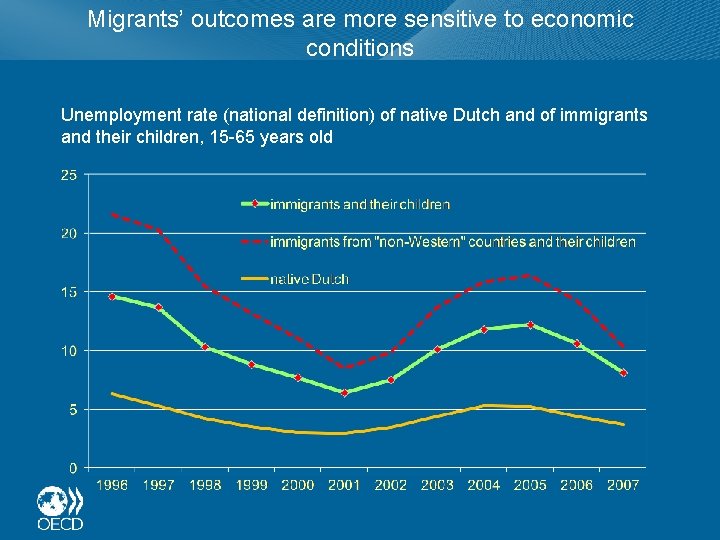
Migrants’ outcomes are more sensitive to economic conditions Unemployment rate (national definition) of native Dutch and of immigrants and their children, 15 -65 years old
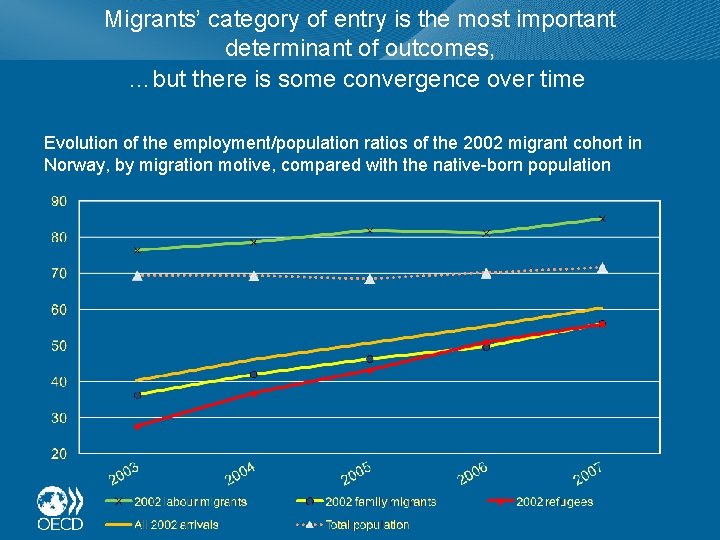
Migrants’ category of entry is the most important determinant of outcomes, …but there is some convergence over time Evolution of the employment/population ratios of the 2002 migrant cohort in Norway, by migration motive, compared with the native-born population
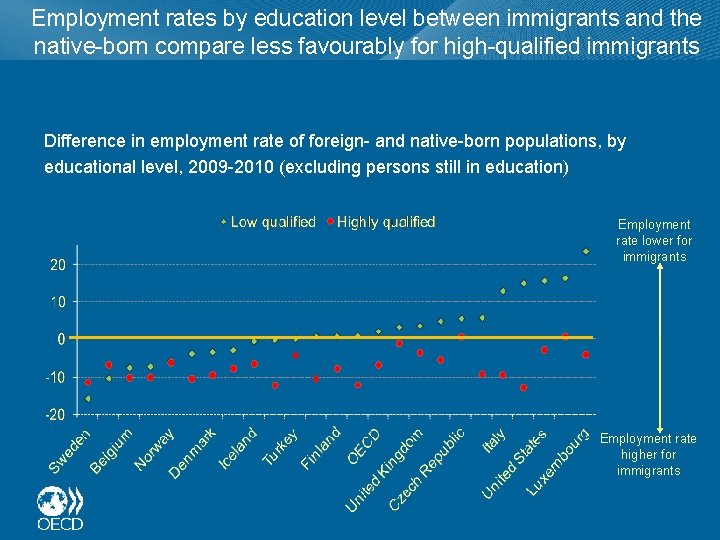
Employment rates by education level between immigrants and the native-born compare less favourably for high-qualified immigrants Difference in employment rate of foreign- and native-born populations, by educational level, 2009 -2010 (excluding persons still in education) Employment rate lower for immigrants Employment rate higher for immigrants
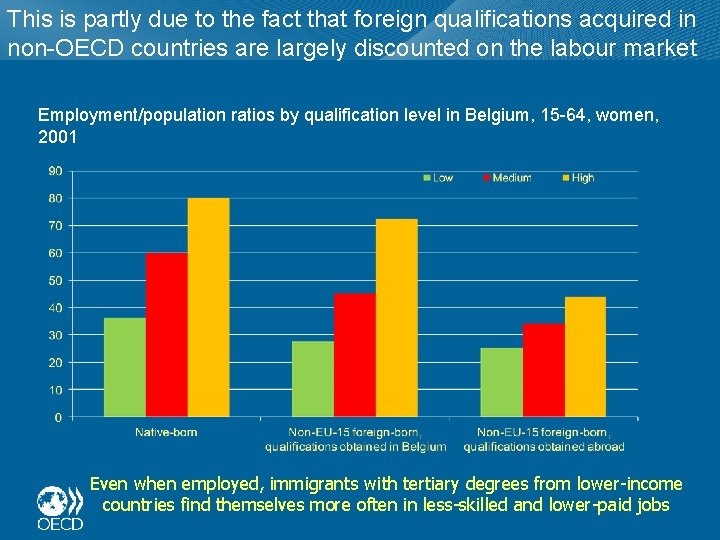
This is partly due to the fact that foreign qualifications acquired in non-OECD countries are largely discounted on the labour market Employment/population ratios by qualification level in Belgium, 15 -64, women, 2001 Even when employed, immigrants with tertiary degrees from lower-income countries find themselves more often in less-skilled and lower-paid jobs
Other observations concerning the labour market integration of immigrants Ø Generally, immigrants encounter problems in entering the labour market, but good wage progression once employed Ø Early labour market entry is an important determinant of long-term labour market outcomes Ø The impact of active labour market policy is not necessarily the same on immigrants and on the native-born Ø Programmes which provide a first step into the labour market (work experiences measures) tend to be especially effective, in combination with (language) training and personalised counselling Ø Wage subsidies have often met with some success, but they are rarely used Ø Well-designed mentorship programmes proved to be both effective and cost-efficient Ø Accreditation of prior learning (APL) seems to be a promising tool, but is rarely used for immigrants
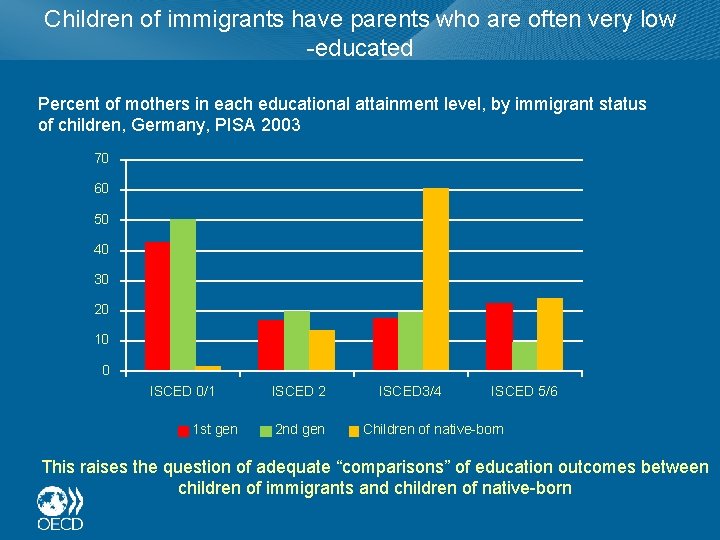
Children of immigrants have parents who are often very low -educated Percent of mothers in each educational attainment level, by immigrant status of children, Germany, PISA 2003 70 60 50 40 30 20 10 0 ISCED 0/1 1 st gen ISCED 2 2 nd gen ISCED 3/4 ISCED 5/6 Children of native-born This raises the question of adequate “comparisons” of education outcomes between children of immigrants and children of native-born
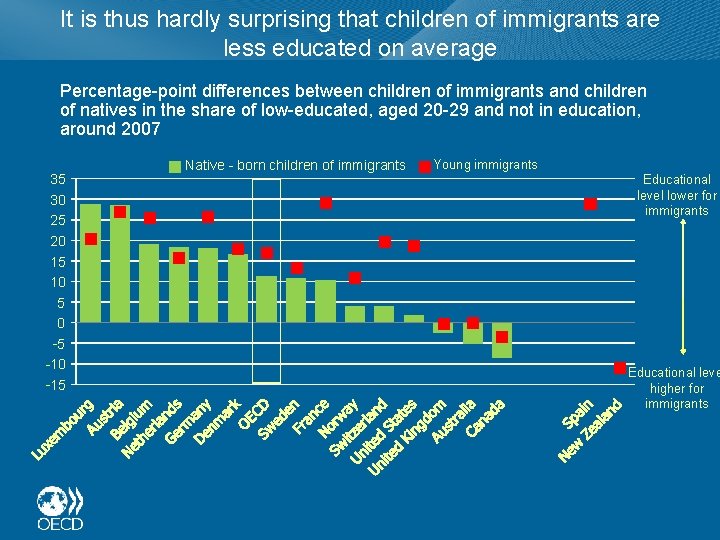
It is thus hardly surprising that children of immigrants are less educated on average Percentage-point differences between children of immigrants and children of natives in the share of low-educated, aged 20 -29 and not in education, around 2007 35 30 25 20 15 10 5 0 -5 -10 -15 Native - born children of immigrants Young immigrants Educational level lower for immigrants Educational leve higher for immigrants
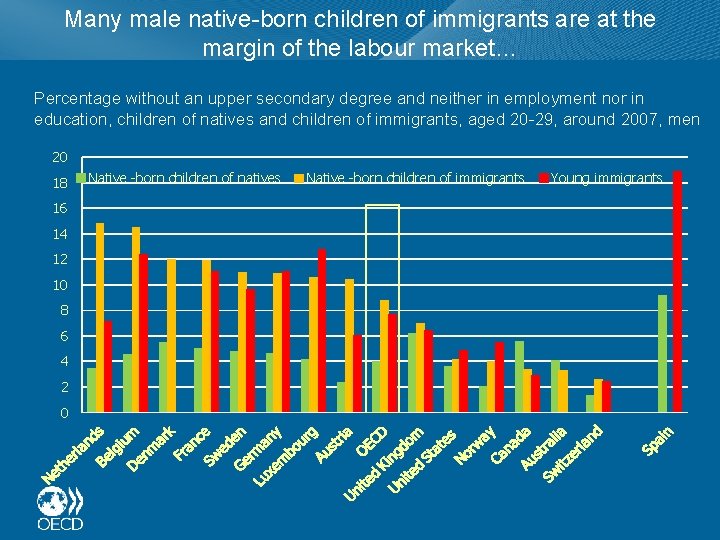
Many male native-born children of immigrants are at the margin of the labour market… Percentage without an upper secondary degree and neither in employment nor in education, children of natives and children of immigrants, aged 20 -29, around 2007, men 20 18 16 14 12 10 8 6 4 2 0 Native -born children of natives Native -born children of immigrants Young immigrants
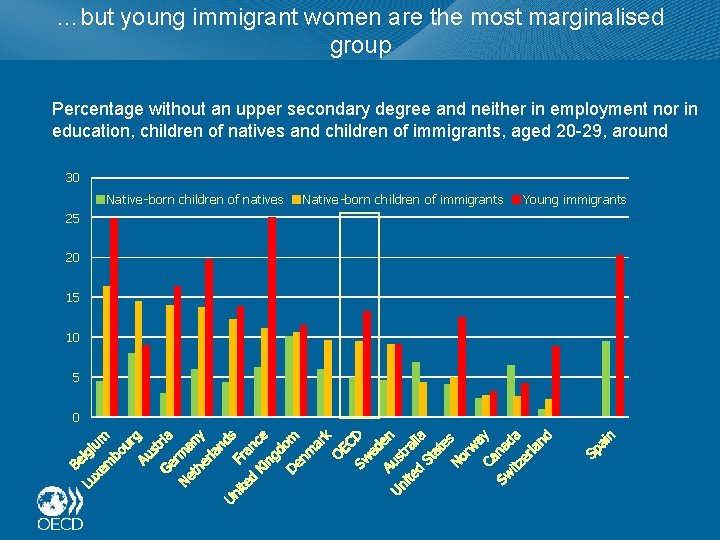
…but young immigrant women are the most marginalised group Percentage without an upper secondary degree and neither in employment nor in education, children of natives and children of immigrants, aged 20 -29, around 30 Native -born children of natives 25 20 15 10 5 0 Native -born children of immigrants Young immigrants
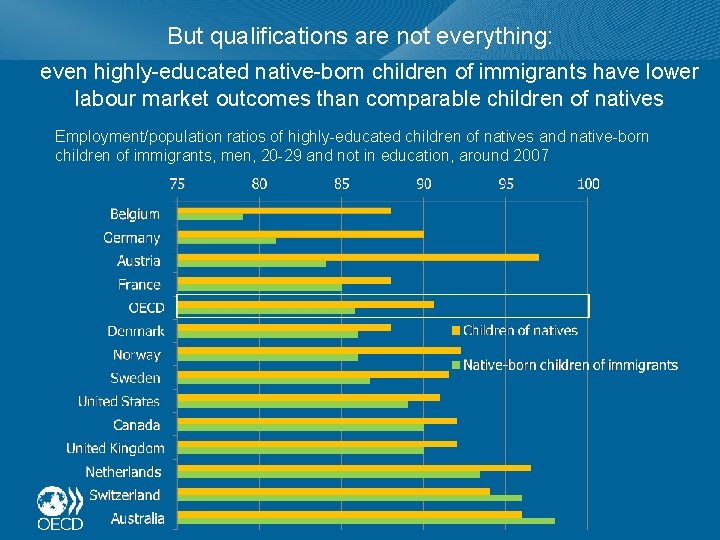
But qualifications are not everything: even highly-educated native-born children of immigrants have lower labour market outcomes than comparable children of natives Employment/population ratios of highly-educated children of natives and native-born children of immigrants, men, 20 -29 and not in education, around 2007
The reasons for the difficult labour market situation even for highly-educated immigrant offspring are difficult to ascertain: Ø Ø Ø Is it essentially a class issue? Lack of networks? Lack of knowledge about labour market functioning? (Other) information asymmetries? (Statistical) discrimination? => testing studies reveal that the incidence of discrimination is higher than commonly thought Ø Employers seem to be looking for « signs » of integration • Naturalised migrants from less developed countries tend to have higher employment rates and to earn more Ø • Ø Joint OECD/EC seminar on naturalisation and socioeconomic integration under the Belgian EU presidency (14 & 15 October 2010, Brussels) Immigrants who changed their name also earn more Amenable to policy intervention!
Learning from good practices some examples Ø Measures to facilitate labour market entry and contacts between immigrants and employers Ø Enterprise-based training (Vocational Qualification Networks – Germany) Ø Ø Temporary employment and temporary employment agency work (Sweden, Netherlands) Wage subsidies are more effective for immigrants (Denmark, Sweden) Ø Mentoring and network-building (Kvinfo-Denmark, programmes de parrainage - France)
Learning from good practices (cont. ) Ø Facilitate rapid integration of new arrivals: Ø Early work experience is crucial: Link language acquisition with work experience (Sweden) Ø Adapt language courses to the needs of the labour market and to immigrants’ competence levels (Australia, Denmark) Ø Target between 300 and 500 hours of language courses for the majority of immigrants (Sweden, France) Ø Incentives for municipalities to get immigrants rapidly integrated into the labour market (Denmark, Sweden) Ø Stepwise introduction into the labour market (“Stepmodel” Denmark, Sweden) Ø Welcoming of immigrants via services “under a single roof” (CNAIs and CLAIs - Portugal) Ø Target introduction programmes towards immigrants lacking basic skills (Norway)
Learning from good practices (cont. ) Ø Tackle migrant-specific labour market integration obstacles Ø Provide specialised public employment services for immigrants (NAV Intro – Norway) Ø Overcome skills recognition problems (programmes for immigrant doctors and nurses – Portugal) Ø Implement pro-active anti-discrimination and diversity policies (diversity plans – Belgium, France) Ø Support SMEs with respect to diversification of hiring channels (Belgium) Ø Promote immigrant employment in the public service (monitoring and moderate affirmative action – Norway; pre-police academy – Netherlands) Ø Enable evaluation and subsequent mainstreaming of effective practices (Benchmarking of municipalities - Denmark)
Thank you for your attention! For further information on the OECD’s work on integration: www. oecd. org/migration
- Slides: 19