
Labour laws Application to employees of public sector
Labour laws Application to employees of public sector by vinay boojhawon senior labour and industrial relations officer ministry of labour, industrial relations, employment and training 04 July 2018 1
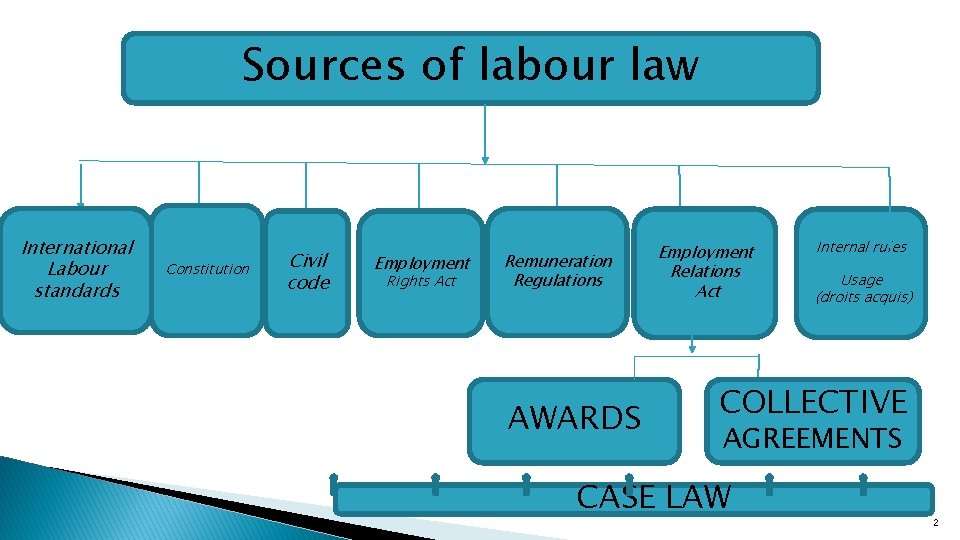
Sources of labour law International Labour standards Constitution Civil code Employment Rights Act Remuneration Regulations AWARDS Employment Relations Act Internal rules Usage (droits acquis) COLLECTIVE AGREEMENTS CASE LAW 2
INTERNATIONAL LABOUR STANDARDS ØDerived from ILO Conventions ØOnce a country ratifies a Convention, it has an obligation to incorporate the provisions of the Convention in its relevant legislation. 3

INTERNATIONAL LABOUR STANDARDS Mauritius has ratified 50 Conventions, including the 8 core conventions: v. Forced labour Convention, 1930, C 029. v. Freedom of Association and Protection of the Right to Organise, 1949, C 087. v. Right to Organise and Collective Bargaining Convention, 1947, C 098. v. Equal Remuneration Convention, 1951, C 100 v. Abolition of Forced Labour Convention, 1957, C 105. v. Discrimination (Employment and Occupation) Convention, 1958, C 111 v. Minimum Age Convention, 1973, C 138. v. Worst Form Child Labour Convention, C 182. 4
�The Constitution is the law behind the law. �As a rule, it is hierarchically superior to other laws. 5
The Constitution (ctd) It sets a number of fundamental rights, including rights relating to the world of work, namely: v 6
The Constitution (CTD) v. Section 7 – Protection from inhuman treatment “No person shall be subjected to torture , or inhuman or degrading punishment or such other treatment” v. Section 13 – Protection of freedom of assembly and association v. Section 16 - Protection from discrimination. 7
Civil Code The Civil Code defines the scope the application of the labour law respect of the contract employment and the termination employment: of in of of 8

Civil Code(CTD) Article 1780: “le contrat de louage des gens de travail qui s’engagent au service de quelqu’un seront regis par le Labour Act. ” 9
Civil Code(CTD) Article 1781: “Le louage (le service fait sans determination de duree peut toujours cesser par la volonte d’une des parties contractantes. Neanmoins, la resiliation du contract par la volonte d’un seul des contractants ne peut etre admise que dans les conditions et formes requises par le Labour Act. ” 10
Remuneration Order Regulations �Regulations are made by the Minister following the recommendations of the National Remuneration Board. �A referral is made to the NRB, only where the Minister is satisfied that no arrangements exist in an industry for the effective regulation of wages and conditions of employment. 11
Remuneration Order Regulations �The Regulations are industry-based. �They cover the collective rights of all workers in a sector, whether or not the category of the worker is specified in the Regulations. 12

Section 3 -Employment Rights Act (ERA) (1) The application of the ERA is subject to any provisions to the contrary in any enactment (Any Act , regulation, rule, proclamation order, or revised edition in force in Mauritius) 13
Section 3 of the ERi. A(ctd) � (2) This Act shall not apply to ◦ (a) a public officer or a local government officer, except for sections 4, 20(1), 54, 61(1)(a) and (d) and (4), 62, 63 and 67(1)(e)(i) in so far as it applies to such public officer or local government officer, (2) and (3) of this Act; � (b) a worker of a statutory body who is governed by the recommendations made by the Pay Research Bureau, except for Parts VIII and XI and sections 4, 20(1), 46(1), (2), (3), (4), (5), (7), (8), (9), (10), (11) and (12), 48, 61, 62, 63, and 67(1)(e)(i) in so far as it applies to that worker, (2) and (3) of this Act. 14
Sections of ERA applicable to public officers �S 4 -Discrimination in employment and occupation ; �S 20 - Equal remuneration for work of equal value; �S 54 - Violence at work; �S 61 -Power to make enquiries; �S 62 - Power to Summon; �S 63 -Complaint Procedure; �S 67 -Offences 15
S 4 -Discrimination in employment and occupation (Discrimination Convention 1958 , No. 111) (a) No worker shall be treated in a discriminatory manner by his employer in his employment or occupation. (b) No person shall be treated in a discriminatory manner by a prospective employer in respect of access to employment or occupation. (2) Any distinction, exclusion or preference in respect of a particular occupation based on the inherent requirements thereof shall not be deemed to be discrimination. (3) A person does not discriminate against another person by imposing, proposing to impose, on that other person, a condition, requirement or practice that has, or is likely to have, a disadvantaging effect, where the condition, requirement or practice is reasonable in the circumstances. 16
S 4 -Discrimination in employment and occupation (4)The matters to be taken into account in determining whether or not a condition, requirement or practice is reasonable in the circumstances include – (a) the nature and extent of the disadvantage resulting or likely to result, from the imposition or proposed imposition of the condition, requirement or practice; (b) the feasibility of overcoming or mitigating the disadvantage; and (c) whether the disadvantage is proportionate to the result sought to be achieved by the person who imposes, or proposes to impose the condition, requirement or practice. 17
S 4 -Discrimination in employment and occupation “Discrimination” includes affording different treatment to different workers attributable wholly or mainly to their respective descriptions by age, race, colour, caste, creed, sexual orientation, HIV status, religion, political opinion, place of origin, national extraction or social origin, which has the effect of nullifying or impairing equality of opportunity or treatment in employment or occupation; 18
S 20. - Equal remuneration for work of equal value � (1) Every employer shall ensure that the remuneration of any worker shall not be less favorable than that of another worker performing the same type of work. � (2) Where an employer has recourse to the services of a job contractor, the job contractor shall ensure that the remuneration of any worker shall not be less favourable than that of another worker performing the same type of work. 19
54. Violence at work (1) No person shall – (a) harass, sexually or otherwise; (b) assault; (c) verbally abuse, swear at or insult; (d) express the intention to cause harm; (e) bully or use threatening behaviour towards; (“threatening behaviour” means any behaviour or declaration of intention to use force on, or to intimidate, a worker; ) (f) use aggressive gesture indicating intimidation, contempt or disdain towards; (g) by words or act, hinder, a worker, in the course of or as a result of his work. 20
54. Violence at work (ctd) �(2) Any person who contravenes subsection (1) shall commit an offence and shall, on conviction, be liable to a fine not exceeding 75, 000 rupees and to imprisonment for a term not exceeding 2 years. 21
54. Violence at work (ctd) (3) For the purpose of subsection (1), a person sexually harasses another person where, in circumstances in which a reasonable person would have foreseen that other person would be humiliated, offended or intimidated, he – � (a) makes an unwelcome sexual advance, or an unwelcome request for a sexual favour to that other person; or � (b) engages in any other unwelcome conduct of a sexual nature towards that other person. 22
61. Power to make enquiries � � � (1) The Permanent Secretary may – (a) enter without previous notice, at any hour of the day or night, any place of work, other than premises used solely for residential purposes except with the permission of the occupier thereof; (b) enter by day and without previous notice any premises which he has reasonable cause to believe to be a place of work other than premises used solely for residential purposes except with the permission of the occupier thereof; (c) carry out any examination or enquiry which he may consider necessary in order to satisfy himself that this Act or any other enactment relating to labour or employment is being strictly observed; (d) interview alone or in the presence of any other person, as he thinks fit, and at such place he deems appropriate, the employer or his representative and any person employed in the enterprise, regarding the application of this Act or any other enactment relating to labour or employment, and any such person shall answer such questions truly to the best of his ability provided that no such person shall be required to give any information tending to incriminate himself; 23
61. Power to make enquiries(ctd) � (3) The Permanent Secretary may request the assistance of a police officer if he has reasonable cause to apprehend any serious obstruction in the execution of his duties. (4) No person shall – � (a) willfully impede or delay the Permanent Secretary in the exercise of any power under this Act or any other enactment relating to labour or employment; � (b) fail to comply with a requirement or request or to answer a question of the Permanent Secretary under subsection (1); � (c) conceal or prevent any person from appearing before or being examined by the Permanent Secretary or any officer delegated by him, or attempt to do so. � 24
62. Power to summon �The power to convene any person whom he believes to have committed an offence under the ERi. A. �Failure to comply with a summon is an offence. 25
63. Complaint procedure � (1) workers’ right to register a complaint. � (2) There shall be no hindrance from employer. � (3) issue of a notice enforcing compliance by PS. 26
67. Offences (ctd) � (1) Any person who – � (e) contravenes – � (i) sections 4(1), 5(1), 8, 10, 12, 13, 14(5), (6), (7), 16(1)(b), 17, 18, 19, 20, 21, 22, 23, 24, 25, 26, 27, 28, 29, 30, 31, 32, 34, 35, 37(2) and (6), 38, 39, 44(5), 47, 50, 51, 53, 55(1), 58(1), 59, 61(4), 62(2), 63 or any subsidiary enactment made under this Act shall commit an offence 27
67. Offences-conviction ◦ ) Any person who commits an offence shall, on conviction, be liable to a fine not exceeding 10, 000 rupees and to imprisonment for a term not exceeding one year. � (3) The Court may, on the conviction of any person under this Act, where it thinks appropriate, make an order directing that person to comply with this Act within such time as may be fixed in the order. 28
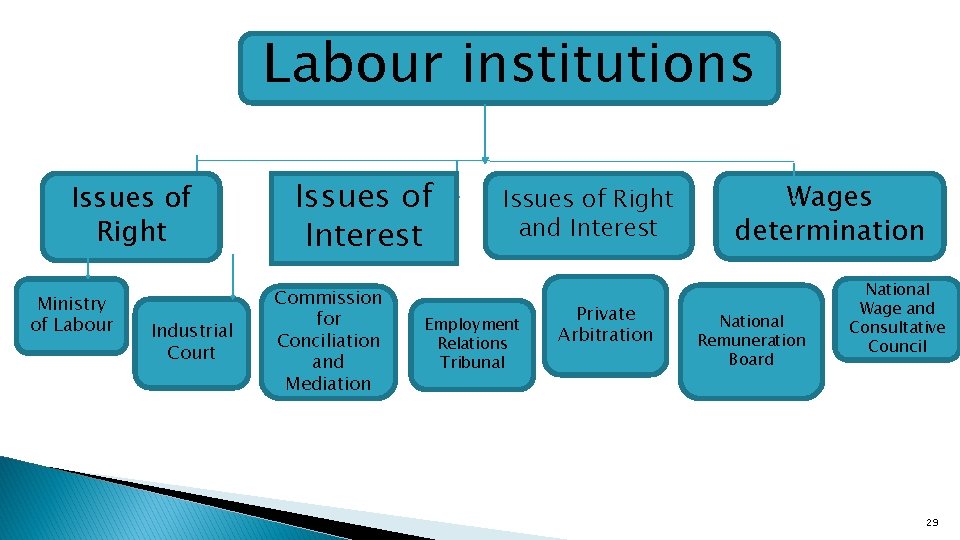
Labour institutions Issues of Right Ministry of Labour Industrial Court Issues of Interest Commission for Conciliation and Mediation Issues of Right and Interest Employment Relations Tribunal Private Arbitration Wages determination National Remuneration Board National Wage and Consultative Council 29

Questions? 30
- Slides: 30