
Labour Cost Index LCI Calculation of the LCI
Labour Cost Index (LCI) Calculation of the LCI in Denmark
Labour Cost index calculation in Denmark • Calculate working day adjusted index on NACE B, C, …, S for total labour costs, wages and salary, other labour costs and total labour costs excluding bonus • Seasonal adjustment • Send the data to Eurostat • Eurostat calculates the aggregates
LCI calculation in Denmark Example Q 2 2012 for NACE C: • Identifying enterprises that have reported for both Q 1 and Q 2
LCI calculation in Denmark • Calculate labour costs per hour for each quarter: – Use the quarterly survey for wages and salaries – Estimates for other costs until survey is completed – Q 1: 255 – Q 2: 266
LCI calculation in Denmark • Calculate the quarterly change between Q 1 and Q 2. – Q 2/Q 1 = 266/255 = 1. 043 • Chain to index from Q 1 (149. 5): – 149. 5 * 1. 043 = 156. 0
LCI calculation in Denmark • In Denmark the base period is Q 1 2000 • Eurostat request base year 2008. • The base period is changed to 2008. – The index is divided by the average index of 2012. – Result: 114, 0 (109, 2 for Q 1) – This result is delivered to Eurostat
LCI calculation in Denmark • The index is seasonal adjusted – We use Demetra – Delivered to Eurostat
LCI calculation in Eurostat • Example for Denmark Q 2 2011 calculating an aggregate: – NACE C: LCI_TOT = 112, 44 – NACE D: LCI_TOT = 119, 27
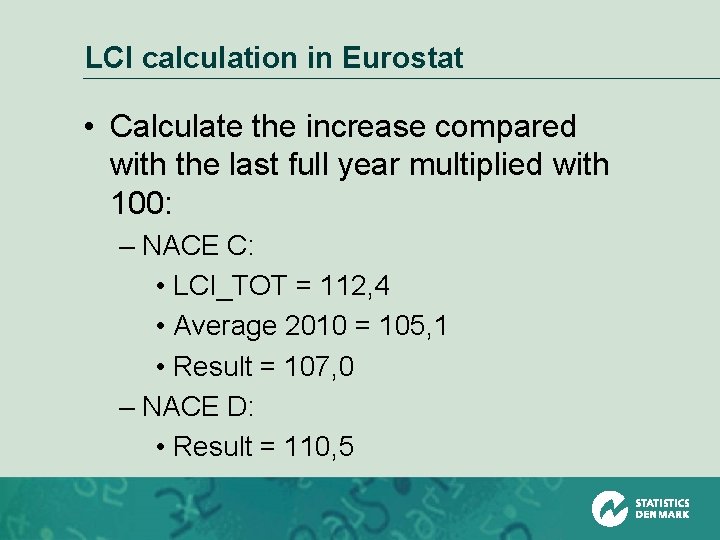
LCI calculation in Eurostat • Calculate the increase compared with the last full year multiplied with 100: – NACE C: • LCI_TOT = 112, 4 • Average 2010 = 105, 1 • Result = 107, 0 – NACE D: • Result = 110, 5
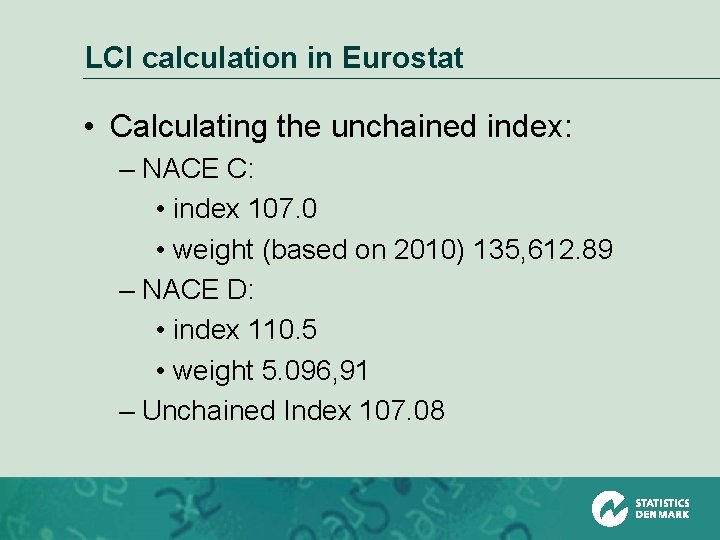
LCI calculation in Eurostat • Calculating the unchained index: – NACE C: • index 107. 0 • weight (based on 2010) 135, 612. 89 – NACE D: • index 110. 5 • weight 5. 096, 91 – Unchained Index 107. 08
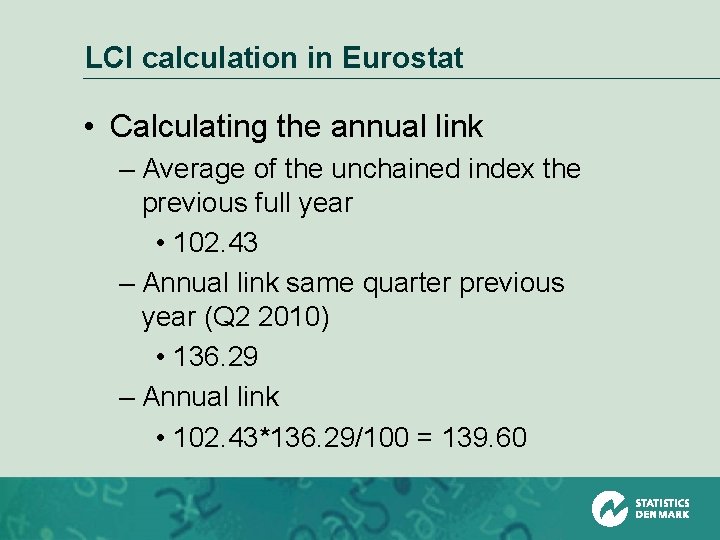
LCI calculation in Eurostat • Calculating the annual link – Average of the unchained index the previous full year • 102. 43 – Annual link same quarter previous year (Q 2 2010) • 136. 29 – Annual link • 102. 43*136. 29/100 = 139. 60
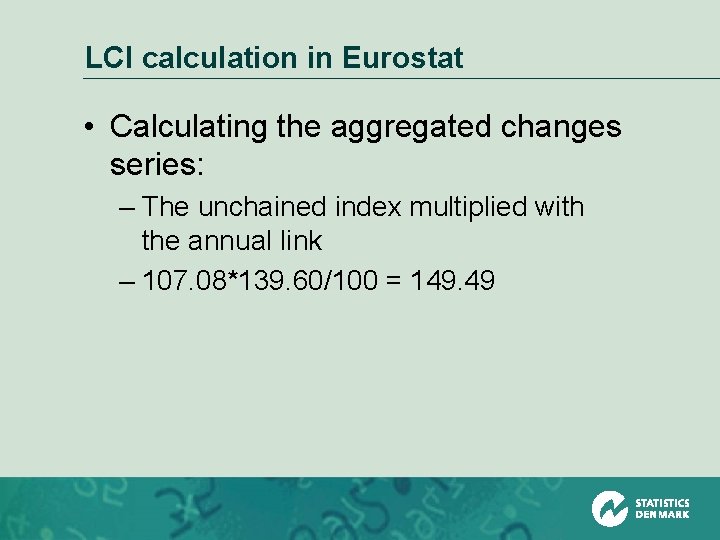
LCI calculation in Eurostat • Calculating the aggregated changes series: – The unchained index multiplied with the annual link – 107. 08*139. 60/100 = 149. 49
LCI calculation in Eurostat • Calculating the aggregated index with base year 2008 for NACE C and D: – Take the aggregated chained series and divide it with the average for 2008 – 149. 49*100/132. 66 = 112. 68
LCI calculation in Eurostat • Issues: • Eurostat and the member states obtain different aggregates • LCI_TOT must be not an independent derived index but a combination, using the appropriate weights and linking technique, of LCI_WAG and LCI_OTH
LCI calculation in Eurostat • Reasons: – Different Indexes for aggregation: Eurostat aggregates at NACE section level while member states might use lower level indices – Different weights: Eurostat uses the weights transmitted by Member States (dataset LCI_WEIGHT_A). If the country uses other weights the aggregation results will be different.
LCI calculation in Eurostat • Reasons: – Use of different linking techniques – Working day adjustment: Eurostat uses the indirect approach while Member States might use a direct approach for aggregates
Issues with Denmark • We do not deliver NACE aggregates • LCI_TOT is not calculated using Eurostat weights, but national weights
- Slides: 17