
LABORATORY TESTING OF COATING PERMEANCE What is it
LABORATORY TESTING OF COATING PERMEANCE What is it and how is it measured? (Part 1 of a 2 -part series) Cheryl Roberts KTA-Tator, Inc.
Purpose of Part 1 and Part 2 � Part 1 – Define water vapor permeance, how to measure it in coatings, and how to interpret the results. � Part 2 – Determine the effect of coating permeance on the performance of wall assemblies and the number of times a building can be repainted.
Presentation Outline � � Introduction: What is Permeance The Basic Laboratory Procedure: Determination of the Water Vapor Permeance of a Coating ASTM D 1653 and ASTM E 96/E 96 M: Differences between the Test Methods Used to Measure the Water Vapor Permeance of a Coating Interpreting the Meaning of Water Vapor Permeance Results: Relative Magnitude of Values, Repeatability of Laboratory Testing, Reporting of Water Vapor Permeance Values on PDS’s

Introduction What is Permeance?
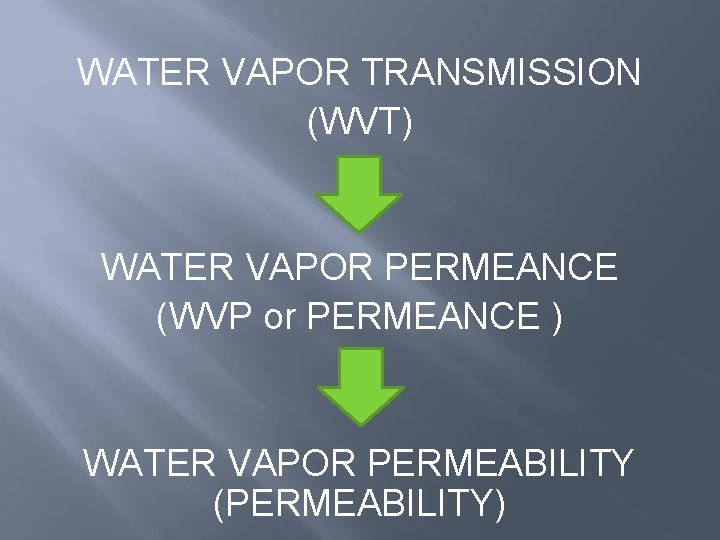
WATER VAPOR TRANSMISSION (WVT) WATER VAPOR PERMEANCE (WVP or PERMEANCE ) WATER VAPOR PERMEABILITY (PERMEABILITY)
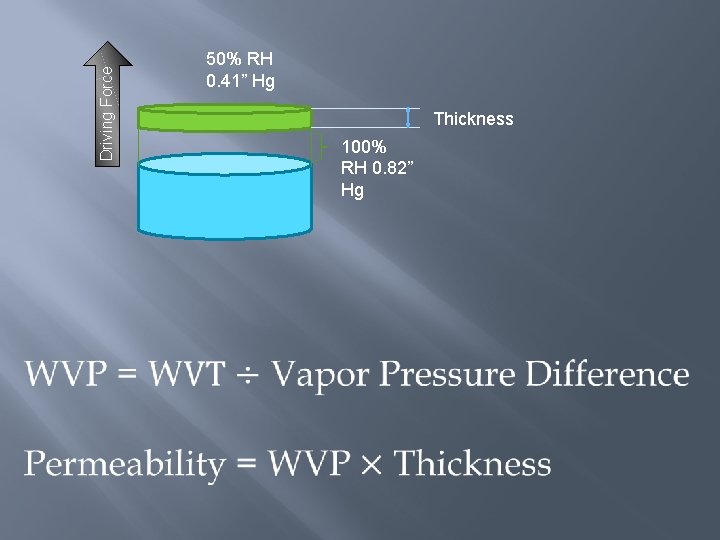
Driving Force 50% RH 0. 41” Hg Thickness 100% RH 0. 82” Hg
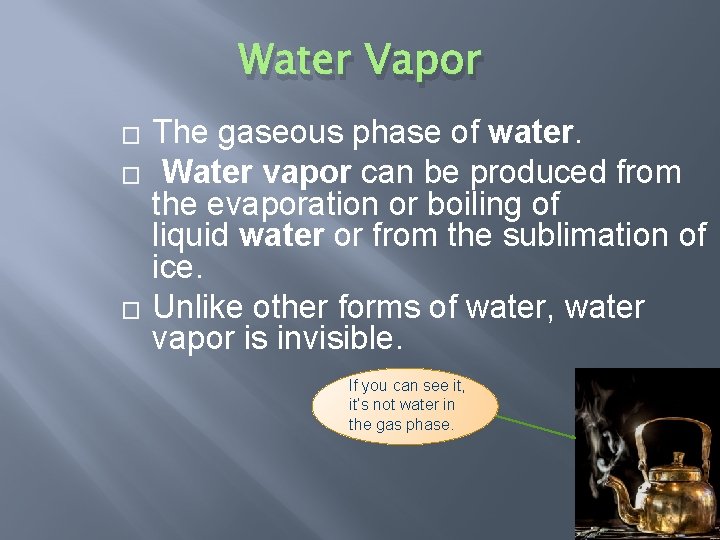
Water Vapor � � � The gaseous phase of water. Water vapor can be produced from the evaporation or boiling of liquid water or from the sublimation of ice. Unlike other forms of water, water vapor is invisible. If you can see it, it’s not water in the gas phase.
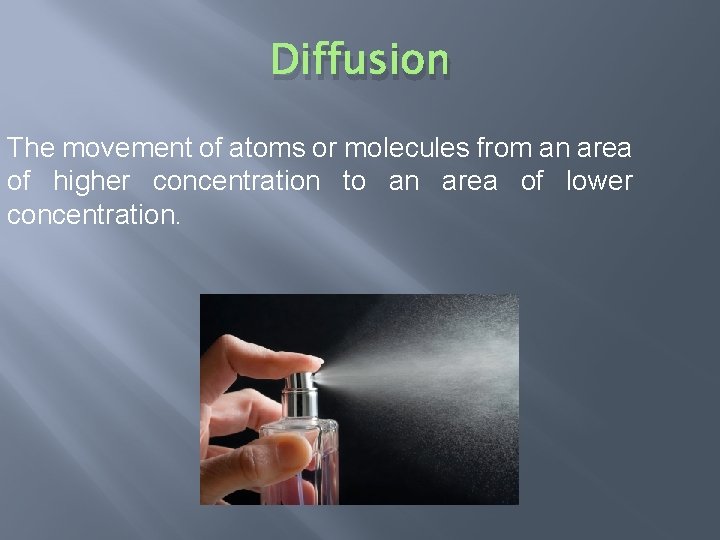
Diffusion The movement of atoms or molecules from an area of higher concentration to an area of lower concentration.
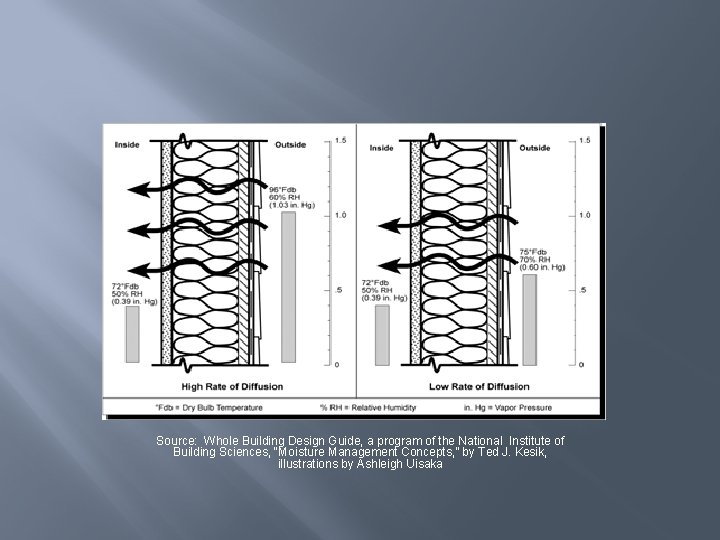
Source: Whole Building Design Guide, a program of the National Institute of Building Sciences, “Moisture Management Concepts, ” by Ted J. Kesik, illustrations by Ashleigh Uisaka
The Basic Laboratory Procedure Determination of the Water Vapor Permeance of a Coating
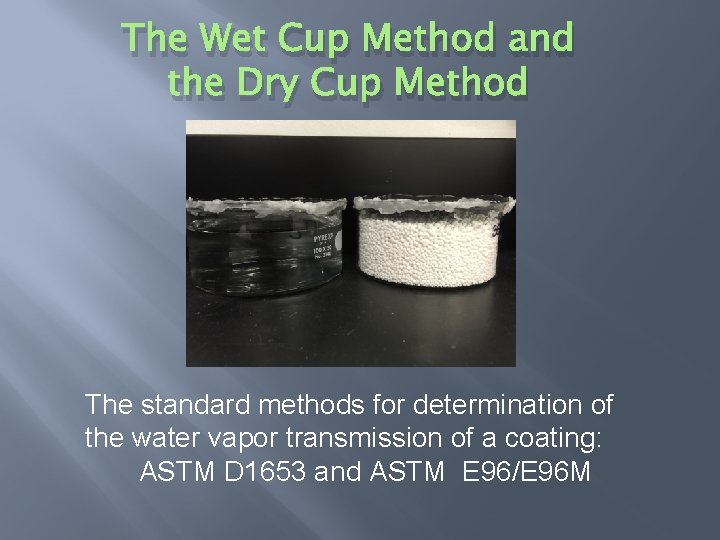
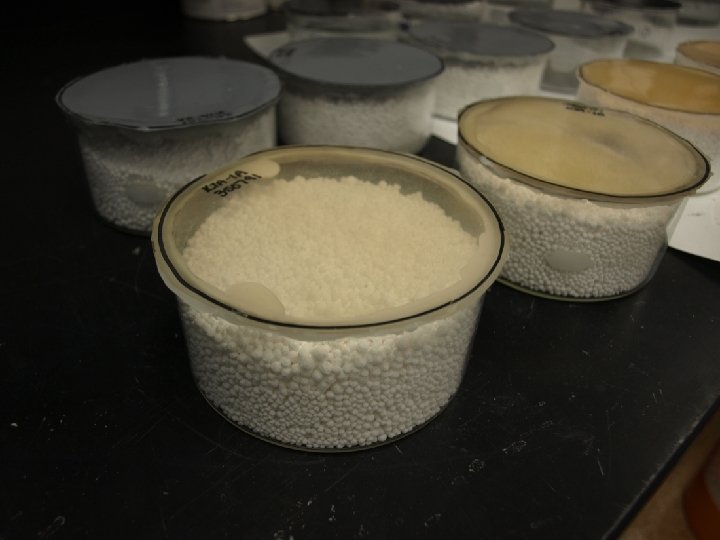
The Wet Cup Method and the Dry Cup Method The standard methods for determination of the water vapor transmission of a coating: ASTM D 1653 and ASTM E 96/E 96 M
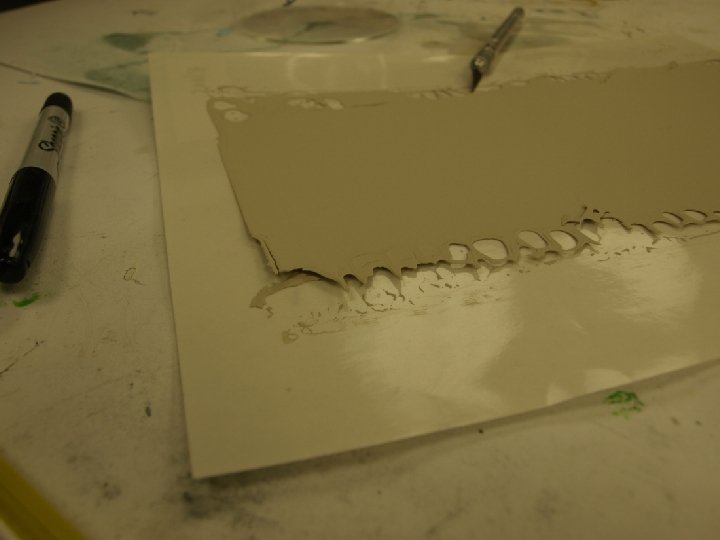
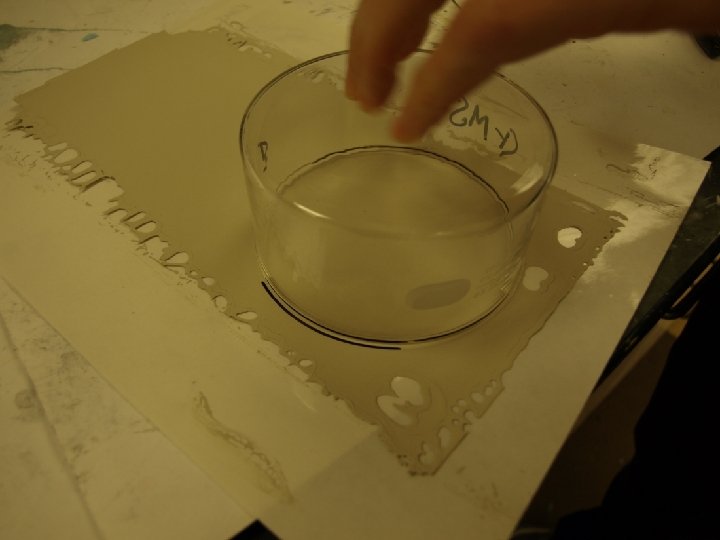
Determination of Water Vapor Permeance
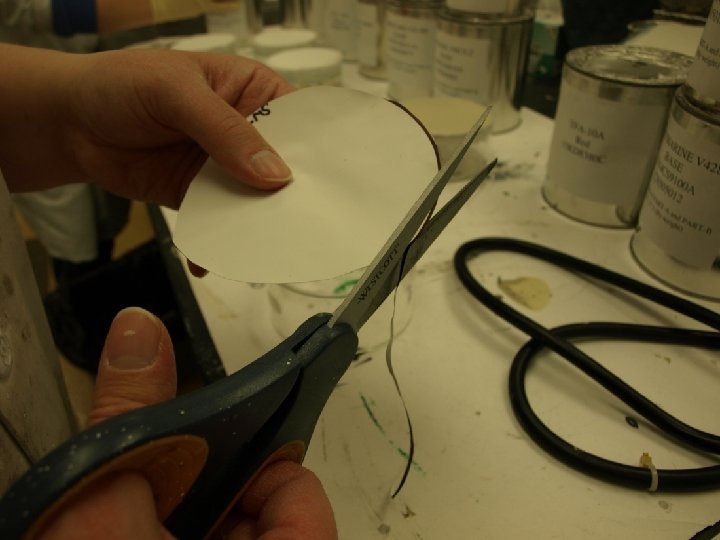
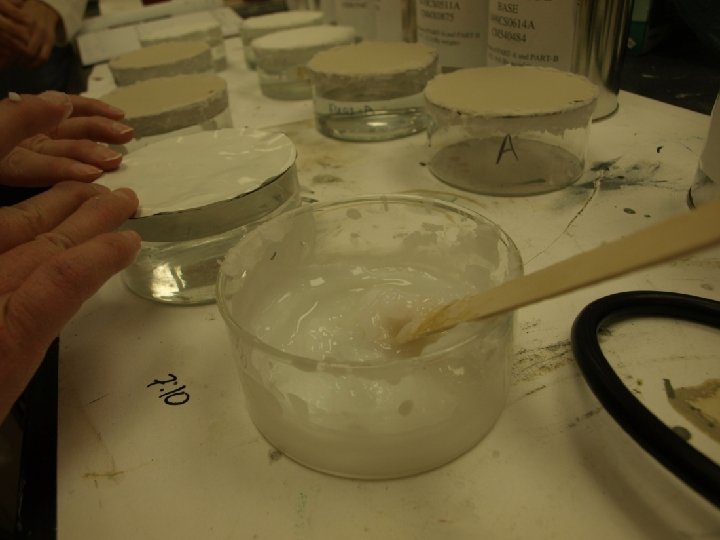
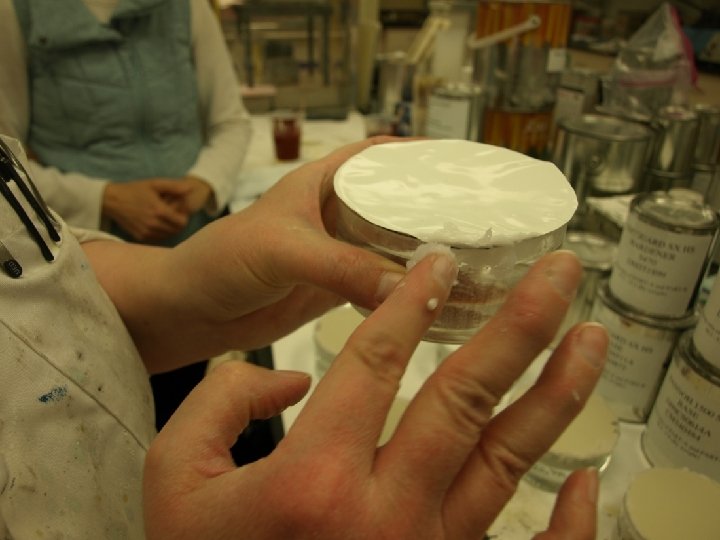
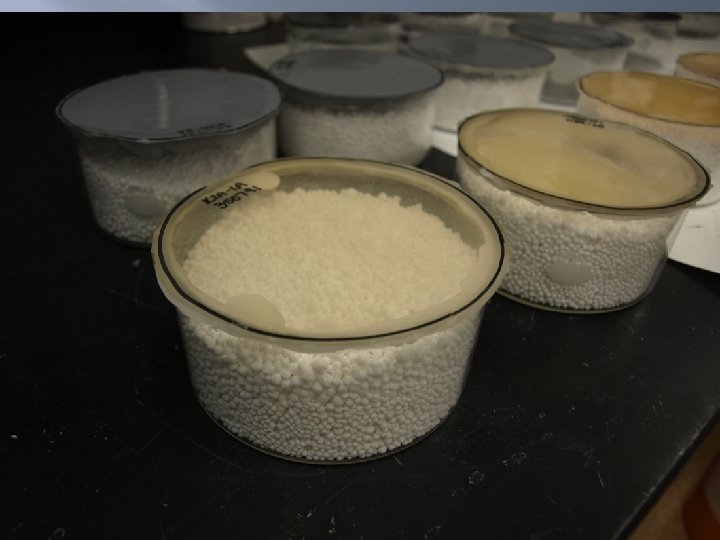
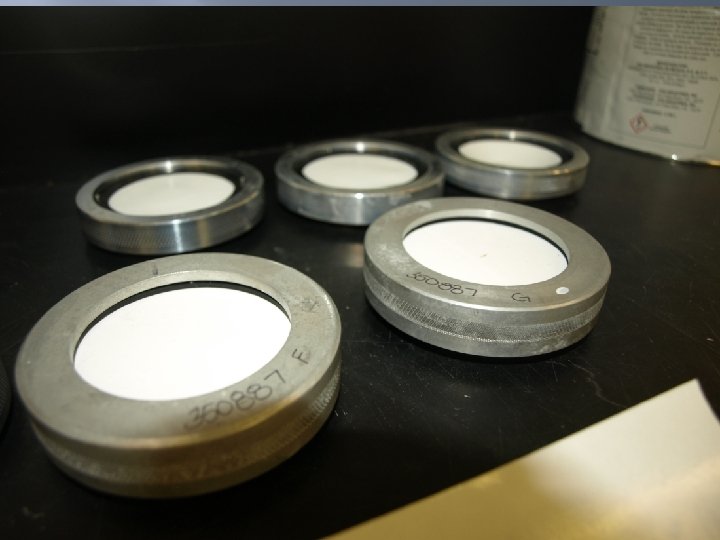
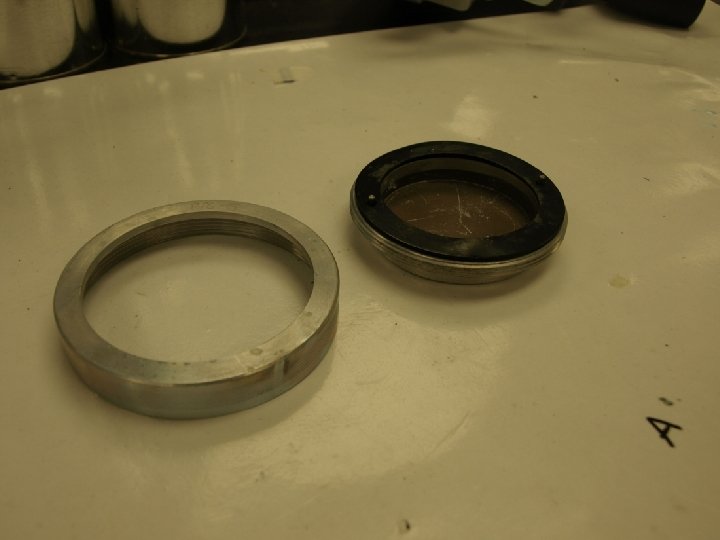
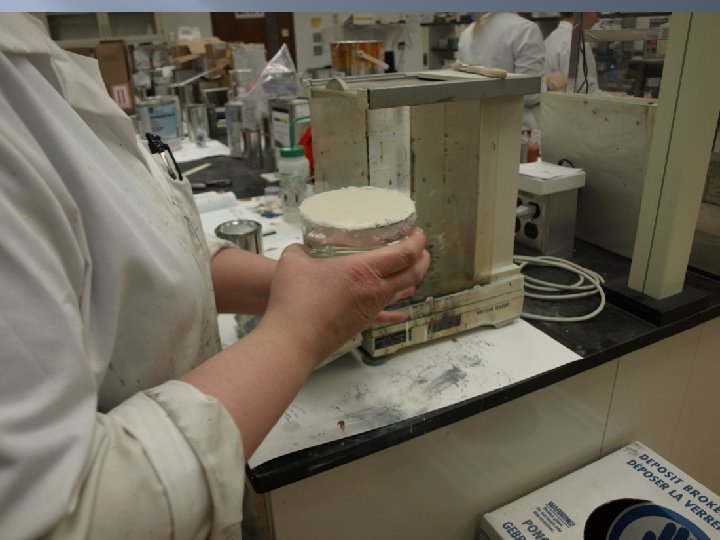
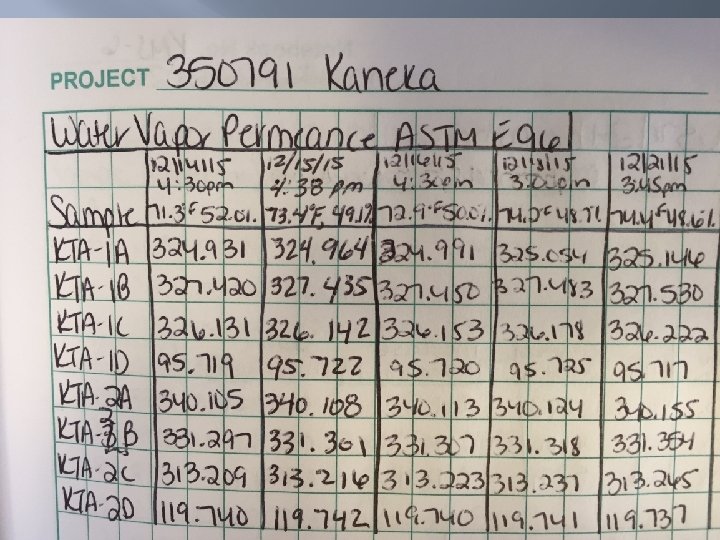
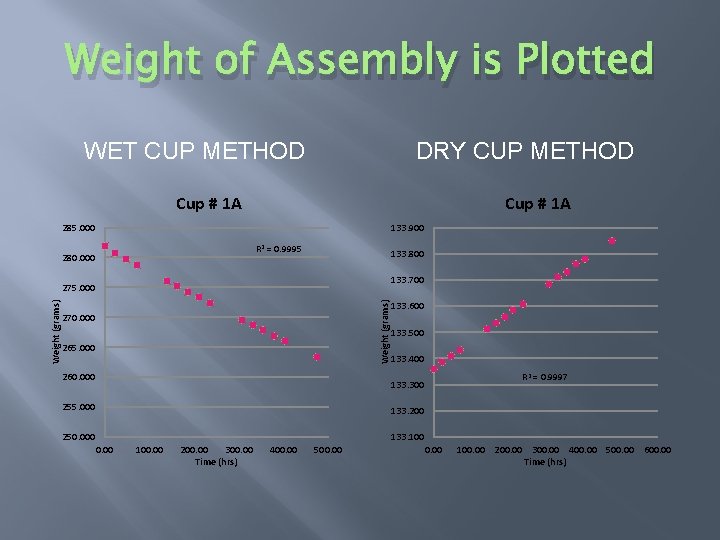
Weight of Assembly is Plotted WET CUP METHOD DRY CUP METHOD Cup # 1 A 285. 000 133. 900 R 2 = 0. 9995 280. 000 133. 800 133. 700 Weight (grams) 275. 000 270. 000 265. 000 260. 000 133. 600 133. 500 133. 400 R 2 = 0. 9997 133. 300 255. 000 133. 200 250. 000 133. 100 0. 00 100. 00 200. 00 300. 00 Time (hrs) 400. 00 500. 00 100. 00 200. 00 300. 00 400. 00 500. 00 600. 00 Time (hrs)
Comparison of Results of Wet Cup and Dry Cup Methods � ASTM D 1653: “Agreement should not be expected between results obtained by different methods or test conditions. “ � Results of Wet Cup Method are sometimes higher than those of Dry Cup Method. � The method should be selected that more nearly approaches conditions of use. � Per ASTM D 1653, which method is preferred depends upon the humidities anticipated in the vicinity of the barrier: Dry Cup Method is preferred when high humidities are not anticipated. � Wet Cup Method is preferred when high humidities are anticipated. �
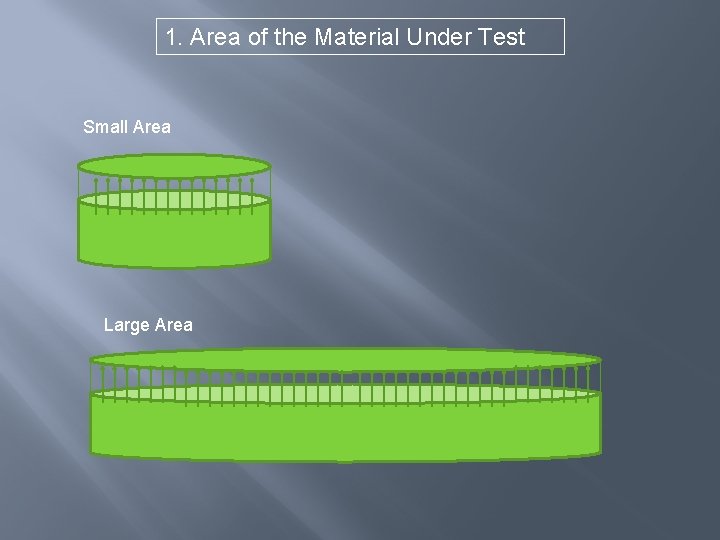
Three Factors That Affect Rate of Weight Change 1. The area of the specimen (used to calculate the Water Vapor Transmission Rate) 2. The driving force – difference between the concentration of water molecules on one side of the membrane versus the other side (used to calculate the Water Vapor Permeance) 3. The thickness of the membrane (used to calculate Permeability)
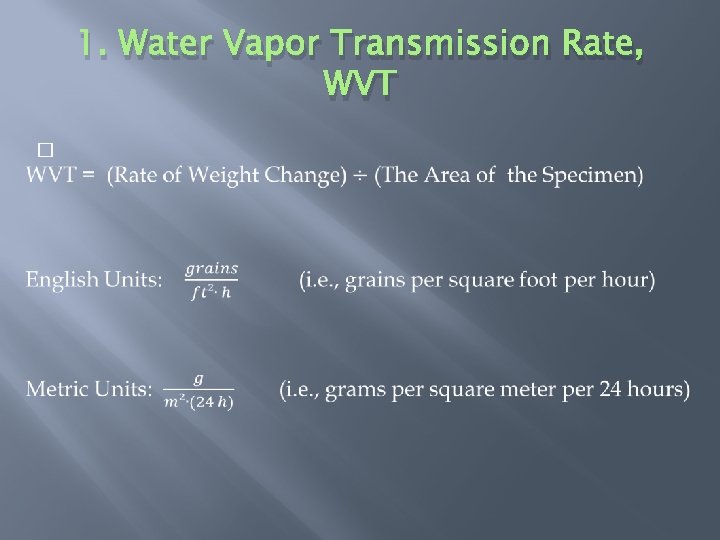
1. Area of the Material under Test (for calculating Water Vapor Transmission Rate) Definition of Water Vapor Transmission Rate The steady water vapor flow in unit time through unit area of a body, between two specific parallel surfaces, under specific conditions of temperature and humidity at each surface.
1. Area of the Material Under Test Small Area Large Area
1. Water Vapor Transmission Rate, WVT �
A nickel weighs about 5 grams.
2. Driving Force = Difference in Concentration (for calculating Water Vapor Permeance) Definition of Water Vapor Permeance The steady water vapor flow in unit time through unit area of a body (WVT), induced by unit vapor pressure difference between the two specific parallel surfaces, under specified temperature and humidity conditions.
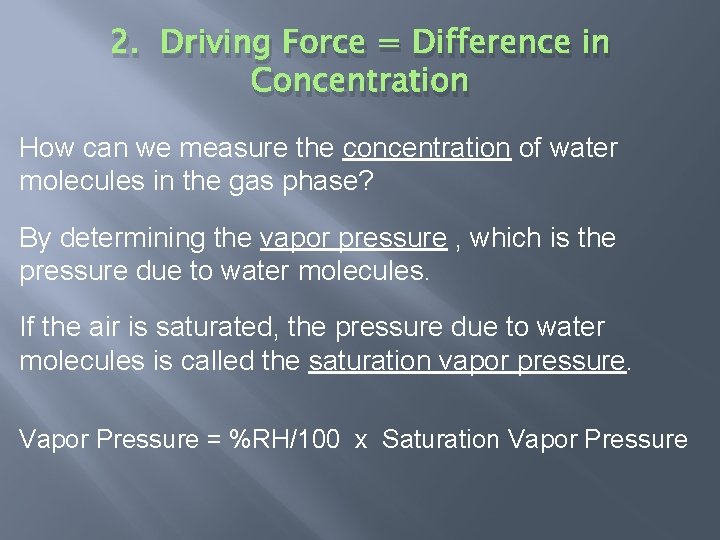
2. Driving Force = Difference in Concentration How can we measure the concentration of water molecules in the gas phase? By determining the vapor pressure , which is the pressure due to water molecules. If the air is saturated, the pressure due to water molecules is called the saturation vapor pressure. Vapor Pressure = %RH/100 x Saturation Vapor Pressure
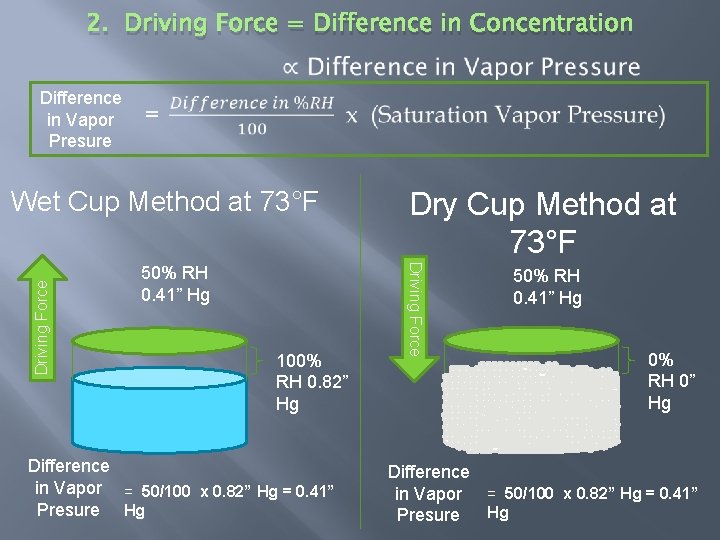
2. Driving Force = Difference in Concentration Difference in Vapor Presure 50% RH 0. 41” Hg 100% RH 0. 82” Hg Difference in Vapor = 50/100 x 0. 82” Hg = 0. 41” Presure Hg Dry Cup Method at 73°F Driving Force Wet Cup Method at 73°F 50% RH 0. 41” Hg 0% RH 0” Hg Difference in Vapor = 50/100 x 0. 82” Hg = 0. 41” Presure Hg
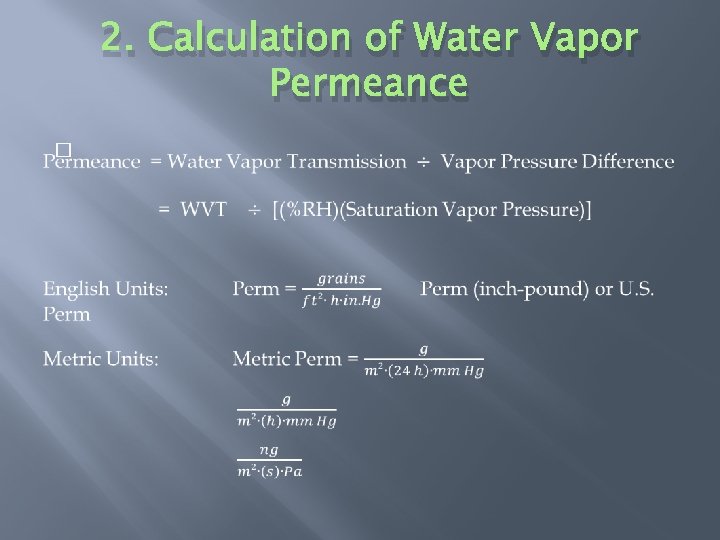
2. Calculation of Water Vapor Permeance �
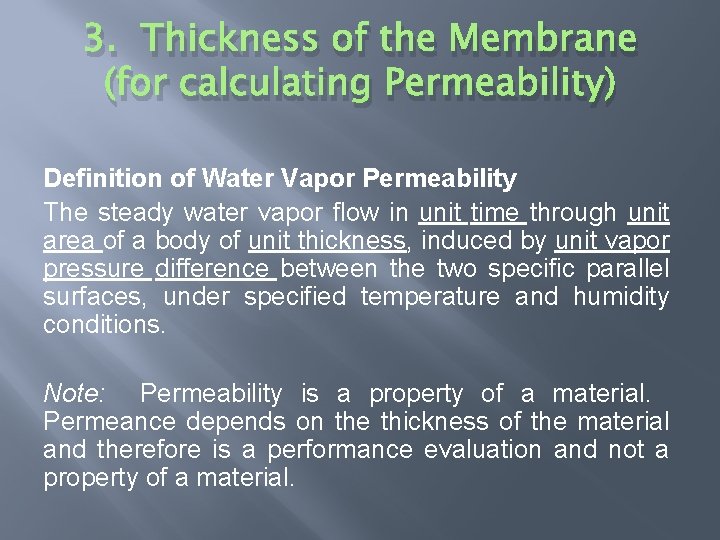
3. Thickness of the Membrane (for calculating Permeability) Definition of Water Vapor Permeability The steady water vapor flow in unit time through unit area of a body of unit thickness, induced by unit vapor pressure difference between the two specific parallel surfaces, under specified temperature and humidity conditions. Note: Permeability is a property of a material. Permeance depends on the thickness of the material and therefore is a performance evaluation and not a property of a material.
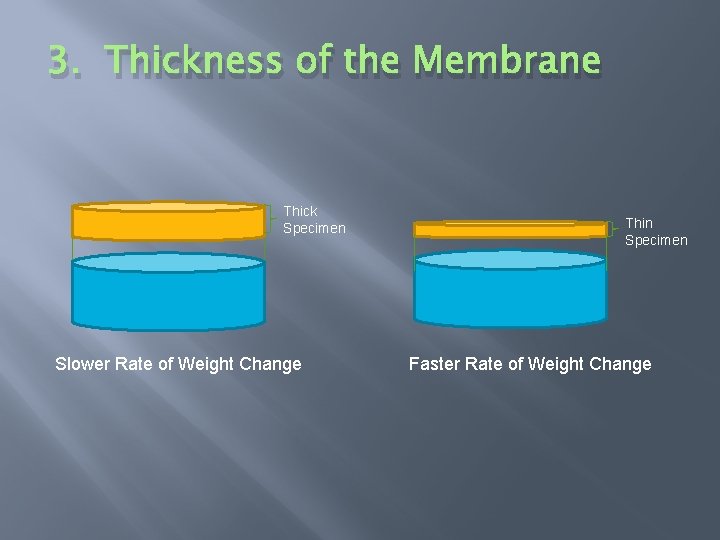
3. Thickness of the Membrane Thick Specimen Slower Rate of Weight Change Thin Specimen Faster Rate of Weight Change
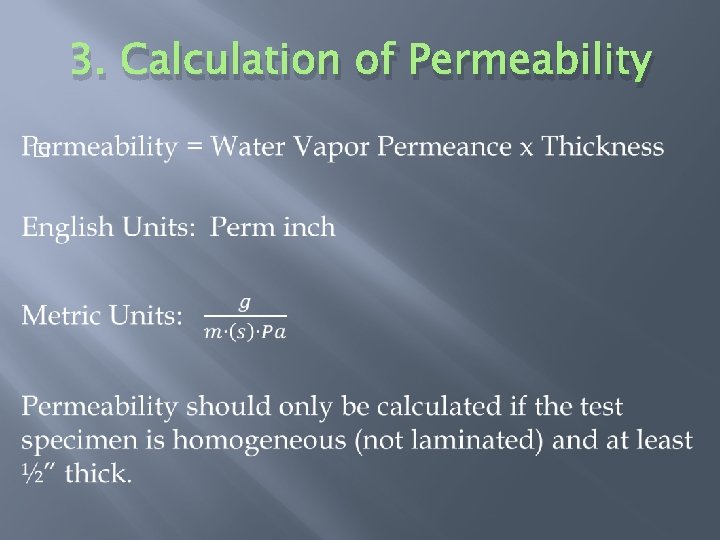
3. Calculation of Permeability �
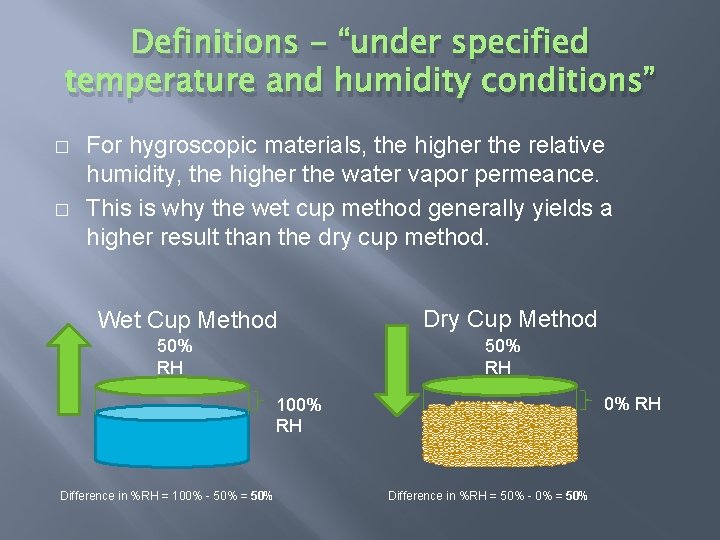
Definitions - “under specified temperature and humidity conditions” � � For hygroscopic materials, the higher the relative humidity, the higher the water vapor permeance. This is why the wet cup method generally yields a higher result than the dry cup method. Wet Cup Method 50% RH Dry Cup Method 50% RH 100% RH Difference in %RH = 100% - 50% = 50% Difference in %RH = 50% - 0% = 50%
ASTM D 1653 and ASTM E 96/E 96 M Differences between the Test Methods Used to Measure the Water Vapor Permeance of a Coating
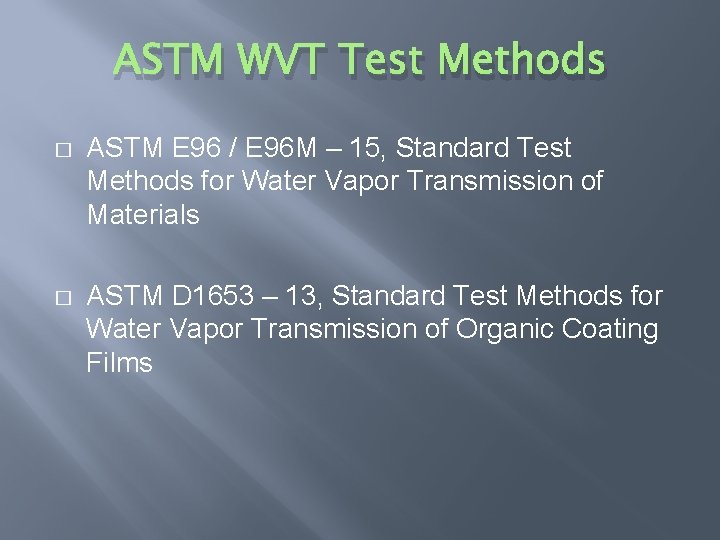
ASTM WVT Test Methods � ASTM E 96 / E 96 M – 15, Standard Test Methods for Water Vapor Transmission of Materials � ASTM D 1653 – 13, Standard Test Methods for Water Vapor Transmission of Organic Coating Films
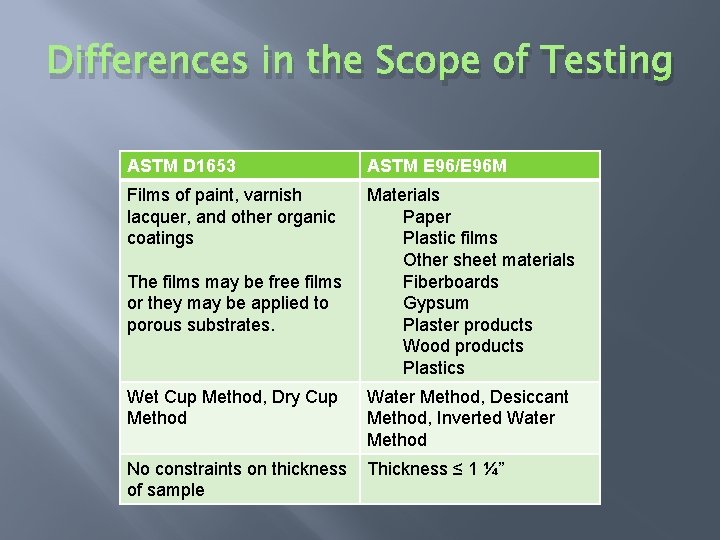
Differences in the Scope of Testing ASTM D 1653 ASTM E 96/E 96 M Films of paint, varnish lacquer, and other organic coatings Materials Paper Plastic films Other sheet materials Fiberboards Gypsum Plaster products Wood products Plastics The films may be free films or they may be applied to porous substrates. Wet Cup Method, Dry Cup Method Water Method, Desiccant Method, Inverted Water Method No constraints on thickness Thickness ≤ 1 ¼” of sample
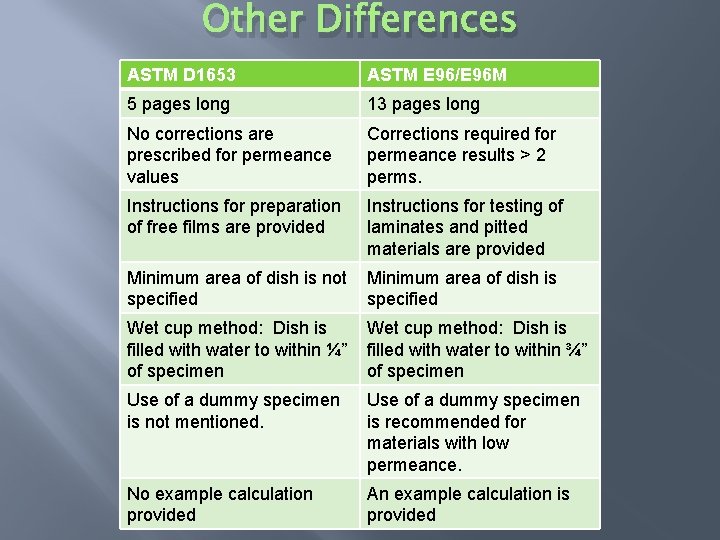
Other Differences ASTM D 1653 ASTM E 96/E 96 M 5 pages long 13 pages long No corrections are prescribed for permeance values Corrections required for permeance results > 2 perms. Instructions for preparation of free films are provided Instructions for testing of laminates and pitted materials are provided Minimum area of dish is not Minimum area of dish is specified Wet cup method: Dish is filled with water to within ¼” filled with water to within ¾” of specimen Use of a dummy specimen is not mentioned. Use of a dummy specimen is recommended for materials with low permeance. No example calculation provided An example calculation is provided
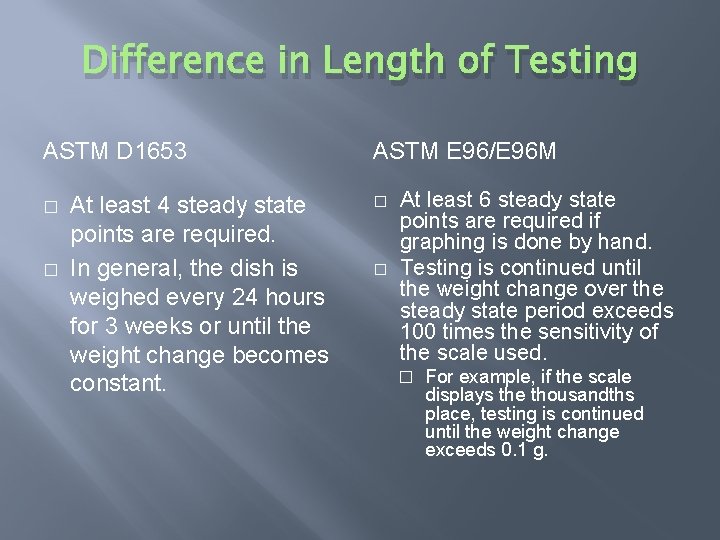
Difference in Length of Testing ASTM D 1653 � � At least 4 steady state points are required. In general, the dish is weighed every 24 hours for 3 weeks or until the weight change becomes constant. ASTM E 96/E 96 M � � At least 6 steady state points are required if graphing is done by hand. Testing is continued until the weight change over the steady state period exceeds 100 times the sensitivity of the scale used. � For example, if the scale displays the thousandths place, testing is continued until the weight change exceeds 0. 1 g.
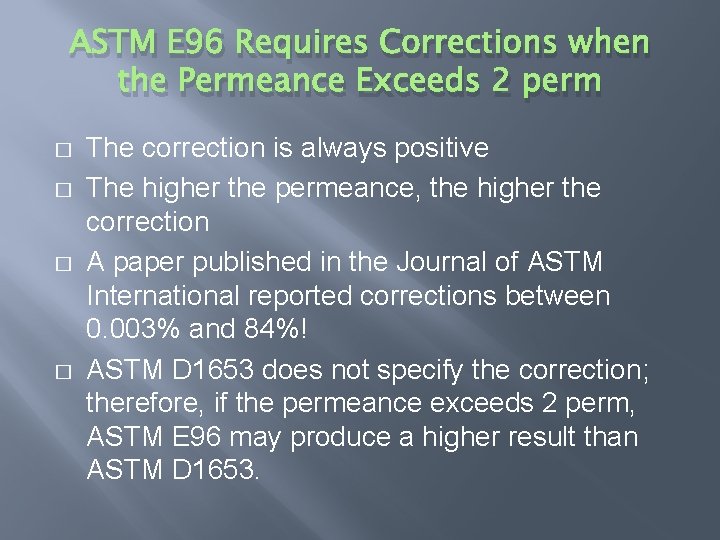
ASTM E 96 Requires Corrections when the Permeance Exceeds 2 perm � � The correction is always positive The higher the permeance, the higher the correction A paper published in the Journal of ASTM International reported corrections between 0. 003% and 84%! ASTM D 1653 does not specify the correction; therefore, if the permeance exceeds 2 perm, ASTM E 96 may produce a higher result than ASTM D 1653.
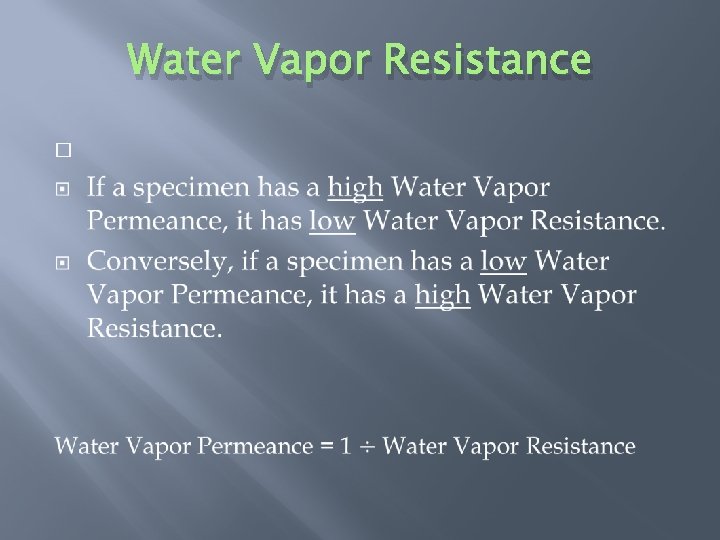
Water Vapor Resistance �
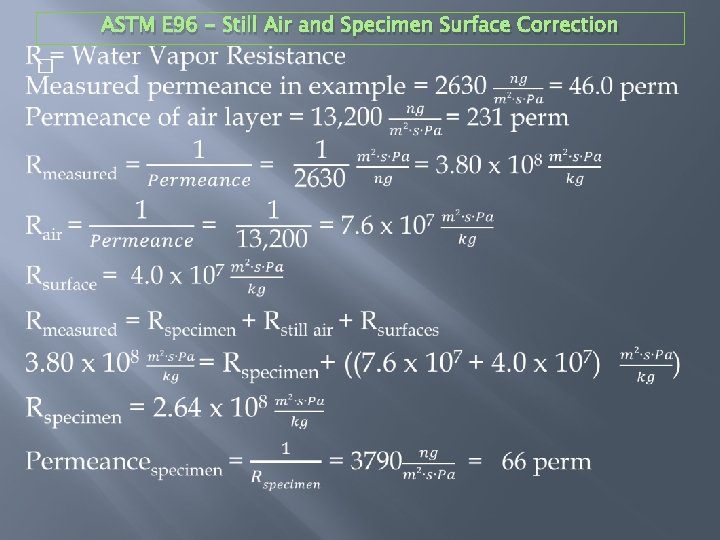
ASTM E 96 - Still Air and Specimen Surface Correction �
Interpreting the Meaning of Permeance Results Relative Magnitude of Values, Repeatability of Laboratory Testing, Reporting of Water Vapor Permeance Values on PDS’s
Magnitude of Water Vapor Permeance Values Vapor retarding materials are generally categorized as: � Vapor Impermeable: less than 0. 1 US perm � Vapor Semi-permeable: between 0. 1 and 1 US perm � Vapor Permeable: greater than 1 US perm Source: Whole Building Design Guide, a program of the National Institute of Building Sciences, “Moisture Management Concepts, ” by Ted J. Kesik, illustrations by Ashleigh Uisaka
Repeatability of ASTM D 1653 � � Dry Cup Method –Two results (each the mean of triplicate runs), obtained by the same operator, should be considered suspect if they differ by more than 0. 25 perms at dry-cup permeances of less than 1. 0 perms. Wet Cup Method – Two results (each the mean of triplicate runs), obtained by the same operator, should be considered suspect if they differ by more than 74. 2% relative at wet-cup permeances of 5 to 30 perms.
Reporting the Results: Standard Test Conditions per ASTM E 96/E 96 M Relative Humidity = 50% for Procedures A-D Relative Humidity = 50% or 90% for Procedure E � Procedure A – Desiccant Method at 73. 4°F (23°C) � Procedure B – Water Method at 73. 4°F � Procedure BW – Inverted Water Method at 73. 4°F � Procedure C – Desiccant Method at 90°F (32. 2°C) � Procedure D – Water Method at 90°F � Procedure E – Desiccant Method at 100°F (37. 8°C)
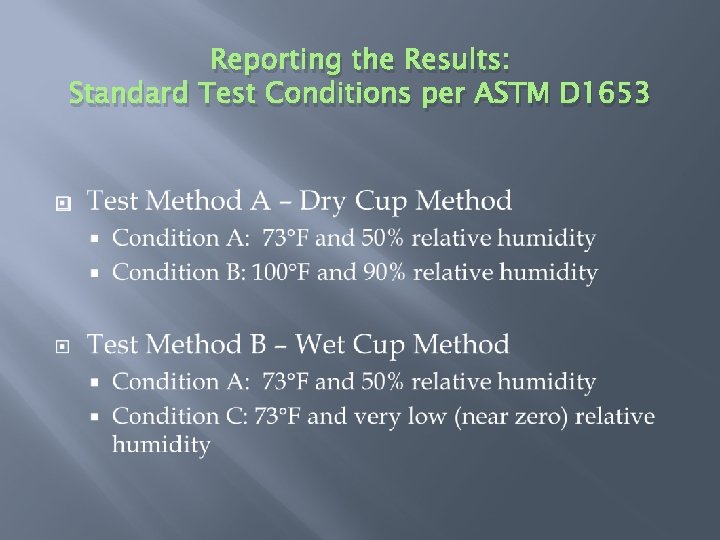
Reporting the Results: Standard Test Conditions per ASTM D 1653 �
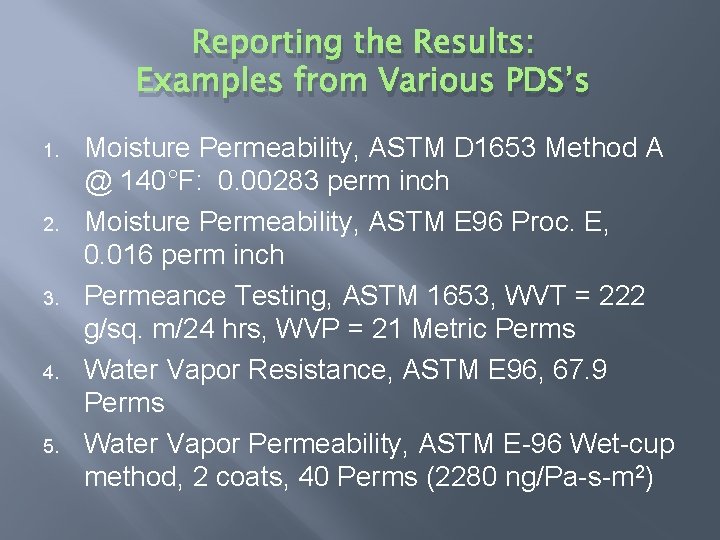
Reporting the Results: Examples from Various PDS’s 1. 2. 3. 4. 5. Moisture Permeability, ASTM D 1653 Method A @ 140°F: 0. 00283 perm inch Moisture Permeability, ASTM E 96 Proc. E, 0. 016 perm inch Permeance Testing, ASTM 1653, WVT = 222 g/sq. m/24 hrs, WVP = 21 Metric Perms Water Vapor Resistance, ASTM E 96, 67. 9 Perms Water Vapor Permeability, ASTM E-96 Wet-cup method, 2 coats, 40 Perms (2280 ng/Pa-s-m 2)
Miscellaneous Can the Water Vapor Permeance of a Paint System Already in Place be Determined? Multiple Layers of Materials: Estimate of Permeance
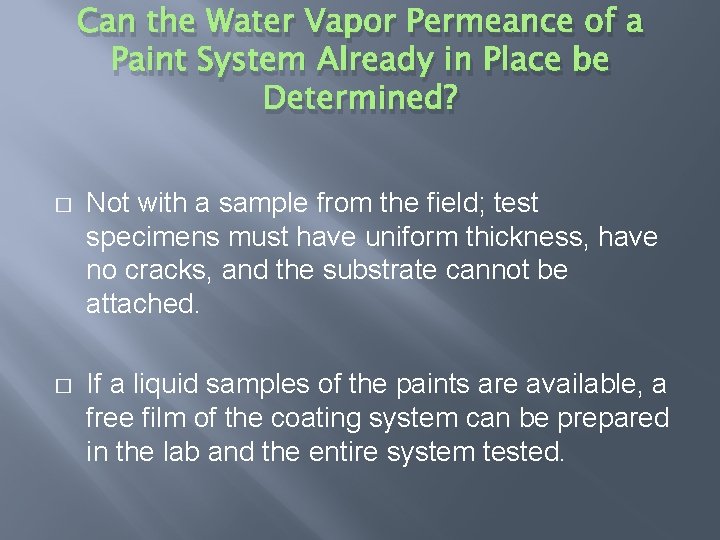
Can the Water Vapor Permeance of a Paint System Already in Place be Determined? � Not with a sample from the field; test specimens must have uniform thickness, have no cracks, and the substrate cannot be attached. � If a liquid samples of the paints are available, a free film of the coating system can be prepared in the lab and the entire system tested.
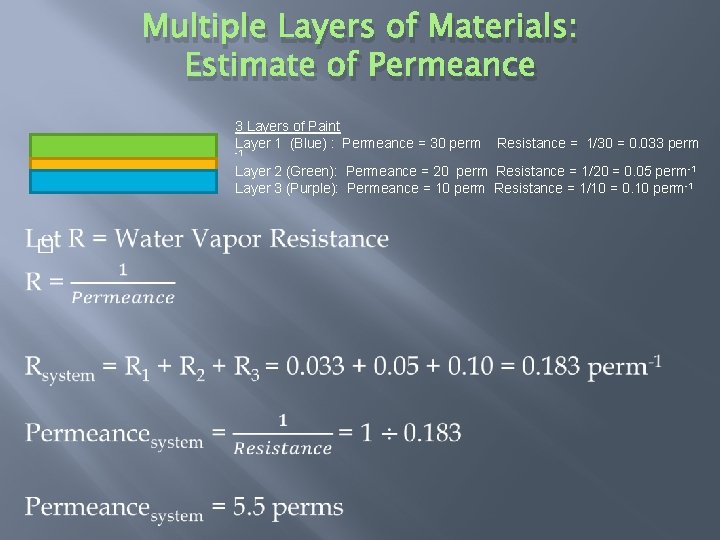
Multiple Layers of Materials: Estimate of Permeance 3 Layers of Paint Layer 1 (Blue) : Permeance = 30 perm Resistance = 1/30 = 0. 033 perm -1 Layer 2 (Green): Permeance = 20 perm Resistance = 1/20 = 0. 05 perm-1 Layer 3 (Purple): Permeance = 10 perm Resistance = 1/10 = 0. 10 perm-1 �
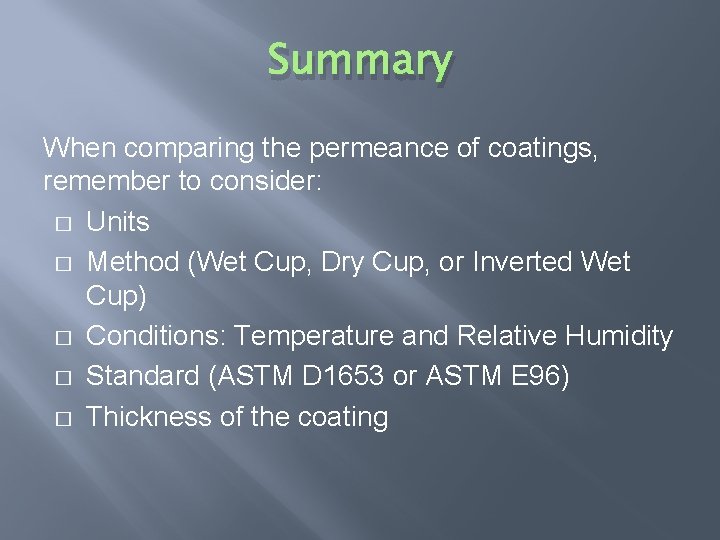
Summary When comparing the permeance of coatings, remember to consider: � Units � Method (Wet Cup, Dry Cup, or Inverted Wet Cup) � Conditions: Temperature and Relative Humidity � Standard (ASTM D 1653 or ASTM E 96) � Thickness of the coating
Questions? Cheryl Roberts – 412 -788 -1300, x 209 (croberts@kta. com)
- Slides: 56