
Laboratory Testing Innate and Adaptive Immune Systems Thomas
Laboratory Testing: Innate and Adaptive Immune Systems Thomas A. Fleisher, M. D. , FAAAAI, FACAAI National Institutes of Health Bethesda, MD, USA
Dr. Fleisher has no conflicts of interest related to this presentation
Principles of Immune Testing STARTING POINT INVOLVES A PATIENT: • Medical history of recurrent infections including microorganism(s), frequency, site(s), therapy required • Family history with attention to early deaths and recurrent infections • Physical examination

Evaluation of Adaptive Immunity: B Cell Function Screening Tests • History of recurrent sinopulmonary infections with encapsulated bacteria • Screening Tests • Immunoglobulin (Ig. G, Ig. A, Ig. M, Ig. E) levels • Specific antibody response • Protein antigens • CHO antigens • HIV testing

Immunoglobulin Levels • Age related differences are significant and must be considered for each evaluation (i. e. use age specific reference intervals to evaluate values) • Normal range = 95% confidence interval 2. 5% controls below 2. 5% controls above • Total immunoglobulin level (for each class) is the net of production, consumption, and loss

Ig. G Subclass Levels • Test is relatively expensive • Frequency of isolated Ig. G subclass deficiency remains controversial • May be useful in evaluating Ig. A deficient patients with recurrent infections • Generally still need to establish a failure to produce specific antibody before initiating Ig. G replacement therapy
Specific Antibody Response • Represents the “ standard” regarding the capacity to mount an antibody response • “Natural antibody” screen: testing for isohemagglutinins (<1 -2 yrs unreliable), antibody level to prior immunization • Provocative testing: immunize with protein and CHO vaccines, obtain pre- and postantibody levels

Evaluation of Adaptive Immunity: Screening of T Cell Function • History recurrent opportunistic infections often with failure to thrive • Screening Tests – HIV test – Lymphocyte count (T cells = ~75% of lymphs) – DTH testing (used less frequently in USA) • Specific response to recall antigens in vivo: antigen specific T cell activation, cytokine production, inflammatory cell migration • Lack of response: anergy versus no prior exposure

Secondary Adaptive Immune Testing: Primary Focus on T cells In vitro assays that help identify the cellular level or degree of T cell dysfunction • Immune cell and specific protein identification: flow cytometry • Immune cell function (ordered based on strong history of a cellular immune defect) • T cell proliferation/cytokine assay (mitogens, recall antigens) • T cell cytotoxicity assays: used infrequently in clinical evaluation
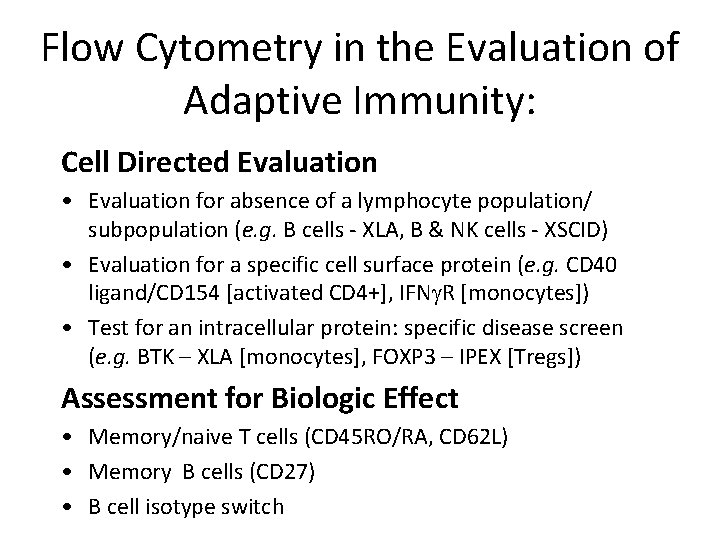
Flow Cytometry in the Evaluation of Adaptive Immunity: Cell Directed Evaluation • Evaluation for absence of a lymphocyte population/ subpopulation (e. g. B cells - XLA, B & NK cells - XSCID) • Evaluation for a specific cell surface protein (e. g. CD 40 ligand/CD 154 [activated CD 4+], IFNg. R [monocytes]) • Test for an intracellular protein: specific disease screen (e. g. BTK – XLA [monocytes], FOXP 3 – IPEX [Tregs]) Assessment for Biologic Effect • Memory/naive T cells (CD 45 RO/RA, CD 62 L) • Memory B cells (CD 27) • B cell isotype switch
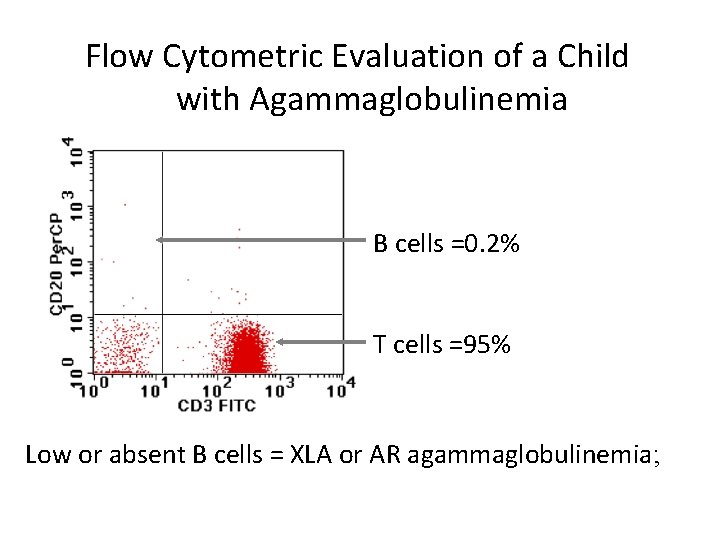
Flow Cytometric Evaluation of a Child with Agammaglobulinemia B cells =0. 2% T cells =95% Low or absent B cells = XLA or AR agammaglobulinemia;
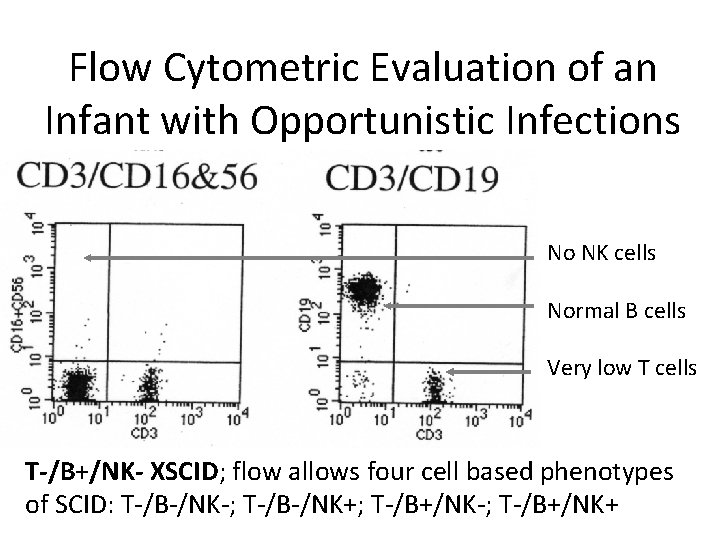
Flow Cytometric Evaluation of an Infant with Opportunistic Infections No NK cells Normal B cells Very low T cells T-/B+/NK- XSCID; flow allows four cell based phenotypes of SCID: T-/B-/NK-; T-/B-/NK+; T-/B+/NK-; T-/B+/NK+

Lymphocyte Function Testing • Response to mitogens, recall antigens, allogeneic cells – Proliferation assessed by 3 H-thymidine incorporation – Cytokine release into culture supernatant – Activation antigen upregulation (e. g. CD 69 by flow) – Cell division(e. g. CFSE) or cell cycle (e. g. Br. DU) • Cytotoxicity: – Antigen specific: requires presensitization, initiated thru Tc. R recognition of viral (or other) peptide on MHC • 51 Cr release from target cells • Flow cytometry test for CD 107 a expression by cytotoxic T cell
Evaluating Innate Immunity
Evaluate NK cells • Very few patients identified with isolated NK cell absence • HLH and XLP are associated with functional NK cell deficiency • Enumerate NK cells using flow cytometry • Evaluate NK cell functional activity using in vitro cytotoxicity assay with K 562 targets – 51 Cr release from target cells – Flow cytometry test for CD 107 a expression by NK cells
Evaluating TLR Function • Clinical phenotype of TLR defects – Recurrent pyogenic infections with limited systemic symptoms (minimal fever, normal or low CRP, etc) – Herpes simplex encephalitis • Screening tests of TLRs utilize stimulation by ligands for specific TLRs • Currently this testing has relatively limited availability in clinical laboratories
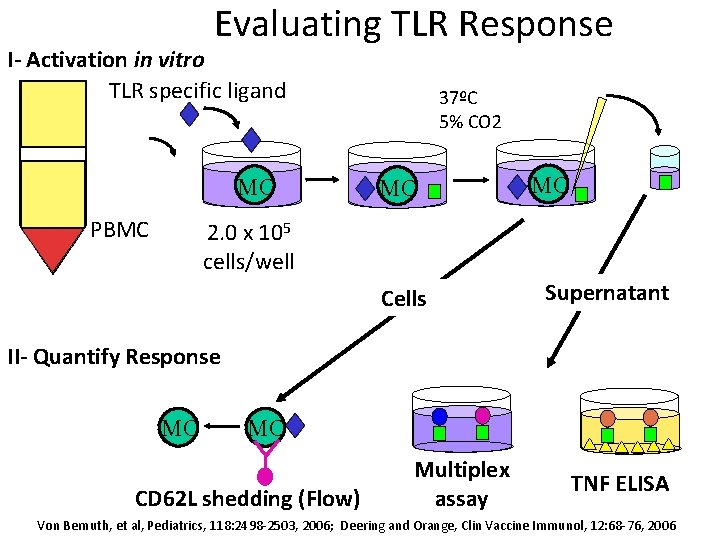
Evaluating TLR Response I- Activation in vitro TLR specific ligand MC PBMC 37ºC 5% CO 2 MC MC 2. 0 x 105 cells/well Cells Supernatant II- Quantify Response MC MC CD 62 L shedding (Flow) Multiplex assay TNF ELISA Von Bernuth, et al, Pediatrics, 118: 2498 -2503, 2006; Deering and Orange, Clin Vaccine Immunol, 12: 68 -76, 2006
Neutrophil Immunodeficiency • History of recurrent/chronic infections with bacteria and fungi involving the skin, lungs, bone, liver and oral cavity • Most often is 2 o to neutropenia • Defined genetic defects primarily impact microbial killing (CGD) or neutrophil migration (LAD)
Screening of Neutrophil Function • Absolute neutrophil count (ANC) • Evaluation of oxidative burst – CGD results from defective oxidative burst – DHR test, NBT test, chemiluminescence • Evaluation of adhesion molecules – Leukocyte adhesion deficiency (LAD) I results from defective CD 18 (b 2 integrin) expression – Test for CD 18 (+ CD 11 a, b, c) expression
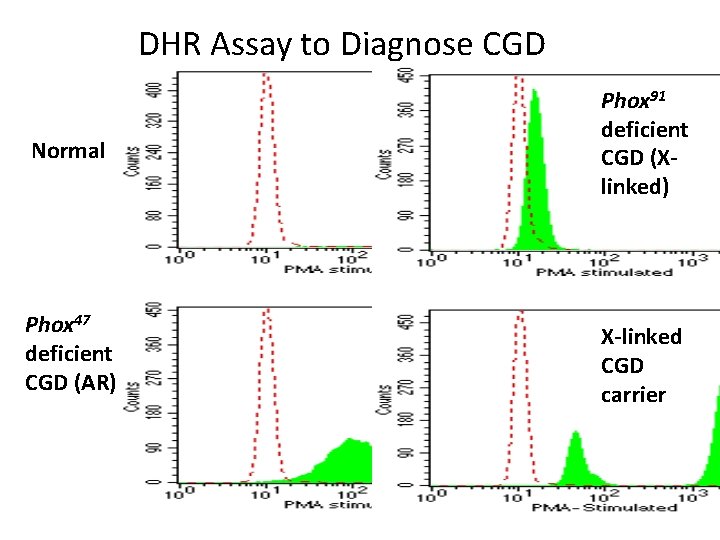
DHR Assay to Diagnose CGD Normal Phox 91 deficient CGD (Xlinked) Phox 47 deficient CGD (AR) X-linked CGD carrier
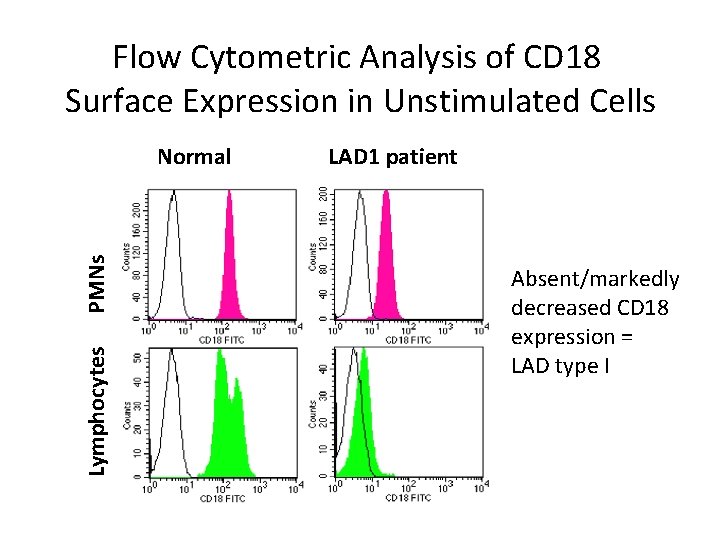
Flow Cytometric Analysis of CD 18 Surface Expression in Unstimulated Cells Lymphocytes PMNs Normal LAD 1 patient Absent/markedly decreased CD 18 expression = LAD type I
Complement Deficiency • Clinical presentation • Recurrent encapsulated bacterial infections: early component deficiency (C 1 q, C 2, C 4, C 3) • Recurrent meningococcal infections: deficiency of terminal complement components (C 5 -C 9) • Screening test: CH 50 (functional assay of total hemolytic complement activity) • Additional testing: AP 50 and complement component assays
Summary • Laboratory testing is crucial in evaluating patients for possible immune defects • The choice of tests should be determined based on the specific clinical history of recurrent and/or chronic infections • There remain patients with a clinical history strongly suggesting an immune defect that using current testing remain undiagnosed • Genetic testing is emerging as an important diagnostic test in resolving possible PID
References • Notarangelo LD, et al. Primary immunodeficiencies: 2009 update. J Allergy Clin Immunol. 2009, 124: 1161. • Oliveira JB, Fleisher TA. Laboratory evaluation of primary immunodeficiencies. J Allergy Clin Immunol. 2010, 125: S 297. • Oliveira JB, Fleisher TA. Molecular and flow cytometry-based diagnosis of primary immunodeficiency disorders. Curr Allergy Asthma Rep. 2010, 10: 460. • Rosenzweig SD, Holland SM. Recent insights into the pathobiology of innate immune deficiencies. Curr Allergy Asthma Rep. 2011, 11: 369.
- Slides: 24