
LABORATORY STUDIES OF THE FORMATION OF INTERSTELLAR DUST
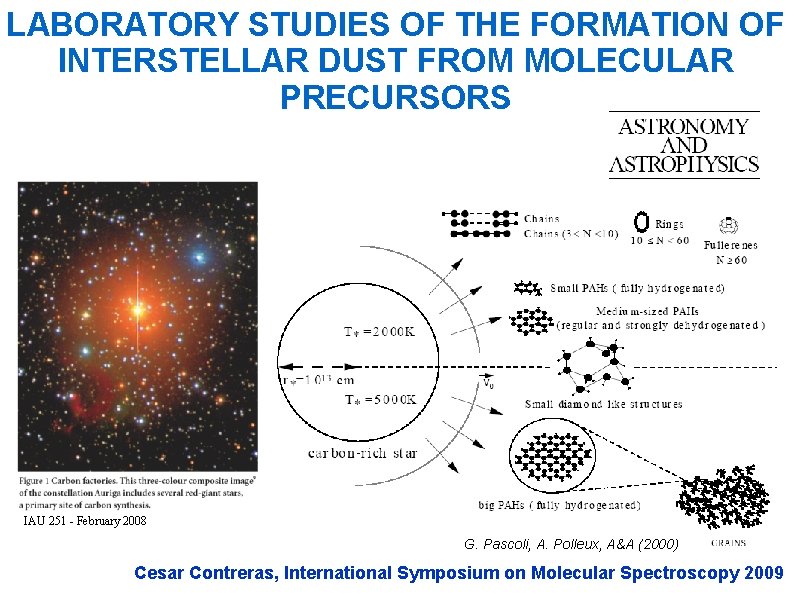
LABORATORY STUDIES OF THE FORMATION OF INTERSTELLAR DUST FROM MOLECULAR PRECURSORS IAU 251 - February 2008 G. Pascoli, A. Polleux, A&A (2000) Cesar Contreras, International Symposium on Molecular Spectroscopy 2009
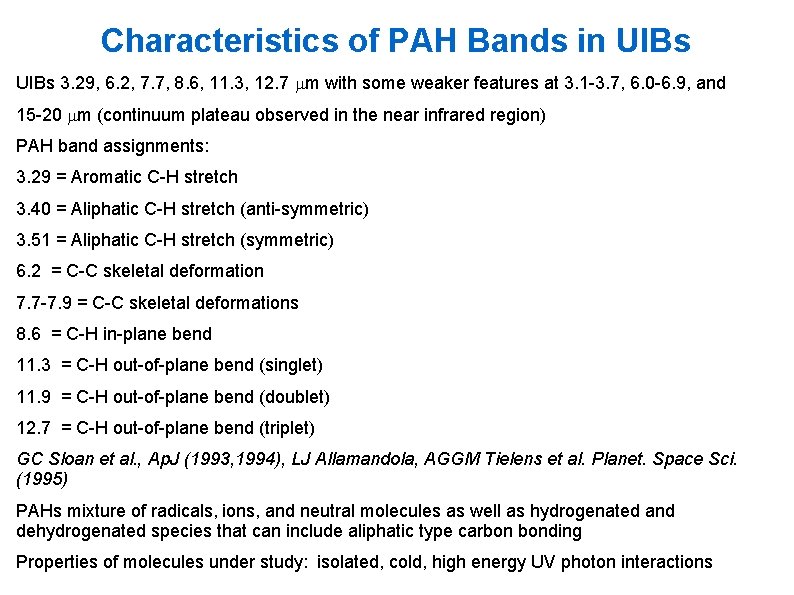
Characteristics of PAH Bands in UIBs 3. 29, 6. 2, 7. 7, 8. 6, 11. 3, 12. 7 m with some weaker features at 3. 1 -3. 7, 6. 0 -6. 9, and 15 -20 m (continuum plateau observed in the near infrared region) PAH band assignments: 3. 29 = Aromatic C-H stretch 3. 40 = Aliphatic C-H stretch (anti-symmetric) 3. 51 = Aliphatic C-H stretch (symmetric) 6. 2 = C-C skeletal deformation 7. 7 -7. 9 = C-C skeletal deformations 8. 6 = C-H in-plane bend 11. 3 = C-H out-of-plane bend (singlet) 11. 9 = C-H out-of-plane bend (doublet) 12. 7 = C-H out-of-plane bend (triplet) GC Sloan et al. , Ap. J (1993, 1994), LJ Allamandola, AGGM Tielens et al. Planet. Space Sci. (1995) PAHs mixture of radicals, ions, and neutral molecules as well as hydrogenated and dehydrogenated species that can include aliphatic type carbon bonding Properties of molecules under study: isolated, cold, high energy UV photon interactions

Polycyclic Aromatic Hydrocarbons in the Interstellar Medium PAH structures Salama et al. Ap. J (1996) Hubble, Spitzer observations show that PAHs are ubiquitous in ISM Carbon nanoparticles Courtesy from R. Ruiterkamp http: //www. spitzer. caltech. edu/features/articles/20050627. shtml
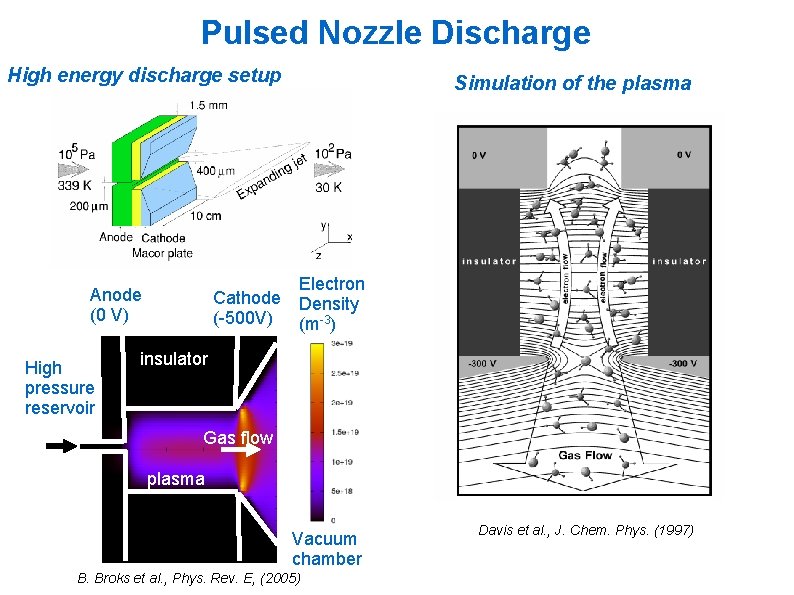
Pulsed Nozzle Discharge High energy discharge setup Electron Cathode Density (-500 V) (m-3) Anode (0 V) High pressure reservoir Simulation of the plasma insulator Gas flow plasma Vacuum chamber B. Broks et al. , Phys. Rev. E, (2005) Davis et al. , J. Chem. Phys. (1997)
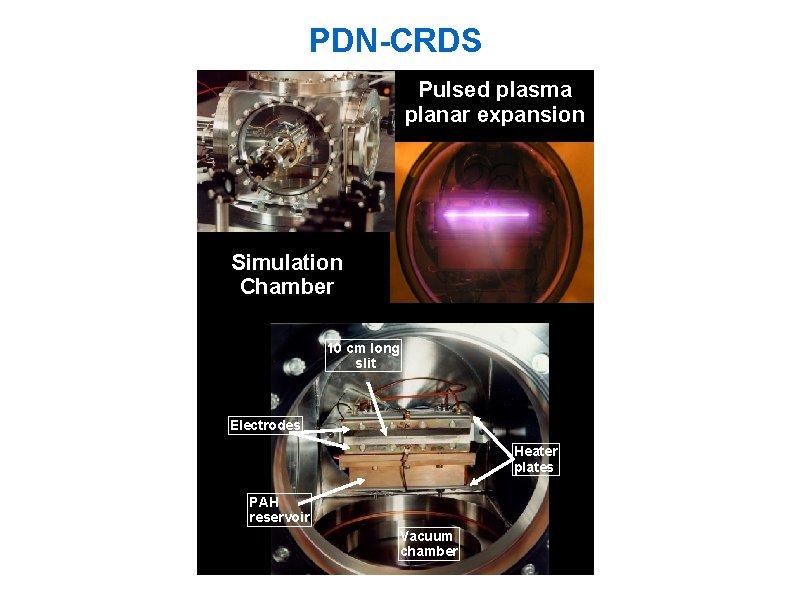
PDN-CRDS Pulsed plasma planar expansion Simulation Chamber 10 cm long slit Electrodes Heater plates PAH reservoir Vacuum chamber
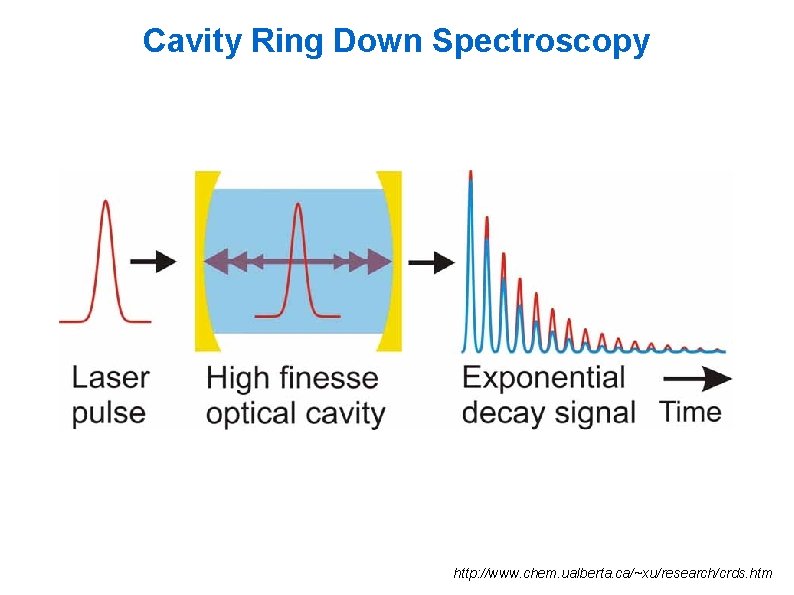
Cavity Ring Down Spectroscopy http: //www. chem. ualberta. ca/~xu/research/crds. htm
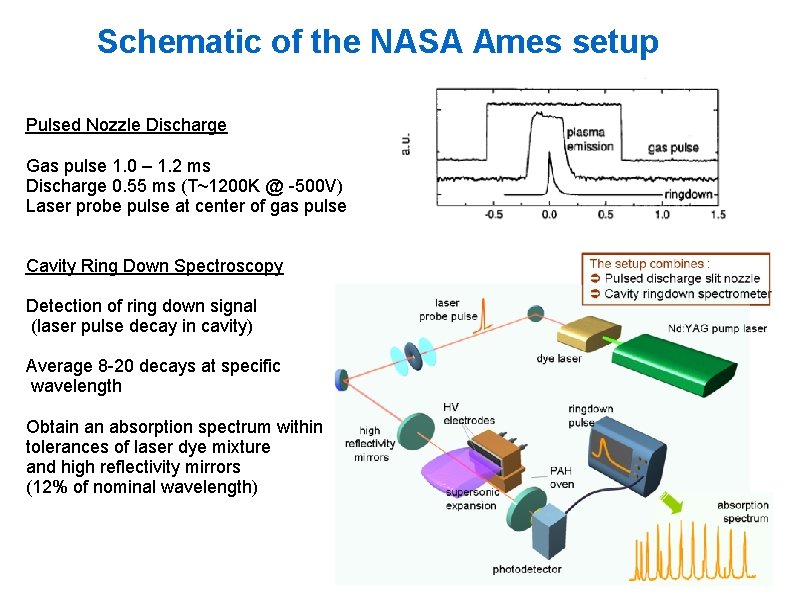
Schematic of the NASA Ames setup Pulsed Nozzle Discharge Gas pulse 1. 0 – 1. 2 ms Discharge 0. 55 ms (T~1200 K @ -500 V) Laser probe pulse at center of gas pulse Cavity Ring Down Spectroscopy Detection of ring down signal (laser pulse decay in cavity) Average 8 -20 decays at specific wavelength Obtain an absorption spectrum within tolerances of laser dye mixture and high reflectivity mirrors (12% of nominal wavelength)
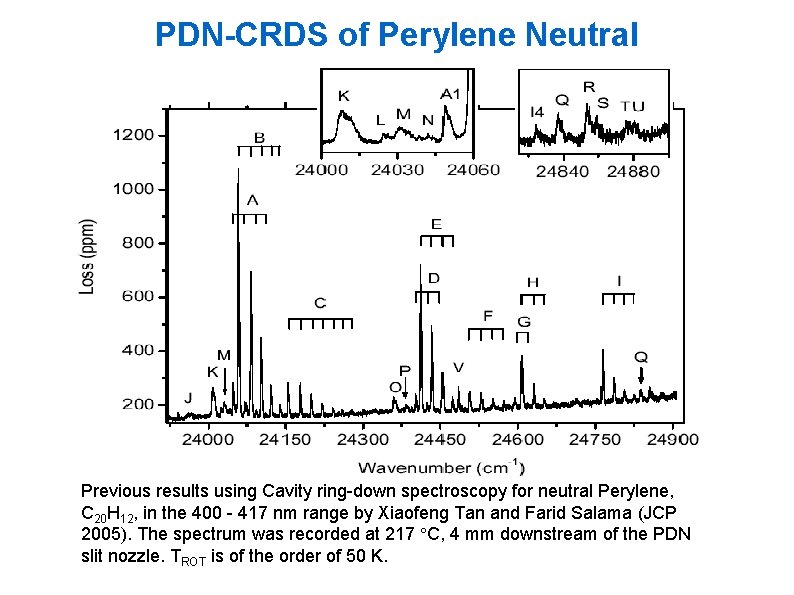
PDN-CRDS of Perylene Neutral Previous results using Cavity ring-down spectroscopy for neutral Perylene, C 20 H 12, in the 400 - 417 nm range by Xiaofeng Tan and Farid Salama (JCP 2005). The spectrum was recorded at 217 C, 4 mm downstream of the PDN slit nozzle. TROT is of the order of 50 K.
PDN-CRDS of Naphthalene Cation Gas phase absorption spectrum of the four stronger vibronic bands of the D 2 D 0 electronic transition band system of Np+.
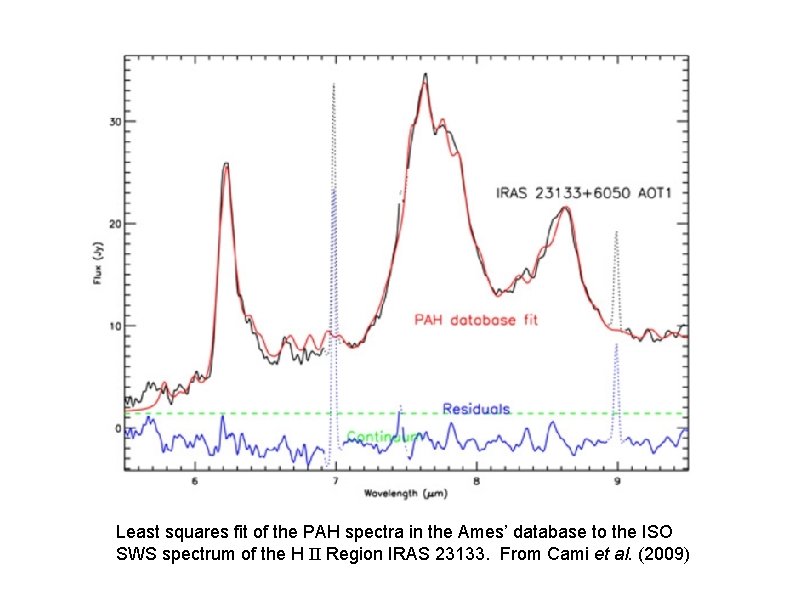
Least squares fit of the PAH spectra in the Ames’ database to the ISO SWS spectrum of the H II Region IRAS 23133. From Cami et al. (2009)
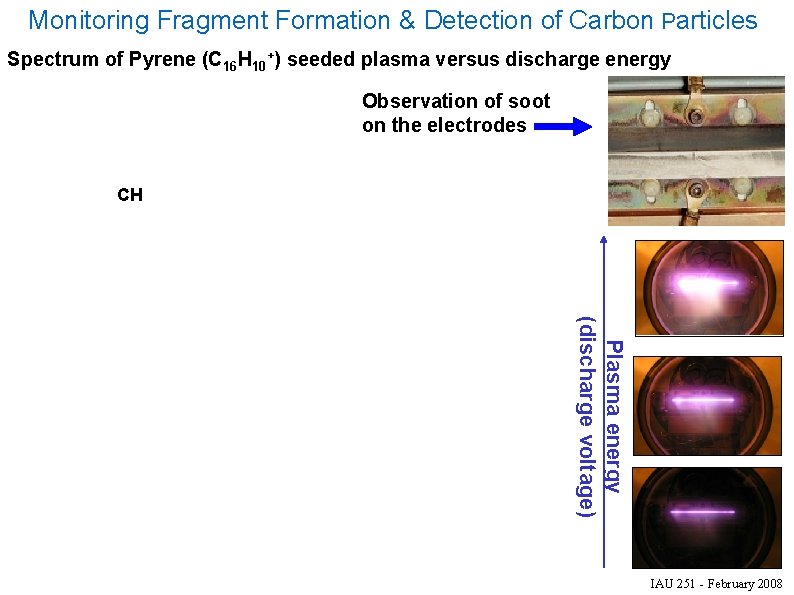
Monitoring Fragment Formation & Detection of Carbon Particles Spectrum of Pyrene (C 16 H 10+) seeded plasma versus discharge energy Observation of soot on the electrodes CH + Plasma energy (discharge voltage) IAU 251 - February 2008
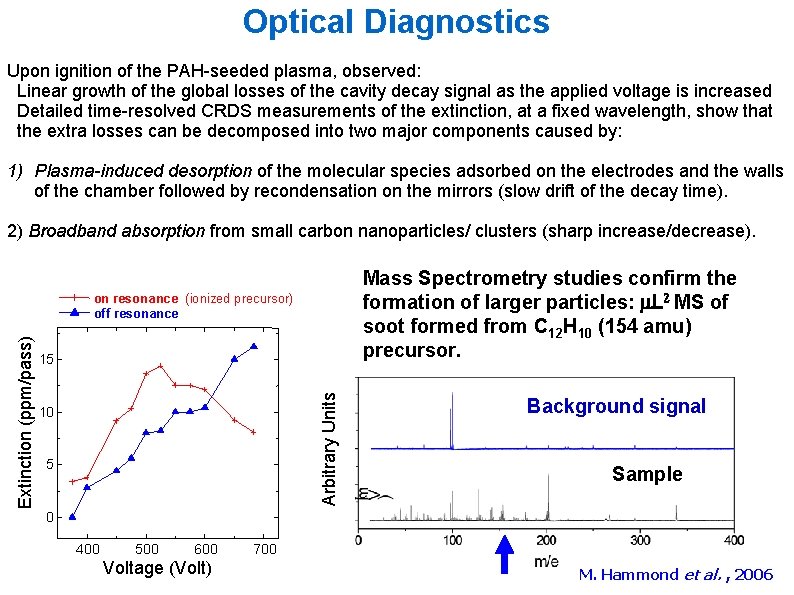
Optical Diagnostics Upon ignition of the PAH-seeded plasma, observed: Linear growth of the global losses of the cavity decay signal as the applied voltage is increased Detailed time-resolved CRDS measurements of the extinction, at a fixed wavelength, show that the extra losses can be decomposed into two major components caused by: 1) Plasma-induced desorption of the molecular species adsorbed on the electrodes and the walls of the chamber followed by recondensation on the mirrors (slow drift of the decay time). 2) Broadband absorption from small carbon nanoparticles/ clusters (sharp increase/decrease). Mass Spectrometry studies confirm the formation of larger particles: L MS of soot formed from C 12 H 10 (154 amu) precursor. 15 Arbitrary Units Extinction (ppm/pass) on resonance (ionized precursor) off resonance 10 5 Background signal Sample 0 400 500 600 Voltage (Volt) 700 M. Hammond et al. , 2006
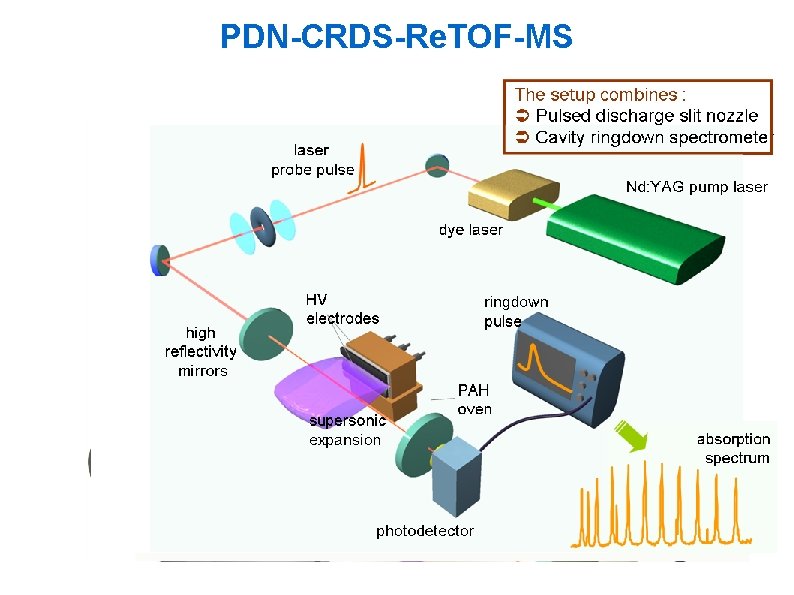
PDN-CRDS-Re. TOF-MS The setup now combines: • Pulsed discharge nozzle • Cavity Ring down spectrometer • Reflectron Time-of-Flight Mass Spectrometer Re. TOF-MS
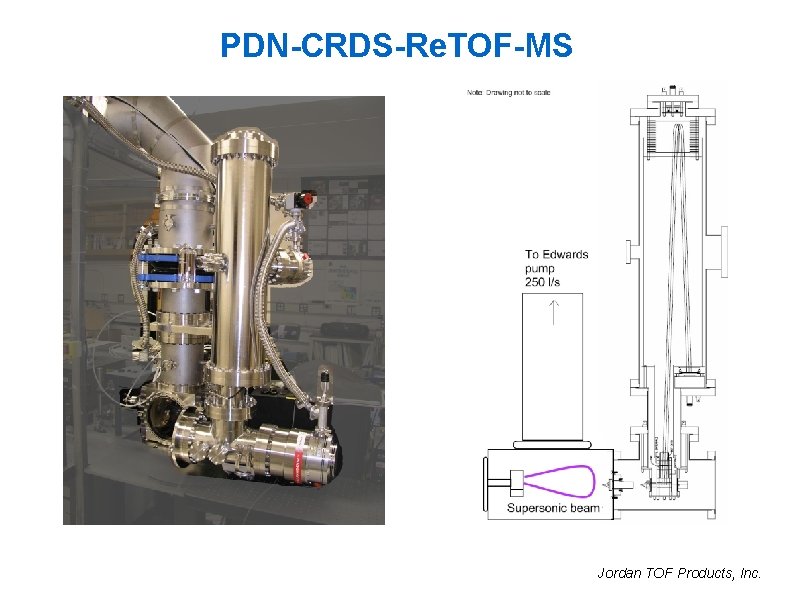
PDN-CRDS-Re. TOF-MS Jordan TOF Products, Inc.
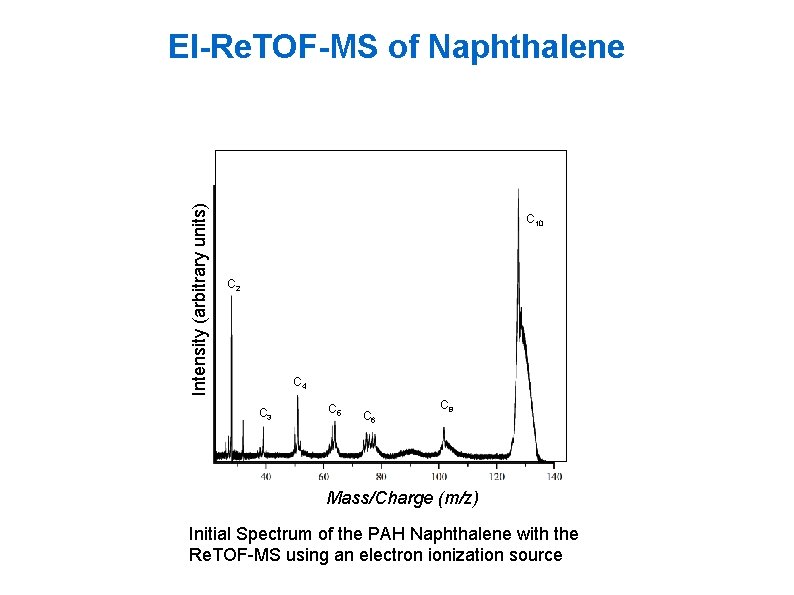
Intensity (arbitrary units) EI-Re. TOF-MS of Naphthalene C 10 C 2 C 4 C 3 C 5 C 6 C 8 Mass/Charge (m/z) Initial Spectrum of the PAH Naphthalene with the Re. TOF-MS using an electron ionization source
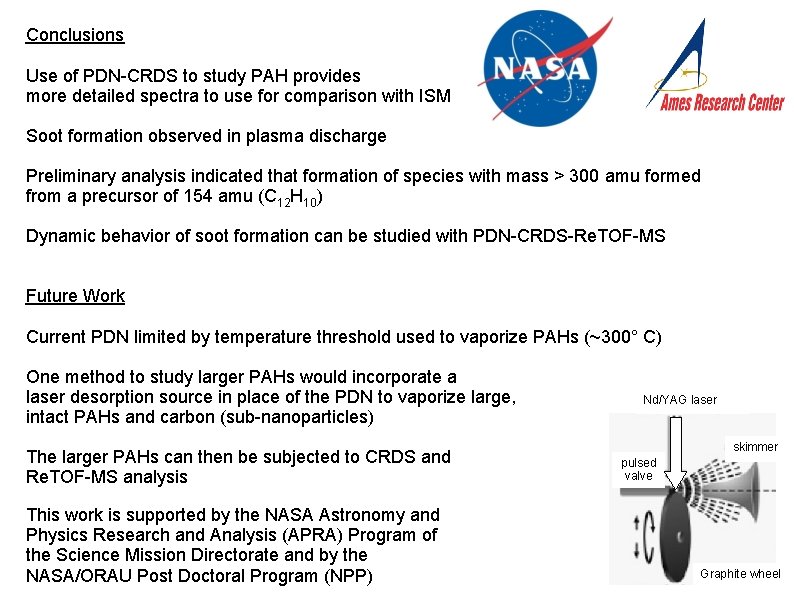
Conclusions Use of PDN-CRDS to study PAH provides more detailed spectra to use for comparison with ISM Soot formation observed in plasma discharge Preliminary analysis indicated that formation of species with mass > 300 amu formed from a precursor of 154 amu (C 12 H 10) Dynamic behavior of soot formation can be studied with PDN-CRDS-Re. TOF-MS Future Work Current PDN limited by temperature threshold used to vaporize PAHs (~300° C) One method to study larger PAHs would incorporate a laser desorption source in place of the PDN to vaporize large, intact PAHs and carbon (sub-nanoparticles) The larger PAHs can then be subjected to CRDS and Re. TOF-MS analysis This work is supported by the NASA Astronomy and Physics Research and Analysis (APRA) Program of the Science Mission Directorate and by the NASA/ORAU Post Doctoral Program (NPP) Nd/YAG laser skimmer pulsed valve Graphite wheel
- Slides: 16