
Laboratory Safety Some Hazards in Senior Lab Strong
Laboratory Safety

-Some Hazards in Senior Lab§ Strong acids and bases § Toxic chemicals § Rotating equipment – pumps – motors – tools § Pressurized Vessels – experiments – gas cylinders – air lines § Trip hazards – hoses – pipes § Electric shock – extension cords – water § Fire – flammable liquids – ignition sources
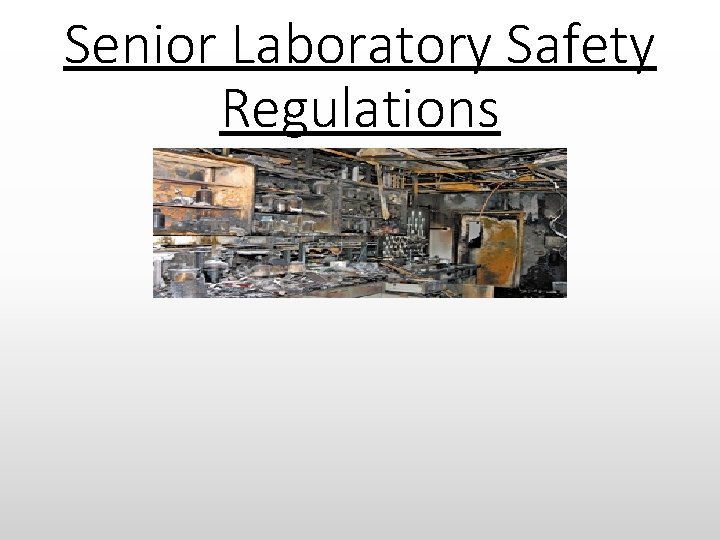
Senior Laboratory Safety Regulations
§ Safety glasses must be worn at all times while you are in the lab. § Food or beverages are not allowed in the lab. § Open toed shoes and shorts are not allowed in the lab. § Do not pour any chemicals down the drain without prior approval from your instructor or lab manager. § Nitrile gloves are supplied for routine protection when working with dilute acids and bases. § Facemasks, safety glasses and lab coats must be worn while working with concentrated acids and bases. § Mixing chemicals must be done in a fume hood unless the lab manager or lab instructor instructs otherwise.
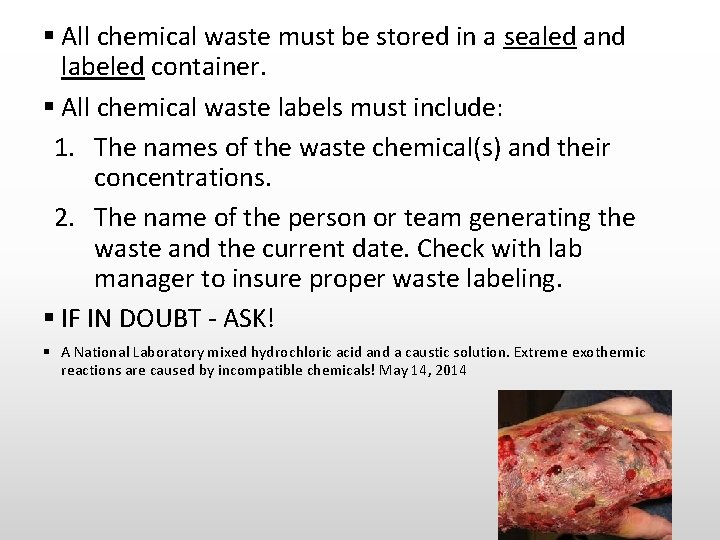
§ All chemical waste must be stored in a sealed and labeled container. § All chemical waste labels must include: 1. The names of the waste chemical(s) and their concentrations. 2. The name of the person or team generating the waste and the current date. Check with lab manager to insure proper waste labeling. § IF IN DOUBT - ASK! § A National Laboratory mixed hydrochloric acid and a caustic solution. Extreme exothermic reactions are caused by incompatible chemicals! May 14, 2014
§ Chemical solutions intended for use at a later date must be stored in a sealed container and clearly labeled with the contents and name of owner or lab group. Check with lab manager regarding storage areas. § Working alone in a research lab is against university regulations. § Senior Lab and Starley computer lab close at 5: 00 pm. § Work areas must be clean and organized upon completion of lab.
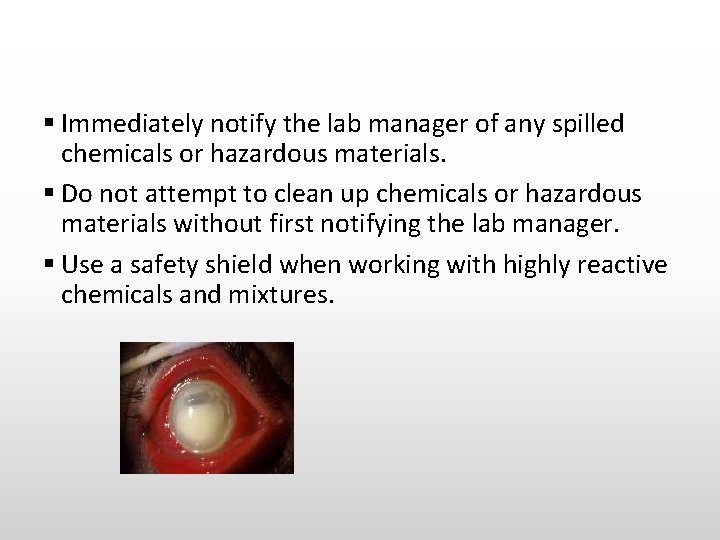
§ Immediately notify the lab manager of any spilled chemicals or hazardous materials. § Do not attempt to clean up chemicals or hazardous materials without first notifying the lab manager. § Use a safety shield when working with highly reactive chemicals and mixtures.
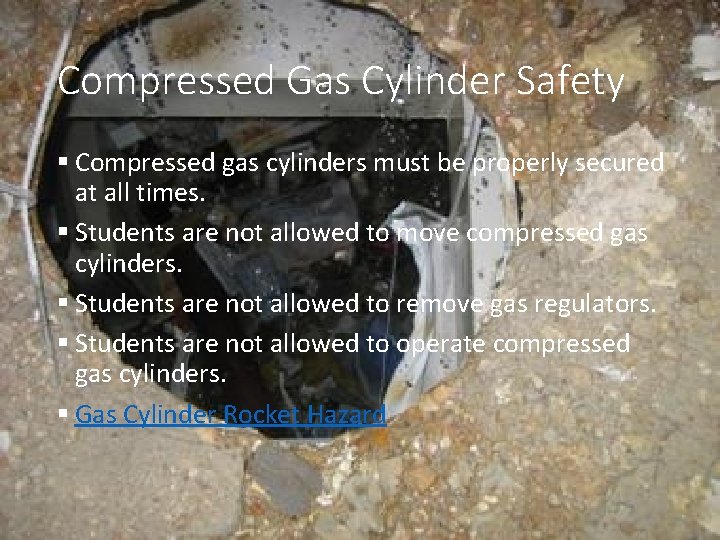
Compressed Gas Cylinder Safety § Compressed gas cylinders must be properly secured at all times. § Students are not allowed to move compressed gas cylinders. § Students are not allowed to remove gas regulators. § Students are not allowed to operate compressed gas cylinders. § Gas Cylinder Rocket Hazard
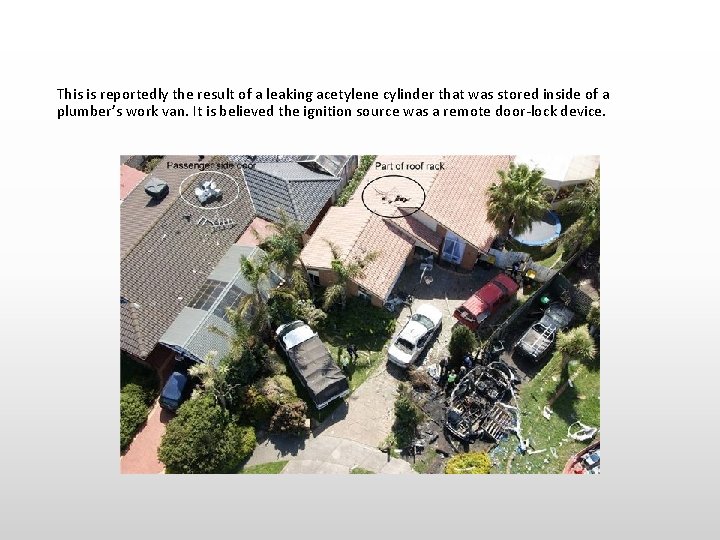
This is reportedly the result of a leaking acetylene cylinder that was stored inside of a plumber’s work van. It is believed the ignition source was a remote door-lock device.
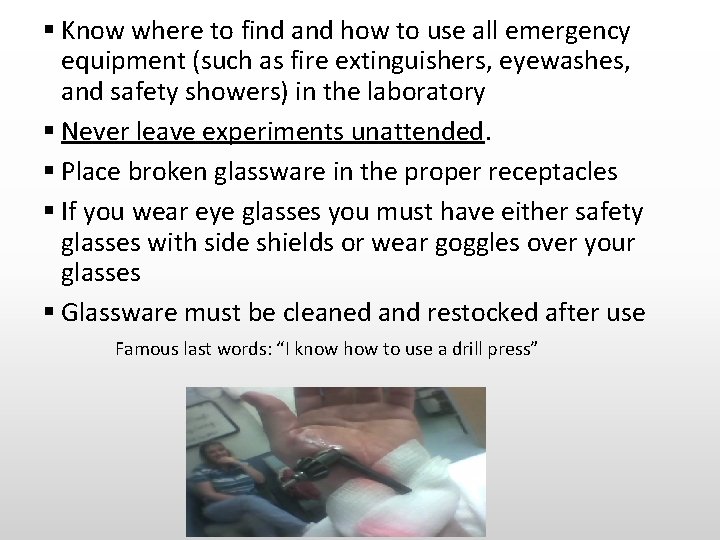
§ Know where to find and how to use all emergency equipment (such as fire extinguishers, eyewashes, and safety showers) in the laboratory § Never leave experiments unattended. § Place broken glassware in the proper receptacles § If you wear eye glasses you must have either safety glasses with side shields or wear goggles over your glasses § Glassware must be cleaned and restocked after use Famous last words: “I know how to use a drill press”
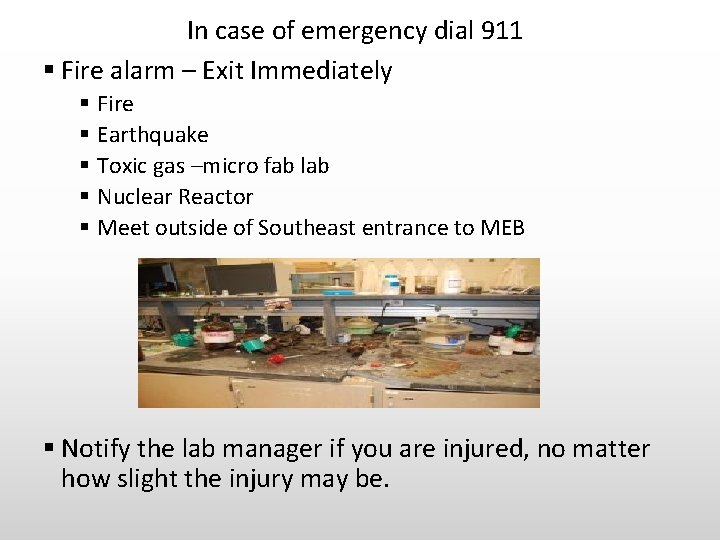
In case of emergency dial 911 § Fire alarm – Exit Immediately § Fire § Earthquake § Toxic gas –micro fab lab § Nuclear Reactor § Meet outside of Southeast entrance to MEB § Notify the lab manager if you are injured, no matter how slight the injury may be.
Glove Safety § It is your responsibility to read and understand the documentation describing glove / chemical compatibility. Use the proper glove for the material you are working with. A chart of glove / chemical compatibility is posted on the Senior Lab web site and in the stock room in the glove storage cabinet. § If in doubt – ASK!
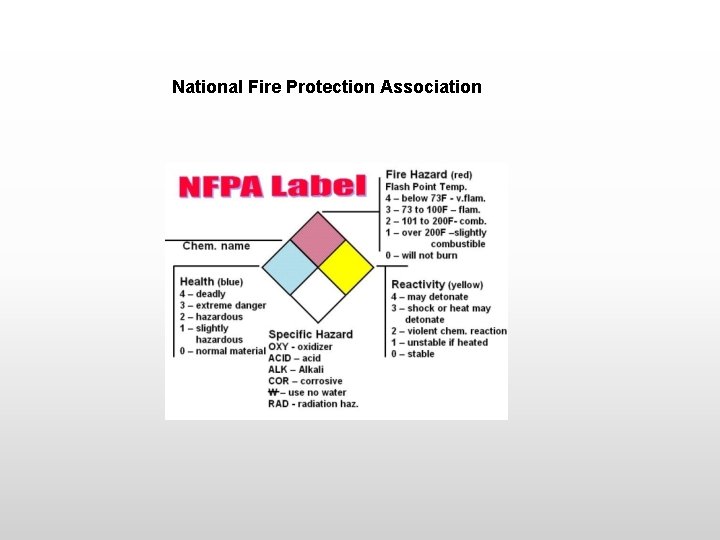
National Fire Protection Association
Eye Wash and Rinse § The first 10 to 15 seconds after exposure to a hazardous substance, especially a corrosive substance, are critical. Delaying treatment, even for a few seconds, may cause serious injury. § The American National Standards Institute (ANSI) Standard recommends that the affected body part must be flushed immediately and thoroughly for at least 15 minutes using a large supply of clean fluid under low pressure. Water does not neutralize contaminants -- it only dilutes and washes them away. This fact is why large amounts of water are needed.
§ Non-penetrating corrosives are chemicals which react with human tissue to form a protective layer which limits the extent of damage. Most acids are nonpenetrating corrosives. Flush area for 20 minutes for non-penetrating corrosives § A minimum 5 -minute flushing time is recommended for mildly irritating chemicals, § Penetrating corrosives, such as most alkalis, hydrofluoric acid and phenol, enter the skin or eyes deeply. Penetrating corrosives require a minimum water flush of 60 minutes or longer
-Student Responsibilities§ Plan work in accordance with lab safety regulations § Use equipment for designed purpose. § Know and use appropriate protective equipment § Be alert to unsafe conditions and actions § call attention to them § correct them § Work so that others (e. g. , coworkers, the public) will not be harmed § Know the laboratory safety requlations
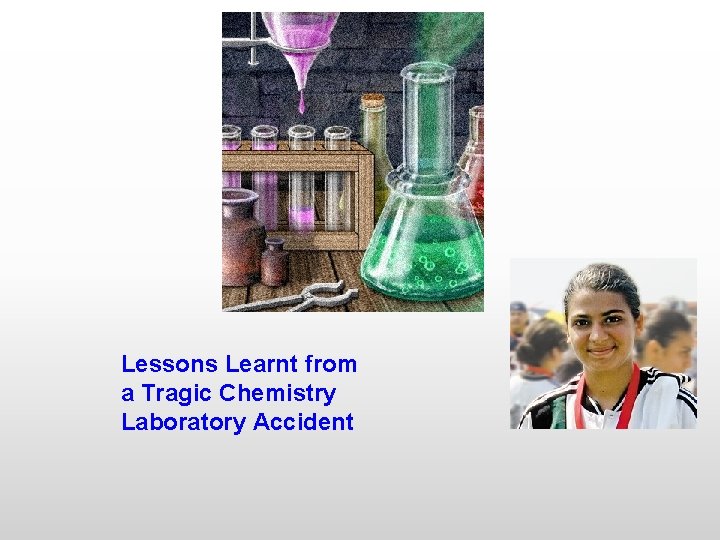
Lessons Learnt from a Tragic Chemistry Laboratory Accident
Ø A fatal accident happened in an organic chemistry laboratory at the University of California, Los Angeles (UCLA) in late December, 2008. A research assistant was using a syringe to transfer about 50 m. L of a pyrophoric chemical (a substance that catches fire spontaneously once exposed to air), tert-butyl lithium, dissolved in pentane, a flammable solvent. Ø The plunger suddenly came apart from the syringe barrel, causing the pyrophoric chemical to spew onto the hands and body of the researcher and catch fire. Ø Even though the fire was finally put out by other laboratory workers, the researcher suffered second to third-degree burns to over 43% of her body. She died in January 2009 due to the burns and the resulting complications, after 18 days in the hospital.
Ø The chemist who supervised a research assistant who died from injuries sustained in a University of California, Los Angeles (UCLA) lab more than four years ago will go on trial in connection with her death. Ø The California Division of Occupational Safety and Health found that the incident was caused by inadequate training, and criminal charges were brought against both the university and Harran.
Ø The appropriateness of using a syringe to transfer pyrophoric liquid in the experimental procedure was questionable. Ø There was no record of any risk assessment conducted of this critical operation involving a highly hazardous chemical. Ø It was unclear how much training was given to her, or whether it included any specific and hands-on training related to handling pyrophoric chemicals and emergency response procedures. Ø The fact that the victim ran in the direction away from the nearest emergency shower after the accident might indicate there was inadequate safety training.
Ø Proper use of fume hood and other safety devices. The victim was conducting the chemical transfer inside a fume hood, however, the sash of the fume hood was apparently raised too high to prevent the chemical from spewing onto the body of the victim Ø If the sash was at a lower position, or if a blast shield or a similar barrier had been placed between the body and the chemical, it might have restricted the injury to the hands and forearms. Ø Lack of protective clothing. The victim was wearing a pair of rubber gloves, which were not flame-proof, and she was not wearing a laboratory coat when the accident occurred.
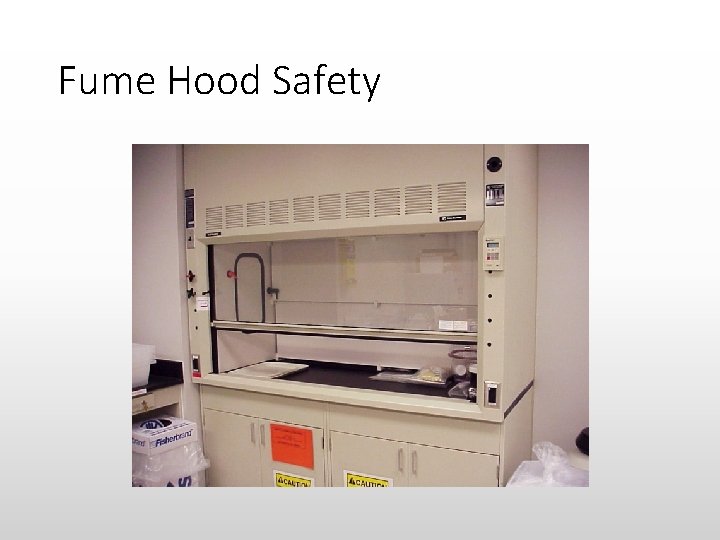
Fume Hood Safety
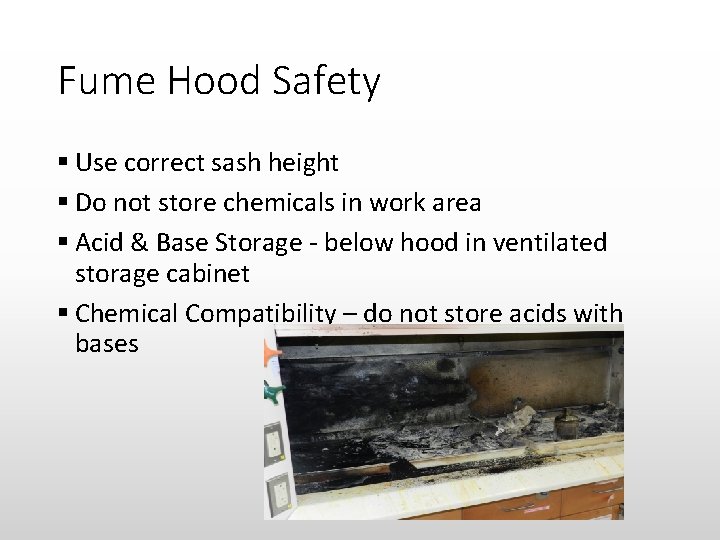
Fume Hood Safety § Use correct sash height § Do not store chemicals in work area § Acid & Base Storage - below hood in ventilated storage cabinet § Chemical Compatibility – do not store acids with bases
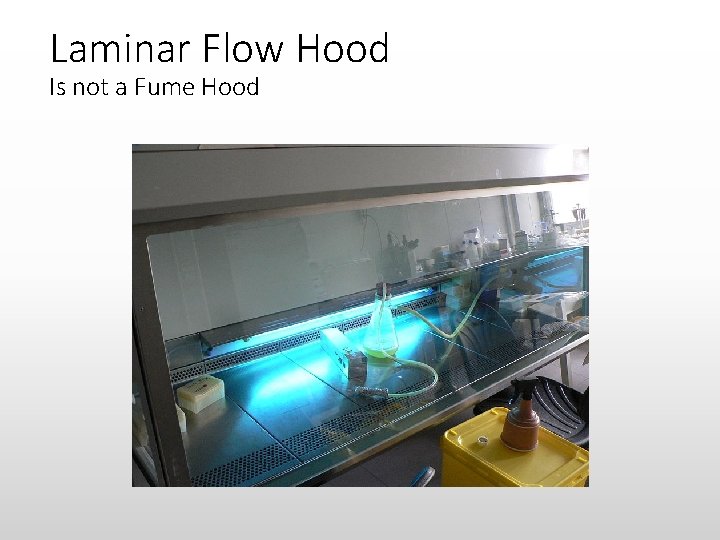
Laminar Flow Hood Is not a Fume Hood
§ You must complete a Job Hazard Analysis and an Equipment Specific Safety Review prior to operating your experiment. § I will deduct up to 10 % of your lab grade for safety violations. § Each time we don't do our best, we accept mediocrity as a way of life. To help set standards of excellence in everything we do we must pay attention to detail. If we don't know the right way to do something, we must ask someone who does.
- Slides: 26