
Laboratory Safety Report Errors to Management 1 Objectives
Laboratory Safety Report Errors to Management 1
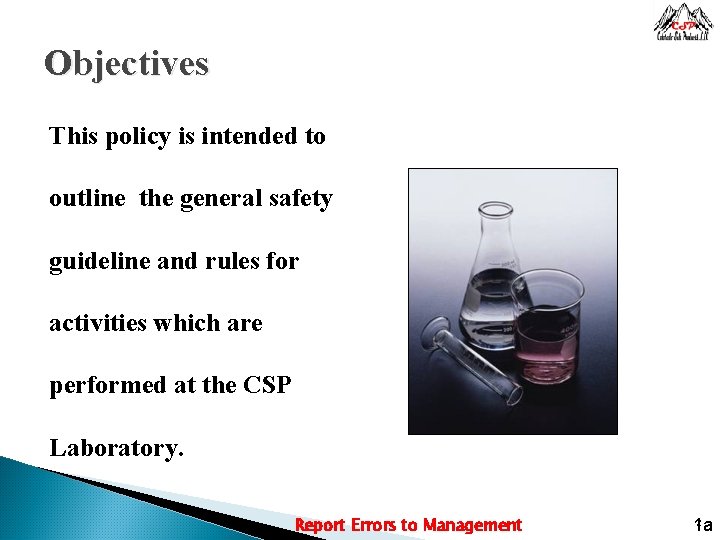
Objectives This policy is intended to outline the general safety guideline and rules for activities which are performed at the CSP Laboratory. Report Errors to Management 2 1 a
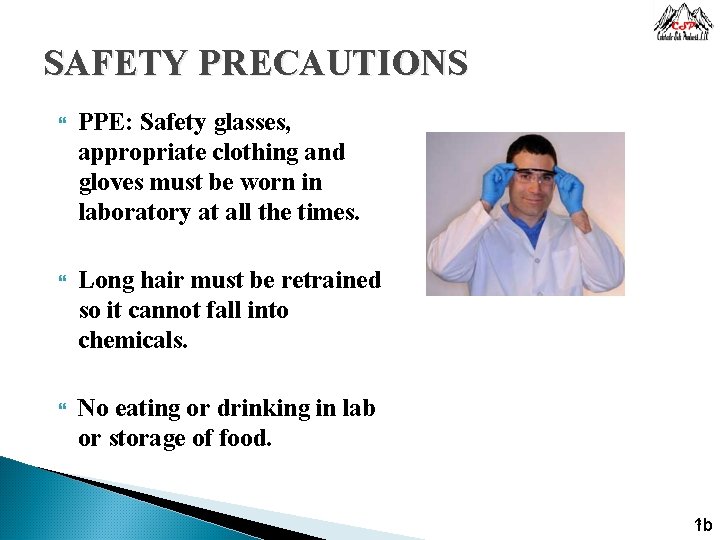
SAFETY PRECAUTIONS PPE: Safety glasses, appropriate clothing and gloves must be worn in laboratory at all the times. Long hair must be retrained so it cannot fall into chemicals. No eating or drinking in lab or storage of food. 3 1 b
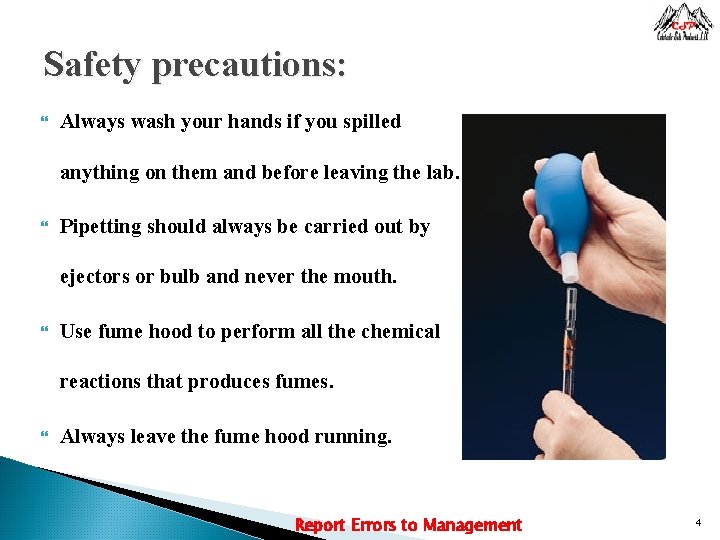
Safety precautions: Always wash your hands if you spilled anything on them and before leaving the lab. Pipetting should always be carried out by ejectors or bulb and never the mouth. Use fume hood to perform all the chemical reactions that produces fumes. Always leave the fume hood running. Report Errors to Management 4

Safety Precautions Discard titration samples in designated disposal site. ◦ In our plant the lab sink drains into vacuumed sealed containment area T-9103. ◦ Do not mix or drain acid and sodium hypochlorite together or close proximity of time, reaction can release toxic Chlorine gas. Do not carry out unauthorized experiments. Prior to working with any chemicals, always read and understand the Safety Data Sheets and respective SOPs. If at anytime you get nauseous, get outside for fresh air, report to authorities. i. e. Shift leads or Plant manager. Report Errors to Management 5

Safety Precautions Keep eye wash stations, emergency showers, fire extinguisher and alarm pullboxes free from obstructions. Keep emergency exits and all corridors free from obstruction. Never allow laboratory facility to come in contact with any food or drinking water. Report Errors to Management 6
Safety Precaution House Keeping: ◦ Clean benches and counters after the completion of each test. ◦ Broken glassware must be disposed into designated waste containers i. e. glass disposal bin under the counter. ◦ Chemical spill must be contained with spill kit immediately and placed in designated containers. ◦ Labels on incoming containers cannot be removed or defaced. ◦ Used empty chemical bottles advised crossed off the label before discarding them in the trash. (note: Please read SDSs and label carefully before rinsing it with water, keeping in mind possible reactivity when rinsing the bottles) Report Errors to Management 7

Laboratory safety Getting Sample : Must wear designated Lab face shield with visor. Buttoned full sleeved shirt. Surgical rubber gloves provided by company, or thicker gloves if needed to protect from heat of hot samples. Plant required PPE. i. e. Hard hat, respirator, steel toe boots and safety glasses with side shield must be worn. Mandatory: carrying a radio on at all times. Report Errors to Management 8
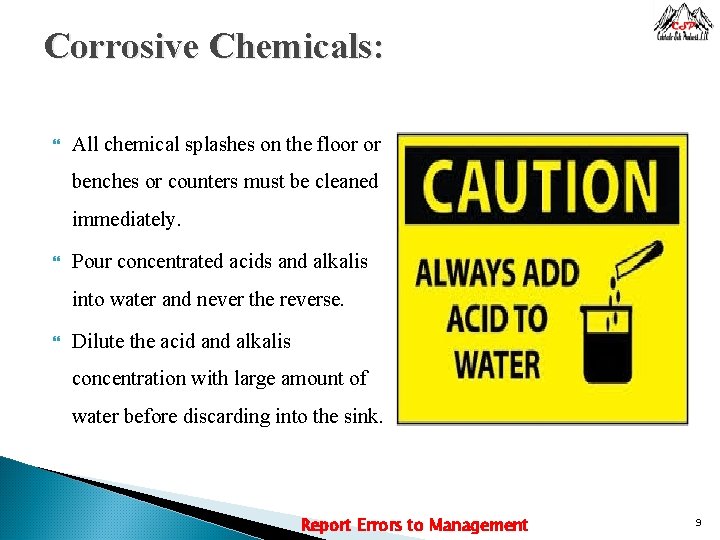
Corrosive Chemicals: All chemical splashes on the floor or benches or counters must be cleaned immediately. Pour concentrated acids and alkalis into water and never the reverse. Dilute the acid and alkalis concentration with large amount of water before discarding into the sink. Report Errors to Management 9
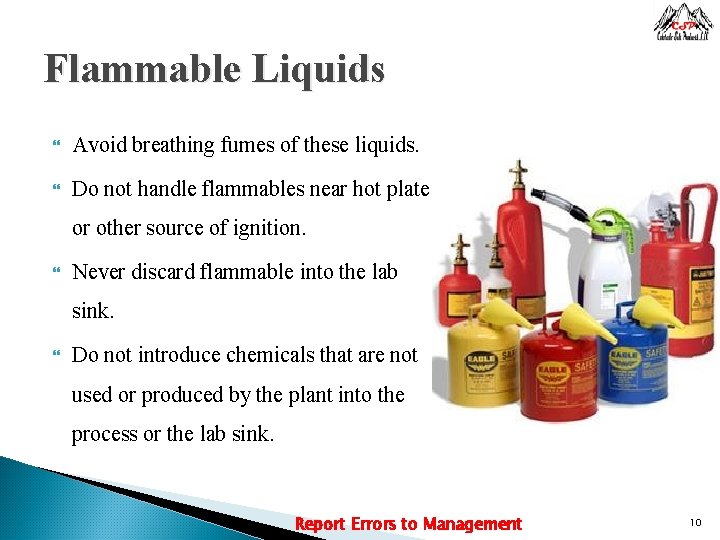
Flammable Liquids Avoid breathing fumes of these liquids. Do not handle flammables near hot plate or other source of ignition. Never discard flammable into the lab sink. Do not introduce chemicals that are not used or produced by the plant into the process or the lab sink. Report Errors to Management 10
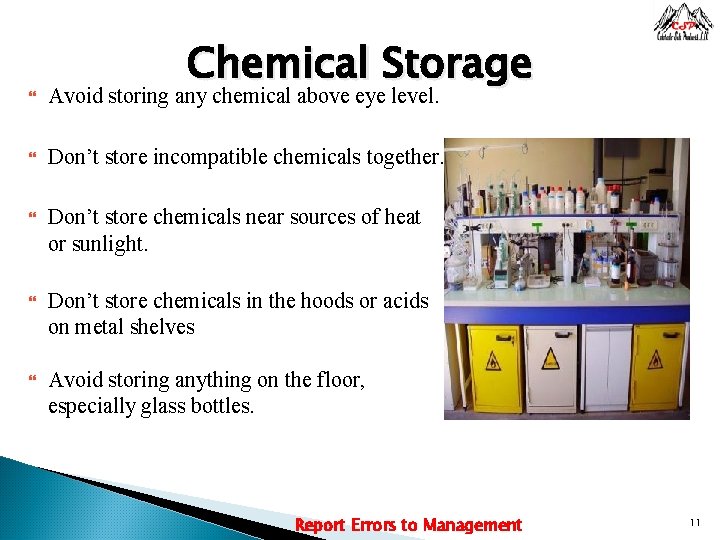
Chemical Storage Avoid storing any chemical above eye level. Don’t store incompatible chemicals together. Don’t store chemicals near sources of heat or sunlight. Don’t store chemicals in the hoods or acids on metal shelves Avoid storing anything on the floor, especially glass bottles. Report Errors to Management 11
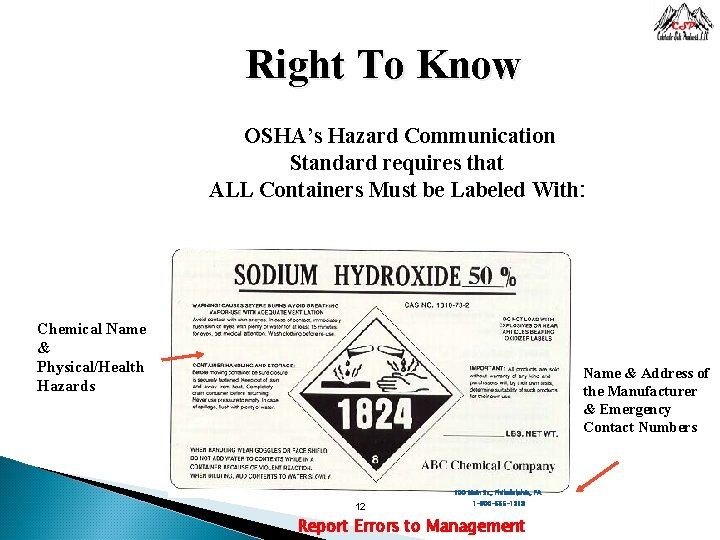
Right To Know OSHA’s Hazard Communication Standard requires that ALL Containers Must be Labeled With: Chemical Name & Physical/Health Hazards Name & Address of the Manufacturer & Emergency Contact Numbers 100 Main St. , Philadelphia, PA 12 1 -800 -555 -1212 Report Errors to Management
Safety Data Sheets (SDSs) An SDSs must be on file & available for each chemicals in the lab. In our plant we have physical copy in control room and electronic copy in drop box under safety folder. • • An SDSs lists: 1, Identification 2, Hazard(s) identification 3, Composition/information on ingredients 4, First-aid measures 5, Fire-fighting measures 6, Accidental release measures 7, Handling and storage 8, Exposure controls/personal protection • 9, Physical and chemical properties • 10, Stability and reactivity • 11, Toxicological information • 12, Ecological information • 13, Disposal considerations • 14, Transport information • 15, Regulatory information • 16, Other information Report Errors to Management 13
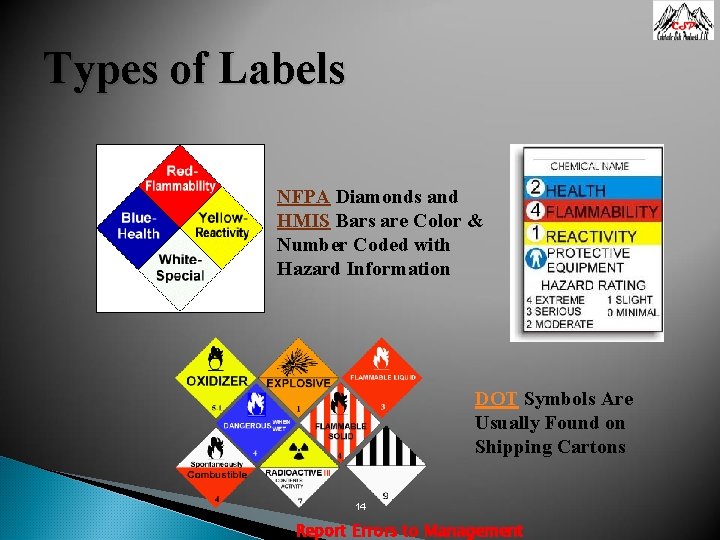
Types of Labels NFPA Diamonds and HMIS Bars are Color & Number Coded with Hazard Information DOT Symbols Are Usually Found on Shipping Cartons 14 Report Errors to Management
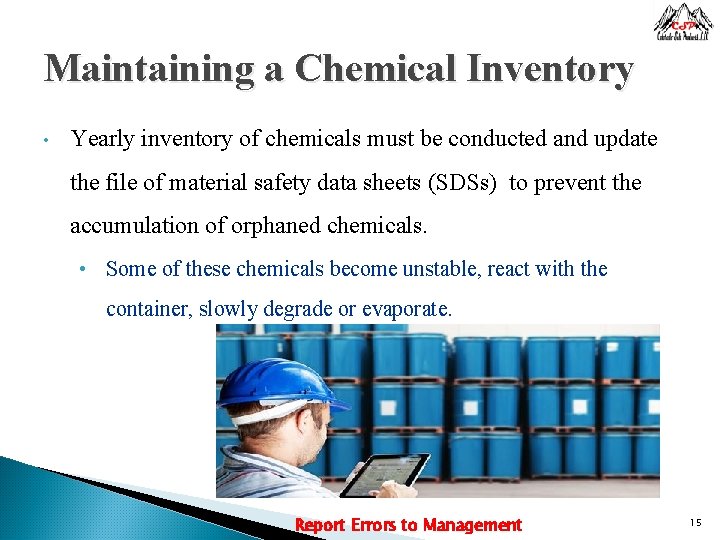
Maintaining a Chemical Inventory • Yearly inventory of chemicals must be conducted and update the file of material safety data sheets (SDSs) to prevent the accumulation of orphaned chemicals. • Some of these chemicals become unstable, react with the container, slowly degrade or evaporate. Report Errors to Management 15
Routinely Inventory: Lab inventory log/orders are done by designated employees every other week, however it does not preclude everyone’s responsibility to keep track of our inventory and reporting to designated personnel if needed. Recordkeeping: Records retained for duration 3 years plus current. Includes tests results and written opinions. Report Errors to Management 16
Communication Pass down at the end or beginning of the shift must include: ◦ General lab and plant status. ◦ Any broken lab equipment. ◦ Deviation from normal process operation that effects directly or indirectly to standard lab operations. Report Errors to Management 17
- Slides: 17