
Laboratory Safety EHS Policy Statement SUNY Polytechnic Institute
Laboratory Safety
EHS Policy Statement SUNY Polytechnic Institute is committed to: • Protecting the health and safety of it’s employees, partners, customers and public • Protecting the environment • Complying with regulatory standards 2
Employee Responsibilities • All individuals are responsible for safety at SUNY Poly • Take an active role in your safety and the safety of others • Plan and perform tasks in a safe manner • Follow SUNY Poly safety policies and procedures • Understand the potential hazards you may be exposed to • Contact your manager if you feel you need additional safety training 3

Hazards in Laboratories • • • Fires or Explosions Chemicals Spills or Releases Electrical/Mechanical Biological Agents Radiation Exposure to hazardous materials via: – Inhalation – Skin absorption – Injection – Ingestion
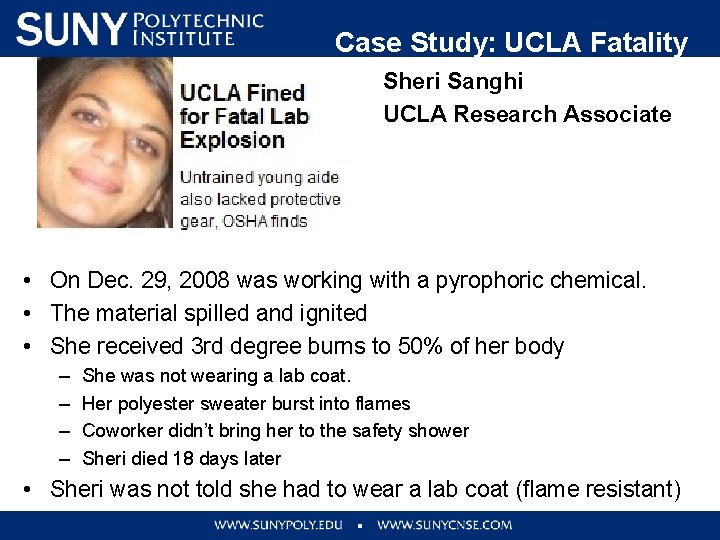
Case Study: UCLA Fatality Sheri Sanghi UCLA Research Associate • On Dec. 29, 2008 was working with a pyrophoric chemical. • The material spilled and ignited • She received 3 rd degree burns to 50% of her body – – She was not wearing a lab coat. Her polyester sweater burst into flames Coworker didn’t bring her to the safety shower Sheri died 18 days later • Sheri was not told she had to wear a lab coat (flame resistant)
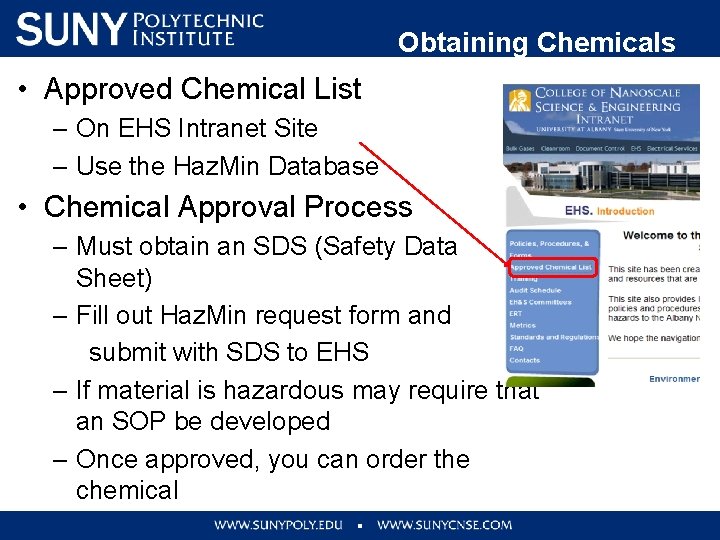
Obtaining Chemicals • Approved Chemical List – On EHS Intranet Site – Use the Haz. Min Database • Chemical Approval Process – Must obtain an SDS (Safety Data Sheet) – Fill out Haz. Min request form and submit with SDS to EHS – If material is hazardous may require that an SOP be developed – Once approved, you can order the chemical
Safety Data Sheets (SDSs) SDS’s contain safety information including: • Physical/chemical properties (p. H, flash point, etc. ) • Toxicity and incompatibility data • Storage and shipping requirements • Required PPE • Emergency response procedures • NFPA Codes • GHS pictograms
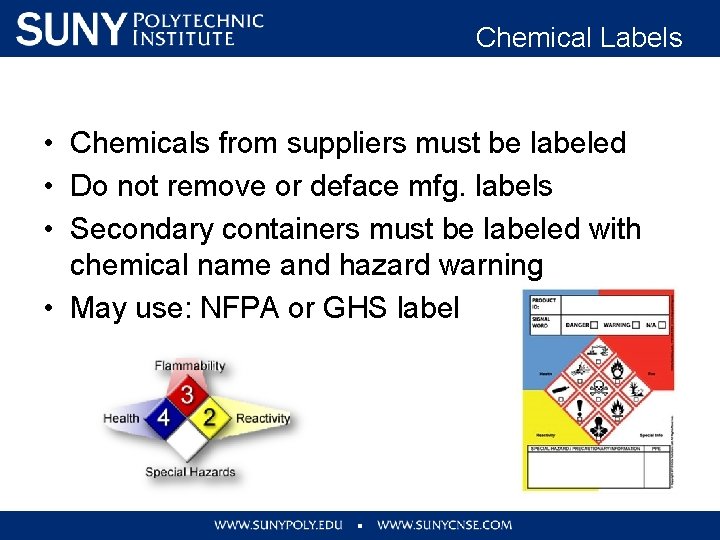
Chemical Labels • Chemicals from suppliers must be labeled • Do not remove or deface mfg. labels • Secondary containers must be labeled with chemical name and hazard warning • May use: NFPA or GHS label
Chemical Hygiene Plan (CHP) • EHS-00082 Policy for Chemical Hygiene Plan • Complies with OSHA Std. 29 CFR 1910. 1450 – available on Intranet • Guidance on storage and handling of chemicals in laboratories • If rated 3 or greater in NFPA the material is a HPM (Hazardous Process Material) and may require a lab specific SOP (Standard Operating Procedure)
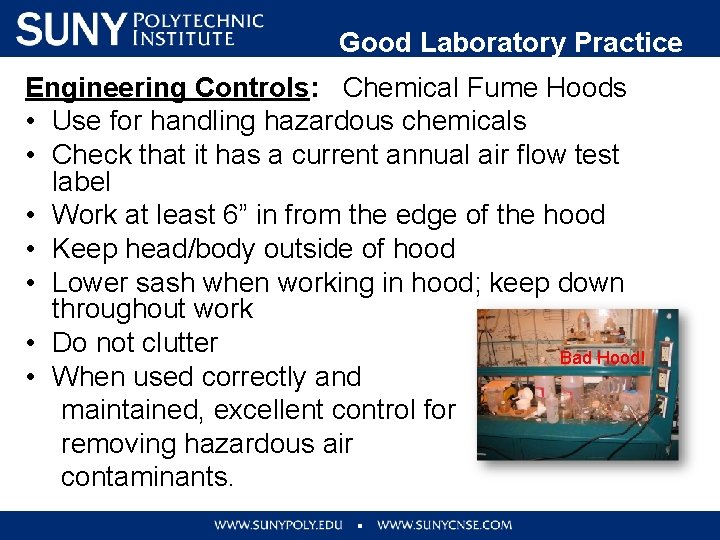
Good Laboratory Practice Engineering Controls: Chemical Fume Hoods • Use for handling hazardous chemicals • Check that it has a current annual air flow test label • Work at least 6” in from the edge of the hood • Keep head/body outside of hood • Lower sash when working in hood; keep down throughout work • Do not clutter Bad Hood! • When used correctly and maintained, excellent control for removing hazardous air contaminants.
Good Laboratory Practice Engineering Controls: Other Controls • Biological Safety Cabinet (BSC) – Sterile environment for biologicals, not for chemicals – Filters air, not for volatile chemicals • Gas Cabinet – Ventilated enclosure for hazardous compressed gases • Glovebox or Glovebag – Inert environment for pyrophoric or water reactive chemicals • Inerting atmospheres – For pyrophoric or water reactive chemicals • Interlocks • Face shield, goggles All of these work by keeping a barrier between you and the hazardous material!

Good Laboratory Practice Storage of Chemicals: • Use the least hazardous material possible • Do not stockpile chemicals, use small quantities • Keep closed/covered when not in use • Proper storage of chemicals – Store (and segregate) by hazard classification • • Flammables: Flammable Storage cabinet or fridge Corrosives – Acid/Base Storage cabinet Oxidizers – away from flammables Check SDS for storage requirements, i. e. temperature, light – 1 st in 1 st out – use oldest chemicals first

Good Laboratory Practice Transferring Chemicals: • Use appropriate PPE; Gloves, safety glasses, arm guards, apron, face shield • Use local exhaust ventilation (hood, snorkel) • Keep away from ignition sources - flammable substances • If mixing solutions- ensure that the chemicals are compatible and proper mixing protocols are established Transporting Chemicals: • Use cart and/or secondary containment (bottle carriers)
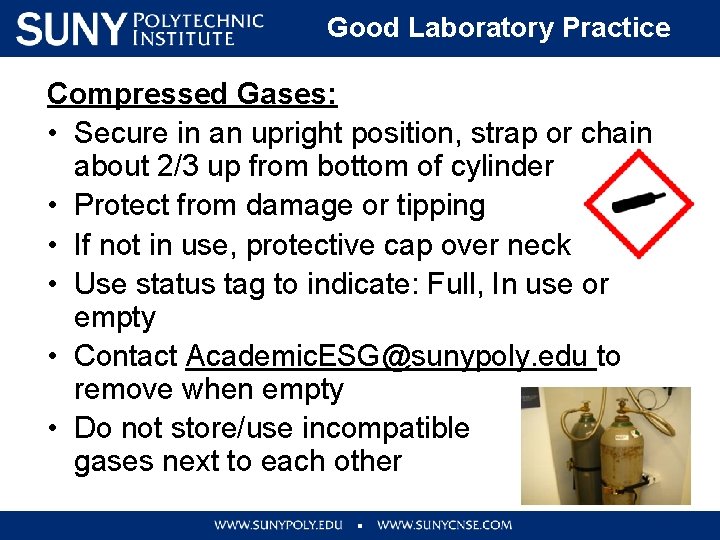
Good Laboratory Practice Compressed Gases: • Secure in an upright position, strap or chain about 2/3 up from bottom of cylinder • Protect from damage or tipping • If not in use, protective cap over neck • Use status tag to indicate: Full, In use or empty • Contact Academic. ESG@sunypoly. edu to remove when empty • Do not store/use incompatible gases next to each other s
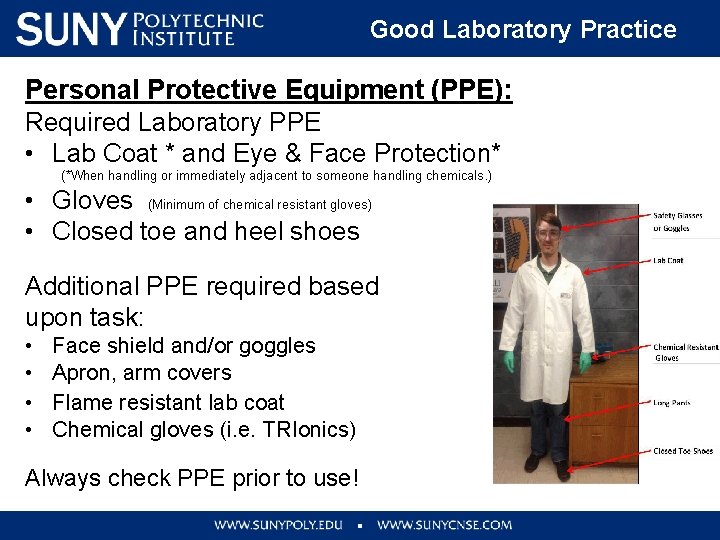
Good Laboratory Practice Personal Protective Equipment (PPE): Required Laboratory PPE • Lab Coat * and Eye & Face Protection* (*When handling or immediately adjacent to someone handling chemicals. ) • Gloves (Minimum of chemical resistant gloves) • Closed toe and heel shoes Additional PPE required based upon task: • • Face shield and/or goggles Apron, arm covers Flame resistant lab coat Chemical gloves (i. e. TRIonics) Always check PPE prior to use!
PPE - Eye and Face Protection Personal Protective Equipment (PPE): Eye and Face Protection • Eye protection (e. g. , safety glasses, goggles) and face protection (e. g. , face shield) is required to be worn in posted areas and during tasks that create eye and/or face hazards. • Safety glasses with side shields are required to be worn to protect the eyes from flying particles, objects, chips, etc. • Goggles are required to be worn to protect the eyes from corrosive chemical (e. g. , acid, base) splash hazards, dust hazards, etc. • Under face shields, safety glasses with side shields or goggles must also be worn depending on the type of hazard. • Although safety glasses must always be worn in laboratories, the following tasks are considered exempt from the safety glasses requirement. The intention of these exemptions is to permit those that are performing such tasks to temporarily allow them to remove their safety glasses: – In research or teaching labs while: working in front of a computer terminal (providing there is no eye hazard), chemical and/or infectious material contact or exposure. Always check PPE prior to use!
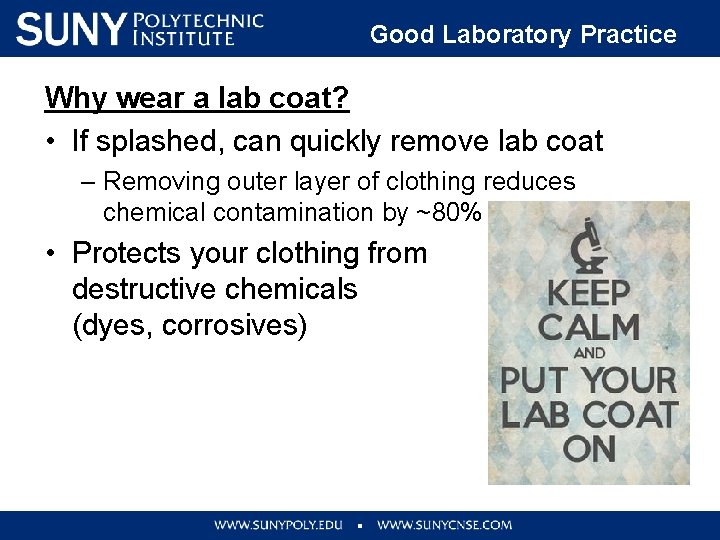
Good Laboratory Practice Why wear a lab coat? • If splashed, can quickly remove lab coat – Removing outer layer of clothing reduces chemical contamination by ~80% • Protects your clothing from destructive chemicals (dyes, corrosives)
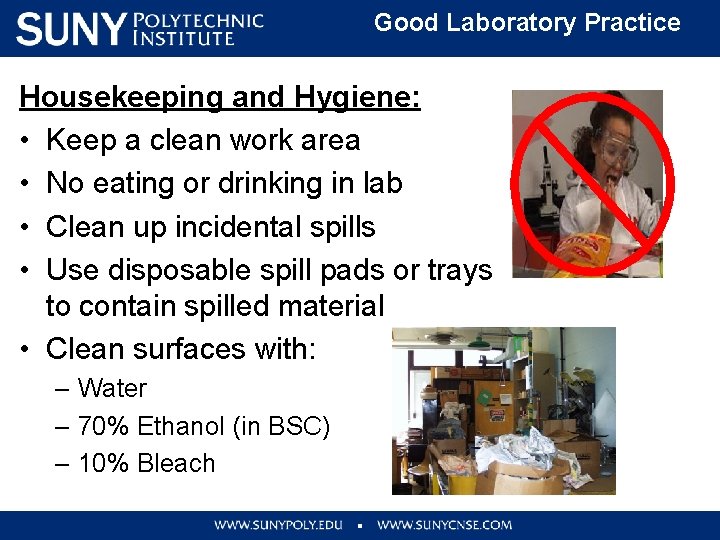
Good Laboratory Practice Housekeeping and Hygiene: • Keep a clean work area • No eating or drinking in lab • Clean up incidental spills • Use disposable spill pads or trays to contain spilled material • Clean surfaces with: – Water – 70% Ethanol (in BSC) – 10% Bleach
Good Laboratory Practice Housekeeping and Hygiene: Hand Hygiene • Design experiments to limit touching chemicals • Change nitrile gloves frequently, especially if chemicals contact gloves • Nitrile are for incidental contact, not direct contact • Wash hands when changing gloves • Prevents unintentional ingestion or skin contamination • Prevents disease transmission (i. e. cold & flu)!
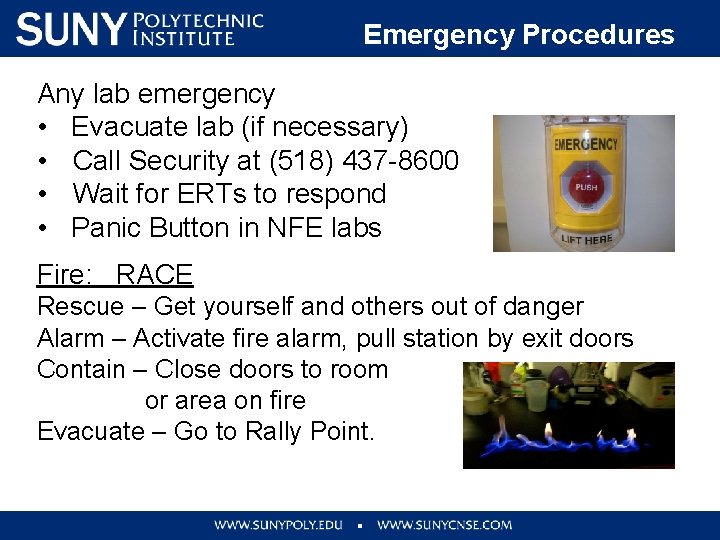
Emergency Procedures Any lab emergency • Evacuate lab (if necessary) • Call Security at (518) 437 -8600 • Wait for ERTs to respond • Panic Button in NFE labs Fire: RACE Rescue – Get yourself and others out of danger Alarm – Activate fire alarm, pull station by exit doors Contain – Close doors to room or area on fire Evacuate – Go to Rally Point.
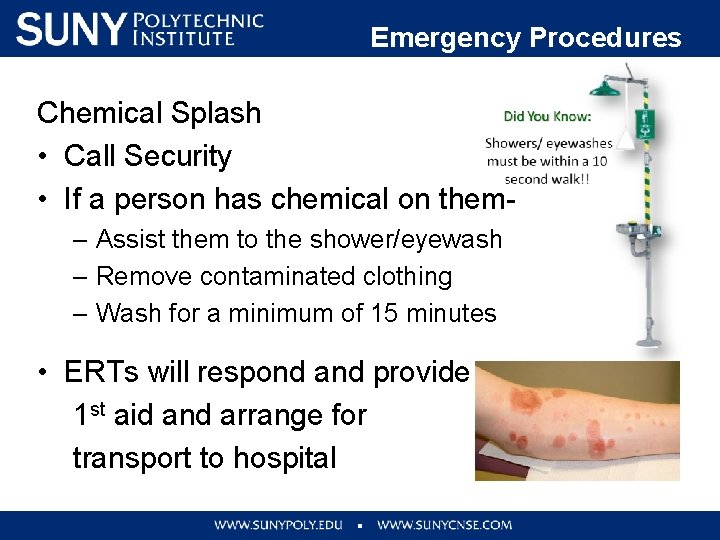
Emergency Procedures Chemical Splash • Call Security • If a person has chemical on them– Assist them to the shower/eyewash – Remove contaminated clothing – Wash for a minimum of 15 minutes • ERTs will respond and provide 1 st aid and arrange for transport to hospital
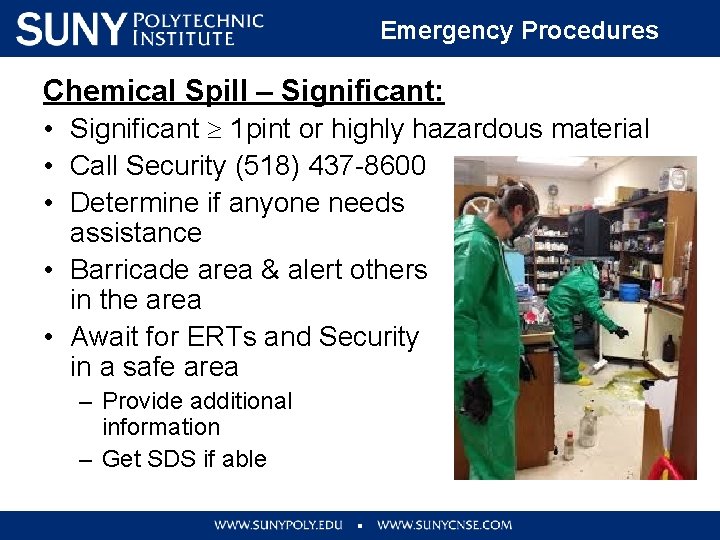
Emergency Procedures Chemical Spill – Significant: • Significant 1 pint or highly hazardous material • Call Security (518) 437 -8600 • Determine if anyone needs assistance • Barricade area & alert others in the area • Await for ERTs and Security in a safe area – Provide additional information – Get SDS if able
Emergency Procedures Chemical Spill – Small • <1 pint (500 ml) of a known substance. • Leave the container where it falls. Do not attempt to handle the material or container with bare hands. • Alert room occupants of the spill. If material is flammable, turn off ignition sources. • Have needed equipment and PPE; review SDS if necessary. • Collect all contaminated material and place in waste container. • Label waste container and put in satellite accumulation area. • If unsure – Call Security!!
Waste Disposal No waste goes down the drain or in the trash • All labs have a designated SAA (Satellite Accumulation Area) for waste. Contact EHS with any disposal questions: sunypolyehs@sunypoly. edu Hazardous Waste– Meets one of the following characteristics: • • Ignitable (FP< 140 F) Corrosive (p. H <2 or >12. 5) Reactive (H 20 reactive, oxidizer, pyrophoric) Toxic
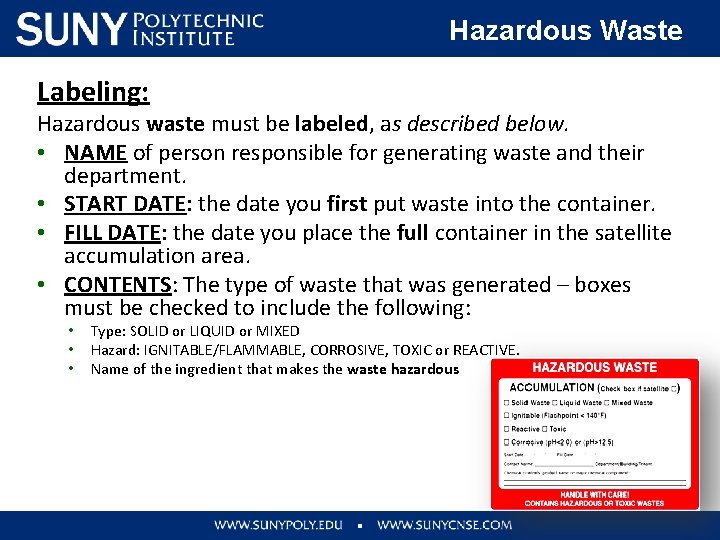
Hazardous Waste Labeling: Hazardous waste must be labeled, as described below. • NAME of person responsible for generating waste and their department. • START DATE: the date you first put waste into the container. • FILL DATE: the date you place the full container in the satellite accumulation area. • CONTENTS: The type of waste that was generated – boxes must be checked to include the following: • • • Type: SOLID or LIQUID or MIXED Hazard: IGNITABLE/FLAMMABLE, CORROSIVE, TOXIC or REACTIVE. Name of the ingredient that makes the waste hazardous
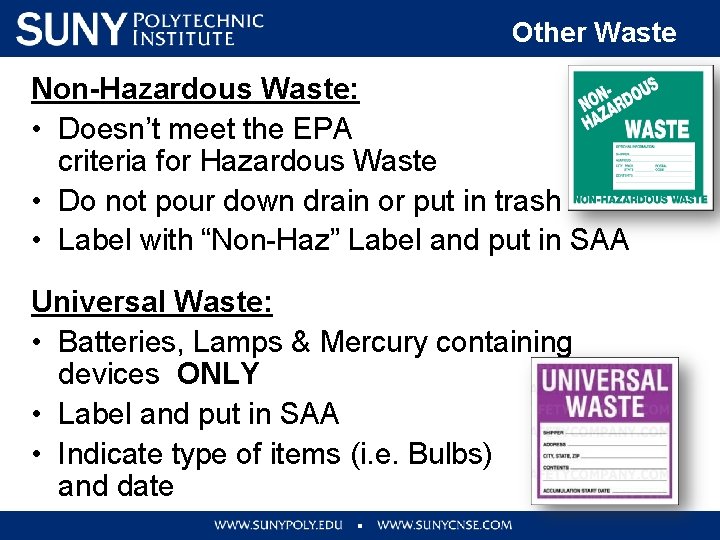
Other Waste Non-Hazardous Waste: • Doesn’t meet the EPA criteria for Hazardous Waste • Do not pour down drain or put in trash • Label with “Non-Haz” Label and put in SAA Universal Waste: • Batteries, Lamps & Mercury containing devices ONLY • Label and put in SAA • Indicate type of items (i. e. Bulbs) and date
Satellite Accumulation Area ALL WASTE IS PLACED IN THE SAA: • Use separate bins to contain waste types (i. e. acids, bases, solvents). Signage is posted at the SAA on what chemicals are compatible and can be mixed • Store only in designated area, do not mix with stock chemicals
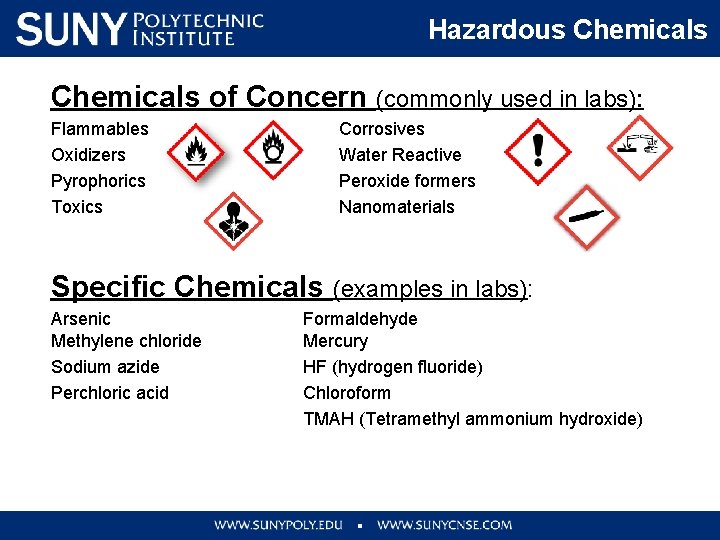
Hazardous Chemicals of Concern (commonly used in labs): Flammables Oxidizers Pyrophorics Toxics Corrosives Water Reactive Peroxide formers Nanomaterials Specific Chemicals (examples in labs): Arsenic Methylene chloride Sodium azide Perchloric acid Formaldehyde Mercury HF (hydrogen fluoride) Chloroform TMAH (Tetramethyl ammonium hydroxide)

Work Alone Policy • EHS-00045 Working Alone Policy • Whenever possible – have 2 or more people in the lab when working with chemicals • A “Buddy” is required when working with highly hazardous materials, such as: (partial list) – TMAH, HF, Pyrophoric chemicals • “Buddy” is to call Security and assist worker in case of emergency • PI will determine when a “Buddy” is needed. Lab Access: • Normal lab access in 7 AM – 9 PM • For extended access PI must submit request to Access Control. Form in Policy
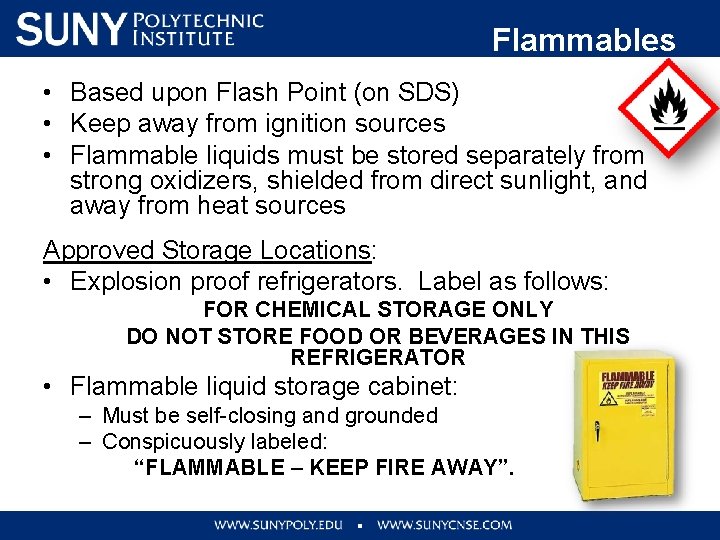
Flammables • Based upon Flash Point (on SDS) • Keep away from ignition sources • Flammable liquids must be stored separately from strong oxidizers, shielded from direct sunlight, and away from heat sources Approved Storage Locations: • Explosion proof refrigerators. Label as follows: FOR CHEMICAL STORAGE ONLY DO NOT STORE FOOD OR BEVERAGES IN THIS REFRIGERATOR • Flammable liquid storage cabinet: – Must be self-closing and grounded – Conspicuously labeled: “FLAMMABLE – KEEP FIRE AWAY”.
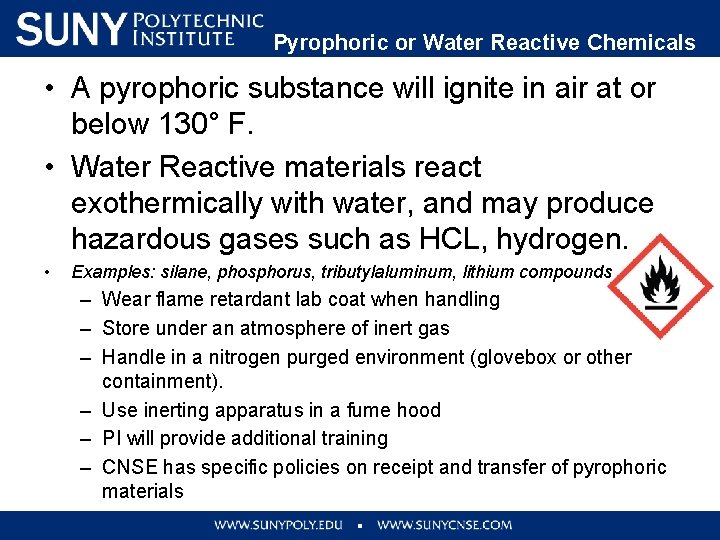
Pyrophoric or Water Reactive Chemicals • A pyrophoric substance will ignite in air at or below 130° F. • Water Reactive materials react exothermically with water, and may produce hazardous gases such as HCL, hydrogen. • Examples: silane, phosphorus, tributylaluminum, lithium compounds – Wear flame retardant lab coat when handling – Store under an atmosphere of inert gas – Handle in a nitrogen purged environment (glovebox or other containment). – Use inerting apparatus in a fume hood – PI will provide additional training – CNSE has specific policies on receipt and transfer of pyrophoric materials
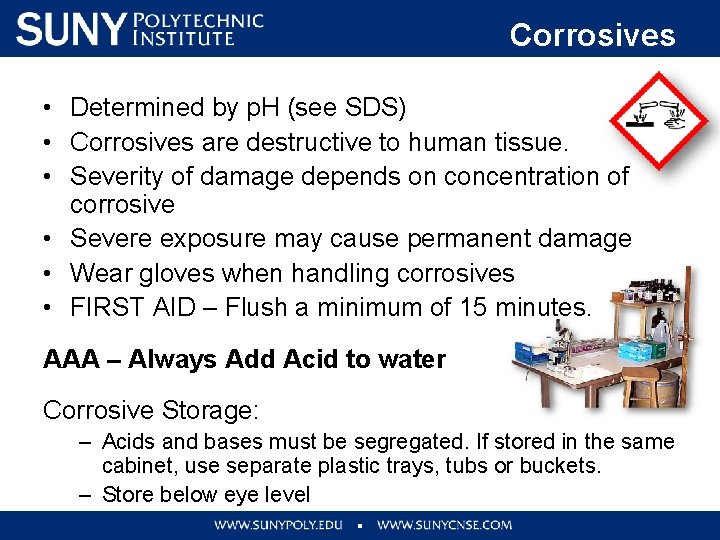
Corrosives • Determined by p. H (see SDS) • Corrosives are destructive to human tissue. • Severity of damage depends on concentration of corrosive • Severe exposure may cause permanent damage • Wear gloves when handling corrosives • FIRST AID – Flush a minimum of 15 minutes. AAA – Always Add Acid to water Corrosive Storage: – Acids and bases must be segregated. If stored in the same cabinet, use separate plastic trays, tubs or buckets. – Store below eye level
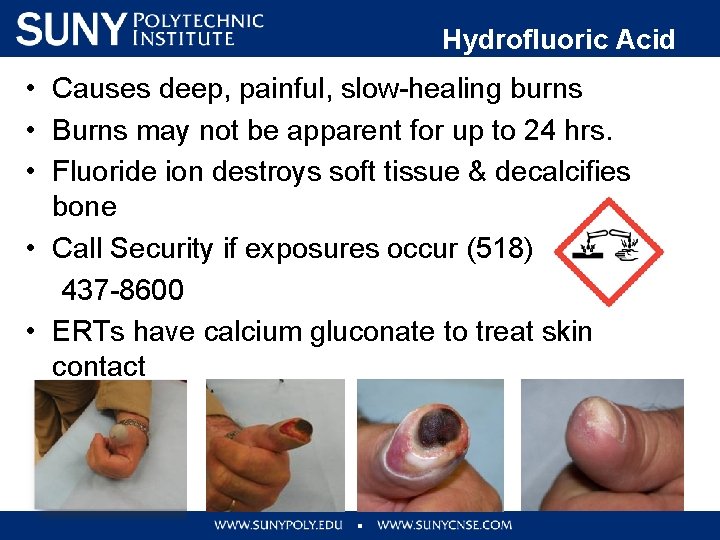
• • • Hydrofluoric Acid (HF) Causes deep, painful, slow-healing burns Burns may not be apparent for up to 24 hrs. Fluoride ion destroys soft tissue & decalcifies bone Call Security if exposures occur (518) 437 -8600 ERTs have calcium gluconate to treat skin contact Day 1 Day 6 Day 12 90 Days
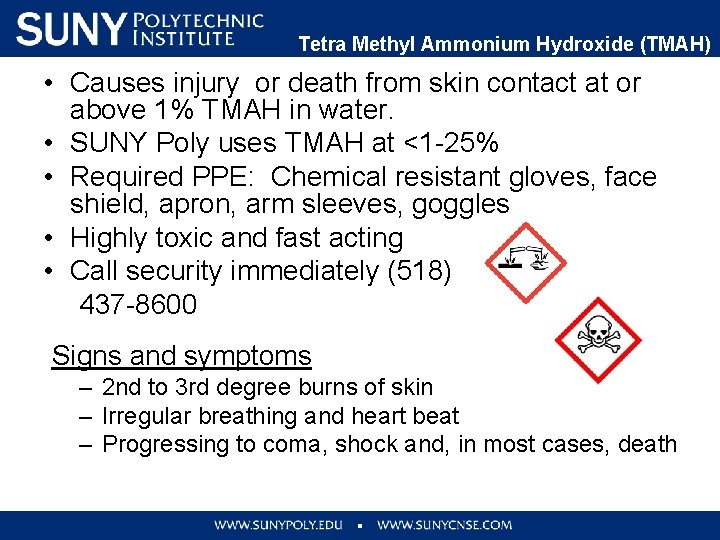
Tetra Methyl Ammonium Hydroxide (TMAH) • Causes injury or death from skin contact at or above 1% TMAH in water. • SUNY Poly uses TMAH at <1 -25% • Required PPE: Chemical resistant gloves, face shield, apron, arm sleeves, goggles • Highly toxic and fast acting • Call security immediately (518) 437 -8600 Signs and symptoms – 2 nd to 3 rd degree burns of skin – Irregular breathing and heart beat – Progressing to coma, shock and, in most cases, death
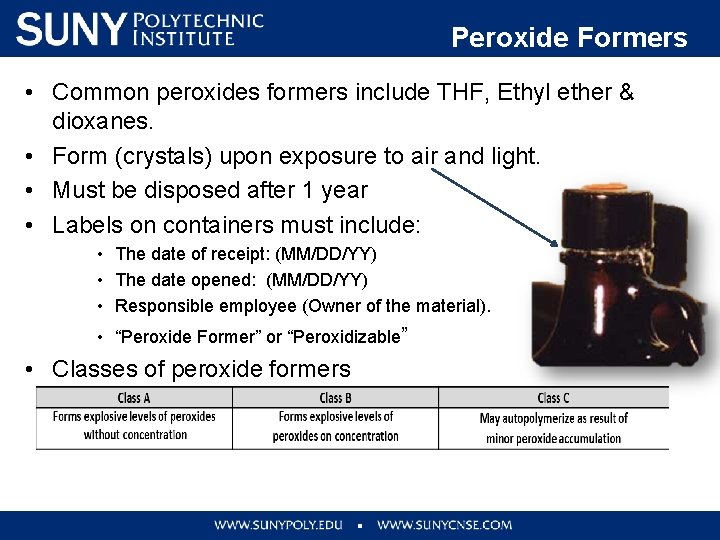
Peroxide Formers • Common peroxides formers include THF, Ethyl ether & dioxanes. • Form (crystals) upon exposure to air and light. • Must be disposed after 1 year • Labels on containers must include: • The date of receipt: (MM/DD/YY) • The date opened: (MM/DD/YY) • Responsible employee (Owner of the material). • “Peroxide Former” or “Peroxidizable” • Classes of peroxide formers
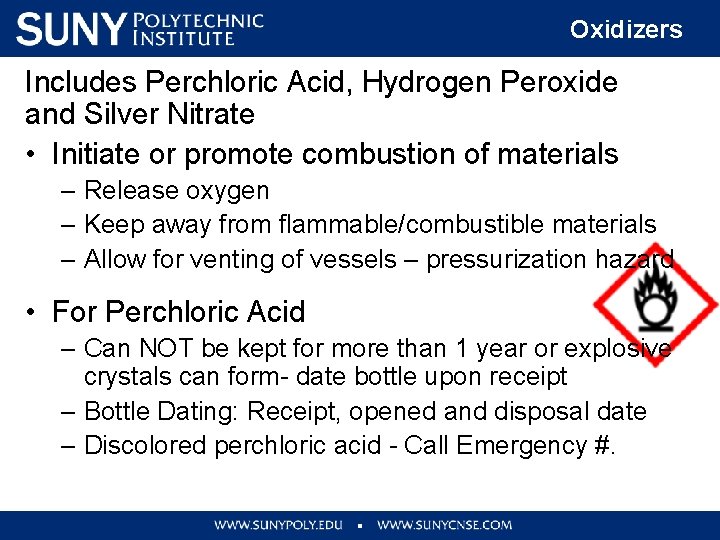
Oxidizers Includes Perchloric Acid, Hydrogen Peroxide and Silver Nitrate • Initiate or promote combustion of materials – Release oxygen – Keep away from flammable/combustible materials – Allow for venting of vessels – pressurization hazard • For Perchloric Acid – Can NOT be kept for more than 1 year or explosive crystals can form- date bottle upon receipt – Bottle Dating: Receipt, opened and disposal date – Discolored perchloric acid - Call Emergency #.
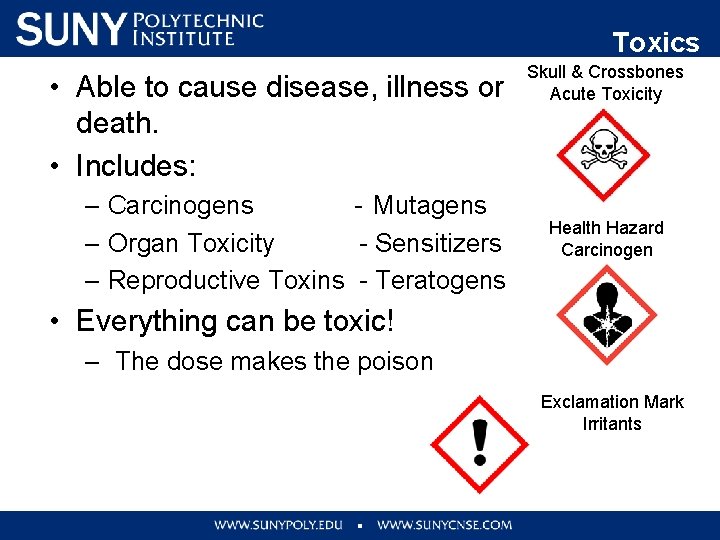
Toxics • Able to cause disease, illness or death. • Includes: – Carcinogens - Mutagens – Organ Toxicity - Sensitizers – Reproductive Toxins - Teratogens Skull & Crossbones Acute Toxicity Health Hazard Carcinogen • Everything can be toxic! – The dose makes the poison Exclamation Mark Irritants
Indicators of Toxicity Levels at which 50% of lab animals expired: • LD 50 – Lethal Dose 50% • LC 50 - Lethal Concentration 50% Exposure Limits: • PEL – Permissible Exposure limit • TLV – Threshold Limit Value • STEL – Short term exposure limit • TWA – Time Weighted average • C- Ceiling The lower the number, the more toxic!! If you have questions, contact EHS.
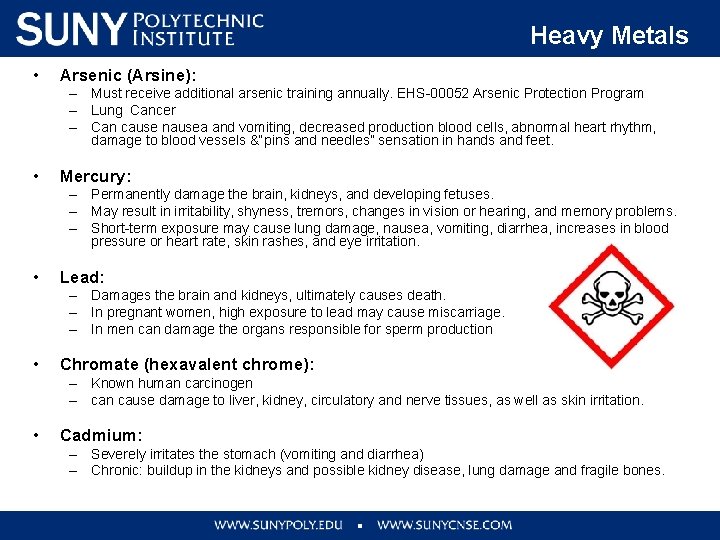
Heavy Metals • Arsenic (Arsine): – Must receive additional arsenic training annually. EHS-00052 Arsenic Protection Program – Lung Cancer – Can cause nausea and vomiting, decreased production blood cells, abnormal heart rhythm, damage to blood vessels &“pins and needles” sensation in hands and feet. • Mercury: – Permanently damage the brain, kidneys, and developing fetuses. – May result in irritability, shyness, tremors, changes in vision or hearing, and memory problems. – Short-term exposure may cause lung damage, nausea, vomiting, diarrhea, increases in blood pressure or heart rate, skin rashes, and eye irritation. • Lead: – Damages the brain and kidneys, ultimately causes death. – In pregnant women, high exposure to lead may cause miscarriage. – In men can damage the organs responsible for sperm production • Chromate (hexavalent chrome): – Known human carcinogen – can cause damage to liver, kidney, circulatory and nerve tissues, as well as skin irritation. • Cadmium: – Severely irritates the stomach (vomiting and diarrhea) – Chronic: buildup in the kidneys and possible kidney disease, lung damage and fragile bones.
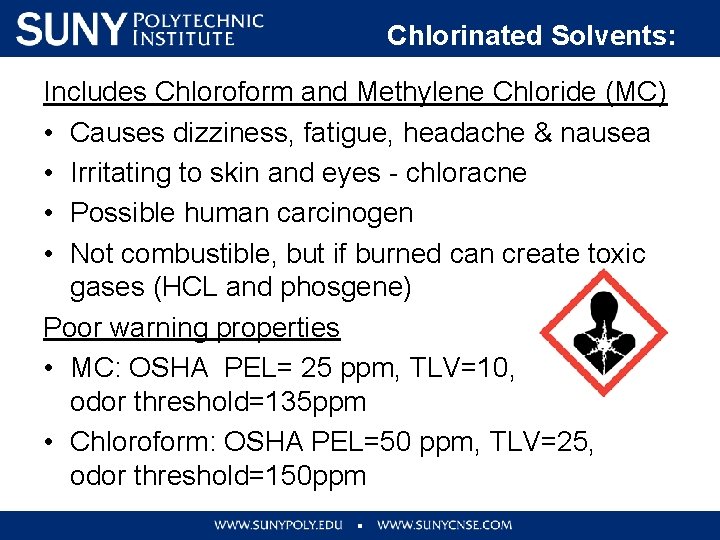
Chlorinated Solvents: Includes Chloroform and Methylene Chloride (MC) • Causes dizziness, fatigue, headache & nausea • Irritating to skin and eyes - chloracne • Possible human carcinogen • Not combustible, but if burned can create toxic gases (HCL and phosgene) Poor warning properties • MC: OSHA PEL= 25 ppm, TLV=10, odor threshold=135 ppm • Chloroform: OSHA PEL=50 ppm, TLV=25, odor threshold=150 ppm
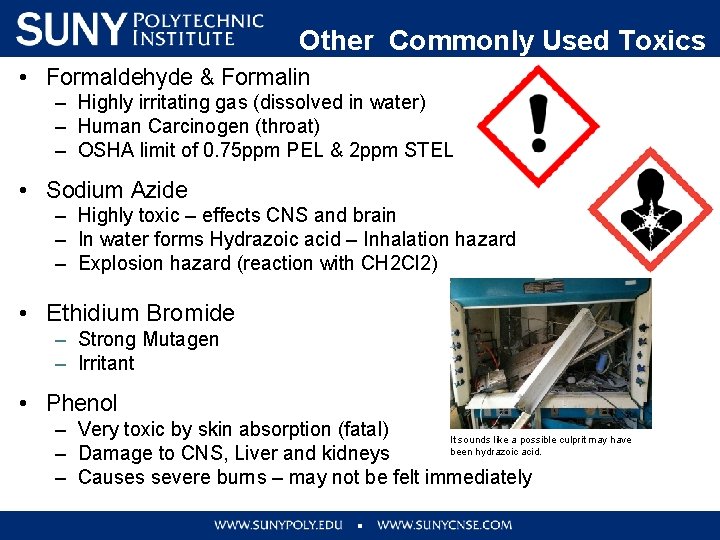
Other Commonly Used Toxics • Formaldehyde & Formalin – Highly irritating gas (dissolved in water) – Human Carcinogen (throat) – OSHA limit of 0. 75 ppm PEL & 2 ppm STEL • Sodium Azide – Highly toxic – effects CNS and brain – In water forms Hydrazoic acid – Inhalation hazard – Explosion hazard (reaction with CH 2 Cl 2) • Ethidium Bromide – Strong Mutagen – Irritant • Phenol – Very toxic by skin absorption (fatal) It sounds like a possible culprit may have been hydrazoic acid. – Damage to CNS, Liver and kidneys – Causes severe burns – may not be felt immediately
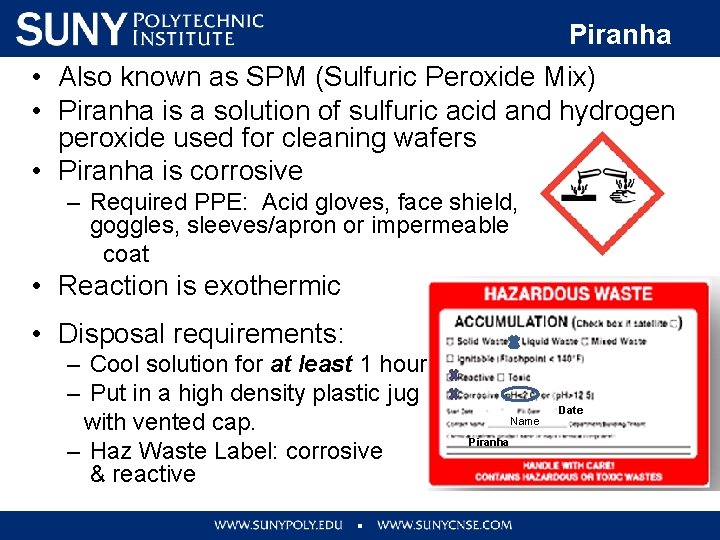
Piranha • Also known as SPM (Sulfuric Peroxide Mix) • Piranha is a solution of sulfuric acid and hydrogen peroxide used for cleaning wafers • Piranha is corrosive – Required PPE: Acid gloves, face shield, goggles, sleeves/apron or impermeable coat • Reaction is exothermic • Disposal requirements: – Cool solution for at least 1 hour – Put in a high density plastic jug with vented cap. – Haz Waste Label: corrosive & reactive Name Piranha Date
Additional Safety Training Based upon your duties in the lab: • *Arsenic - Online • Biosafety and *Bloodborne Pathogens- Online via CITI • Compressed gas cylinder - Online • Cryogens - Online • *Radiation – Online or in-class • *Lasers (Class 3 b or 4) – Online • *Hazardous Waste - Online Additional training may be provided by Academic Engineering Support Group * Required annually
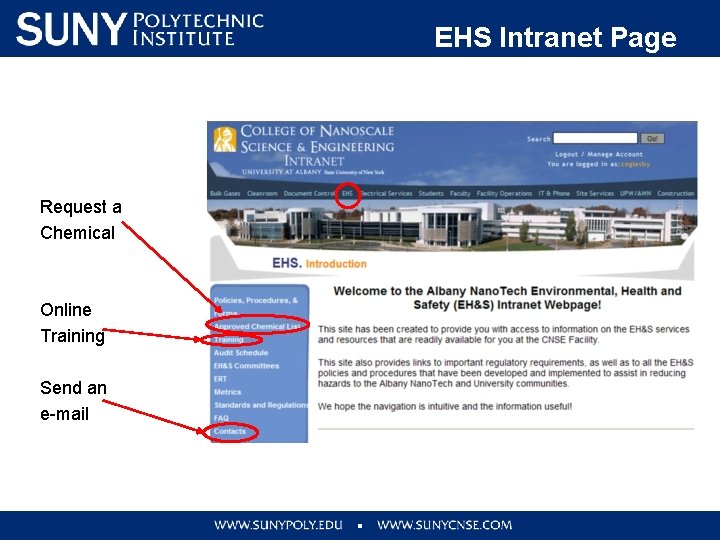
EHS Intranet Page Request a Chemical Online Training Send an e-mail
Additional Resources • • EHS Dept. and Policies YOUR Principle Investigator Lab Specific Chemical Hygiene Plan (in Lab) Prudent Practices in the Laboratory (National Research Council) http: //nap. edu/12654 • Hazardous Chemical Handbook • Biosafety in Microbiological and Biomedical Laboratories 5 th Edition (CDC) • CRC Handbook of Lab Safety 5 th Edition
Close • SUNY Poly is committed to providing you a safe working environment • You are a key player in this effort • All individuals on-site are expected to share this commitment • Each of us must comply with safety and environmental laws and SUNY Poly safety requirements • Thank you in advance for your support and efforts toward environmental, health and safety at SUNY Poly and in the laboratory
- Slides: 46