
Laboratory Quality Control workshop TGHN online workshop 21
Laboratory Quality Control workshop TGHN online workshop 21 st to 22 nd October 2020
DOCUMENTATION Jean Paul Assam, Ph. D Senior Lecturer (University of Yaoundé 1, Cameroon)
Learning Objectives At the end of this module, participants should be able to: Define Good Documentation Practice and purpose of Laboratory documentation as foundation of Quality Management System (QMS) Cite Essential documents required for QMS Know the document control process and the importance of master list Complete laboratory records in compliance with good documentation practice (GCP) guidance Understand the Compliance with documentation in audits Understand the format of Standard Operating Procedure (SOP) and Master list Index
What is Good Documentation Practice? Document is information (meaningful data) and its supporting medium, in form of paper, CD, Computer file, microfilm, x-Ray film etc Documents provides information or evidence or may serve as an official record. Record is a document stating results achieved or provide evidence of activities performed. Guidelines are documents that provide recommended practices and instructions. Policy is a plan or adopted course or principle of action intended to influence and determine the decisions or actions of an organization. Procedures (or Standard Operating Procedure (SOP)) are documents that specify the way to carry out an activity or a process
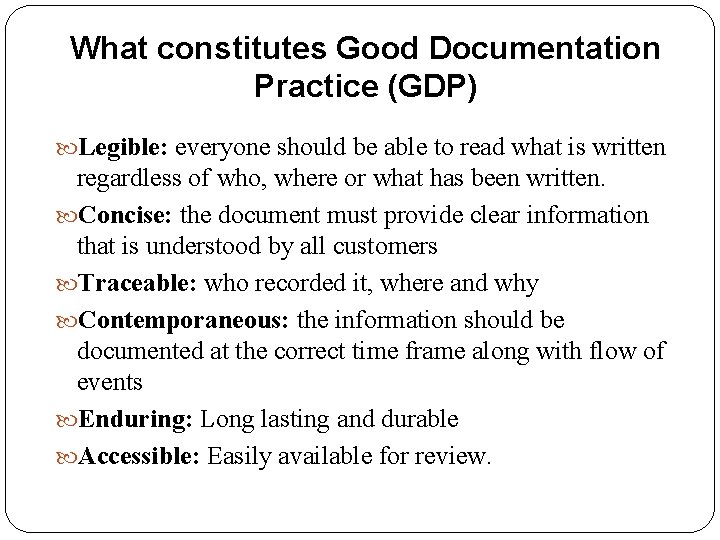
What constitutes Good Documentation Practice (GDP) Legible: everyone should be able to read what is written regardless of who, where or what has been written. Concise: the document must provide clear information that is understood by all customers Traceable: who recorded it, where and why Contemporaneous: the information should be documented at the correct time frame along with flow of events Enduring: Long lasting and durable Accessible: Easily available for review.

Purpose of Laboratory Documentation is the foundation of the QMS All aspects of the laboratory function MUST be documented To provide the basic guide for good document practices with regard to creation, approval, review, maintenance, correction or errors, verification and archiving etc Ensures documented evidence, traceability, provide records and audit trails for investigation Ensures availability of data for validation, review and statistical analysis. Control of Process - Ensures all staff knows what to do, how to do it and when to do it. To improve performance
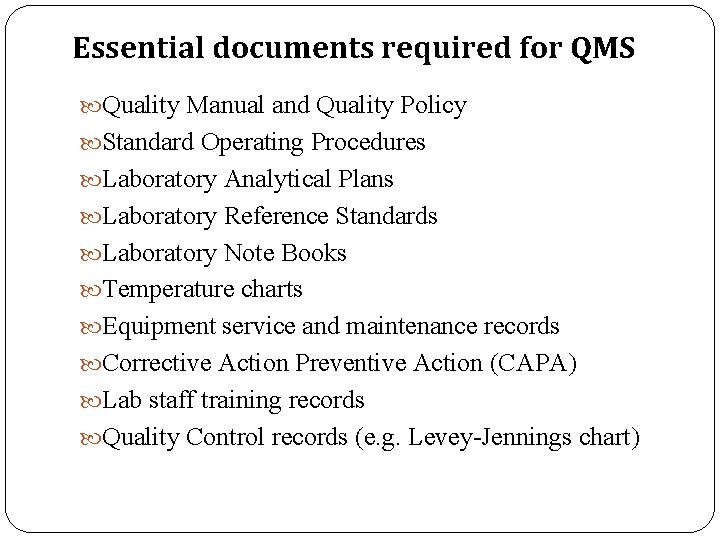
Essential documents required for QMS Quality Manual and Quality Policy Standard Operating Procedures Laboratory Analytical Plans Laboratory Reference Standards Laboratory Note Books Temperature charts Equipment service and maintenance records Corrective Action Preventive Action (CAPA) Lab staff training records Quality Control records (e. g. Levey-Jennings chart)
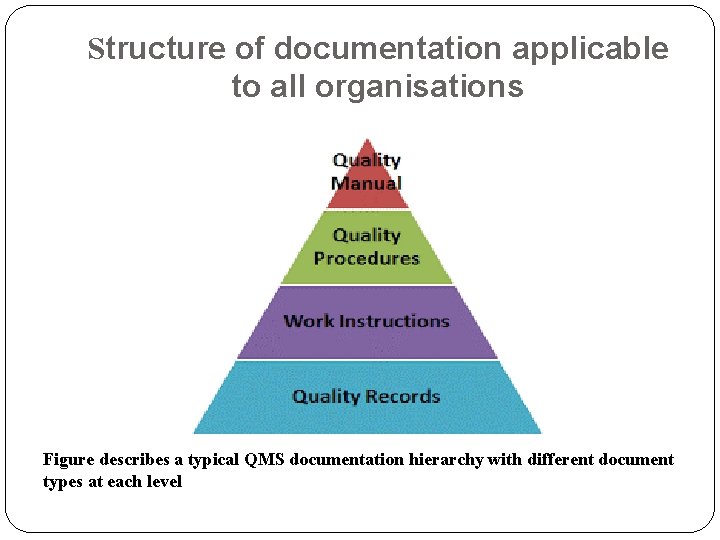
Structure of documentation applicable to all organisations Figure describes a typical QMS documentation hierarchy with different document types at each level

Document control process The ISO 15189 (Medical Laboratories- requirements for quality and compliance)standards (4. 3) requires that “The laboratory shall control documents required by the quality management system and shall ensure that unintended use of obsolete documents is prevented” All controlled documents must be identified to include: A title Unique identifier on each page Date of the current version and/or the version number Page number to total number of pages (e. g. page 1 of 2) Authority of issue Current authorised versions and their distribution should be identified by a means of a Master List Index
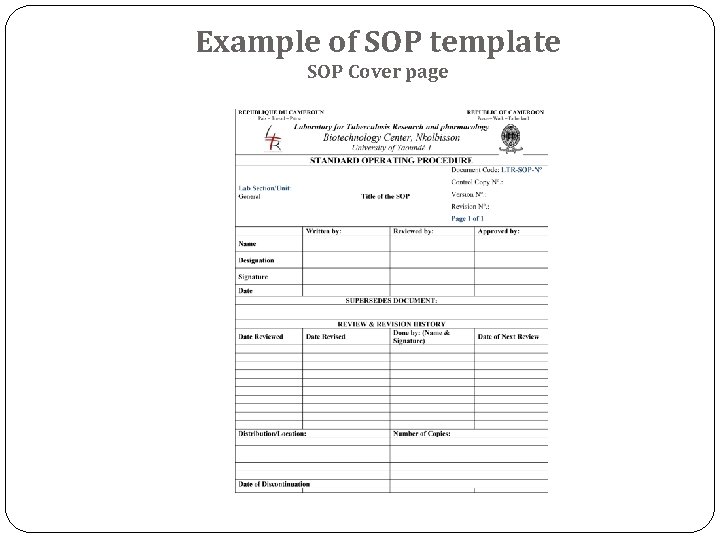
Example of SOP template SOP Cover page
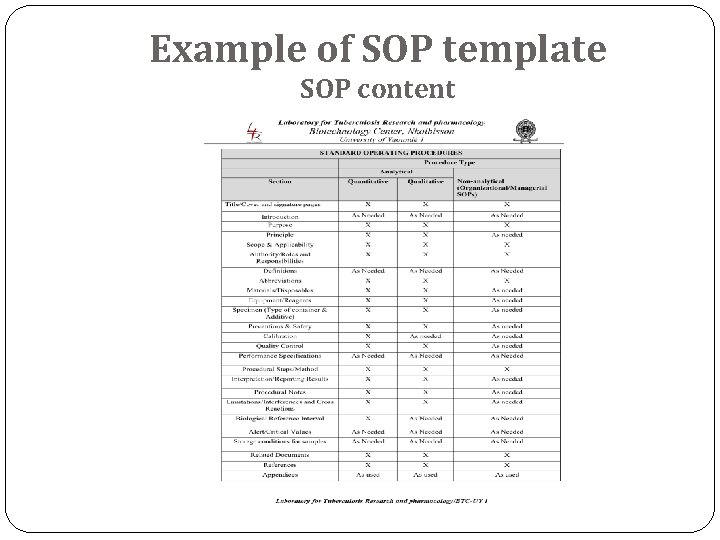
Example of SOP template SOP content
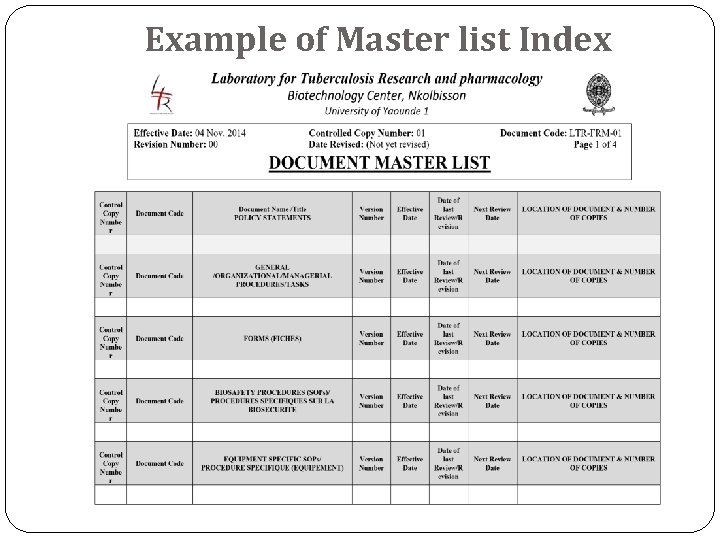
Example of Master list Index
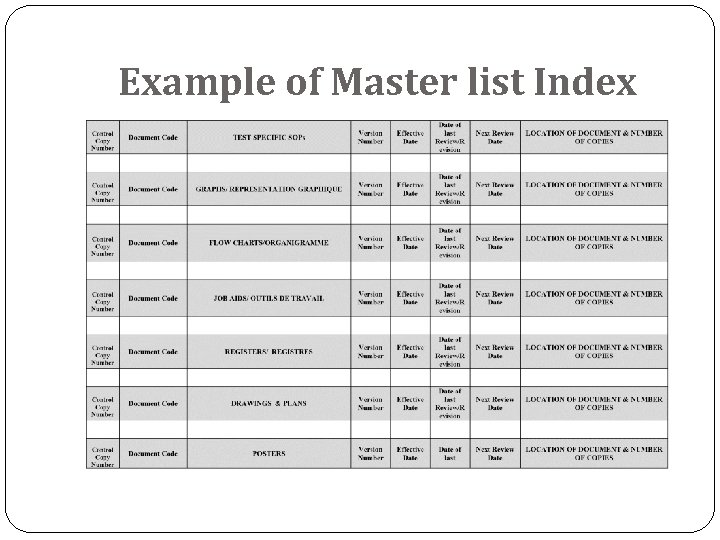
Example of Master list Index
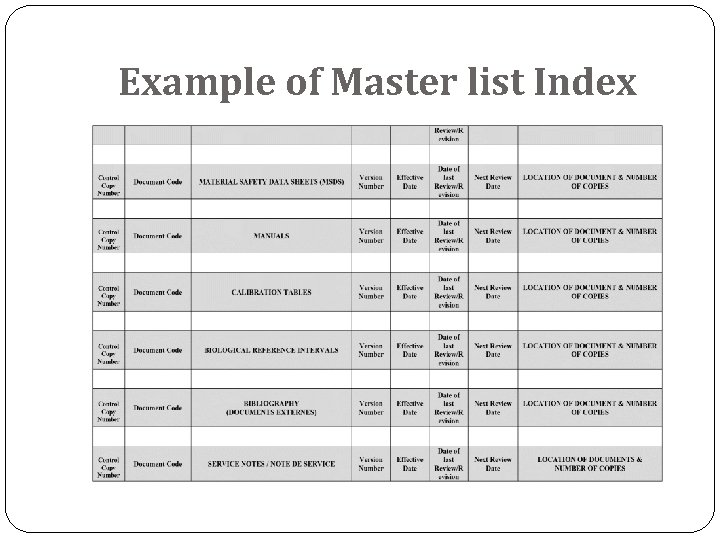
Example of Master list Index
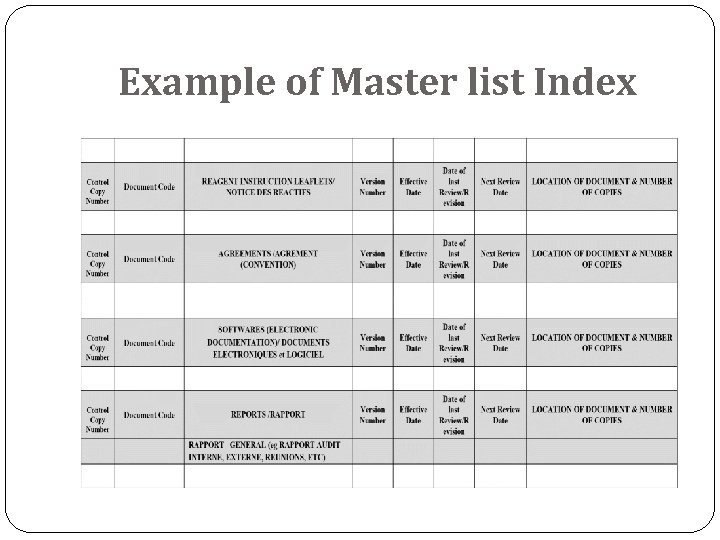
Example of Master list Index
Document control process Approve documents for adequacy prior to issue by authorised staff; Review and update documents as necessary and re-approve; Ensure that changes and the current revision status of documents are identified; Ensure that current relevant versions of applicable documents are available at points of use; Ensure that documents remain legible and readily identifiable; Ensure that documents of external origin are identified and their distribution controlled; and Prevent the unintended use of obsolete documents and apply suitable identification to them if they are retained for any purpose.
What is required for "control"? The whole point of controlling documented information is to make sure it is "available, current and suitable for use" and also "protected” Identification: How is documented information identified? Format: What is the best format for this information? Review and approval: When a new document is found, or is created, how is it approved for release? Distribution, access, retrieval and use: How will you provide access to released documents everywhere they are needed?
What is required for "control"? Storage and preservation: How do you protect the documented information from unauthorised changes, or loss? Control of changes: When changes are made, how do you identify them? Retention and disposition: How do you prevent the use of obsolete documents? External documents: How do you find and control documents from external sources? Document master copy Each controlled document has one master copy. This is the copy to which all changes are initially made and from which further copies are made and issued as required. The location of the master copy is recorded on the Document Master List.
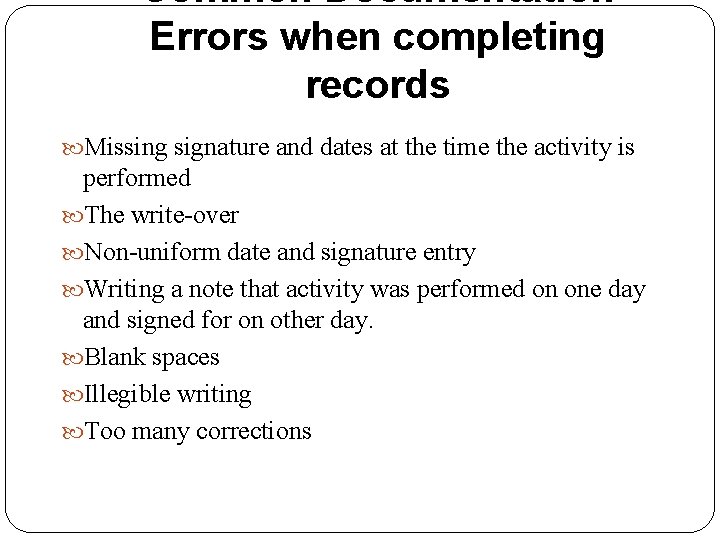
Common Documentation Errors when completing records Missing signature and dates at the time the activity is performed The write-over Non-uniform date and signature entry Writing a note that activity was performed on one day and signed for on other day. Blank spaces Illegible writing Too many corrections

Principles of Good Documentation Practice (GDP) for compliance A document bearing original signatures should never be destroyed Never falsify information Never you a White-out and cover-tapes Never obliterate information or record Never over-write a record Never use pencil – all information should be completed in permanent Black or Blue ink No spaces, lines or fields are to be left blank Never use symbols e. g. ditto marks or arrows to indicate repetitive and consecutive
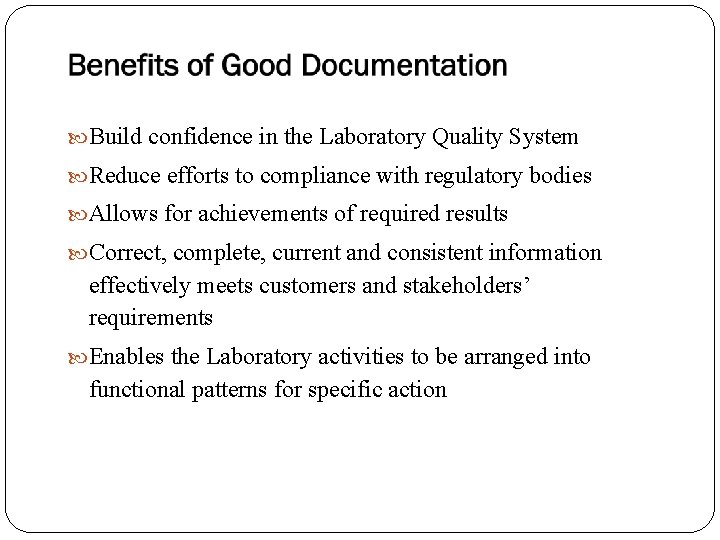
Build confidence in the Laboratory Quality System Reduce efforts to compliance with regulatory bodies Allows for achievements of required results Correct, complete, current and consistent information effectively meets customers and stakeholders’ requirements Enables the Laboratory activities to be arranged into functional patterns for specific action
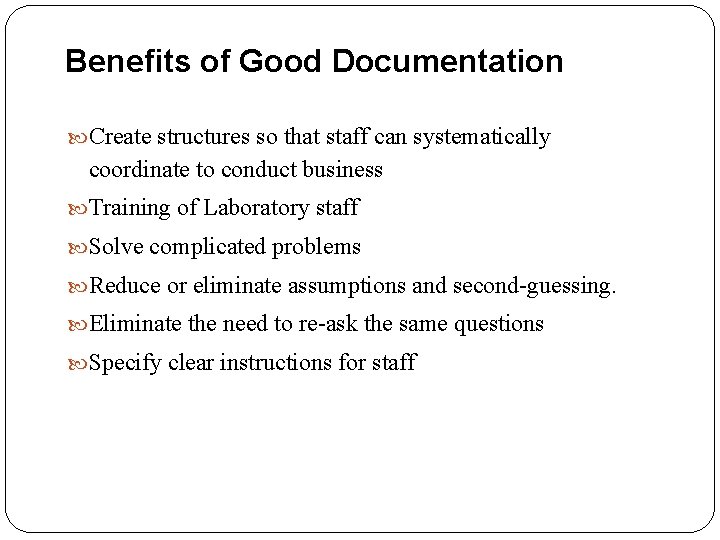
Benefits of Good Documentation Create structures so that staff can systematically coordinate to conduct business Training of Laboratory staff Solve complicated problems Reduce or eliminate assumptions and second-guessing. Eliminate the need to re-ask the same questions Specify clear instructions for staff
THANK YOU FOR YOUR ATTENTION!
- Slides: 23