
Laboratory practical works Constants of homeostasis homeostatic indices
Laboratory (practical) works

Constants of homeostasis (homeostatic indices), rigid and non-rigid ones Purpose: to observe any several homeostatic indices, and to define among them rigid and non-rigid ones. Equipment: textbook. Course: 1. Find in physiology textbook several homeostatic constants. 2. Classify them as rigid and non-rigid and add to a table given in “Results”. 3. Right in “Conclusion” definitions of homeostatic constants, rigid and non-rigid ones. Results:
Preparing of neuro-muscular preparation Purpose: to prepare of a neuro-muscular preparation. Equipment: preparation set, 0, 9 % solution of sodium chloride, cotton wool. Object: a frog. Course: 1. Prepare the neuro-muscular preparation (n/m-p). 2. Make a scheme of the n/m-p, mark it main three elements. Results:
First Galvani’s experiment Purpose: to show the biopotentials, exactly – the role of potential difference for a muscle contraction. Equipment: preparation set, 0, 9 % solution of sodium chloride, cotton wool, galvanic forceps (or two-different-metals hook). Object: a frog. Course: 1. Prepare a n/m-p. 2. Suspend the preparation on a copper hook so that it touches a zinc plate (or simultaneously touch by galvanic forceps both nerve and muscle of the preparation). 3. Make a scheme of the work. Results: Conclusion.
Second Galvani’s experiment Purpose: to show an existence of rest potential. Equipment: preparation set, Ringer solution, a glass hook. Object: a frog. Course: 1. Prepare the neuro-muscular preparation. 2. Damage a part of second (non-neuro-muscular preparation) muscle with scissors. 3. Pile the sciatic nerve so that it touches damaged and undamaged surfaces of second muscle. 4. Make a scheme of the work. Results: Conclusion.
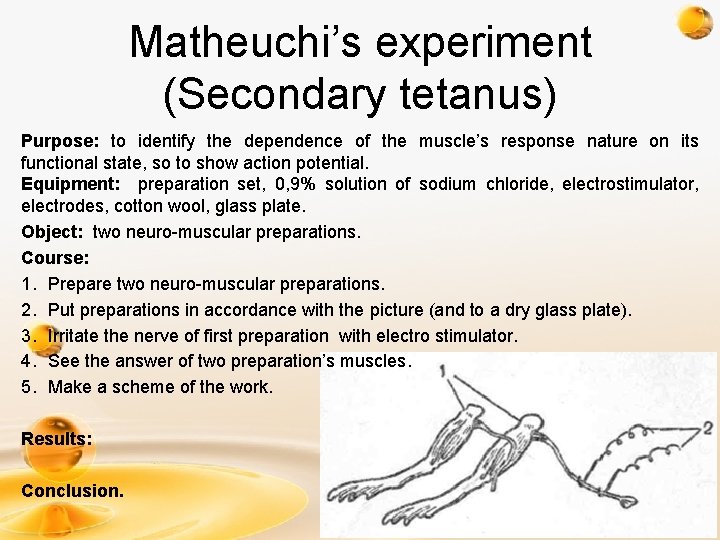
Matheuchi’s experiment (Secondary tetanus) Purpose: to identify the dependence of the muscle’s response nature on its functional state, so to show action potential. Equipment: preparation set, 0, 9% solution of sodium chloride, electrostimulator, electrodes, cotton wool, glass plate. Object: two neuro-muscular preparations. Course: 1. Prepare two neuro-muscular preparations. 2. Put preparations in accordance with the picture (and to a dry glass plate). 3. Irritate the nerve of first preparation with electro stimulator. 4. See the answer of two preparation’s muscles. 5. Make a scheme of the work. Results: Conclusion.
Dependence of contraction amplitude of the skeletal muscle on strength of stimulus Purpose: to show the relationship between magnitude of irritation and muscle contraction strength. Equipment: preparation set, Ringer solution, electrostimulator and electrodes. Object: neuro-muscular preparation. Course: 1. Prepare the neuro-muscular preparation. 2. Find the irritation threshold of the muscle for it minimal contraction. 3. Increase the stimulus force and record muscle contraction. Results: Conclusion.
The comparison of nerve and muscle excitability (direct and indirect irritation of muscle) Purpose: to compare thresholds of nervous and muscular tissues. Equipment: preparation set, Ringer solution, electrostimulator and electrodes, cotton wool. Object: neuro-muscular preparation. Course: 1. Prepare the neuro-muscular preparation. 2. Bring the electrodes to the nerve and apply irritation, slowly increasing it from a zero-level. Note the appearance of minimal muscle contraction and mark it strength which will be a threshold of a nerve. 3. Replace the electrodes to the muscle and determine the muscle stimulation threshold by further increasing of the irritant strength. Mark a threshold level of the muscle. 4. Draw two positions of the electrodes. (Results and Conclusion are on the next slide. )
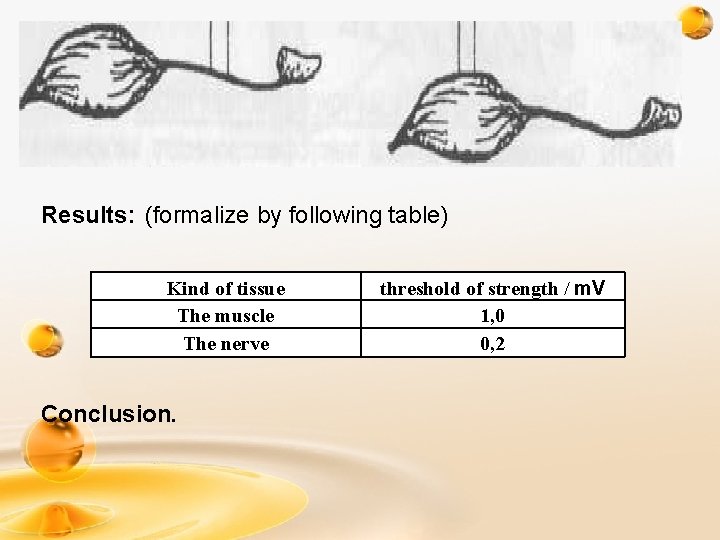
Results: (formalize by following table) Kind of tissue The muscle The nerve Conclusion. threshold of strength / m. V 1, 0 0, 2
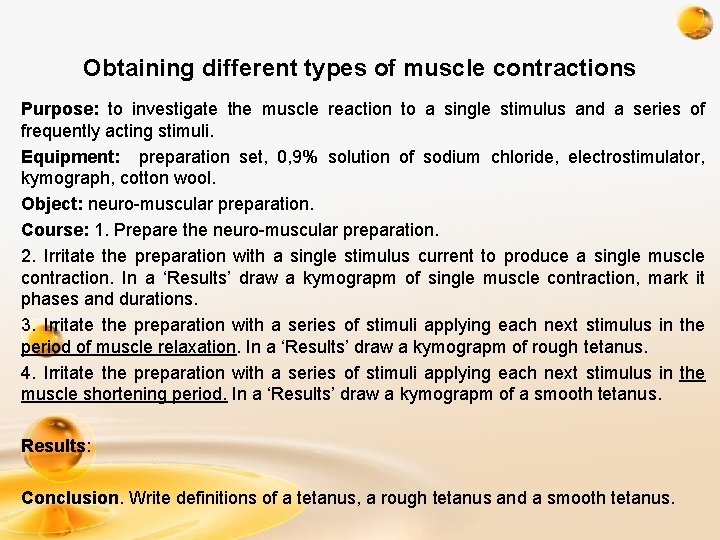
Obtaining different types of muscle contractions Purpose: to investigate the muscle reaction to a single stimulus and a series of frequently acting stimuli. Equipment: preparation set, 0, 9% solution of sodium chloride, electrostimulator, kymograph, cotton wool. Object: neuro-muscular preparation. Course: 1. Prepare the neuro-muscular preparation. 2. Irritate the preparation with a single stimulus current to produce a single muscle contraction. In a ‘Results’ draw a kymograpm of single muscle contraction, mark it phases and durations. 3. Irritate the preparation with a series of stimuli applying each next stimulus in the period of muscle relaxation. In a ‘Results’ draw a kymograpm of rough tetanus. 4. Irritate the preparation with a series of stimuli applying each next stimulus in the muscle shortening period. In a ‘Results’ draw a kymograpm of a smooth tetanus. Results: Conclusion. Write definitions of a tetanus, a rough tetanus and a smooth tetanus.

• Thus at the lecture, we discussed the first works that underlie physiology as a science. • Your task is as follows: • 1. To read the summarized material. • 2. Thoroughly understand the first 3 works, namely - First experiment of Galvani, Second experiment of Galvani, Matheuchi experiment. • 3. Find the implementation of these works described in Internet. • 4. Draw up the protocols of these 3 laboratory works as we discussed at the lecture. • 5. Be sure to draw conclusions what proves each one of these experoments. http: //freeppt. ru
- Slides: 11