
Laboratory Organisation Working in the Science Industry Lesson

Laboratory Organisation Working in the Science Industry Lesson 5
THIS WEEK ® Designing a new science teaching lab: ® Pre-planning ® Size and space requirements ® Calculating size of rooms ® Importance of size
Old Lab Design ® Come a long way since 19 th and early 20 th centuries and is constantly evolving ® e. g. Traditional labs had heavy, hard, wooden benches with surfaces that needed to have linseed oil applied ® Open central lead lined latrines ran through the middle of these benches draining into open dilution traps at the end
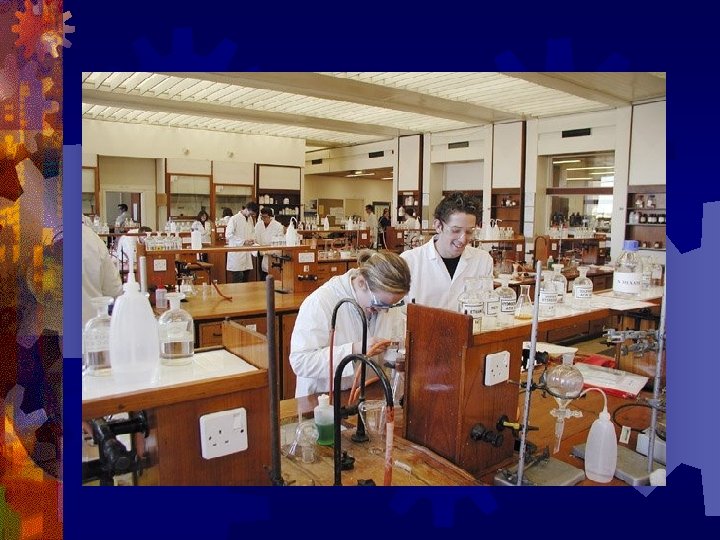
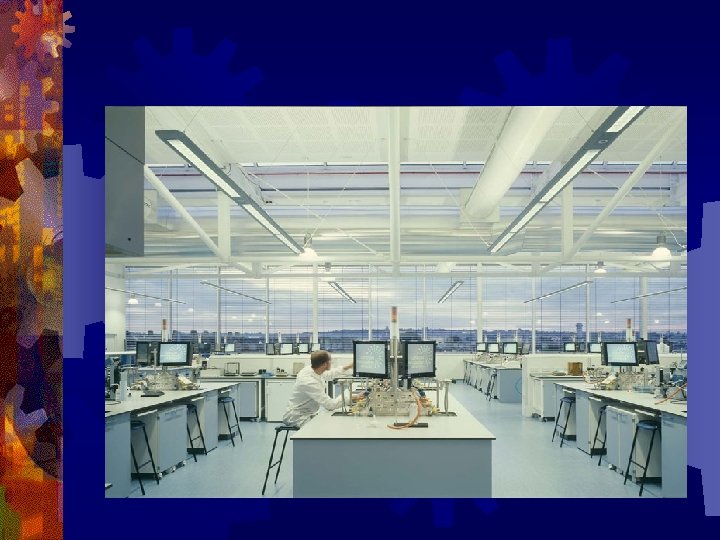
Lab Design ® As there are many different types of laboratories; each one will be very different in terms of its design requirements, facilities and equipment needs
Laboratories need… ® Preparation ® Store rooms ® Greenhouses ® Animal houses ® Dark room/Optics ® Outside/ponds etc. ® Disposal equipment
Pre-Planning ® When you are designing a teaching lab: ® What do you have to think about? ® What do you have to consider? ® What do you have to plan for? ® What are the issues? ® Who do you have to consider?
Pre-Planning ® What § § § do you have to think about? Number and type of labs required Preparation/storage rooms Number of students/staff working in the lab Planning permissions Funding
Pre-Planning ® What do you have to consider? • The total running costs • New or refurbished laboratory • Some architects are very experienced in laboratory design but many are not ® Specify to contractors precisely what you want
Pre-Planning ® What • • do you plan for? Large enough prep and storage rooms Ventilation Enough fume cupboards Large enough floor area Bench spaces Eye wash station Lockers to store bags and coats
Pre-Planning ® What • • are the issues? Disturbing teaching during construction Delivery times Shortage of staff Delays are commonplace
Pre-Planning ® Who • • • do you have to consider? The scientists/science teachers and technicians The Headteacher School pupils and students The architect The builder The local authority adviser for science and health and safety
Lab Size ® The size of the room needed is obviously related to the number of pupils to be taught there. ® There are no regulations controlling the size of individual laboratories but adequate space is clearly needed for safe practical work
CAS ® Laboratories at CAS have a floor area of 3 m² person ® This space is large enough to caters for a minimum of 25 students. 25 x 3=75 m² ® This is the minimum floor area requirements for general purpose laboratories
Recommended Guidelines ® Df. EE, Science Accommodation for Secondary Schools (1999) now suggests 79 – 91 m 2. ® Some Local Education Authorities standardise on 80 or 85 m 2. ® Department of Education (2003) states: “Laboratory should be 90 m 2 minimum in all new builds – for refurbishment of existing laboratories the minimum size should be 83 m 2. ”
Useful Information ® ® ® Df. EE, The Stationery Office (1999) Building Bulletin 80 (revised 1999): Science Accommodation in Secondary Schools. A Design Guide. The Association for Science Education (1989) Building for Science, a Laboratory Design Guide. ASE School Laboratories for the 21 st Century. [http: //www. ase. org. uk/ldtl/docs/SL 21 C. pdf] CLEAPSS Designing and Planning Laboratories L 14. NEEBE (2006) Laboratory 21 – School Science Laboratories Design for the 21 st century Concepts and Proposals. [http: //www. ase. org. uk/ldtl/docs/laboratory 21. pdf] DENI (2003) Part 19 Science
Websites ® Association for Science Education (ASE), Laboratory Design for Teaching and Learning http: //www. ase. org. uk/ldtl/ ® CLEAPSS http: //www. cleapss. org. uk/ ® Department of Education http: //www. deni. gov. uk/
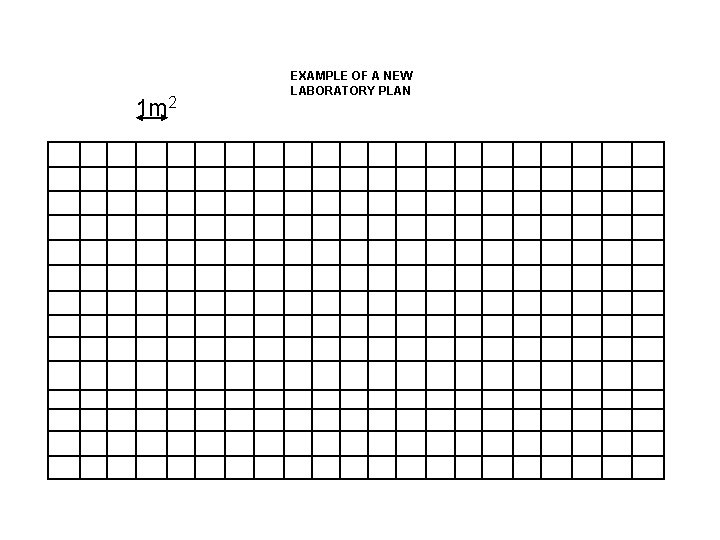
1 m 2 EXAMPLE OF A NEW LABORATORY PLAN
Grid Plan for Assignment 2 ® You can use the grid given above to plan for your general purpose laboratory or you can draw them in an A 3 paper ® The squares in the plan are scaled at 1 meter square ® You would need to show: fire exists, doors, windows, walls, prep-room and storage room
- Slides: 20