
Laboratory Neutrino Physics Experiments Enabled with High Resolution
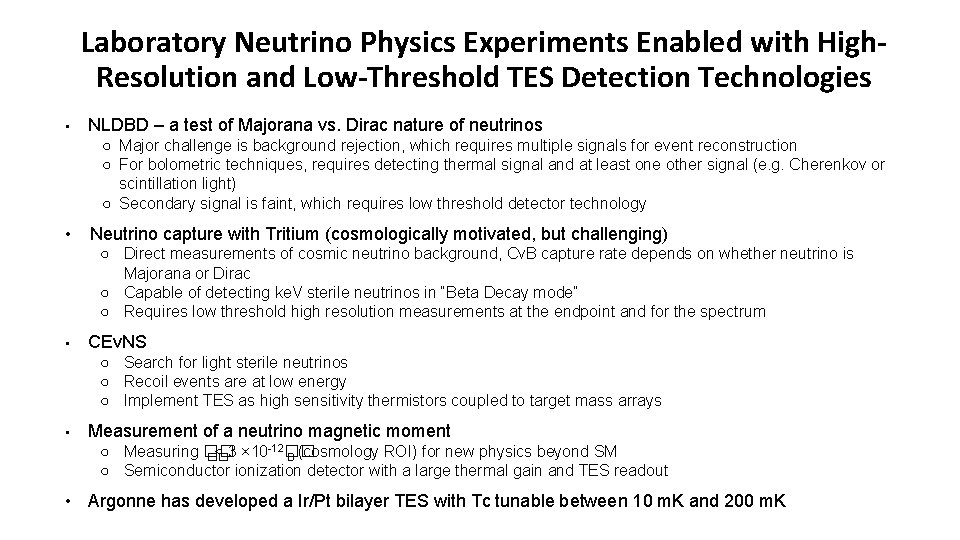
Laboratory Neutrino Physics Experiments Enabled with High. Resolution and Low-Threshold TES Detection Technologies • NLDBD – a test of Majorana vs. Dirac nature of neutrinos ○ Major challenge is background rejection, which requires multiple signals for event reconstruction ○ For bolometric techniques, requires detecting thermal signal and at least one other signal (e. g. Cherenkov or scintillation light) ○ Secondary signal is faint, which requires low threshold detector technology • Neutrino capture with Tritium (cosmologically motivated, but challenging) ○ Direct measurements of cosmic neutrino background, Cv. B capture rate depends on whether neutrino is Majorana or Dirac ○ Capable of detecting ke. V sterile neutrinos in “Beta Decay mode” ○ Requires low threshold high resolution measurements at the endpoint and for the spectrum • CEv. NS ○ Search for light sterile neutrinos ○ Recoil events are at low energy ○ Implement TES as high sensitivity thermistors coupled to target mass arrays • Measurement of a neutrino magnetic moment ○ Measuring �� < 3 × 10 -12�� �� B (cosmology ROI) for new physics beyond SM ○ Semiconductor ionization detector with a large thermal gain and TES readout • Argonne has developed a Ir/Pt bilayer TES with Tc tunable between 10 m. K and 200 m. K
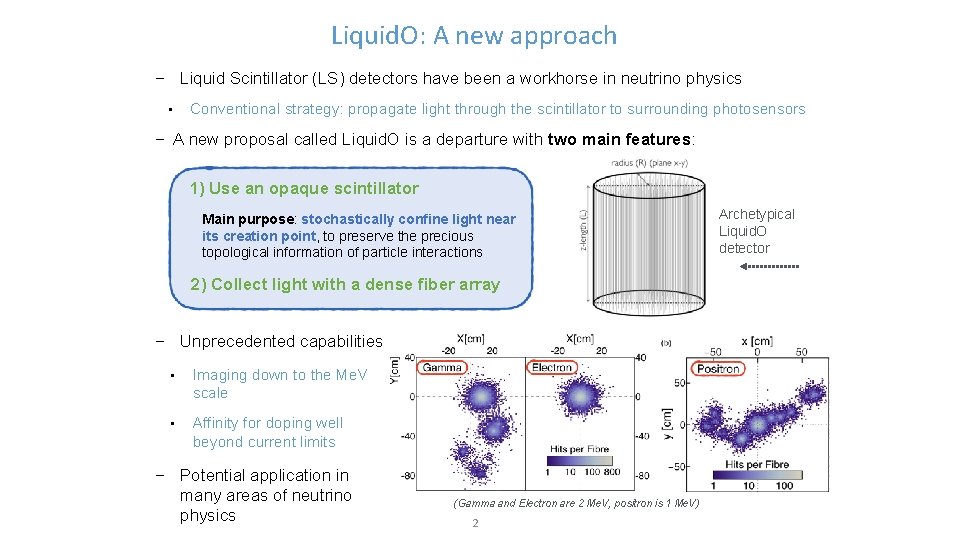
Liquid. O: A new approach − Liquid Scintillator (LS) detectors have been a workhorse in neutrino physics • Conventional strategy: propagate light through the scintillator to surrounding photosensors − A new proposal called Liquid. O is a departure with two main features: 1) Use an opaque scintillator Main purpose: stochastically confine light near its creation point, to preserve the precious topological information of particle interactions 2) Collect light with a dense fiber array − Unprecedented capabilities: • Imaging down to the Me. V scale • Affinity for doping well beyond current limits − Potential application in many areas of neutrino physics (Gamma and Electron are 2 Me. V, positron is 1 Me. V) 2 Archetypical Liquid. O detector
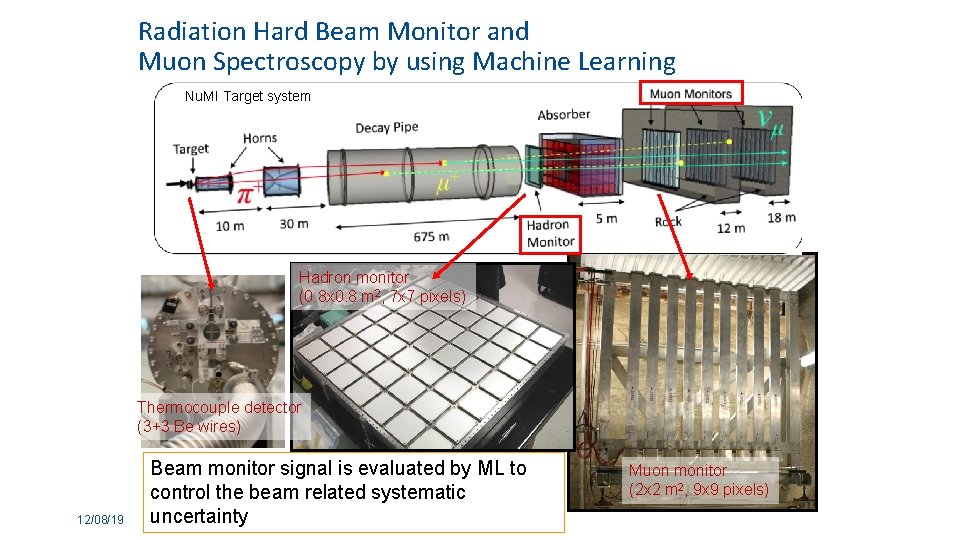
Radiation Hard Beam Monitor and Muon Spectroscopy by using Machine Learning Nu. MI Target system Hadron monitor (0. 8 x 0. 8 m 2, 7 x 7 pixels) Thermocouple detector (3+3 Be wires) 12/08/19 Beam monitor signal is evaluated by ML to control the beam related systematic uncertainty CPAD 2019, K. Yonehara Muon monitor (2 x 2 m 2, 9 x 9 pixels)
- Slides: 3