
LABORATORY INSPECTIONS Jerry Gordon Manager For Laboratory Safety
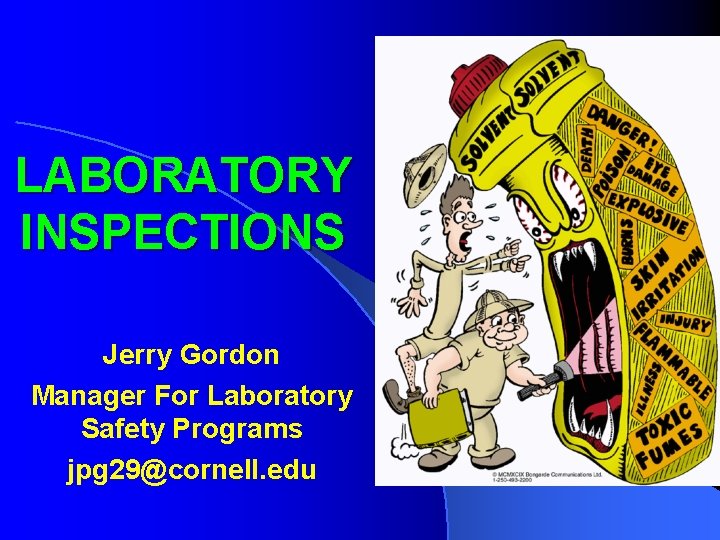
LABORATORY INSPECTIONS Jerry Gordon Manager For Laboratory Safety Programs jpg 29@cornell. edu
Who Is This Training For? l For all faculty, staff, graduate assistants, and DSRs who want to take a proactive approach to operating their labs safely by identifying potential issues through laboratory self inspections.

Objectives l Identify reasons to conduct self inspections of labs l Identify areas of concern and common issues found in labs l Identify corrective actions to take best management practices to address areas of concern

Why Inspect Labs? ? ? l Determine compliance with regulations – Raise level of awareness for lab personnel – Identify and address issues before a “real” inspection l Opportunity for additional training l Health and safety check of laboratory facilities l Outlet for faculty, staff, and graduate student concerns

Inspecting Labs l How to inspect labs – Use of checklists vs. “the walk around” – Include faculty, staff, and graduate students – Send a copy of the final report to the faculty l Best to go with experienced inspector first – It takes time and practice to be consistent l Cooperation vs. confrontation l Provide solutions, not just citations

Inspecting Labs l Recommended frequency of inspections – Weekly by lab occupants l e. g. Friday afternoon cleanups – Formal once-a-month by designated lab representatives or DSRs – Minimum once per semester – Voluntary yearly consultations by EH&S Provides a second set of eyes l Incorporates any changes to the regulations l Can provide recommendations for similar issues from other labs l
Inspecting Labs l What to bring along during an inspection – The checklist – A notepad and pen – Scotch tape – Permanent marker – Multi-tool (screwdrivers, wire cutters, etc) – Examples of signs and labels to hand out – Digital camera is useful for documentation and training pictures

Inspecting Labs l When issues are found: – Take corrective action to address the issue immediately l Do you need to document the issue if corrected in front of you? – Notify others in the lab of any issues discovered – Use labels and signs as reminders – Include as topics for discussion at lab group and safety committee meetings
For This Training Program… l Should – Recommendation by EH&S as a best management practice for labs – Things that outside inspectors LIKE to see when they go through a lab l Must – Regulatory requirement involved – Specific items outside inspectors look for to determine compliance with regulations
Inspection Areas l Housekeeping l General Safety l Chemical Waste / EPA l Other Wastes l Other Regulations l Emergency l Communication

Housekeeping l Arguably THE most important issue in your lab l Gives a general impression of the overall condition of your lab l Can have a significant impact on the outcome of an inspection by an outside agency l Citable OSHA violation – Indication of more serious problems
Housekeeping l Includes benches, hoods, cabinets, sinks, refrigerators and freezers – Chemical containers, sharps, trash, clutter l All chemical spills must be cleaned up – Includes drips from containers, splashes on cabinet fronts or in hoods, etc l Keep overhead storage to a minimum – Do not store heavy items overhead
Housekeeping l When requesting maintenance work, please be considerate of maintenance staff by: – Ensuring all chemicals and apparatus have been removed from the work area – Ensuring the work area is clean of chemical spills or residue – Notifying them of any potential hazards or possible chemical contamination
General Safety l Personal Protective Equipment l Electrical Safety l Refrigerators l Machine Guarding l Fume Hoods l Gas Cylinders l Respirators
Personal Protective Equipment l The department or unit is responsible for deciding what PPE is required l Has the lab completed an assessment of the hazards in their work area and determined the appropriate PPE? – Assistance with hazard assessments and choosing the right PPE can be obtained from EH&S – Ex. See the glove selection chart in the CHP
Personal Protective Equipment l Is the appropriate PPE available and in good condition? l Is the appropriate PPE being worn? l Have the lab workers been trained on proper use of the PPE? l Has this information been included in the lab’s Standard Operating Procedures?
Electrical Safety l Maintain plugs, cords, and equipment in good condition – Get repaired immediately if needed – Look for cracked cords, bare insulation – Electrical tape is not acceptable l Extension cords are for temporary use only l Use power strips if necessary l Do not cascade power strips and extension cords
Electrical Safety l Do not block electric power panels – Need to maintain clearance and have ready access to breakers l Ensure all missing breakers are reported to building coordinator – Missing breakers need breaker caps installed l Emergency cut off switches and breakers must be labeled – Contact building coordinator for assistance
Electrical Safety l Do not store oxidizers or flammables around power panels or other ignition sources l Be aware when using electrical devices around sinks and other sources of water – Use a Ground Fault Circuit Interrupter (GFCI) around wet areas
Electrical Safety l Do not alter or repair fixed wiring in buildings – Contact building coordinator for assistance l All electrical devices or equipment must be third party tested – Underwriters Laboratories – UL listed
Refrigerators l Do not store food in chemical refrigerators – Chemical refrigerators should be labeled as “Chemicals Only, No Food” l For sample storage, include an identification key on outside of refrigerator l Should store liquid chemicals in secondary containers such as trays l Practice good housekeeping – Clean up all spills
Refrigerators l Clean refrigerators on a regular basis l Defrost l Only freezers on a regular basis special rated flammable storage refrigerators may be used for storage of flammable liquids
Refrigerators l All refrigerators should have an ECO disposal registration sticker – Check with your DSR or Building Coordinator OR – Contact Facility Coordinator or Anne Wildman at ECO at AW 72@cornell. edu
Cold Rooms l Same principles of refrigerator storage apply l No storage of food l Should not store flammable liquids and cryogenic gases in cold rooms – Flammability and explosion hazard – Asphyxiation hazard
Machine Guarding l All moving parts need to be properly guarded l Includes belts, pinch points, and blades – Vacuum pumps, hydraulic presses, cutting devices, grinders, rotating shafts
Fume Hoods l Hoods are not storage cabinets – Temporary storage for experiments is acceptable – Excess storage interferes with air flow – Any equipment stored in hoods should be elevated to allow air to flow properly under equipment l Keep sash as low as possible – Safety measure during use – Energy conservation measure when not in use
Fume Hoods l Hoods are not disposal devices – Illegal to evaporate hazardous waste l Do not use heated Perchloric acid in standard fume hoods – Vapors can form shock-sensitive compounds that can explode – Requires a Perchloric acid fume hood with a special wash down function
Gas Cylinders l Must be secured upright at all times – Includes half size cylinders – Use of chains is preferred l Label with a Full/In Use/Empty tag l Replace cap when not in use
Gas Cylinders l Keep away from ignition sources l Separate Oxygen and fuel cylinders – At least by 20 feet or a half hour fire wall l Only order what you need – do not stockpile on loading docks l Just-In-Time delivery – Next day service by Airgas
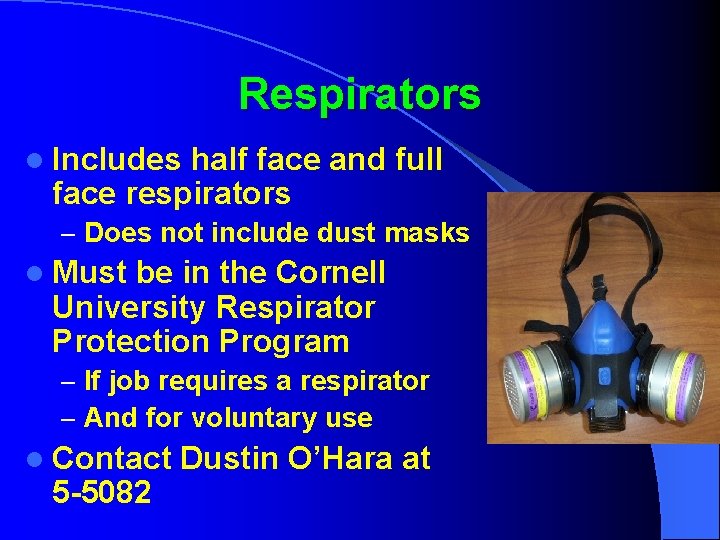
Respirators l Includes half face and full face respirators – Does not include dust masks l Must be in the Cornell University Respirator Protection Program – If job requires a respirator – And for voluntary use l Contact 5 -5082 Dustin O’Hara at
Chemical Safety l Proper Labeling l Chemical Segregation l Chemical Storage l Peroxide Formers
Chemical Labeling l All containers must be labeled – Includes wash bottles, reagent bottles, and other chemical containers l Labels must identify contents l For original containers – Tape label if it is falling off – Relabel with permanent label l Deface old labels that do not accurately describe contents of chemical containers
Chemical Labeling l Labels on non-original containers should include: – Full chemical name – Hazards present > flammable, corrosive, health hazards l If using structures, formulas, or abbreviations – Should have a key explaining abbreviations l Recommend using EH&S Right-To-Know labels (see www. ehs. cornell. edu)
Chemical Labeling l Should date containers when received and opened – Dispose of expired and old chemicals l Especially formers recommended for peroxide
Chemical Segregation l Store chemicals according to hazard class l Do not store chemicals by: – Alphabetically – Carbon number (organic chemicals) – Liquids versus solids – Small bottles versus large bottles – Whatever fits on the shelf l Until chemicals have been segregated
Chemical Segregation l Benefits of segregation by hazard classes – Safer storage – Increase knowledge about the chemical – Identify potentially explosive chemicals – Identify multiples of the same chemical l Read container labels and MSDSs l Assistance with lab cleanouts and segregating chemicals is available, contact EH&S for more information – Email chemwaste@cornell. edu
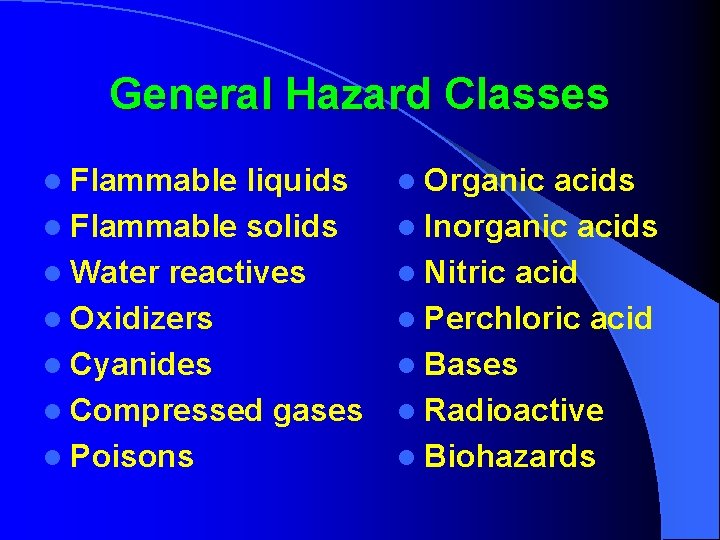
General Hazard Classes l Flammable liquids l Flammable solids l Water reactives l Oxidizers l Cyanides l Compressed gases l Poisons l Organic acids l Inorganic acids l Nitric acid l Perchloric acid l Bases l Radioactive l Biohazards
Chemical Storage l Minimize amount of chemicals stored – Take advantage of Just-In-Time delivery l Store small bottles in front of large bottles l Store with labels facing out
Chemical Storage l Store older and used bottles in front of full containers – Use up the older containers and containers with smaller amounts remaining first l Do not store hazardous liquids above eye level – Especially no acids or bases – Other chemicals injurious to the eyes
Chemical Storage l Recommend storing chemicals in secondary containers such as trays, buckets, or bottle holders l Recommend labeling cabinets and storage areas with hazard class labels l Rule of thumb - should not store more than 10 gallons of flammables outside a flammable cabinet – Includes flammable chemicals in use
Peroxide Formers l Hazards of peroxide formers – Flammable – Can form potentially explosive crystals l All peroxide formers should be tested for peroxides every 6 months from the date opened – Record test date and results on container – Should also record date opened – Test strips available at Chemistry stockroom l Minimize quantities stored
Peroxide Formers l Common examples – Ethyl ether – Dioxane – Tetrahydrofuran – Sodium amide – Potassium metal l There include: are many others out there – read material safety data sheets
Chemical Waste / EPA l Hazardous l Satellite l Other Accumulation Areas Wastes l Universal l Used Waste Issues Oil Wastes
Hazardous Waste Issues l All hazardous waste containers must be labeled with the words “Hazardous Waste” and with words identifying the contents l All hazardous waste containers must be kept closed l Containers must be in good condition – EPA and “Inherently waste-like”
Hazardous Waste Issues l Do not store chemicals in or around sinks without secondary containment l Waste should be stored in secondary containment – Trays, buckets, etc – Segregate by hazard class
Hazardous Waste Issues l Leave some airspace in waste containers l Do not accumulate excessive amounts of waste l Accumulate waste in the smallest size container needed for the experiment l Date containers when you are ready to submit a waste tag to EH&S
Hazardous Waste Issues l Satellite Accumulation Area – The term EPA uses for where you generate your waste l Hazardous waste must be stored at or near the point of generation – Means in the lab the waste was generated – Do not move waste between rooms l EPA would interpret this as creation of a 90 day storage area similar to what EH&S maintains
Other Wastes l Check with building manager first to see what program they have for other wastes l Universal l Used wastes oil l Solutions containing Silver
Universal Wastes l Includes used batteries and light bulbs l Needs to be labeled with the words “Universal Waste _______” l Universal waste needs to have an accumulation start date l Dispose of within one year – Recommend disposal within 9 months
Used Oil l Must label container with the words “Used Oil” l Must store used oil in a proper container in good condition l Keep spills containers closed to minimize – Should store in secondary containers such as trays
Used Oil l Do not mix other waste with used oil – Doing so can result in hazardous waste l Contact your building manager for the location of used oil drum in the building
Solutions Containing Silver l EH&S has a program to recycle – Using a Silver filtering unit Silver l Examples include: – Photographic fixers – Silver nitrate staining solutions l Contact your DSR for the location of the nearest Silver filtering unit or call Nathan Clark at EH&S at 4 -8068
Other Regulations l Radioactive Materials l Biohazardous l Lasers l Pesticides l Shipping l Security Materials
Radioactive Materials l All rooms using radioactive materials must be listed on the radioactive materials permit l Exposure areas marked – All rad work surfaces must be labeled with rad signs or tape around the perimeter l No food or drink are allowed in rad labs
Radioactive Materials l Radioactive stocks must be locked up if no one is in the lab l Contact 5 -5600 Agnes Morris with questions at
Biohazards l Requirements for Biohazardous materials – Access to room must be restricted – Includes proper signage on door – Hygiene and decontamination protocols are required – No food or drink are allowed in labs with biohazardous materials
Biohazards l Biological Safety Cabinets – Used for containment procedures for aerosols/splashes l Not designed for use as a chemical fume hood – Requires annual certification by an outside contractor Vet school has a contract with B&V Testing l Other schools need to make their own arrangements l
Biohazards l Training may include Blood Borne Pathogen and/or Basic Biosafety training l Self audit form available on the EH&S webpage – http: //www. ehs. cornell. edu/bio/Selfaudit. htm l Contact the Biosafety Officer - Frank Cantone at 4 -4888 with any questions
Biohazard Sharps l Sharps that require disposal in a sharps container – Needles and syringes – Or any item contaminated with a biohazardous agent or used in a biomedical laboratory l Pasteur pipettes, razor blades, scapels, microscope slides, and broken glass
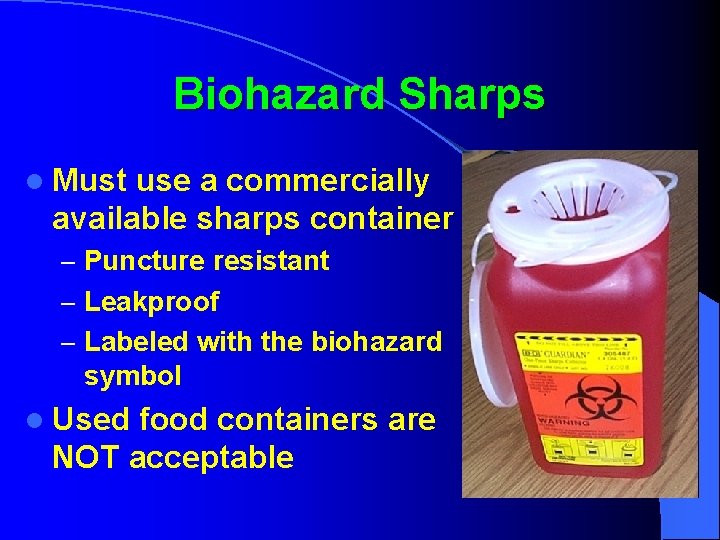
Biohazard Sharps l Must use a commercially available sharps container – Puncture resistant – Leakproof – Labeled with the biohazard symbol l Used food containers are NOT acceptable
Biohazards l All Regulated Medical Waste non-sharp items must be placed in red biohazard bags – Plasticware, gloves, toweling, etc l Must have a completed Cornell University Medical Waste Tracking Tag for disposal of Regulated Medical Waste
Biohazards l Dispose of Regulated Medical Waste through EH&S – Vet College has separate procedures l Contact 4624 Kevin Fitch with questions at 5 -
Lasers l There are special requirements for class 3 A and higher Lasers
Lasers l Class 3 A Lasers must be labeled with – The words “Caution” or “danger” – The hazard class – Power output – Type of laser – Wavelength – Pulse duration, if applicable – The room/work area must also be labeled with this information
Lasers l Class 3 B or 4 Laser requirements – Labeling similar to Class 3 A requirements – Signs, including lighted signs when in use – Proper eye protection – Interlocking and/or blocking – Power control / cutoff switches – Standard Operating Procedures
Lasers l There are special requirements for class 3 A and higher Lasers l Proper training is also required – EH&S offers a Laser Safety training class – Contact Cindy Martin at 4 -4473 for more information
Pesticides l Pesticide use requirements – Proper labeling of containers – Proper training – Proper certification l Agricultural use, including greenhouses, require Worker Protection Standard (WPS) training l Contact Eric Harrington at 5 -0485 or eh 22@cornell. edu
Shipping l If shipping hazardous materials (including packages with dry ice), then you need proper training – DOT Hazardous Materials Shipping training l EH&S offers this training class – Contact Mike Lonon at 5 -6995 for more information
Security l Understand that security of laboratories is a real issue in today’s world l Recognize that security is related to but different than laboratory safety – Accidental vs. intended l Realize there are simple steps you can take to help protect your laboratory and your research materials
Security Steps You Can Take l First identify what items you should try to protect – Take a fresh look at your building and work areas l Minimize the quantities of highly hazardous materials kept on hand – Utilize substitution or disposal l Control access to research areas – Keep doors locked when no one is present
Security Steps You Can Take l Secure your highly hazardous – Locked storage cabinets materials l Know who is in research areas – Question people you don’t know l “Can I help you? ” – Consider using ID badges l Be informed and train research group members on your security policy
Security l Highly recommend attending the new EH&S training program: “Security of Hazardous Materials Used in Research” l Contact Czora at EH&S at 4 -4693 for more information
Emergency l Aisle Space l Fire Extinguishers l Combustible Storage l Spill Kits l Emergency Procedures l Eyewash/Showers l HASP
Emergency l Keep corridors and hallways clear of equipment, boxes, and other items l Aisle space – Storage of bottles, waste, boxes, equipment, wires, cords on floors – Need minimum of 36” aisle space between benches and equipment
Fire Extinguishers l Do not block fire extinguishers l Check to make sure extinguishers are fully charged – If not, contact Clayton Bronson at 5 -8200 l Do not block or wedge fire doors
Combustible Storage l Combustibles include: – Wood, paper, boxes, plastics l Keep amount of combustibles stored to a minimum l Keep away from sources of ignition – Electric power panels, open flames, etc
Combustible Storage l Ceiling clearance for the entire room – Sprinklered areas - must not store combustibles within 18” below the crown of the sprinkler head – Nonsprinklered areas - must not store any combustibles within 2 feet of ceiling
Eyewash/Showers l Ensure easy access to eyewash and emergency showers – Handheld bottles not acceptable l Should test eyewashes weekly – Run/flush for 2 -3 minutes – EH&S does annual inspections l Contact EH&S at 5 -5237 when new units are installed
Spill Kits l In case of an emergency or when in doubt, CALL 911 or – Call 255 -1111 when using a cell phone l Spill kits are recommended, but need proper procedures and training l EH&S offers the training class “Cleaning Up Small Spills”
Hazard Assessment Signage Program (HASP) l All labs should have HASP signage on outside of door l HASP will be available on the EH&S webpage soon l Need to submit updates to your DSR – HASP files need to be sent to EH&S to convert the updates for you – Contact Robin Goodloe at 5 -5613 or jag 16@cornell. edu
Communication l Chemical Hygiene Plan l Standard Operating Procedures l Material l Training Safety Data Sheets
Chemical Hygiene Plan l Chemical Hygiene Plan (CHP) needs to be readily available – Required by OSHA – Recommend keeping hard copy in lab – Electronic version is acceptable l As part of the campus CHP, you still need to have site specific standard operating procedures
SOPs l Standard Operating Procedures (SOPs) are required for handling highly hazardous materials: – Highly toxic chemicals – Carcinogenic materials
SOPs l SOPs include information such – Chemical hazards – Authorized personnel – Training requirements – Use location – Personal Protective Equipment – Waste disposal – Decontamination – Exposure – Spill control as:
SOPs l See Chemical Hygiene Plan for more information – Generic and specific examples are available via the EH&S webpage - ww. ehs. cornell. edu – EH&S offers a “Writing SOPs” training class
Material Safety Data Sheets l Responsibility of supervisors to ensure MSDSs are accessible – Paper or electronic format – Should have MSDS websites bookmarked – Should be able to produce a MSDS within 5 minutes l EH&S recommends keeping hard copy of MSDSs in the lab l Always read the MSDS before working with new chemicals
Training l All lab workers are required to attend laboratory safety training – Should attend the EH&S training program “Chemical Safety for Laboratory Workers Graduate Students and Employees” l Recommend hazardous waste training provided by EH&S for all generators of hazardous waste – Required by some departments and colleges
Training l To see a complete list of EH&S training, go to www. ehs. cornell. edu and point to Training, then click on Safety Education Course Listing
Keys To Success l Cooperation vs. confrontation l Provide solutions, not just citations l Be patient and persistent with changes l Be proactive and schedule a Laboratory Workplace Consultation with EH&S to get started NOW! – – Voluntary assistance Includes a consultation report Contact EH&S at chemwaste@cornell. edu Or call Agnes Morris at 5 -5600
My Offer To You…. l This training is available to all DSRs, faculty, staff, and graduate assistants at your location l “Hands On” In-Lab training is also available – You do the inspections – I’ll provide assistance and advice l Email to set up a time for this training program or for In-Lab training on inspecting your labs
QUESTIONS? ? ? Your comments are appreciated, please fill out a training evaluation form. Thank You! Jerry Gordon Manager For Laboratory Safety Programs jpg 29@cornell. edu
- Slides: 91