
Laboratory for Membrane Preparation and Characterisation Alberto Figoli
Laboratory for Membrane Preparation and Characterisation Alberto Figoli Institute on Membrane Technology (ITM-CNR) Via Pietro Bucci Cubo 17/C, Rende (CS) 87030 Tel. 0039 -0984 -492027, fax 0039 -0984 -402103 a. figoli@itm. cnr. it
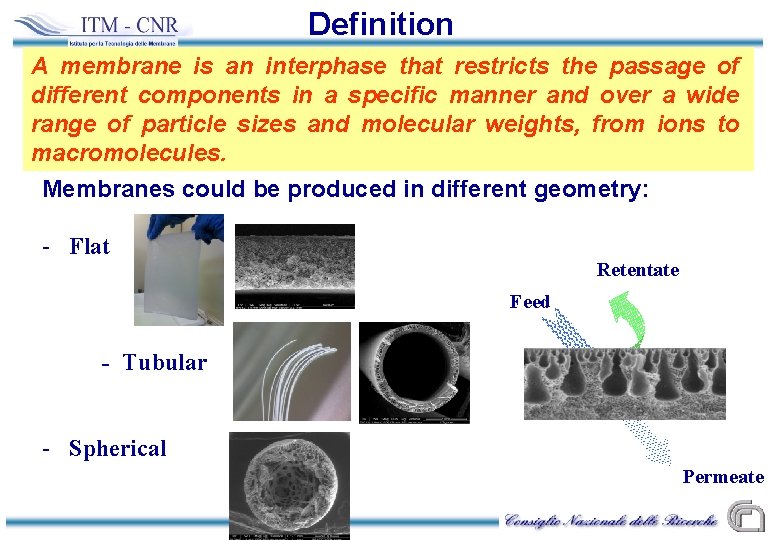
Definition A membrane is an interphase that restricts the passage of different components in a specific manner and over a wide range of particle sizes and molecular weights, from ions to macromolecules. Membranes could be produced in different geometry: - Flat Retentate Feed - Tubular - Spherical Permeate

Membrane Preparation by Phase Separation The main traditional techniques employed for preparation of membranes by phase inversion, which are listed below: EIPS = Evaporation induced phase separation VIPS = Vapor induced phase separation TIPS = Temperature induced phase separation NIPS/DIPS = Non-Solvent induced or Diffusion induced phase separation Polymeric solution Casting knife Support NIPS VIPS The only thermodynamic presumption for all procedures is that the system must have a miscibility gap over a defined concentration/temperature range A. Figoli et al. , Polymeric Membranes, Chapter 1, pp 1 -44, In Membrane Fabrication, Edited by Nidal Hilal, Ahmad Fauzi Ismail, and Chris Wright, CRC Press, Print ISBN: 978 -1 -4822 -1045 -3; 2015
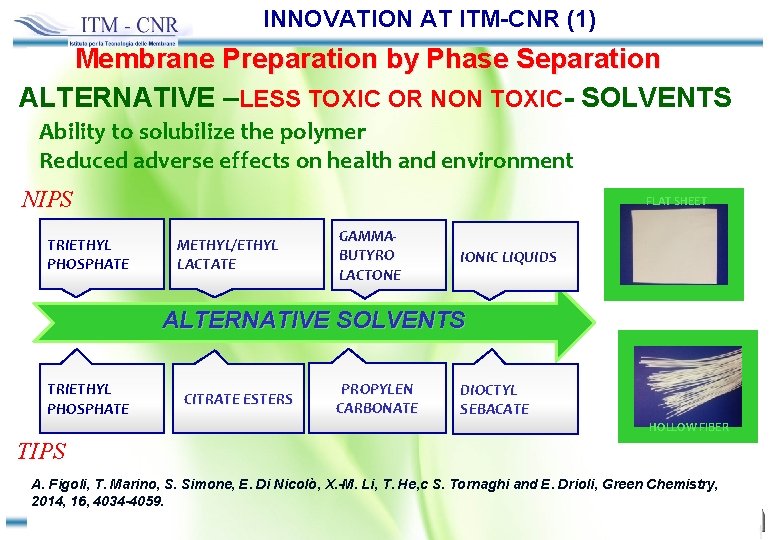
INNOVATION AT ITM-CNR (1) Membrane Preparation by Phase Separation ALTERNATIVE –LESS TOXIC OR NON TOXIC- SOLVENTS Ability to solubilize the polymer Reduced adverse effects on health and environment NIPS TRIETHYL PHOSPHATE FLAT SHEET METHYL/ETHYL LACTATE GAMMABUTYRO LACTONE IONIC LIQUIDS ALTERNATIVE SOLVENTS TRIETHYL PHOSPHATE CITRATE ESTERS PROPYLEN CARBONATE DIOCTYL SEBACATE HOLLOW FIBER TIPS A. Figoli, T. Marino, S. Simone, E. Di Nicolò, X. -M. Li, T. He, c S. Tornaghi and E. Drioli, Green Chemistry, 2014, 16, 4034 -4059.
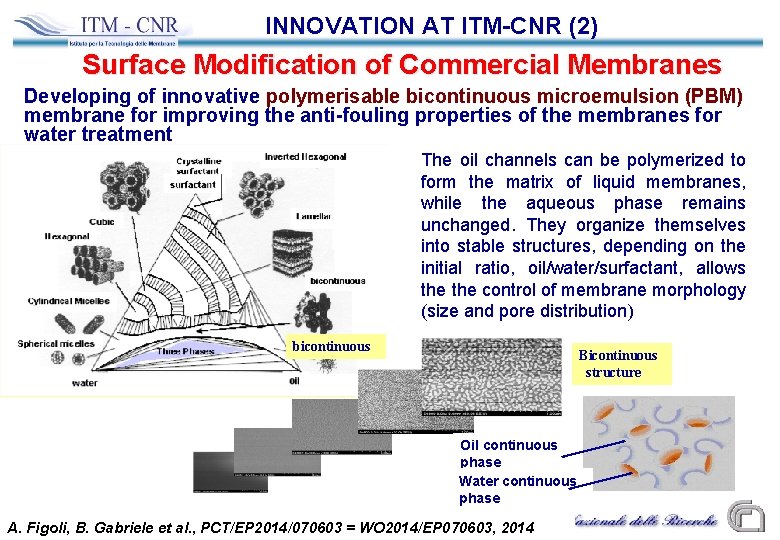
INNOVATION AT ITM-CNR (2) Surface Modification of Commercial Membranes Developing of innovative polymerisable bicontinuous microemulsion (PBM) membrane for improving the anti-fouling properties of the membranes for water treatment The oil channels can be polymerized to form the matrix of liquid membranes, while the aqueous phase remains unchanged. They organize themselves into stable structures, depending on the initial ratio, oil/water/surfactant, allows the control of membrane morphology (size and pore distribution) bicontinuous Bicontinuous structure Oil continuous phase Water continuous phase A. Figoli, B. Gabriele et al. , PCT/EP 2014/070603 = WO 2014/EP 070603, 2014
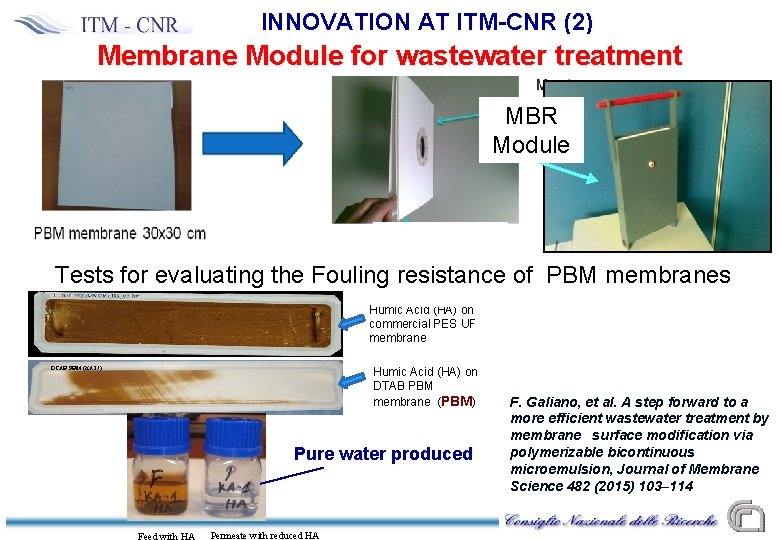
INNOVATION AT ITM-CNR (2) Membrane Module for wastewater treatment MBR Module Tests for evaluating the Fouling resistance of PBM membranes Humic Acid (HA) on commercial PES UF membrane DTAB PBM (KA 27) Humic Acid (HA) on DTAB PBM membrane (PBM) Pure water produced Feed with HA Permeate with reduced HA F. Galiano, et al. A step forward to a more efficient wastewater treatment by membrane surface modification via polymerizable bicontinuous microemulsion, Journal of Membrane Science 482 (2015) 103– 114

INNOVATION AT ITM-CNR (3) Innovative Strategy for Self Cleaning Membrane Preparation A novel chemo-mechanical strategy to arm the surface pores with oxygen evolving catalysts (POMs) that are known to liberate nascent oxygen gas when exposed to aqueous H 2 O 2 as chemical trigger. Imaging of catalystic clusters (bright areas) on the pore mouth and inner walls of the membrane Gas bubbles enables beads rejection and cleaning the membrane H 2 O incubation H 2 O washing Advanced material Interfaces, 2 (2015) 1500034 Fluorescent beads
- Slides: 7