
Laboratory Exercise 2 Microscopy Care and Use of
Laboratory Exercise 2 “Microscopy”

Care and Use of the Microscope • In this exercise, we will study the application of a compound microscope, know its parts and function, and learn to use and take care of it. • These terms should be familiar to you: magnification, resolution, stereoscopic(dissection), simple-, compound-, and electronmicroscopy (scanning or transmission). • This laboratory exercise correlates with Chapter 3 of your lecture textbook; Exercise 2 of your laboratory manual

Laboratory Lecture

Concept: Cell Biology tools - microscopy & chemistry • The quality of an image depends on – Magnification, the ratio of an object’s image size to its real size – Resolution, the measure of the clarity of the image, or the minimum distance of two distinguishable points – Contrast, visible differences in parts of the sample (can be enhanced by stains/markers)

Human height Length of some nerve and muscle cells 0. 1 m Chicken egg 1 cm 1 mm Frog egg 100 µm 10 µm Most plant and animal cells Nucleus Most bacteria 1 µm 100 nm 1 nm 0. 1 nm Mitochondrion Smallest bacteria Viruses Ribosomes Proteins Lipids Small molecules Atoms Electron microscope 1 m Light microscope -Naked Eye. 2 mm -Light Microscope. 2 mm -Electron Microscope 2 nm 10 m Unaided eye Scale of Resolution
Light Microscopy • In a light microscope (LM), visible light passes through a specimen and then through glass lenses, which magnify the image • Various techniques enhance contrast and enable cell components to be stained or labeled • Most subcellular structures, including organelles (membrane-enclosed compartments), are too small to be resolved by a Light Microscope
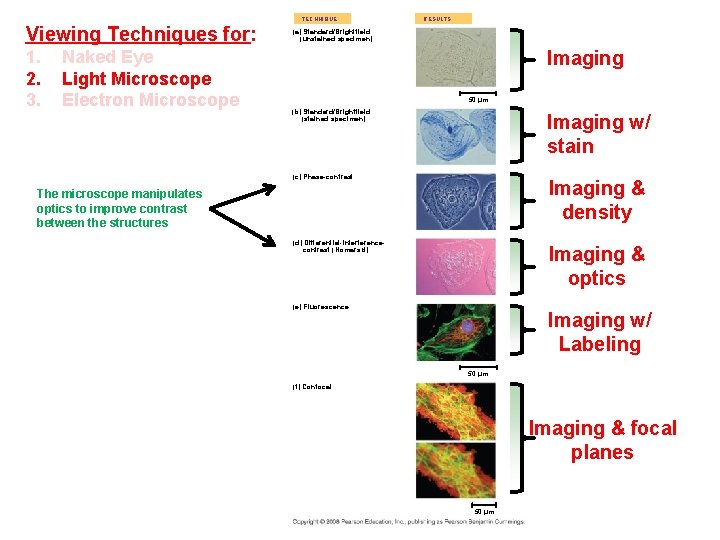
TECHNIQUE Viewing Techniques for: 1. 2. 3. Naked Eye Light Microscope Electron Microscope RESULTS (a) Standard/Brightfield (unstained specimen) Imaging 50 µm (b) Standard/Brightfield (stained specimen) Imaging w/ stain (c) Phase-contrast Imaging & density The microscope manipulates optics to improve contrast between the structures (d) Differential-interferencecontrast (Nomarski) Imaging & optics (e) Fluorescence Imaging w/ Labeling 50 µm (f) Confocal Imaging & focal planes 50 µm
Electron microscopy • Two basic types of electron microscopes (EMs) are used to study subcellular structures • Scanning electron microscopes (SEMs) focus a beam of electrons onto the surface of a heavy metal stained specimen, providing images that look 3 -D • Transmission electron microscopes (TEMs) focus a beam of electrons through a heavy metal stained specimen, used mainly to study the internal structure of cells
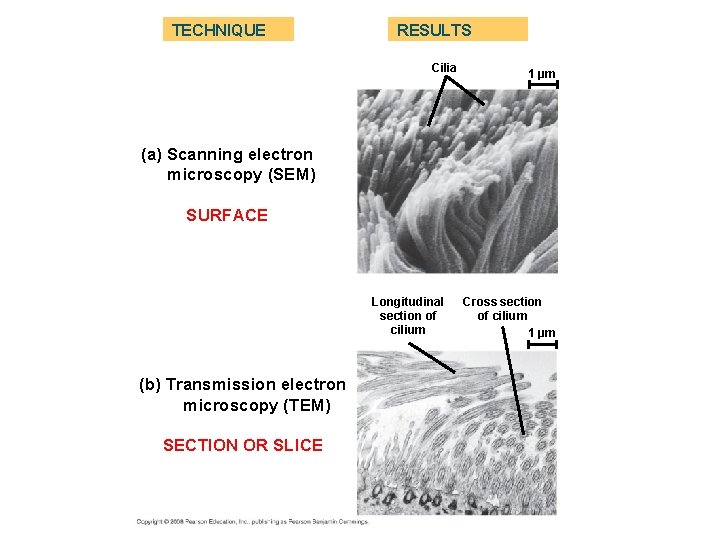
TECHNIQUE RESULTS Cilia 1 µm (a) Scanning electron microscopy (SEM) SURFACE Longitudinal section of cilium (b) Transmission electron microscopy (TEM) SECTION OR SLICE Cross section of cilium 1 µm

What procedures are we doing? • We will know the parts of-, the proper use ofand the clean up procedure for a bright-field compound and dissection microscope. • You will examine a slide with the letter “e” (or words affixed to it), and a prepared slide (any tissue) using a compound microscope. • DO NOT PREPARE A WET MOUNT FROM THE CELLS OF YOUR INNER CHEEK (ignore the procedure on p. 26)

Resources available… • Anatomy and Physiology Laboratory Study Pages; submenu: Microscope http: //ctle. hccs. edu/biologylabs/AP 1 index. html

Lets get familiar with each other • We will be working in groups to complete exercises (3 groups of 8 – groups A, B and C or 6 groups of 4 – group 1, 2, 3, 4, 5 and 6) • [Lets look in the laboratory manual. . . ] Within your group, who is the group leader for the exercise? Who is going to do which experiment(s) of that exercise? You must decide amongst yourselves. • Next step: decide who is going to get the materials to complete the exercise. This is collaboration!
• Compound Microscope • Immersion oil • “e” slide • Prepared tissue slide • Cleanser • Fine (Lens) and Coarse paper towels
- Slides: 13