
Laboratory Directed Research and Development LDRD Review by
Laboratory Directed Research and Development (LDRD) Review by ASCAC* Dawn Bonnell based on Martin Berzins’ earlier presentations. (i) Overview of LDRD (ii)Committee Charge (iii)Committee Composition (iv) Review Process * On behalf of and with BERAC, BESAC, FESAC, HEPAP, NSAC, DPAC EMB and NEAC
LDRD Projects Overview LDRD projects are required to be : § Relevant to DOE/NNSA, Medium term (<36 Months) and “small” § Must include one or more of Advanced study of hypotheses, concepts, or innovative approaches to scientific or technical problems; Experiments and analyses directed towards “proof of principle” or early determination of the utility of new scientific ideas, technical concepts, or devices or Conception and preliminary technical analyses of experimental facilities or devices. Source DOE Reports to Congress 2005 to 2015

LDRD Historical Background • Funding for the LDRD like activities goes back to Atomic Energy act of 1954 • In 1985 DOE established Exploratory Research and Development Program • In 1991 this became Laboratory Directed Research and Development Program, with funding limited to 6% of the funds available to DOE • In 2006 the 6% limit was increased to 8% • In 2014 the Energy and Water Appropriations act reduced the 8% limit back to 6%. Current spend is about $540 M • LDRD Funding is accumulated as part of the overhead charged by individual labs Source DOE Reports to Congress 2005 to 2015
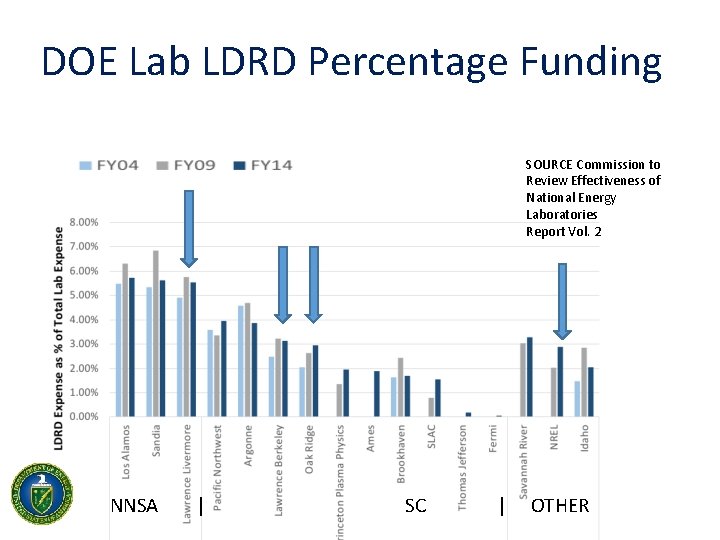
DOE Lab LDRD Percentage Funding SOURCE Commission to Review Effectiveness of National Energy Laboratories Report Vol. 2 NNSA | SC | OTHER
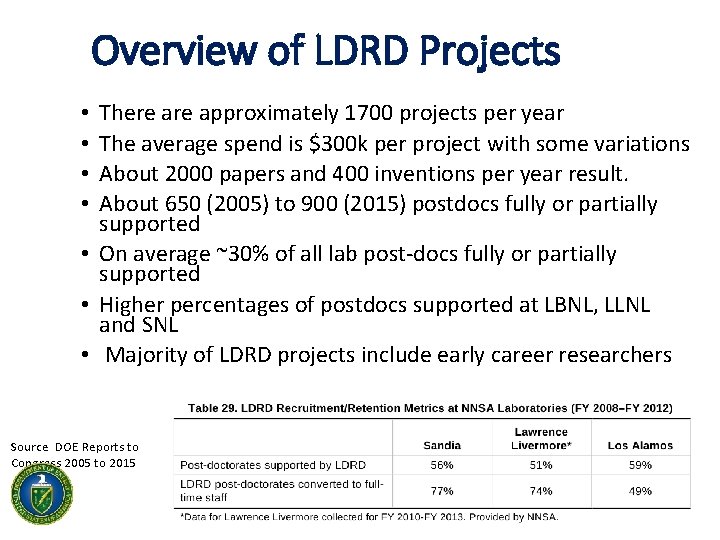
Overview of LDRD Projects There approximately 1700 projects per year The average spend is $300 k per project with some variations About 2000 papers and 400 inventions per year result. About 650 (2005) to 900 (2015) postdocs fully or partially supported • On average ~30% of all lab post-docs fully or partially supported • Higher percentages of postdocs supported at LBNL, LLNL and SNL • Majority of LDRD projects include early career researchers • • Source DOE Reports to Congress 2005 to 2015
Committee Charge The June 17, 2015, the interim report of the Secretary of Energy Advisory Board (SEAB)Task Force on DOE National Laboratories recommended an independent peer review of the LDRD program impacts and process of four laboratories, evaluating up to ten years of funded projects. ASCAC is asked to review the LDRD program processes and the impact of LDRD at four of the DOE Labs, to include at least one SC Lab, one NNSA Lab, and one of the applied energy Labs. Please choose Labs that have had LDRD programs for at least ten years. ASCAC should consider each Lab's processes to: (i) determine the funding levels for the LDRD programs; (ii) determine Lab-specific goals and allocate resources among the goals; (iii) select specific projects; and (iv) evaluate the success and impact of the LDRD program against Labspecific goals and the overall objectives of the LDRD program over a tenyear period.
Committee Membership Formation Professors Dan Reed and Martin Berzins asked for committee nominations from the chairs of • Basic Energy Sciences Advisory Committee (BESAC)) • Biological and Environmental Research Advisory Committee (BERAC) • Fusion Energy Sciences Advisory Committee (FESAC) • High Energy Physics Advisory Panel (HEPAP) • Nuclear Science Advisory Committee (NSAC) • Defense Programs Advisory Committee (DPAC) • Environmental Management Board (EMB) Everyone nominated accepted.
Committee Membership • • ASCAC Tony Hey ( STFC, UK & UW) and Martin Berzins (Utah) (Chair) BESAC Dawn Bonnell (Penn) BERAC Karin Remington (CTO Arjuna Solutions) FESAC Chris Keane (WSU) HEPAP and NSAC Karsten Heeger (Yale) DPAC Jolie Cizewski (Rutgers) NEAC Joy Rempe ( Rempe and Associates) EMB Beverly Ramsey (Desert Research Institute)
Committee Process Discuss how best to address the committee charge using available information (including lab self-assessment already in place) and the lab visits Formulate a detailed set of questions for the four labs based on the committee charge regarding: (i) Processes for determining the funding levels for the LDRD programs; (ii) Processes for determining Lab-specific goals and allocating resources among the goals; (iii) Processes for selecting specific projects; and (iv) Processes for evaluating the success and impact of the LDRD program against Lab-specific goals and the overall objectives of the LDRD program over a ten-year period.
Committee Lab Visits Committee charge request visits to four labs including one SC lab, one NNSA lab and one applied energy lab. All the labs should have had LDRD activities for a decade. Based on this charge we conducted four visits
January 4, 1017
January 5 -6, 2017
January 26, 2017
February 2, 2017
Timeline (i) September to November 2016 - teleconferences to formulate implementation of committee charge and timing and format of lab visits (ii) December 2016 to February 2017 Lab visits (iii) Mid January 2017 to early March 2017 report drafting (iv) March/April 2017 Comment period on Initial Report (v) April/May Final Report
- Slides: 16