
Laboratory Diagnosis of HSV Infection Peter Leone MD
Laboratory Diagnosis of HSV Infection Peter Leone, MD Associate Professor of Medicine University of North Carolina
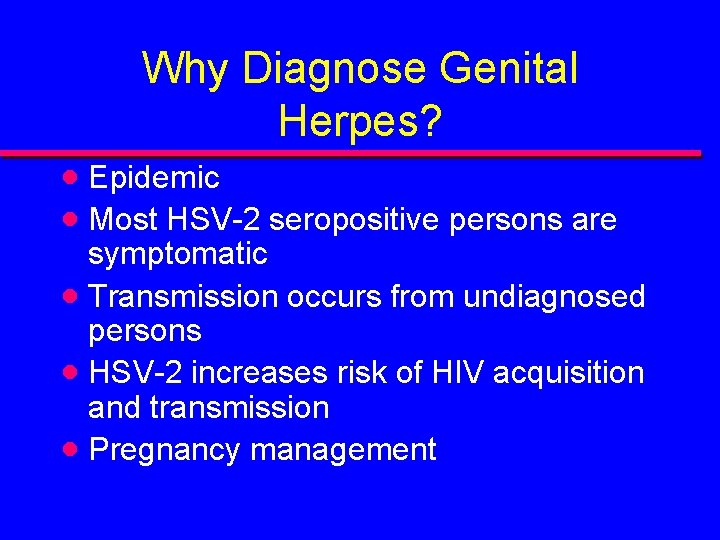
Why Diagnose Genital Herpes? · Epidemic · Most HSV-2 seropositive persons are symptomatic · Transmission occurs from undiagnosed persons · HSV-2 increases risk of HIV acquisition and transmission · Pregnancy management

Underrecognition by Clinicians and Patients: What Should We Do? · · Recognize that prevalence within our practices is higher than anticipated Appreciate that genital HSV-2 does not discriminate Elevate our “index of suspicion” in all sexually active patients Provide patient education about signs and symptoms of genital herpes ¨Many patients with unrecognized disease “become symptomatic” once they receive adequate counseling 1, 2 1. Lowhagen GB, et al. Acta Derm Venereol 2005; 85(3): 248 -252. 2. Wald A, et al. N Engl J Med 2000; 342(12): 844 -850.
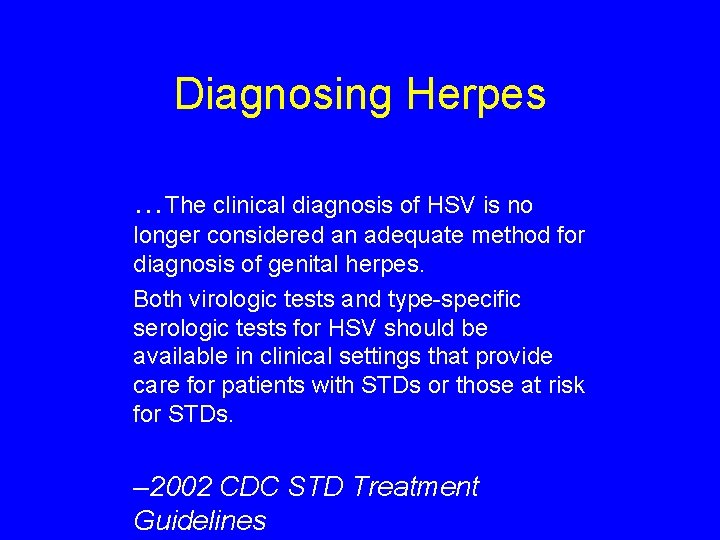
Diagnosing Herpes …The clinical diagnosis of HSV is no longer considered an adequate method for diagnosis of genital herpes. Both virologic tests and type-specific serologic tests for HSV should be available in clinical settings that provide care for patients with STDs or those at risk for STDs. – 2002 CDC STD Treatment Guidelines
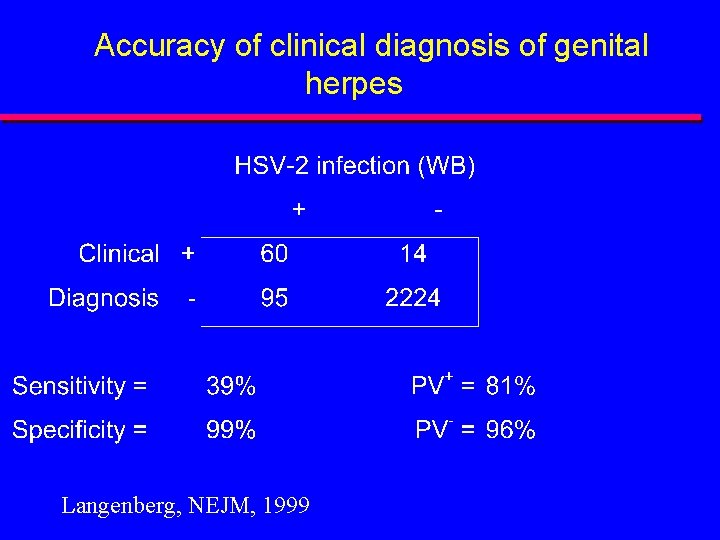
Accuracy of clinical diagnosis of genital herpes Langenberg, NEJM, 1999
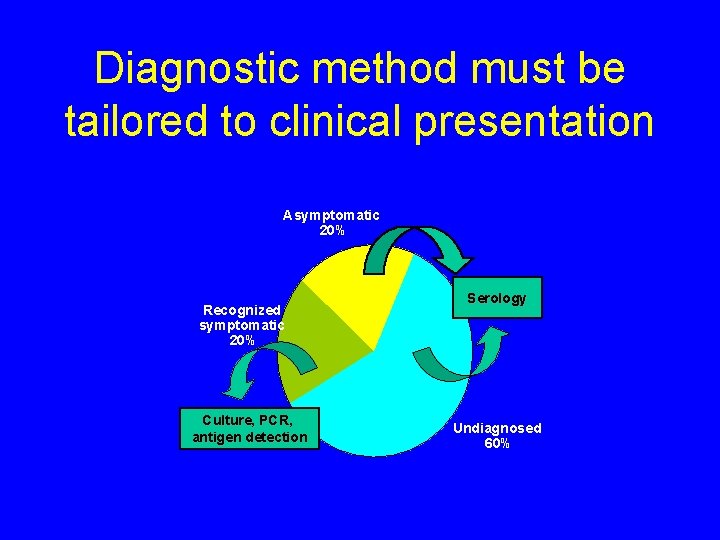
Diagnostic method must be tailored to clinical presentation Asymptomatic 20% Recognized symptomatic 20% Culture, PCR, antigen detection Serology Undiagnosed 60%

Lesion Evaluation
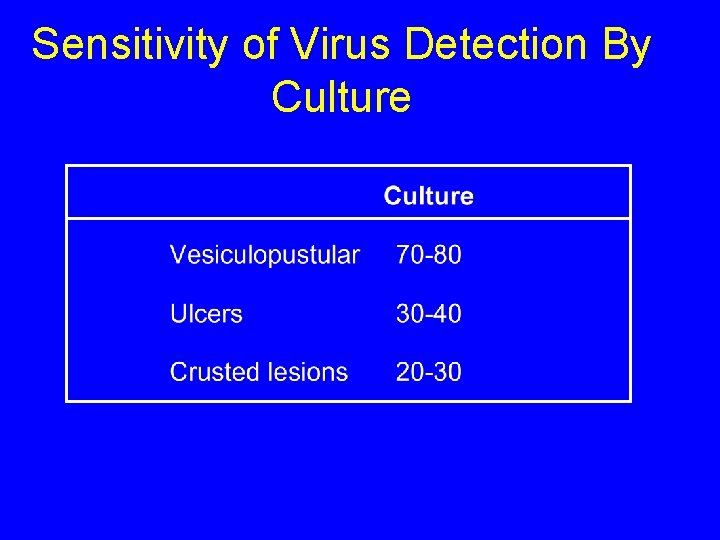
Sensitivity of Virus Detection By Culture
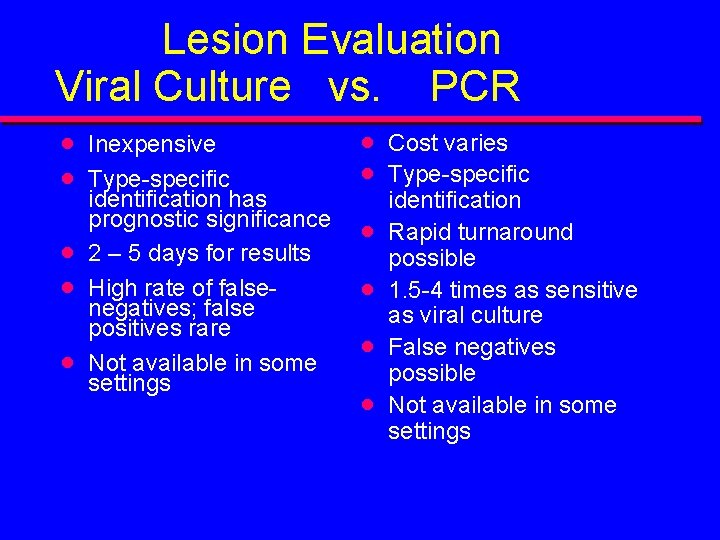
Lesion Evaluation Viral Culture vs. PCR · · · Inexpensive Type-specific identification has prognostic significance 2 – 5 days for results High rate of falsenegatives; false positives rare Not available in some settings · · · Cost varies Type-specific identification Rapid turnaround possible 1. 5 -4 times as sensitive as viral culture False negatives possible Not available in some settings
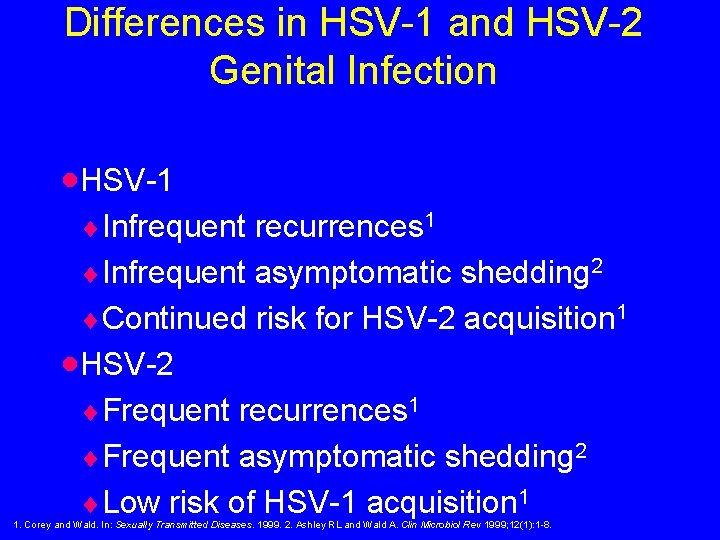
Differences in HSV-1 and HSV-2 Genital Infection ·HSV-1 ¨Infrequent recurrences 1 ¨Infrequent asymptomatic shedding 2 ¨Continued risk for HSV-2 acquisition 1 ·HSV-2 ¨Frequent recurrences 1 ¨Frequent asymptomatic shedding 2 ¨Low risk of HSV-1 acquisition 1 1. Corey and Wald. In: Sexually Transmitted Diseases. 1999. 2. Ashley RL and Wald A. Clin Microbiol Rev 1999; 12(1): 1 -8.

Serologic Evaluation
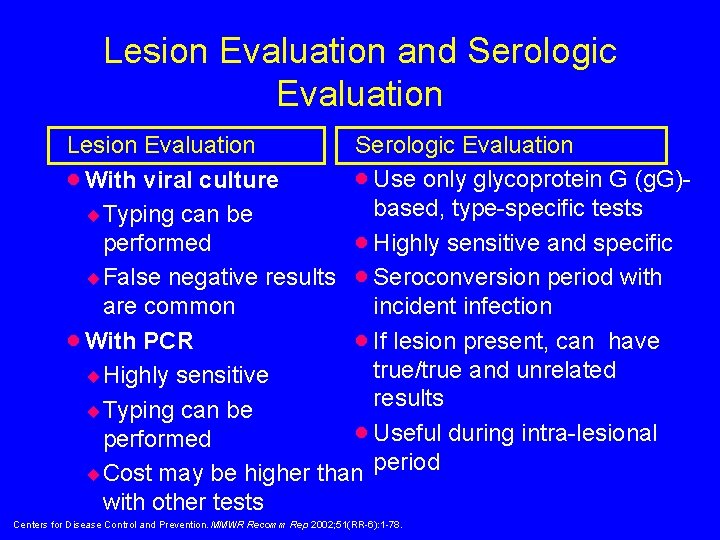
Lesion Evaluation and Serologic Evaluation Lesion Evaluation · Use only glycoprotein G (g. G)· With viral culture based, type-specific tests ¨ Typing can be · Highly sensitive and specific performed ¨ False negative results · Seroconversion period with incident infection are common · If lesion present, can have · With PCR true/true and unrelated ¨ Highly sensitive results ¨ Typing can be · Useful during intra-lesional performed period ¨ Cost may be higher than with other tests Centers for Disease Control and Prevention. MMWR Recomm Rep 2002; 51(RR-6): 1 -78.

Accurate Type-Specific HSV Serology HSV virus Envelope: g. B, g. C, g. D, g. E, g. G, g. H, g. I, g. K, g. L, g. M Tegument: VP 16 Nucleocapsid: VP 5, ICP 35 Ashley R. Herpes. 1998; 5: 33 -38. DNA core Glycoprotein g. G tests Western blot g. G ELISA* g. G-membrane tests* g. G immunoblot* *Commercial tests.
Performance and interpretation of serologic tests · What is the Gold Standard? · Interpretation of Western Blot is still part · Discrepant analysis · Time to seroconversion

Western Blot · · · “Gold standard” Complicated Expensive Limited availability Not FDA approved
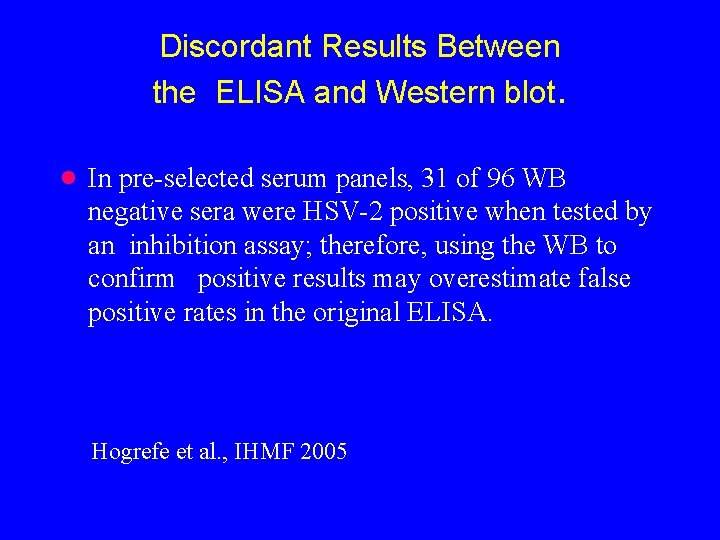
Discordant Results Between the ELISA and Western blot. · In pre-selected serum panels, 31 of 96 WB negative sera were HSV-2 positive when tested by an inhibition assay; therefore, using the WB to confirm positive results may overestimate false positive rates in the original ELISA. Hogrefe et al. , IHMF 2005
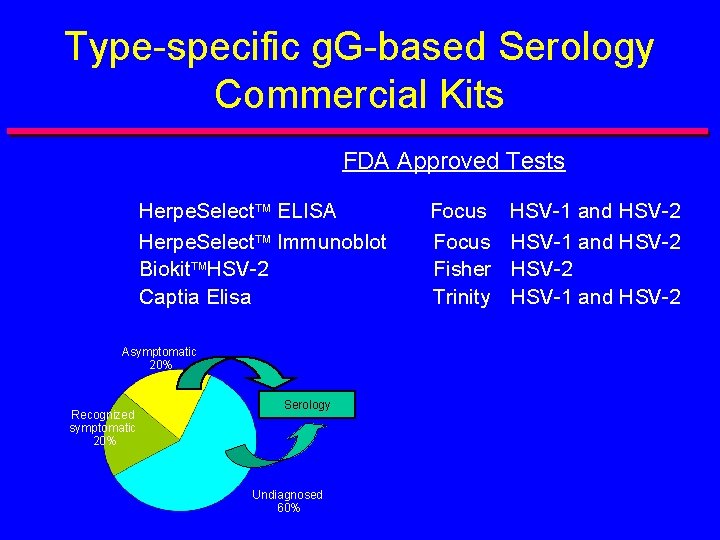
Type-specific g. G-based Serology Commercial Kits FDA Approved Tests Herpe. Select ELISA Herpe. Select Immunoblot Biokit HSV-2 Captia Elisa Asymptomatic 20% Recognized symptomatic 20% Serology Undiagnosed 60% Focus Fisher Trinity HSV-1 and HSV-2 HSV-1 and HSV-2
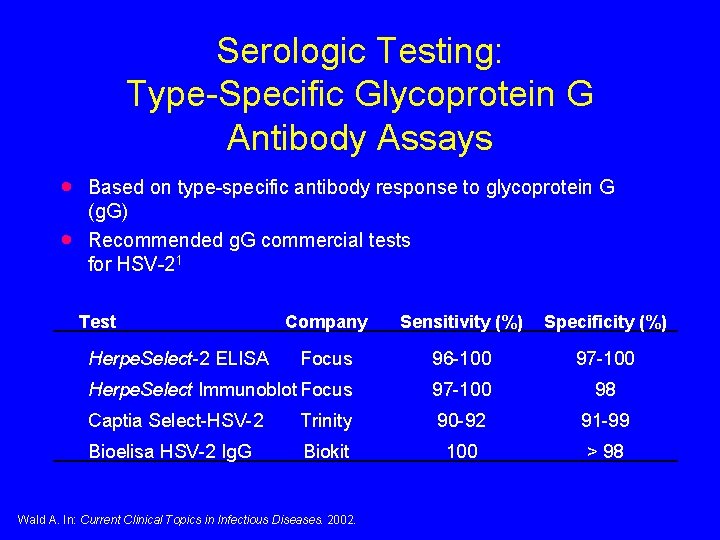
Serologic Testing: Type-Specific Glycoprotein G Antibody Assays · · Based on type-specific antibody response to glycoprotein G (g. G) Recommended g. G commercial tests for HSV-21 Test Company Sensitivity (%) Specificity (%) Focus 96 -100 97 -100 Herpe. Select Immunoblot Focus 97 -100 98 Captia Select-HSV-2 Trinity 90 -92 91 -99 Bioelisa HSV-2 Ig. G Biokit 100 > 98 Herpe. Select-2 ELISA Wald A. In: Current Clinical Topics in Infectious Diseases. 2002.
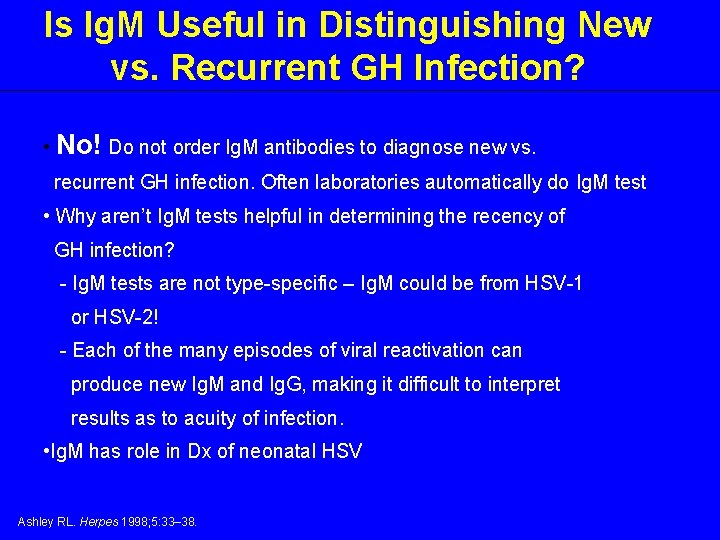
Is Ig. M Useful in Distinguishing New vs. Recurrent GH Infection? • No! Do not order Ig. M antibodies to diagnose new vs. recurrent GH infection. Often laboratories automatically do Ig. M test • Why aren’t Ig. M tests helpful in determining the recency of GH infection? - Ig. M tests are not type-specific – Ig. M could be from HSV-1 or HSV-2! - Each of the many episodes of viral reactivation can produce new Ig. M and Ig. G, making it difficult to interpret results as to acuity of infection. • Ig. M has role in Dx of neonatal HSV Ashley RL. Herpes 1998; 5: 33– 38.
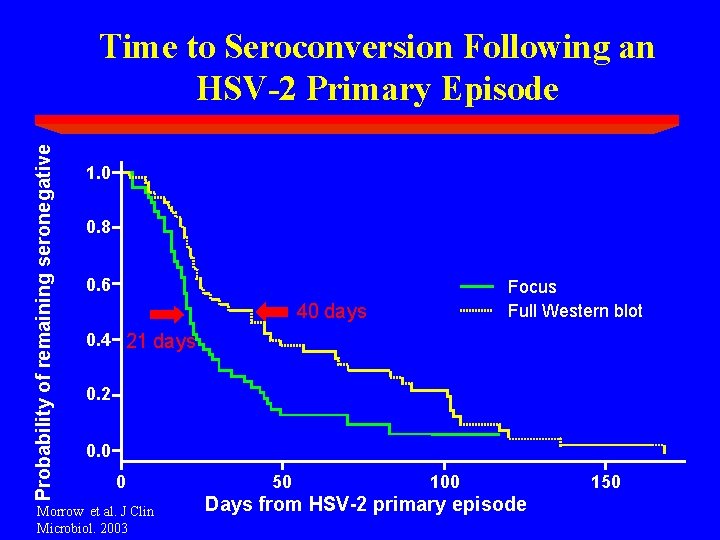
Probability of remaining seronegative Time to Seroconversion Following an HSV-2 Primary Episode 1. 0 0. 8 0. 6 Focus Full Western blot 40 days 0. 4 21 days 0. 2 0. 0 0 Morrow et al. J Clin Microbiol. 2003 50 100 Days from HSV-2 primary episode 150
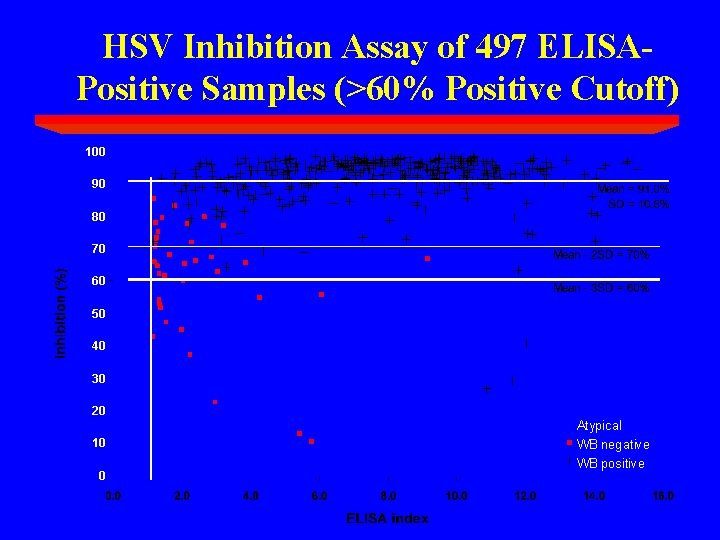
HSV Inhibition Assay of 497 ELISAPositive Samples (>60% Positive Cutoff) 100 90 80 70 60 50 40 30 20 10 0 Atypical WB negative WB positive
Performance of the 2 Generation Focus Herpe. Select HSV-2 Ig. G ELISA on Selected Serum Panels · The 2 generation Herpe. Select HSV-2 ELISA reduced the number of false positive results by ~40% when the WB used as the gold standard respectively. Hogrefe et al. , IHMF 2005
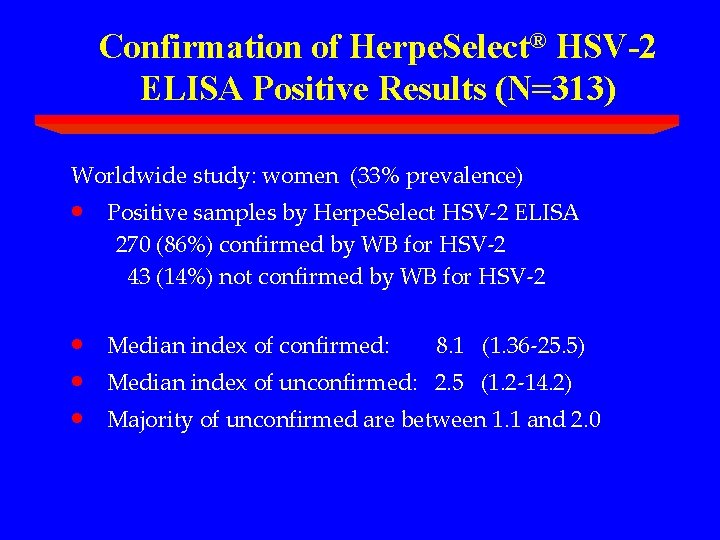
Confirmation of Herpe. Select® HSV-2 ELISA Positive Results (N=313) Worldwide study: women (33% prevalence) · Positive samples by Herpe. Select HSV-2 ELISA 270 (86%) confirmed by WB for HSV-2 43 (14%) not confirmed by WB for HSV-2 · · · Median index of confirmed: 8. 1 (1. 36 -25. 5) Median index of unconfirmed: 2. 5 (1. 2 -14. 2) Majority of unconfirmed are between 1. 1 and 2. 0
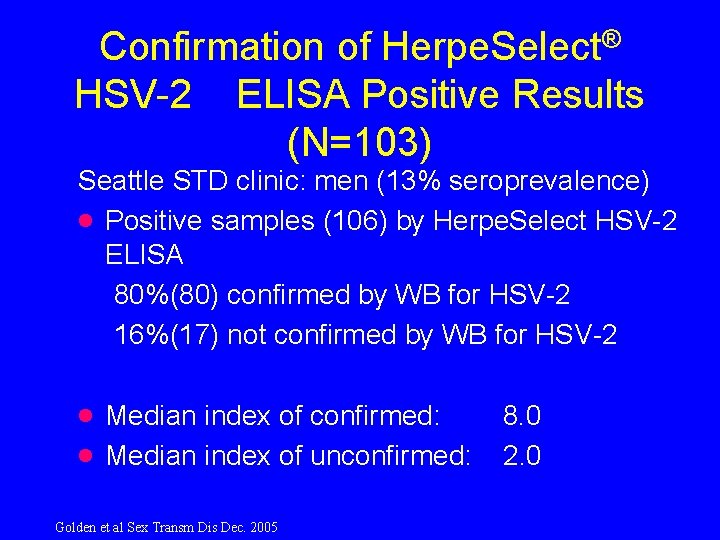
Confirmation of Herpe. Select® HSV-2 ELISA Positive Results (N=103) Seattle STD clinic: men (13% seroprevalence) · Positive samples (106) by Herpe. Select HSV-2 ELISA 80%(80) confirmed by WB for HSV-2 16%(17) not confirmed by WB for HSV-2 · · Median index of confirmed: Median index of unconfirmed: Golden et al Sex Transm Dis Dec. 2005 8. 0 2. 0
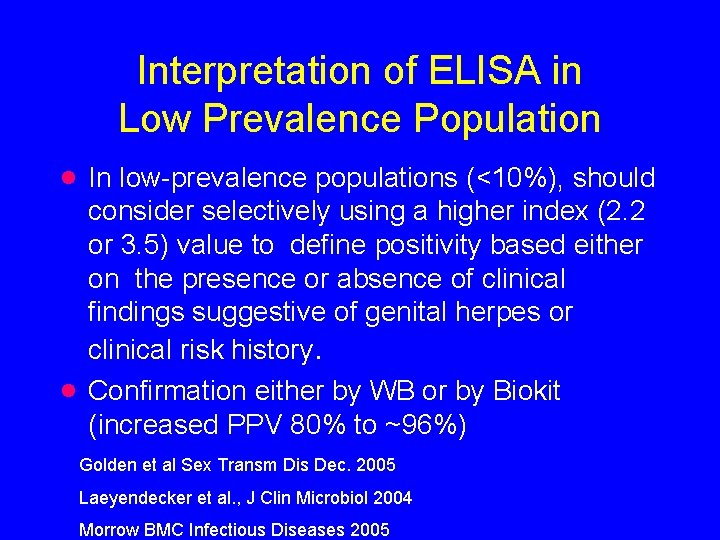
Interpretation of ELISA in Low Prevalence Population · · In low-prevalence populations (<10%), should consider selectively using a higher index (2. 2 or 3. 5) value to define positivity based either on the presence or absence of clinical findings suggestive of genital herpes or clinical risk history. Confirmation either by WB or by Biokit (increased PPV 80% to ~96%) Golden et al Sex Transm Dis Dec. 2005 Laeyendecker et al. , J Clin Microbiol 2004 Morrow BMC Infectious Diseases 2005
Interpretation of Test Results · In patients with culture-positive or PCR-positive genital lesions ¨ You have a confirmed type-specific, site-specific diagnosis · If seronegative for the type identified on culture, assume new infection · In pregnant patients, it is important to distinguish new infection from established infection · Ig. M-based tests are not reliable for distinguishing new infection from established infection and should never be used for this purpose
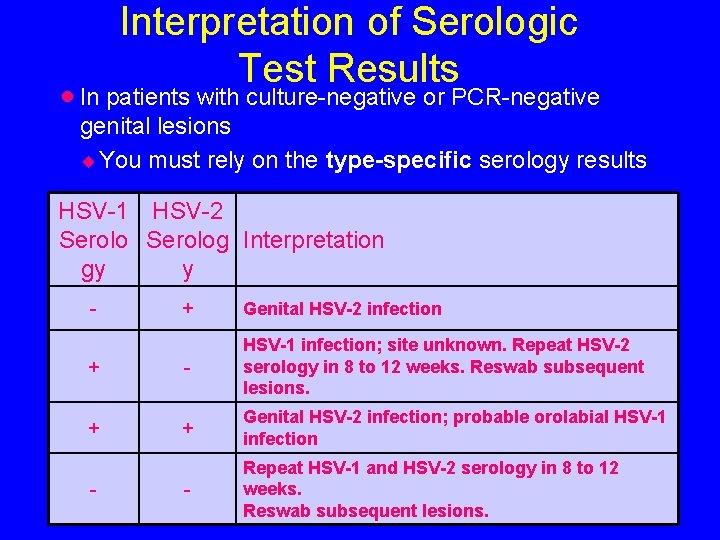
Interpretation of Serologic Test Results · In patients with culture-negative or PCR-negative genital lesions ¨ You must rely on the type-specific serology results HSV-1 HSV-2 Serolog Interpretation gy y - + Genital HSV-2 infection + - HSV-1 infection; site unknown. Repeat HSV-2 serology in 8 to 12 weeks. Reswab subsequent lesions. + + Genital HSV-2 infection; probable orolabial HSV-1 infection - Repeat HSV-1 and HSV-2 serology in 8 to 12 weeks. Reswab subsequent lesions. -
Undiagnosed Patients: What Should We Do? · Inform patients about the importance of testing ¨Reassure patients that if they are diagnosed, they have many available management options and resources · Offer HSV type-specific testing · Provide patient-sensitive and timely follow-up care after testing is performed
Candidates for Serologic Testing · Patients ¨ With recurrent genitourinary symptoms ¨ With a culture-negative lesion or clinical diagnosis only ¨ Presenting for STI screening or requesting herpes testing ¨ Diagnosed with an STI ¨ With a current or past partner with genital herpes ¨ With HIV-infection ¨ Who are pregnant? (not in ACOG guidelines) Centers for Disease Control and Prevention. MMWR Recomm Rep 2002; 51(RR-6): 1 -78.
Summary · · Work-up genital lesions Confirm all clinical diagnosis with Typespecific test Don’t be afraid to use Type –specific serology When screening for GH, keep in mind clinical history and local prevalence with low (1. 1 to 2. 0 or 3. 0) serologic ELISA index assay
- Slides: 30