
Laboratory detection of vibrationrotation transitions of 12 CH
Laboratory detection of vibration-rotation transitions of 12 CH+ and 13 CH+ And improved measurement of their rotational transition frequencies JOSE-LUIS DOMÉNECH, Institute for the Structure of Matter, CSIC, Spain PAVOL JUSKO, STEPHAN SCHLEMMER & OSKAR ASVANY I. Physicalisches Institut, Universitat zu Köln, Germany José Luis Doménech. TL 09 73 rd ISMS, Urbana June 2018
CH+: a short background • CH+ was one of the first molecules and the first molecular ion discovered in space (trough visible absorption lines) (Dunham 1937), identified in the lab by Douglas & Herzberg (1941). • Really ubiquitous in the ISM. Observed by electronic transitions both in emission and absorption in the Milky Way and in other Galaxies. • Key molecule in C chemistry. Long standing puzzle: CH+ is “too” abundant in diffuse clouds. • Formation (difficult): ‐ CH+ + H 2 → CH+ + H endothermic (~4300 K, or ~0. 4 e. V); ‐ unless H 2 v≥ 1 • Destruction (easy): ‐ CH+ + H 2 → CH 2+ + H 2 ‐ CH+ + H → C+ + H 2 ‐ CH+ + e‐ → C + H José Luis Doménech. TL 09 73 rd ISMS, Urbana June 2018
CH+: a short background • Simple 1Σ in the ground state • Rotational J=1‐ 0 transition at ~830 GHz: impossible from ground (12 CH+ with ALMA in highly redshifted galaxies) 13 CH+ has been observed with APEX. • In space: ‐ Cernicharo with ISO (1997): 6 FIR lines ‐ and later, extensively, with Herschel, both in absorption against bright sources and in emission in warm environments • In the laboratory (pure rotation): ‐ Amano (2010): J=1‐ 0 of 12 CH+, 13 CH+, 12 CD+ ‐ Yu el al. (ISMS 2015): up to J=2‐ 3, 12 CH+, 13 CH, J=4‐ 3 12 CD+ Now: Journal of Molecular spectroscopy Volume 350, August 2018, Pages 30‐ 36 • Up to now, NO IR vibration‐rotation spectrum. José Luis Doménech. TL 09 73 rd ISMS, Urbana June 2018
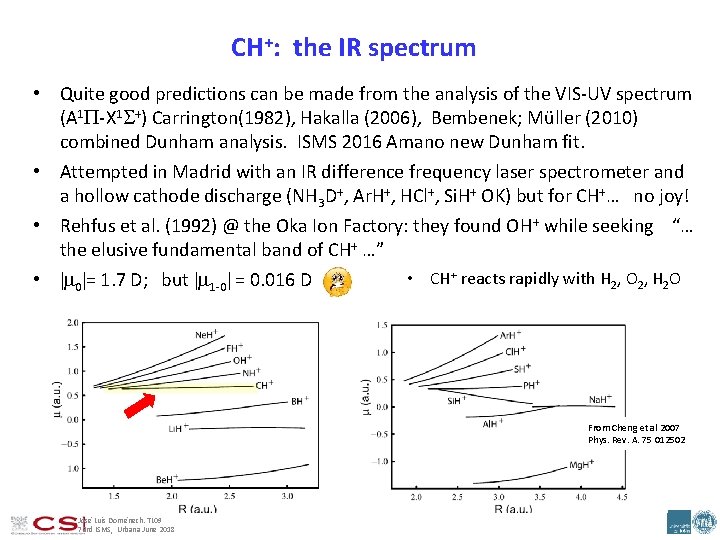
CH+: the IR spectrum • Quite good predictions can be made from the analysis of the VIS‐UV spectrum (A 1 ‐X 1 +) Carrington(1982), Hakalla (2006), Bembenek; Müller (2010) combined Dunham analysis. ISMS 2016 Amano new Dunham fit. • Attempted in Madrid with an IR difference frequency laser spectrometer and a hollow cathode discharge (NH 3 D+, Ar. H+, HCl+, Si. H+ OK) but for CH+… no joy! • Rehfus et al. (1992) @ the Oka Ion Factory: they found OH+ while seeking “… the elusive fundamental band of CH+ …” • CH+ reacts rapidly with H 2, O 2, H 2 O • 0 = 1. 7 D; but 1‐ 0 = 0. 016 D From Cheng et al 2007 Phys. Rev. A. 75 012502 José Luis Doménech. TL 09 73 rd ISMS, Urbana June 2018
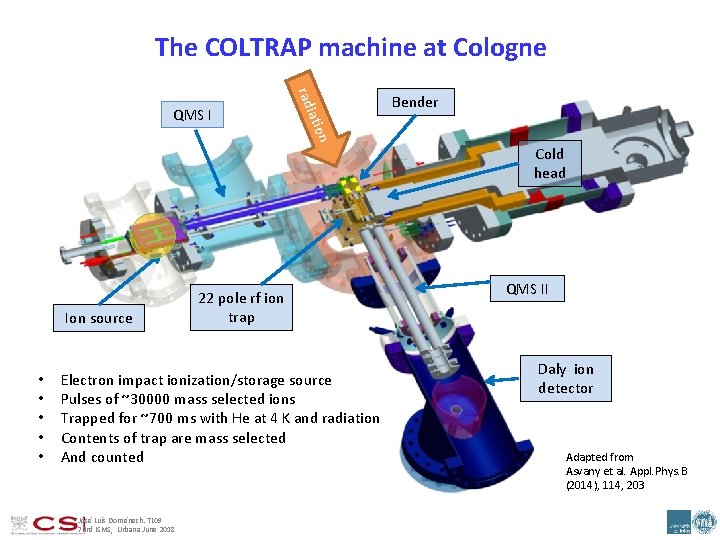
The COLTRAP machine at Cologne rad n iatio QMS I Ion source • • • 22 pole rf ion trap Electron impact ionization/storage source Pulses of ~30000 mass selected ions Trapped for ~700 ms with He at 4 K and radiation Contents of trap are mass selected And counted José Luis Doménech. TL 09 73 rd ISMS, Urbana June 2018 Bender Cold head QMS II Daly ion detector Adapted from Asvany et al. Appl. Phys. B (2014), 114, 203
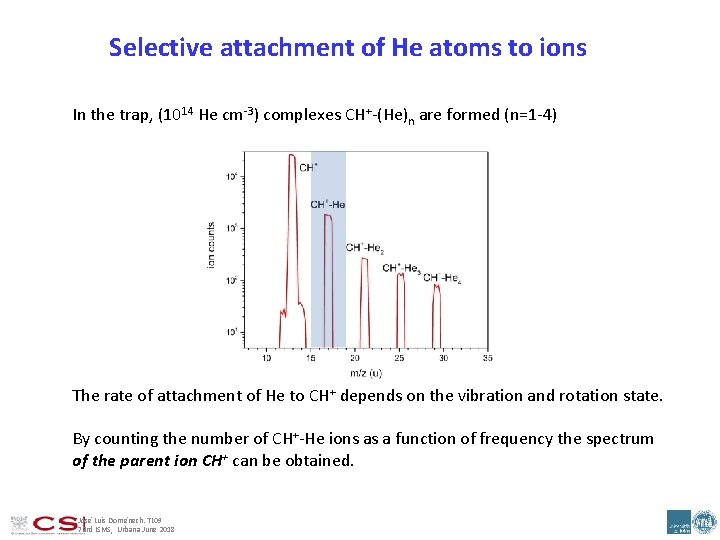
Selective attachment of He atoms to ions In the trap, (1014 He cm‐ 3) complexes CH+‐(He)n are formed (n=1‐ 4) The rate of attachment of He to CH+ depends on the vibration and rotation state. By counting the number of CH+‐He ions as a function of frequency the spectrum of the parent ion CH+ can be obtained. José Luis Doménech. TL 09 73 rd ISMS, Urbana June 2018
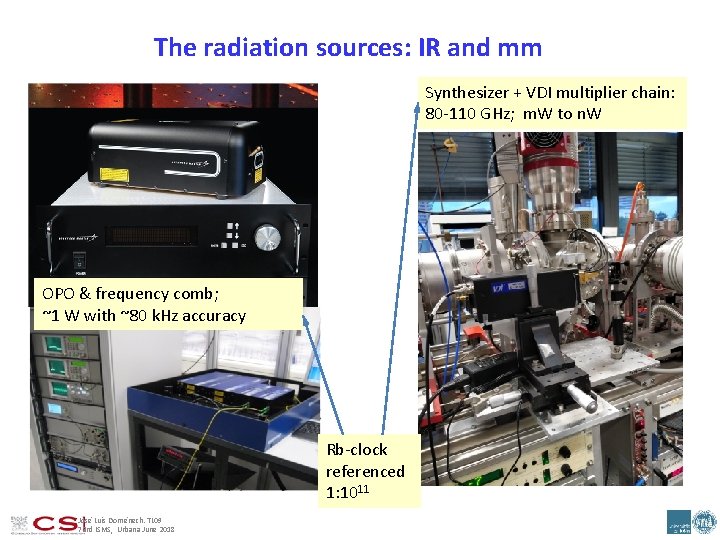
The radiation sources: IR and mm Synthesizer + VDI multiplier chain: 80‐ 110 GHz; m. W to n. W OPO & frequency comb; ~1 W with ~80 k. Hz accuracy Rb‐clock referenced 1: 1011 José Luis Doménech. TL 09 73 rd ISMS, Urbana June 2018
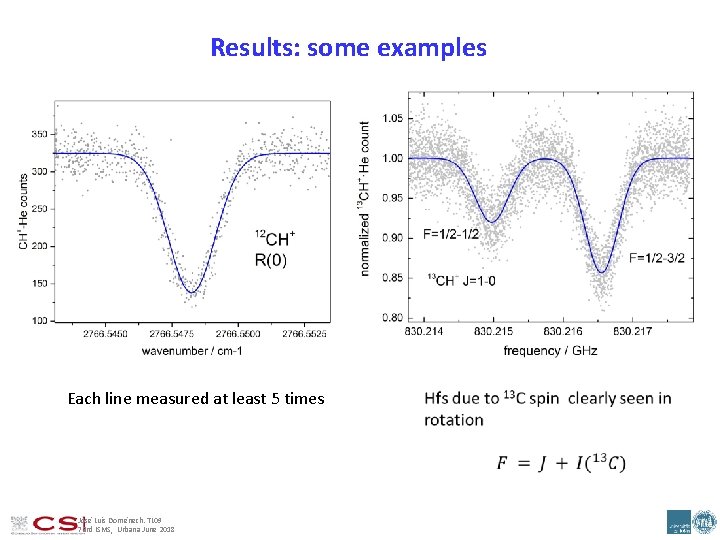
Results: some examples Each line measured at least 5 times José Luis Doménech. TL 09 73 rd ISMS, Urbana June 2018
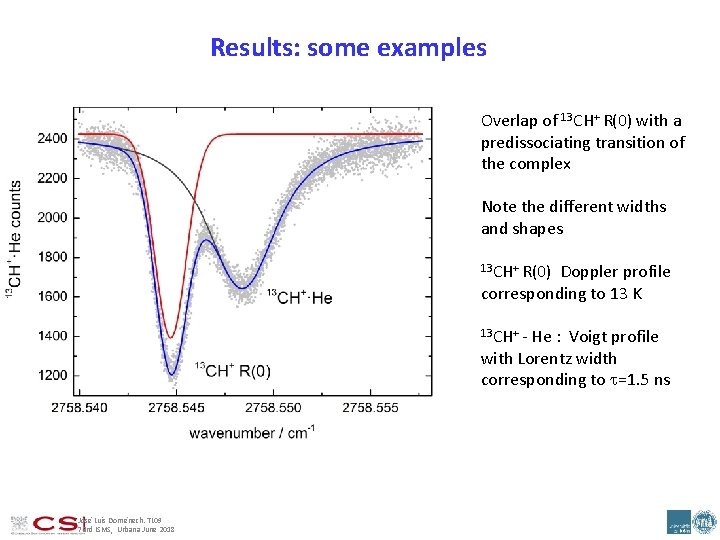
Results: some examples Overlap of 13 CH+ R(0) with a predissociating transition of the complex Note the different widths and shapes 13 CH+ R(0) Doppler profile corresponding to 13 K 13 CH+ ‐ He : Voigt profile with Lorentz width corresponding to =1. 5 ns José Luis Doménech. TL 09 73 rd ISMS, Urbana June 2018
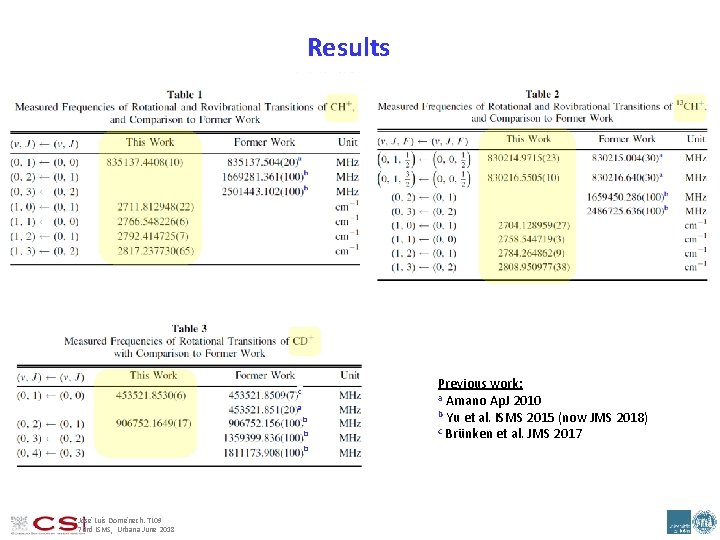
Results c a b b b José Luis Doménech. TL 09 73 rd ISMS, Urbana June 2018 Previous work: a Amano Ap. J 2010 b Yu et al. ISMS 2015 (now JMS 2018) c Brünken et al. JMS 2017
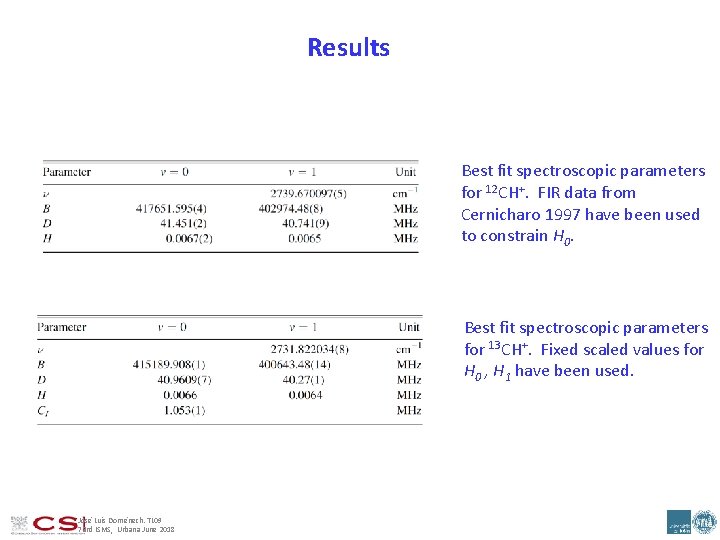
Results Best fit spectroscopic parameters for 12 CH+. FIR data from Cernicharo 1997 have been used to constrain H 0. Best fit spectroscopic parameters for 13 CH+. Fixed scaled values for H 0 , H 1 have been used. José Luis Doménech. TL 09 73 rd ISMS, Urbana June 2018
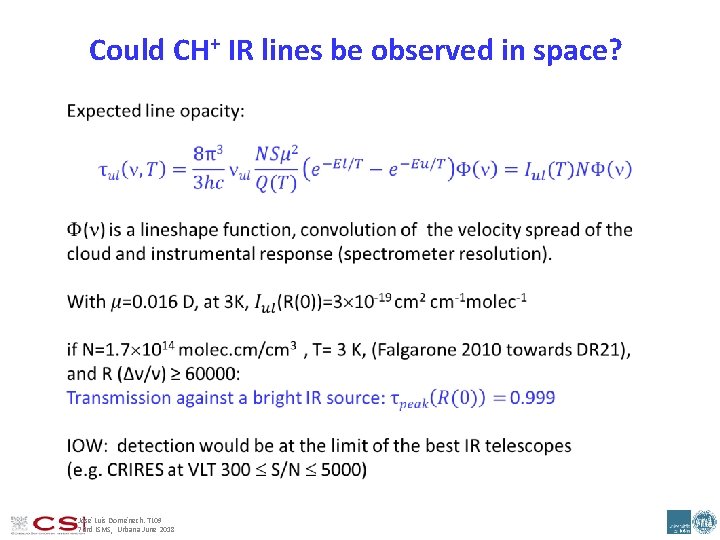
Could CH+ IR lines be observed in space? José Luis Doménech. TL 09 73 rd ISMS, Urbana June 2018
Summary • We have measured for the first time in the laboratory eight vibration rotation transitions of 12 CH+ and 13 CH+, with high accuracy. • We have remeasured and confirmed the lowest frequency rotational transitions of 12 CH+, 13 CH+ and 12 CD+ to better than 1 ppb. • v=0‐ 0, J=1‐ 0 12 CH+ not observable from ground. • IR observations may help in future searches for this ion in the ISM. • IR observations have higher angular resolution than radio and can target different sources • Possibilities: v=1‐ 0 J=1‐ 0 with IR telescopes at high resolution (1: 10 6) CRIRES+ VLT (2019, R~100000) i. SHELL at NASA IRTF (R~75000) METIS at the Extremely Large Telescope GMTNIRS at the Giant Magellan Telescope The full story: Doménech, Jusko, Schlemmer, Asvany, Astrophysical J. 2018, 857: 61 José Luis Doménech. TL 09 73 rd ISMS, Urbana June 2018
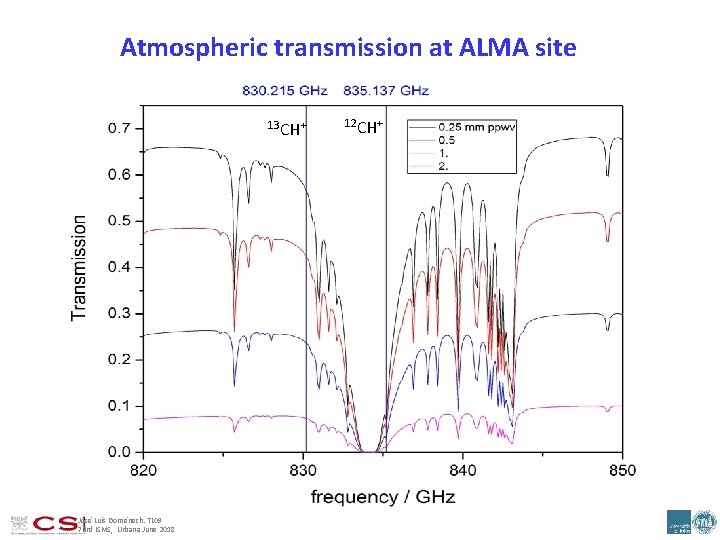
Atmospheric transmission at ALMA site 13 CH+ José Luis Doménech. TL 09 73 rd ISMS, Urbana June 2018 12 CH+
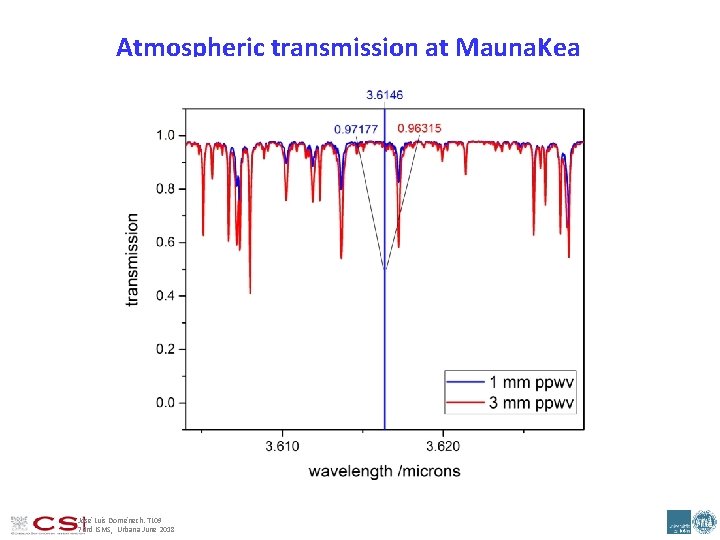
Atmospheric transmission at Mauna. Kea José Luis Doménech. TL 09 73 rd ISMS, Urbana June 2018
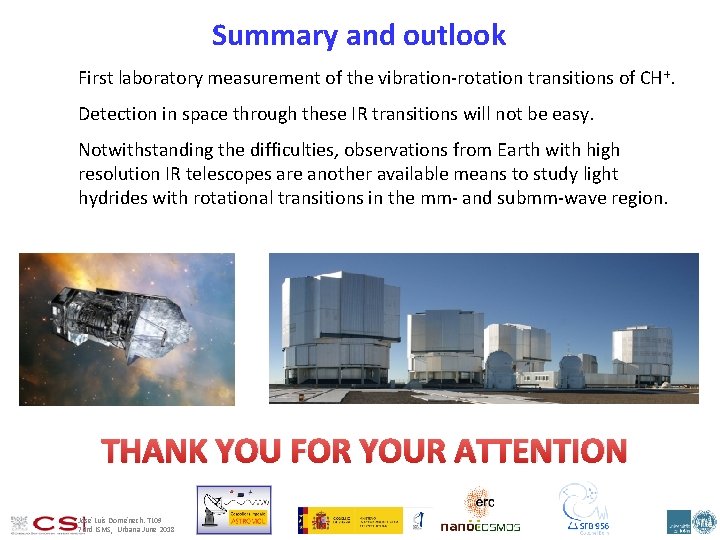
Summary and outlook First laboratory measurement of the vibration‐rotation transitions of CH +. Detection in space through these IR transitions will not be easy. Notwithstanding the difficulties, observations from Earth with high resolution IR telescopes are another available means to study light hydrides with rotational transitions in the mm‐ and submm‐wave region. THANK YOU FOR YOUR ATTENTION José Luis Doménech. TL 09 73 rd ISMS, Urbana June 2018
- Slides: 16