
Laboratory Based Methods Dissertation Support Writing a Method
Laboratory Based Methods Dissertation Support: Writing a Method (cont’d)

Improve your Vocabulary! Method (noun): a manner or mode of procedure, esp. an orderly, logical, or systematic of only In your dissertation, use ‘method’way if you instruction, inquiry, investigation, experiment, have one set of instructions and use presentation ‘methodology’ if you have more than one set of instructions (i. e. you did lab work AND you something Methodology (noun): a set orelse). system of methods, principles and rules for regulating a given discipline, as in the arts or sciences.
The method answers two main questions: 1) How was the data collected / generated? 2) How was the data analysed?

A good method must be… REPEATABLE!! DETAILED BUT CONCISELY WRITTEN!! EASY TO UNDERSTAND
• Your method should clearly state the experimental design. • Anyone should be able to read your method and perform the exact same experiment. • This is the hallmark of a proper scientific method However, this does not mean you include EVERY single detail…
So how can you do this? You need to state specifically what you did…. . But you don’t need irrelevant detail or detail that has been written before (reference & put in appendix) Structure it, chronologically and by topic
The method is not a recipe! • Try to avoid bullet points and numbered lists. • Write the method in scientific prose, as acceptable for publication in the scientific press. • Look at the format, detail & style of published methods related to your subject. • Don’t use 1 st person (I or we) or present / future tense • Use the 3 rd person passive past (was/were). • Use metric units!
Materials • Include in your method detail on any specific materials or equipment used. • But, no lists of: Pens, Notebooks, Clipboards, Sample bags, Dissection Kit, Pipettes, Crucibles, Test Tubes, Bunsen Burners, Chemicals, etc -Not important! Unless they are different to standard referenced procedures.
Lab Based Methodology • Most dissertations involving lab work also involve other research eg sample collection, feed trial, behaviour analysis, etc • Must give full description of materials and procedures that are specific to your research and justify their use. • Most lab methods use standard protocols that don’t require full description. State technique, equipment used and reference.

E. G. Published method for food analysis (Morris et al 2005)
Some Hints for Good Method Writing • Keep precise notes of what you did, why you did it, and what happened maybe keep a research diary so that there is a record of the methods used. • Carefully structure into logical format using sections and subsections, both chronologically and based on topic. • Write concisely & scientifically; remember who your audience will be. • Start writing each section as soon as possible (no need to have completed all research!) • Could someone else repeat your work? • Get someone else to proof read / give feedback supervisor / peer / etc
Use the Following Structure: 1. Describe precisely the materials used in the study. 2. Explain how the materials were prepared. 3. Describe & justify the research protocol. 4. Explain how measurements were made and what calculations were performed. 5. State which statistical tests were done to analyse the data.
Use the Following Structure: 1. 2. 3. 4. Describe the materials used in the study. Remember: Explainstandard how thelab materials protocolswere need prepared. onlythe state technique, specific Describe research protocol. equipment and be Explain how measurements were made referenced. and what(Included calculations performed. in full in were appendix) 5. State which statistical tests were done to analyse the data.
Location? • The method comes after the Introduction, Aims and Objectives, and the Hypotheses.
Look at the papers given (and others!) to guide you • Try to identify how the authors have described the following: – Their materials – Their protocols – Could you follow their method? – Could you repeat their experiment?
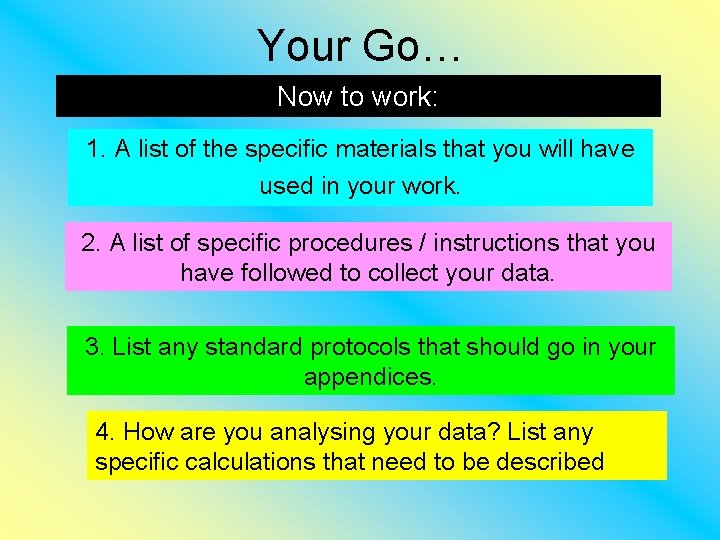
Your Go… Now to work: 1. A list of the specific materials that you will have used in your work. 2. A list of specific procedures / instructions that you have followed to collect your data. 3. List any standard protocols that should go in your appendices. 4. How are you analysing your data? List any specific calculations that need to be described

Any Questions? Please direct any questions using microphone or chat Also ask your supervisor’s advice! …. . good luck!
- Slides: 17