
Laboratory astrophysics using high power short pulse lasers
Laboratory astrophysics using high power short pulse lasers Karl Krushelnick Center for Ultra-fast Optical Science, University of Michigan, Ann Arbor
Outline • High power lasers • Ultra-high magnetic fields from short pulse interactions • Magnetic fields from long-pulse (ns) interactions – driven magnetic reconnection • Relevance to astrophysics
High intensity lasers Recent developments in short pulse (sub-picosecond) laser technology have enabled intensities greater than 1020 W/cm 2 and Petawatt (1015 Watt) lasers Can produce plasmas with relativistic electron temperatures – leading to fundamentally new physics At high intensities laser energy is converted to to very energetic electrons which can subsequently produce x-rays and energetic ions Need > 10 Petawatt lasers to get relativistic ions (relativistic shocks)
History of laser intensity (from G. Mourou, Physics Today)
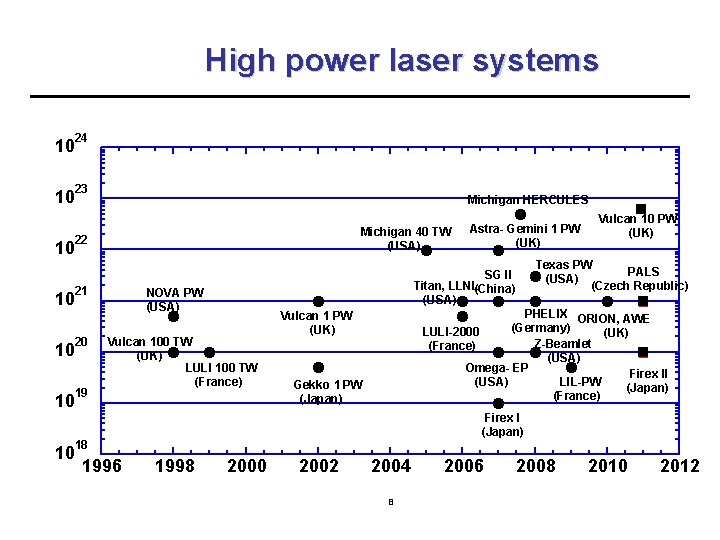
High power laser systems 24 10 23 10 Michigan HERCULES Michigan 40 TW (USA) 22 10 21 20 10 19 SG II Titan, LLNL(China) (USA) NOVA PW (USA) 10 Vulcan 100 TW (UK) LULI 100 TW (France) 10 1996 Vulcan 10 PW (UK) Texas PW PALS (USA) (Czech Republic) PHELIX ORION, AWE (Germany) LULI-2000 (UK) Z-Beamlet (France) (USA) Omega- EP Firex II (USA) LIL-PW (Japan) (France) Vulcan 1 PW (UK) Gekko 1 PW (Japan) Firex I (Japan) 18 10 Astra- Gemini 1 PW (UK) 1998 2000 2002 2004 B 2006 2008 2010 2012
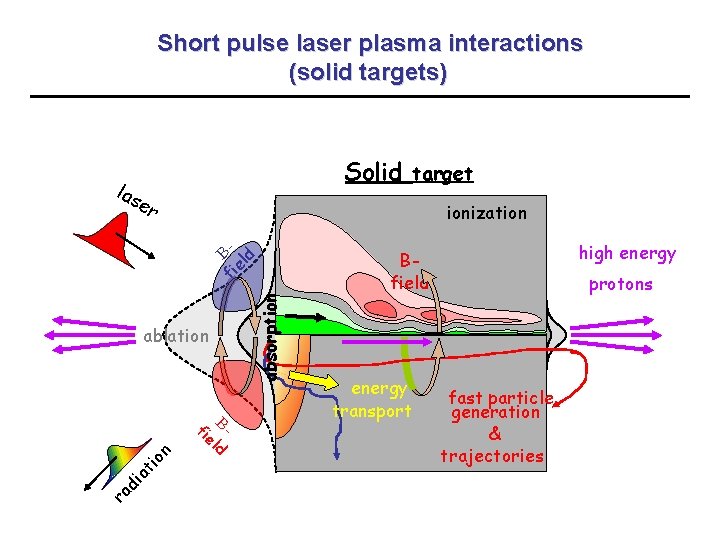
Short pulse laser plasma interactions (solid targets) Solid target las er ra di at i on ablation fi Bel d absorption fi Bel d ionization high energy Bfield energy transport protons fast particle generation & trajectories

Mechanisms of magnetic field generation in intense laser plasma interactions Critical density surface r 1. Non parallel temperature and density gradients. z B n 2. Current due to fast electrons generated during the interaction (Weibel instability) T 3. DC currents generated by the spatial and temporal variation of the ponderomotive force of the incident laser pulse Bdc ~ Blaser* * R. N. Sudan, Phys. Rev. Lett. , 70, 3075 (1993) Laser

Mechanisms of magnetic field generation in high power laser plasma interactions
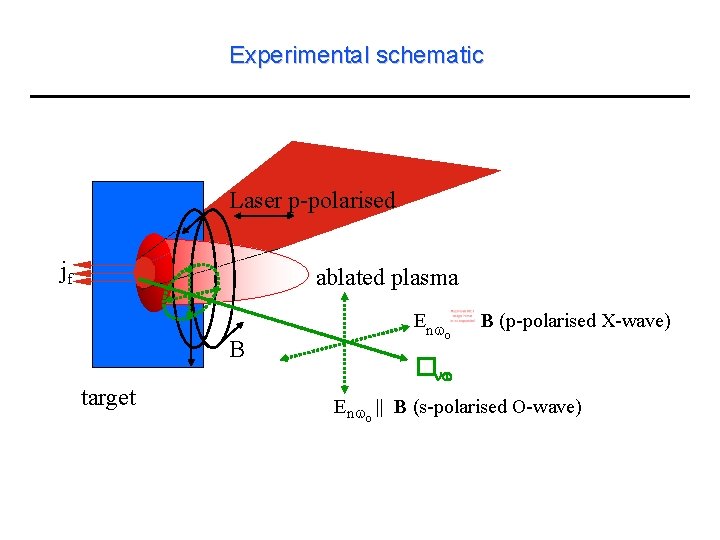
Experimental schematic Laser p-polarised jf ablated plasma B target En o B (p-polarised X-wave) �n E n o || B (s-polarised O-wave)
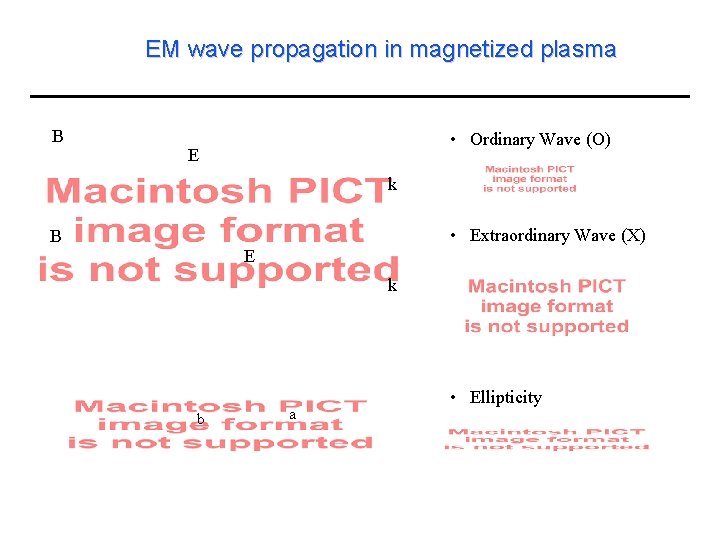
EM wave propagation in magnetized plasma B • Ordinary Wave (O) E k • Extraordinary Wave (X) B E k b a • Ellipticity

X-Wave cutoffs Region of harmonic generation 2 o 3 o 4 o 5 o 6 o 7 o 8 o 9 o nc nc o=1µm
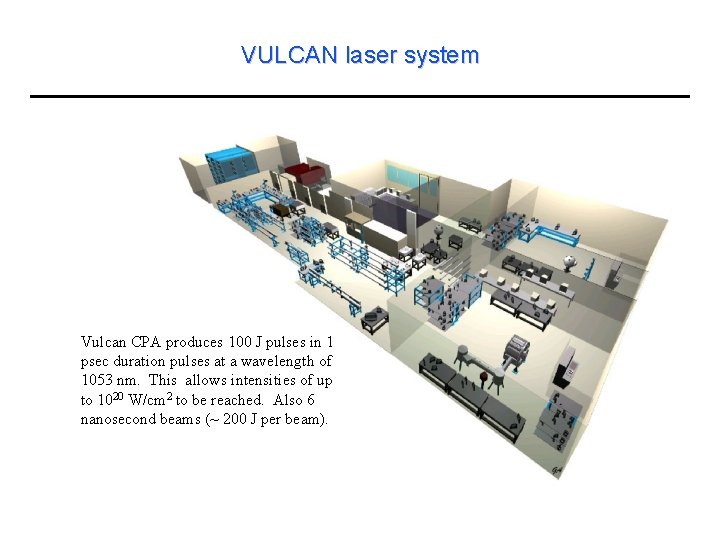
VULCAN laser system Vulcan CPA produces 100 J pulses in 1 psec duration pulses at a wavelength of 1053 nm. This allows intensities of up to 1020 W/cm 2 to be reached. Also 6 nanosecond beams (~ 200 J per beam).
Observation of cutoffs (Tatarakis et al. Nature, 415, 280 (2002)) Indicates fields up to ~ 400 MG

Harmonics of the laser frequency are emitted at very high orders (> 1000 th) Conversion Efficiency (10 -6) 5 37 th 30 th 22 nd 4 3 2 1 0 250 300 350 400 450 500 550 Wavelength (Å) I. Watts et al. , Phys. Rev. Lett. 88, 155001 (2002)

p-pol Laser beam s-pol
Harmonic depolarization follows 3 scaling b/a is the induced ellipticity • this suggests that fields in the higher density regions of plasma are up to 0. 7 ± 0. 1 Gigagauss New facilities may generate fields approaching 10 Giga. Gauss <1
Photon bubble instability
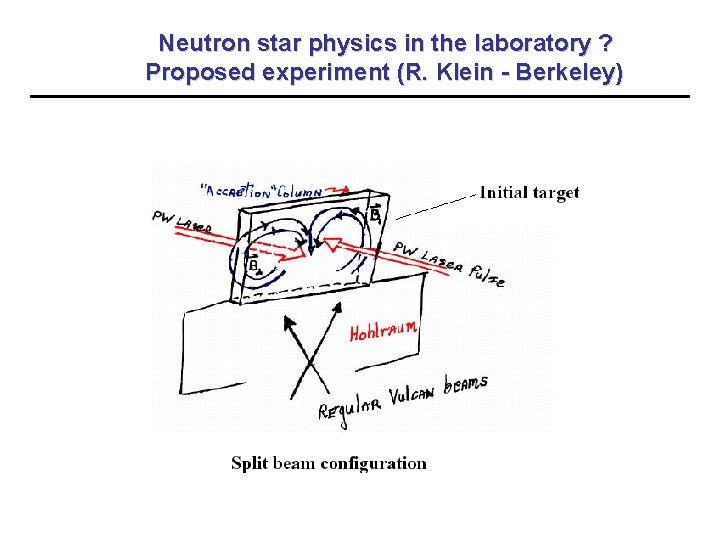
Neutron star physics in the laboratory ? Proposed experiment (R. Klein - Berkeley)
Neutron star physics in the laboratory ? Difficulties with such experiments: - duration of magnetic field is < 10 psec - extent of magnetic field is small (especially “depth”) - need radiation source as well (high energy lasers or z-pinch) Other possible experiments: - atomic physics of plasmas in very high fields -“picosecond” spatially resolved absorption spectroscopy (inner shell transitions) - may be relevant for astrophysics
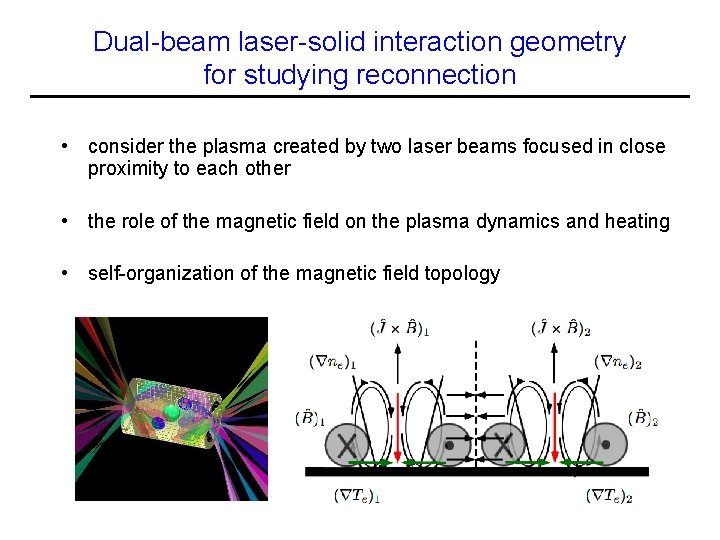
Dual-beam laser-solid interaction geometry for studying reconnection • consider the plasma created by two laser beams focused in close proximity to each other • the role of the magnetic field on the plasma dynamics and heating • self-organization of the magnetic field topology
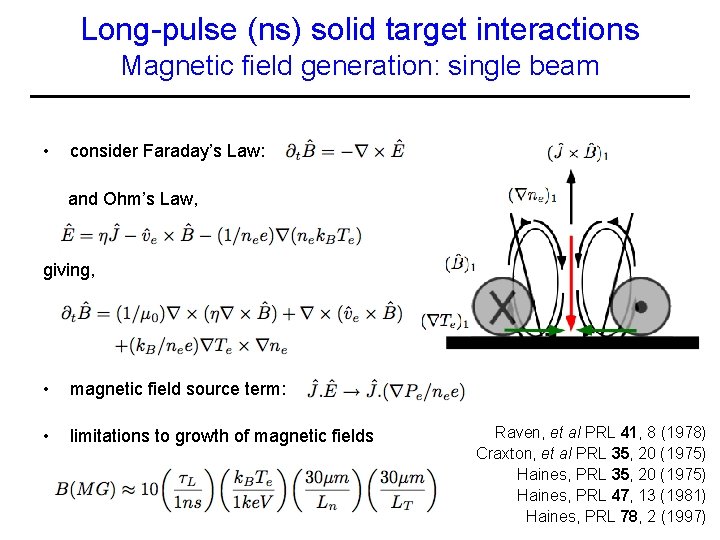
Long-pulse (ns) solid target interactions Magnetic field generation: single beam • consider Faraday’s Law: and Ohm’s Law, giving, • magnetic field source term: • limitations to growth of magnetic fields Raven, et al PRL 41, 8 (1978) Craxton, et al PRL 35, 20 (1975) Haines, PRL 47, 13 (1981) Haines, PRL 78, 2 (1997)
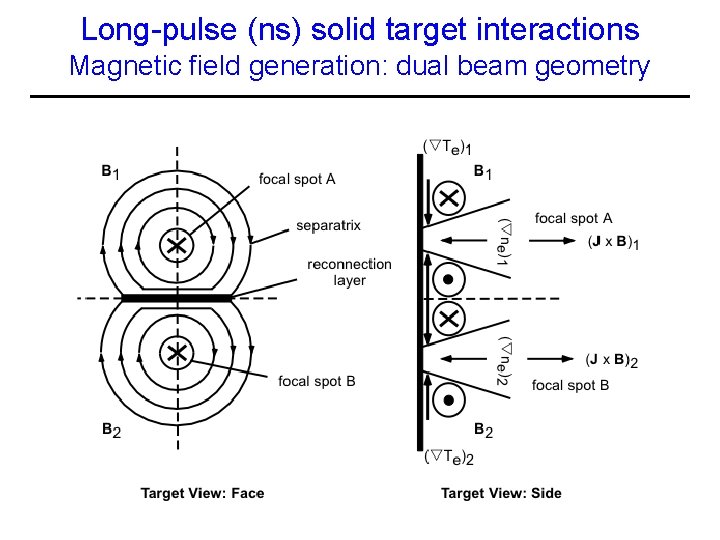
Long-pulse (ns) solid target interactions Magnetic field generation: dual beam geometry
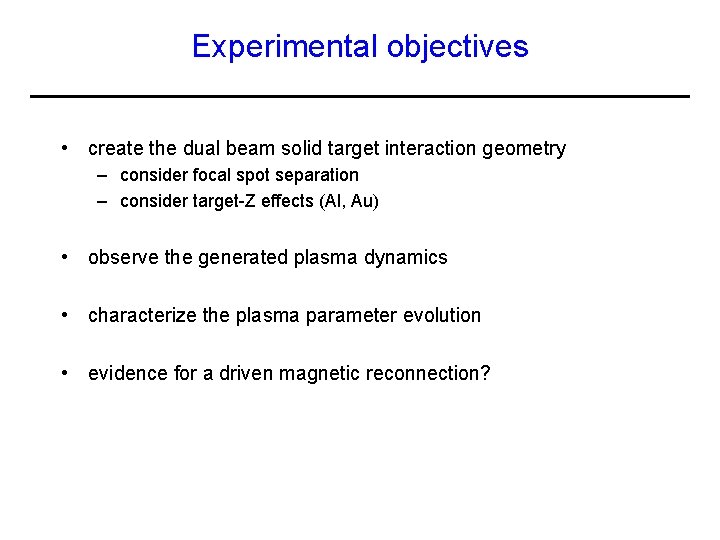
Experimental objectives • create the dual beam solid target interaction geometry – consider focal spot separation – consider target-Z effects (Al, Au) • observe the generated plasma dynamics • characterize the plasma parameter evolution • evidence for a driven magnetic reconnection?
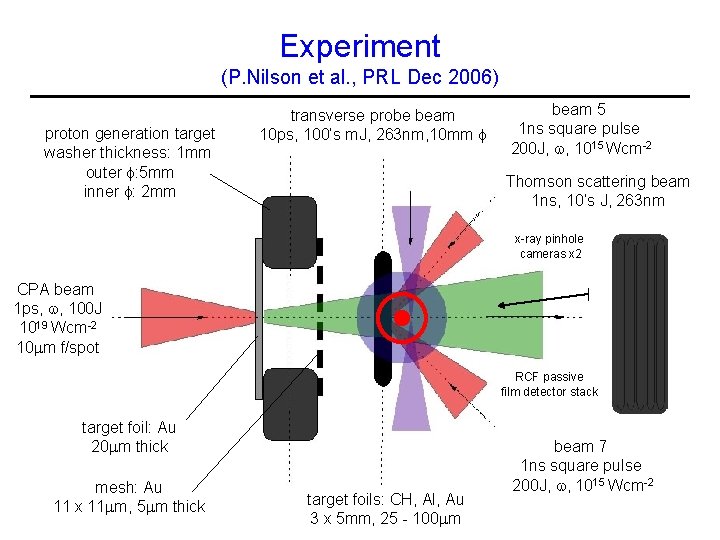
Experiment (P. Nilson et al. , PRL Dec 2006) proton generation target washer thickness: 1 mm outer : 5 mm inner : 2 mm transverse probe beam 10 ps, 100’s m. J, 263 nm, 10 mm beam 5 1 ns square pulse 200 J, , 1015 Wcm-2 Thomson scattering beam 1 ns, 10’s J, 263 nm x-ray pinhole cameras x 2 CPA beam 1 ps, , 100 J 1019 Wcm-2 10 m f/spot RCF passive film detector stack target foil: Au 20 m thick mesh: Au 11 x 11 m, 5 m thick target foils: CH, Al, Au 3 x 5 mm, 25 - 100 m beam 7 1 ns square pulse 200 J, , 1015 Wcm-2
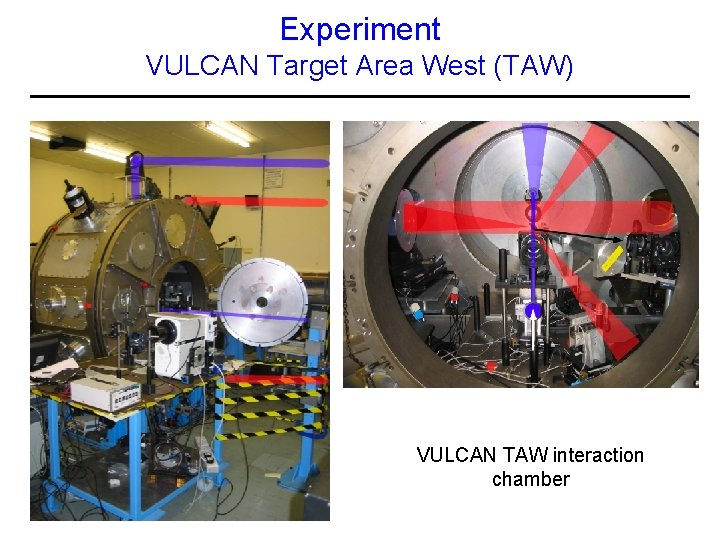
Experiment VULCAN Target Area West (TAW) VULCAN TAW interaction chamber
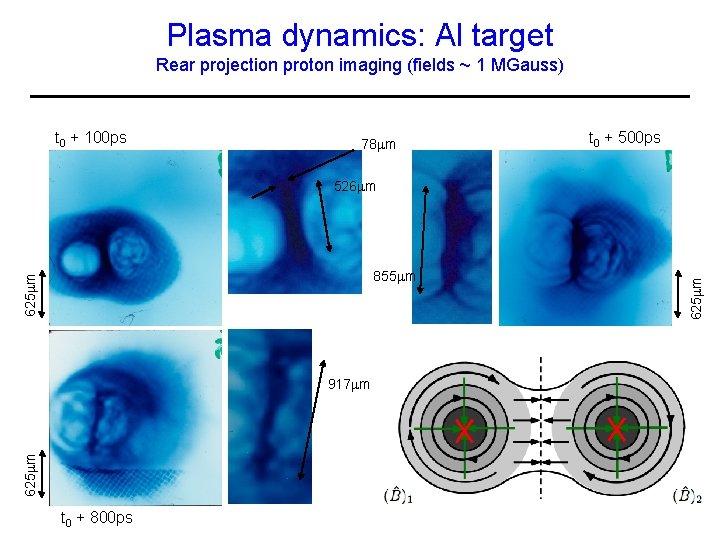
Plasma dynamics: Al target Rear projection proton imaging (fields ~ 1 MGauss) t 0 + 100 ps 78 m t 0 + 500 ps 625 m 855 m 625 m 917 m t 0 + 800 ps 625 m 526 m
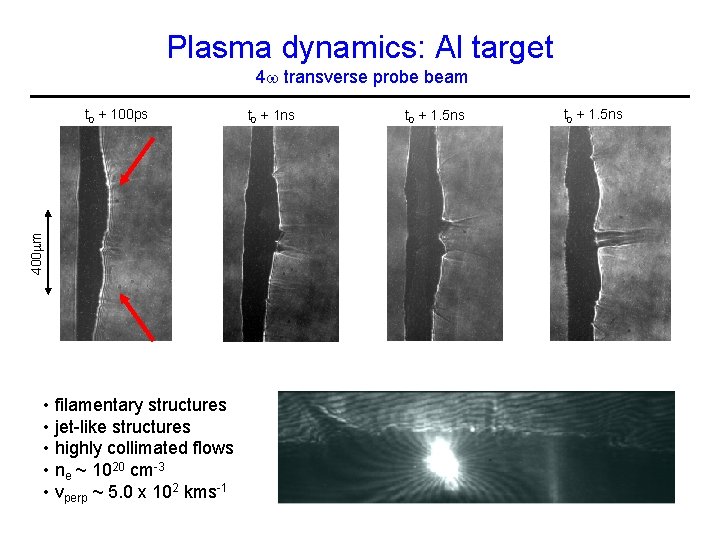
Plasma dynamics: Al target 4 transverse probe beam 400 m t 0 + 100 ps • filamentary structures • jet-like structures • highly collimated flows • ne ~ 1020 cm-3 • vperp ~ 5. 0 x 102 kms-1 t 0 + 1 ns t 0 + 1. 5 ns
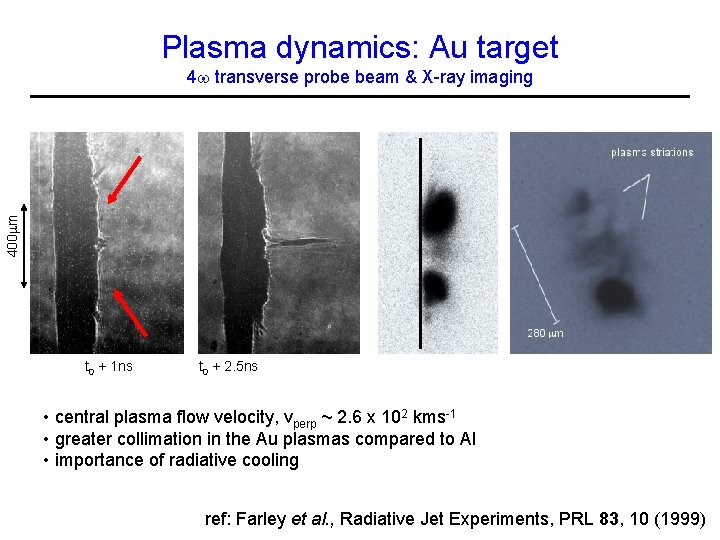
Plasma dynamics: Au target 400 m 4 transverse probe beam & X-ray imaging t 0 + 1 ns t 0 + 2. 5 ns • central plasma flow velocity, vperp ~ 2. 6 x 10² kms-1 • greater collimation in the Au plasmas compared to Al • importance of radiative cooling ref: Farley et al. , Radiative Jet Experiments, PRL 83, 10 (1999)
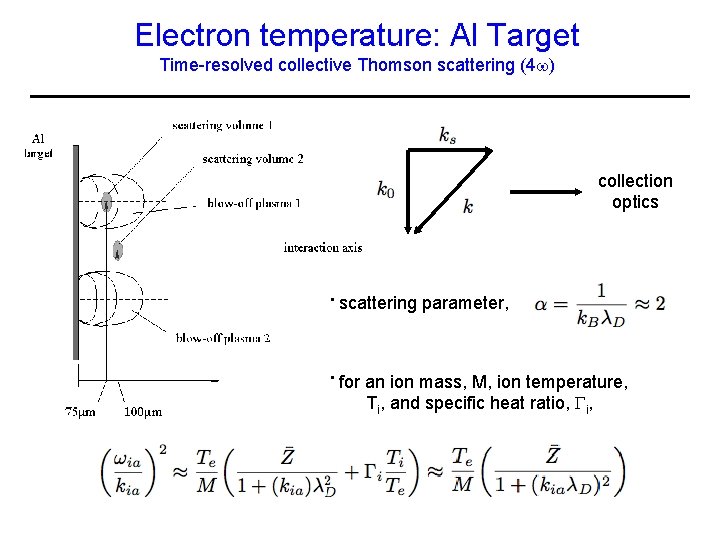
Electron temperature: Al Target Time-resolved collective Thomson scattering (4 ) collection optics • scattering • for parameter, an ion mass, M, ion temperature, Ti, and specific heat ratio, i,
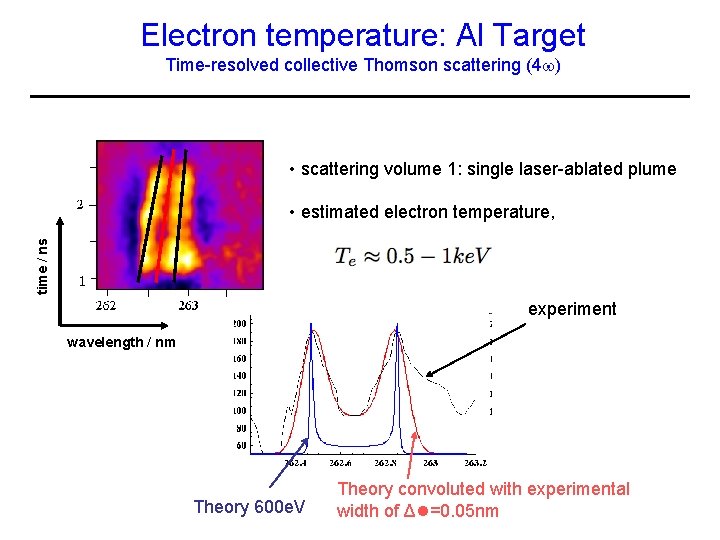
Electron temperature: Al Target Time-resolved collective Thomson scattering (4 ) • scattering volume 1: single laser-ablated plume time / ns • estimated electron temperature, experiment wavelength / nm Theory 600 e. V Theory convoluted with experimental width of Δ =0. 05 nm
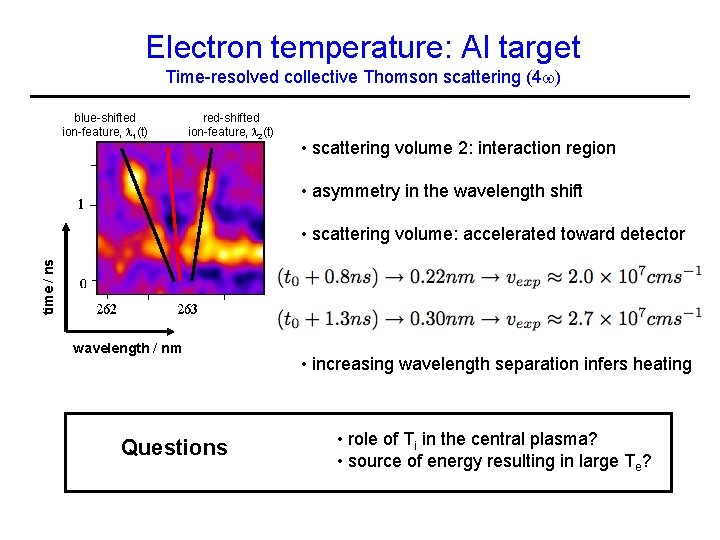
Electron temperature: Al target Time-resolved collective Thomson scattering (4 ) blue-shifted ion-feature, 1(t) red-shifted ion-feature, 2(t) • scattering volume 2: interaction region • asymmetry in the wavelength shift time / ns • scattering volume: accelerated toward detector wavelength / nm Questions • increasing wavelength separation infers heating • role of Ti in the central plasma? • source of energy resulting in large Te?
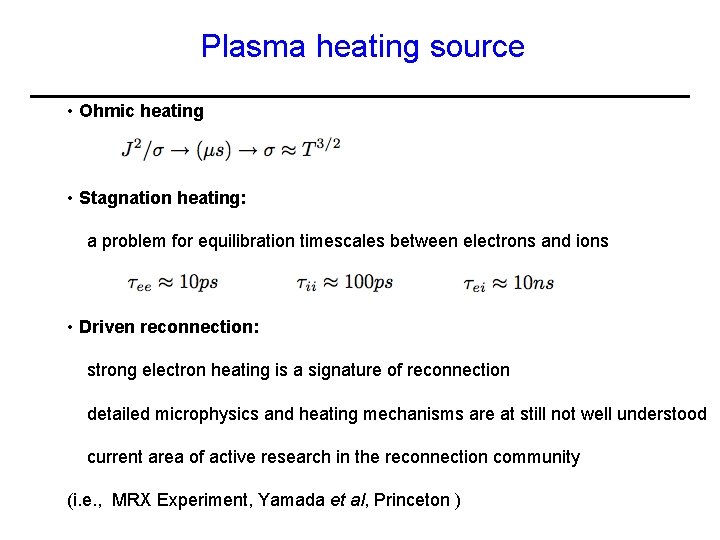
Plasma heating source • Ohmic heating • Stagnation heating: a problem for equilibration timescales between electrons and ions • Driven reconnection: strong electron heating is a signature of reconnection detailed microphysics and heating mechanisms are at still not well understood current area of active research in the reconnection community (i. e. , MRX Experiment, Yamada et al, Princeton )
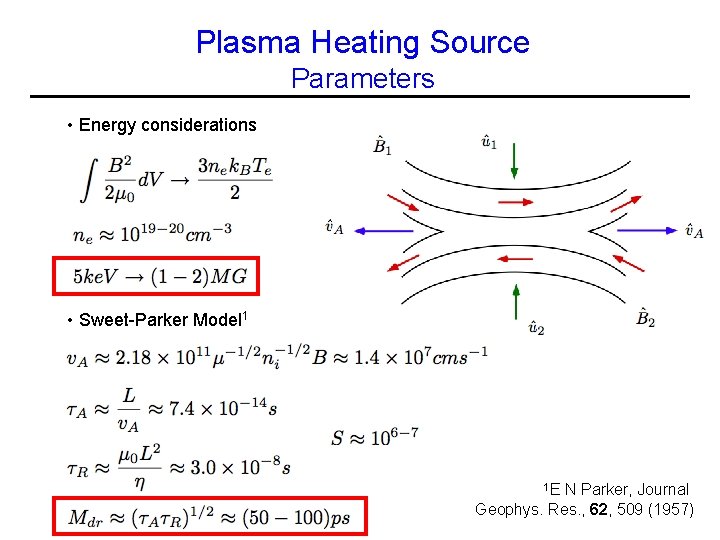
Plasma Heating Source Parameters • Energy considerations • Sweet-Parker Model 1 1 E N Parker, Journal Geophys. Res. , 62, 509 (1957)
Summary • we have studied the interaction between laser-ablated plasmas in two beam long pulse (ns) interaction geometries with planar mid- and high-Z solid targets • we have characterized the ablation dynamics and plasma outflows using transverse optical probing • we have observed B-field null formation using rear-projection proton probing • we have measured strong electron heating via Thomson scattering • the plasma dynamics and estimated reconnection rates appear consistent with the driven magnetic reconnection model given by Sweet & Parker • questions remain about the details of jet formation and electron/ion heating
Summary of magnetic field measurements • Ultra high magnetic fields (~ 1 GGauss) are produced during high intensity (> 1019 W/cm 2) laser plasma interactions. • We have developed techniques which have allowed field measurements using harmonic polarimetry and which suggests the existence of fields of ~ 0. 7 GGauss near the critical density surface. • Difficult to study hydrodynamics in such high fields - however the effect of such high fields on atomic physics should be possible • Lower fields produced by long (nanosecond) pulses are shown to greatly affect the dynamics of the interaction (reconnection and jet formation)
- Slides: 35