
Laboratory 7 Heat Transfer and Thermal Insulation Overview
Laboratory 7: Heat Transfer and Thermal Insulation
Overview • • • Objective Background Materials Procedure Report / Presentation Closing
Objectives • Design/construct container to minimize heat loss from an egg within • Understand concept of minimal design • Understand heat transfer
Heat Transfer • Energy transferred from one object to another due to temperature difference
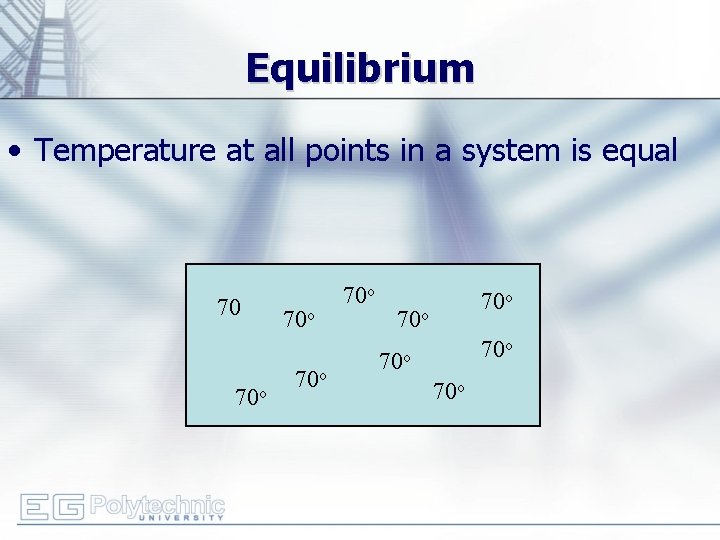
Equilibrium • Temperature at all points in a system is equal 65 70 o 73 70 o 25 95 70 o o 125 39 70 o 90 58 70 o 50 o 70 70 o 80
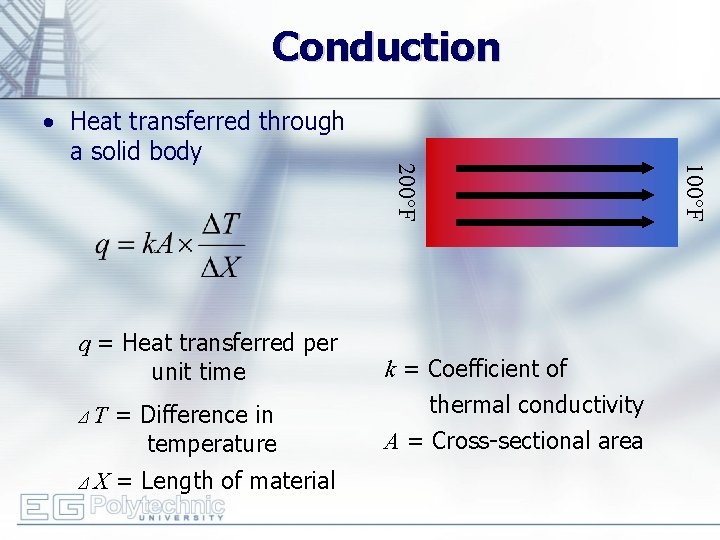
Conduction ΔT = Difference in temperature ΔX = Length of material k = Coefficient of thermal conductivity A = Cross-sectional area 100°F q = Heat transferred per unit time 200°F • Heat transferred through a solid body
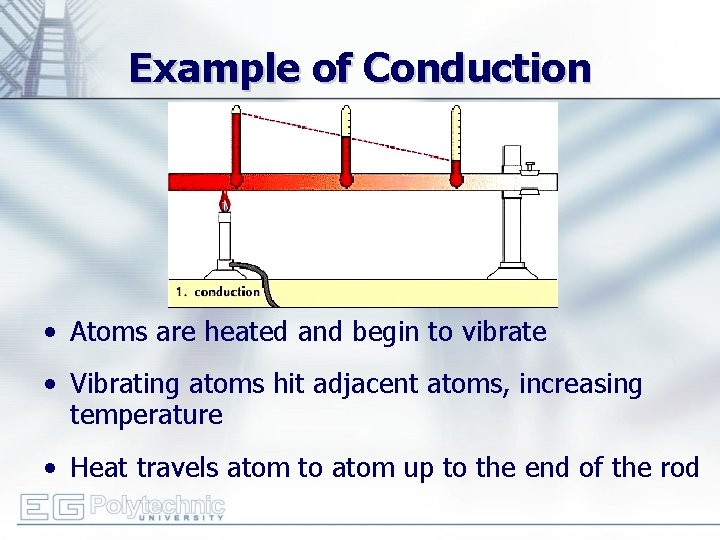
Example of Conduction • Atoms are heated and begin to vibrate • Vibrating atoms hit adjacent atoms, increasing temperature • Heat travels atom to atom up to the end of the rod
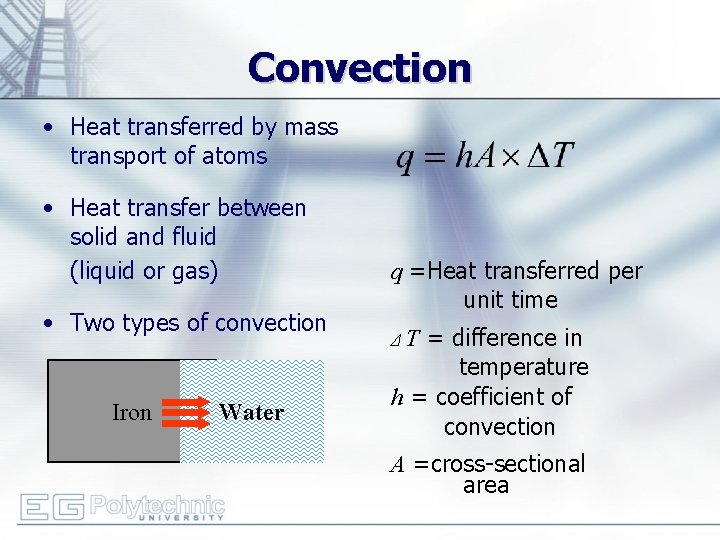
Convection • Heat transferred by mass transport of atoms • Heat transfer between solid and fluid (liquid or gas) • Two types of convection Iron Water q =Heat transferred per unit time = difference in temperature h = coefficient of convection ΔT A =cross-sectional area
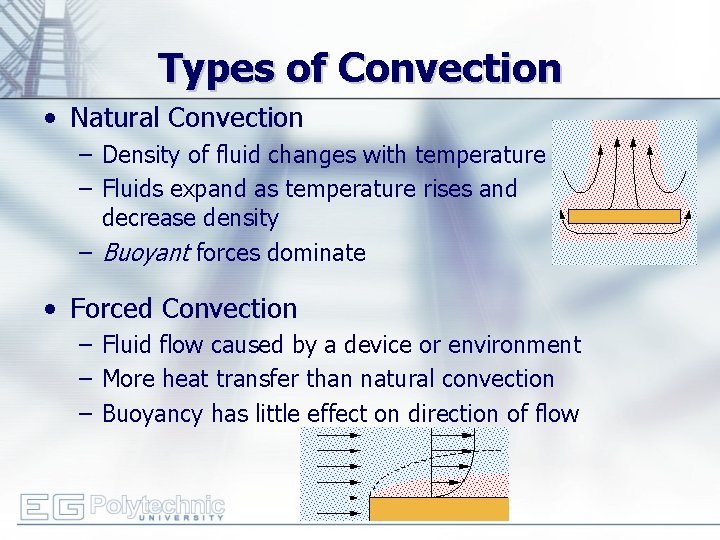
Types of Convection • Natural Convection – Density of fluid changes with temperature – Fluids expand as temperature rises and decrease density – Buoyant forces dominate • Forced Convection – Fluid flow caused by a device or environment – More heat transfer than natural convection – Buoyancy has little effect on direction of flow
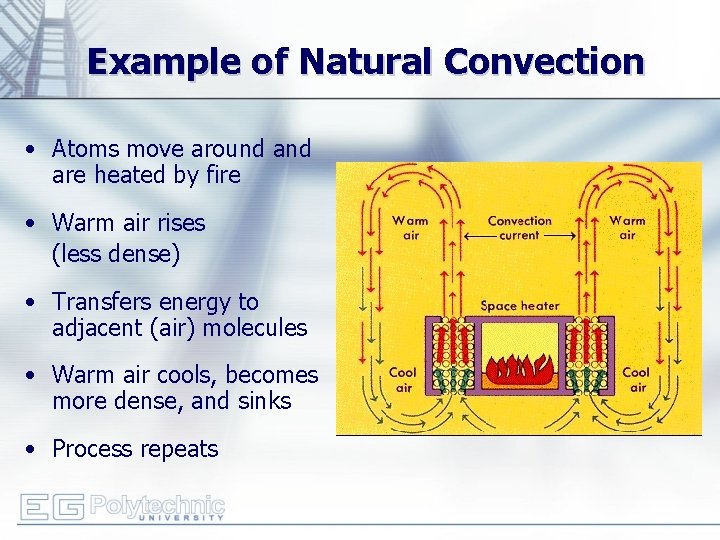
Example of Natural Convection • Atoms move around are heated by fire • Warm air rises (less dense) • Transfers energy to adjacent (air) molecules • Warm air cools, becomes more dense, and sinks • Process repeats
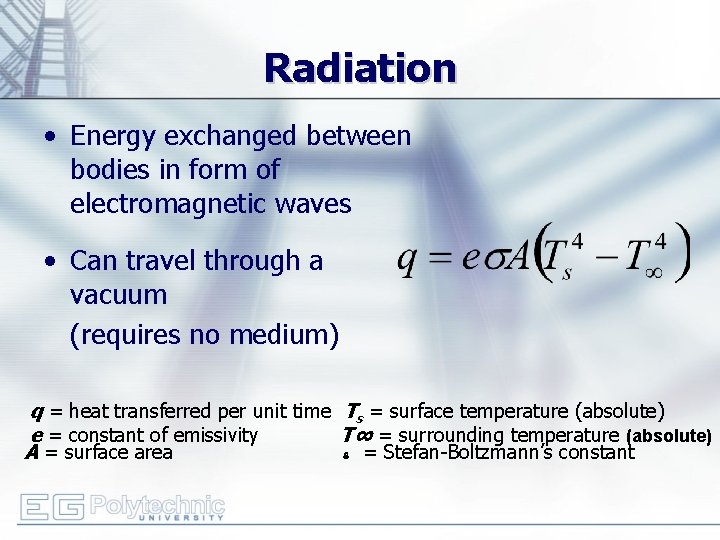
Radiation • Energy exchanged between bodies in form of electromagnetic waves • Can travel through a vacuum (requires no medium) q = heat transferred per unit time Ts = surface temperature (absolute) e = constant of emissivity T∞ = surrounding temperature (absolute) A = surface area s = Stefan-Boltzmann’s constant
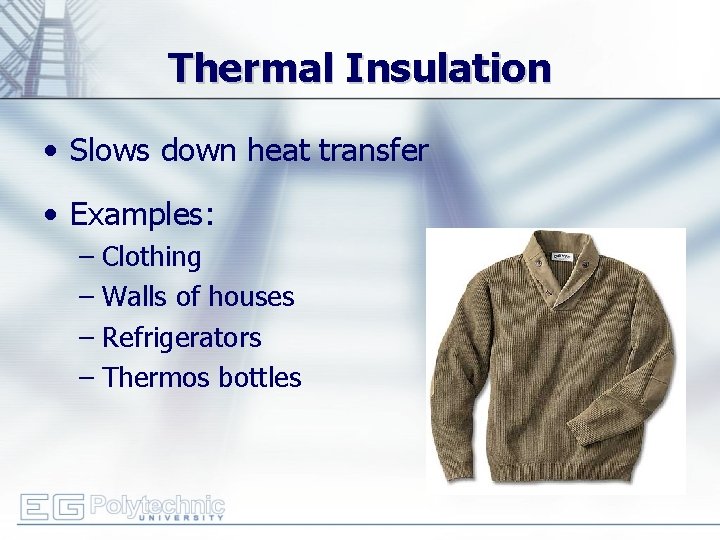
Thermal Insulation • Slows down heat transfer • Examples: – Clothing – Walls of houses – Refrigerators – Thermos bottles
Minimal Design • Minimal design - ability to design an object that is both functional and economical – Goal 1: Maximize functionality – Goal 2: Minimize cost
Materials For This Lab • • • Foam chips Plastic wrap Tape Aluminum foil Cup – Styrofoam – Paper • Plastic cup lid • Boiled egg • Thermocouple and wire connectors • Thermal Lab. VIEW program • DAC board
Problem Statement • Design/construct insulating container to accept hot egg just removed from boiling water • Container should minimize heat loss from egg • Use minimal design concepts
Material Price List • • Large foam cup…………$0. 50 Lid…………………. . . $0. 25 Paper cup…………. . $0. 40 Styrofoam pieces…………. . $0. 05 / 6 Tape………………. . . $0. 10 / ft Aluminum foil……………. . $0. 30 / ft 2 Plastic wrap. ………. . $0. 02 / ft 2
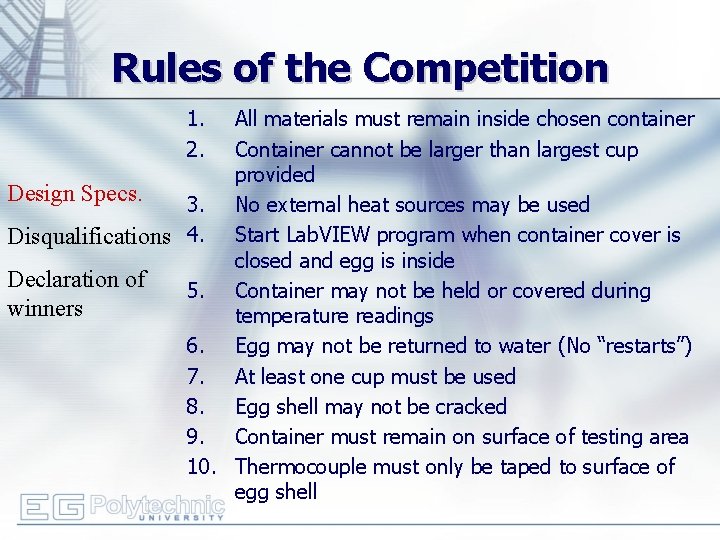
Rules of the Competition 1. 2. All materials must remain inside chosen container Container cannot be larger than largest cup provided Design Specs. 3. No external heat sources may be used Disqualifications 4. Start Lab. VIEW program when container cover is closed and egg is inside Declaration of 5. Container may not be held or covered during winners temperature readings 6. Egg may not be returned to water (No “restarts”) 7. At least one cup must be used 8. Egg shell may not be cracked 9. Container must remain on surface of testing area 10. Thermocouple must only be taped to surface of egg shell
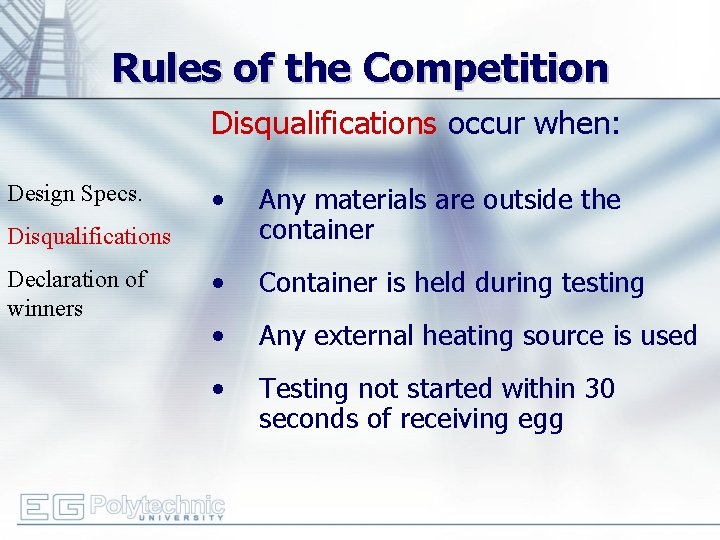
Rules of the Competition Disqualifications occur when: Design Specs. • Any materials are outside the container • Container is held during testing • Any external heating source is used • Testing not started within 30 seconds of receiving egg Disqualifications Declaration of winners
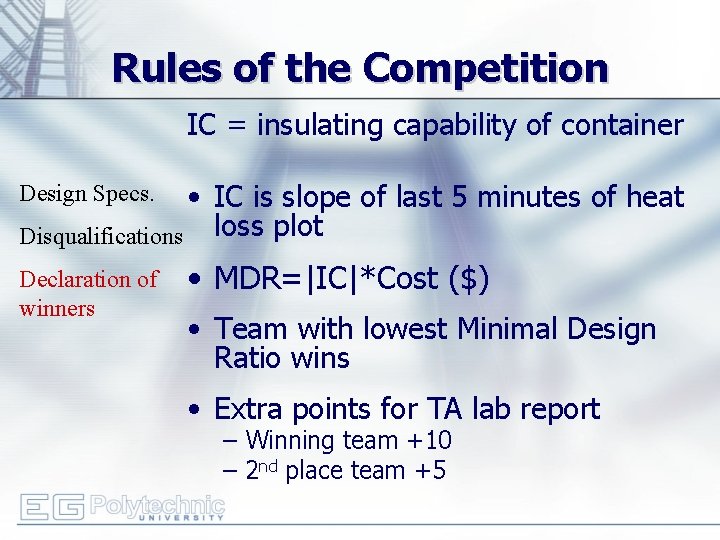
Rules of the Competition IC = insulating capability of container • IC is slope of last 5 minutes of heat Disqualifications loss plot Design Specs. Declaration of winners • MDR=|IC|*Cost ($) • Team with lowest Minimal Design Ratio wins • Extra points for TA lab report – Winning team +10 – 2 nd place team +5
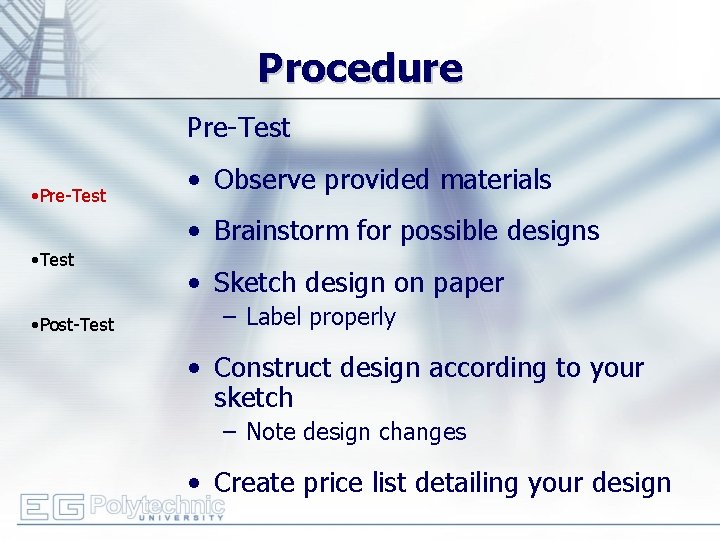
Procedure Pre-Test • Pre-Test • Observe provided materials • Brainstorm for possible designs • Test • Post-Test • Sketch design on paper – Label properly • Construct design according to your sketch – Note design changes • Create price list detailing your design
Procedure Test • Pre-Test • Post-Test * TA performs test using an unmodified cup (control experiment) 1. Receive boiled egg from instructor 2. Tape one end of thermocouple wire to egg (constant contact essential) 3. Insert egg with attached thermocouple 4. Quickly close container 5. Start Lab. VIEW program
Procedure Post-Test • Pre-Test • Post-Test • Lab. VIEW program has run for 15 minutes – Excel table automatically created after test • Use data on table to create Excel graph of Temperature vs. Time • Show table and graph to TA – TA will initial lab notes that table and graph have been created • Save table and graph • Have photo taken of container
Assignment: Report • Full Team Report (one report per team) • Title page • Discussion topics in the manual • Include original data with instructor’s initials • Scan in lab notes (ask TA for assistance) – TA must initial that table and graph were completed • Include table, graph, and photo of container
Assignment: Presentation • Team presentation • State rules of competition • Describe your design and its concepts • Explain steps taken to complete lab • Professional-looking tables and graph • How could your current design be improved? • Refer to “Creating Power. Point Presentations” found on EG website
Closing • Have all original data signed by TA • Each team member should have turn using software • Submit all work electronically • Return all unused materials to TA • Discard egg after testing
- Slides: 25