
Laboratory 2 Hardware Analysis and Synthesis Overview Objectives
Laboratory 2: Hardware Analysis and Synthesis
Overview Objectives t Background t Materials t Procedure t Report / Recitation t Problems t Closing t
Objectives t Build a robot and test it against the EG standard (passes 80% of tests) t Define product evaluation, accuracy, and precision t Demonstrate the importance of product evaluation
Concept: Product Evaluation t Engineers perform prototype testing Look for improvement suggestions t Continuously improves product quality t t Tests are performed to a company standard If the standard is met, the product is acceptable t If standard not met, product may be redesigned or withdrawn t
Concept: Accuracy and Precision t Accuracy: t t Comparison of the average of the results to the standard Precision: Repeatability of the results t How close are the results to each other? t
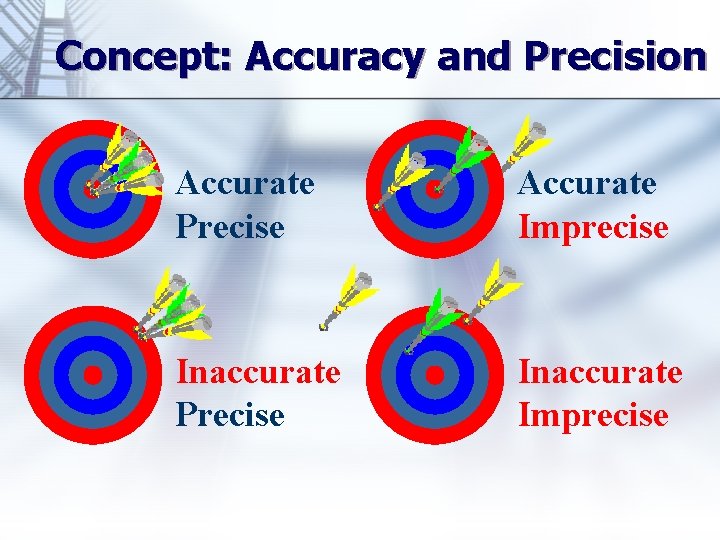
Concept: Accuracy and Precision Accurate Precise Accurate Imprecise Inaccurate Precise Inaccurate Imprecise
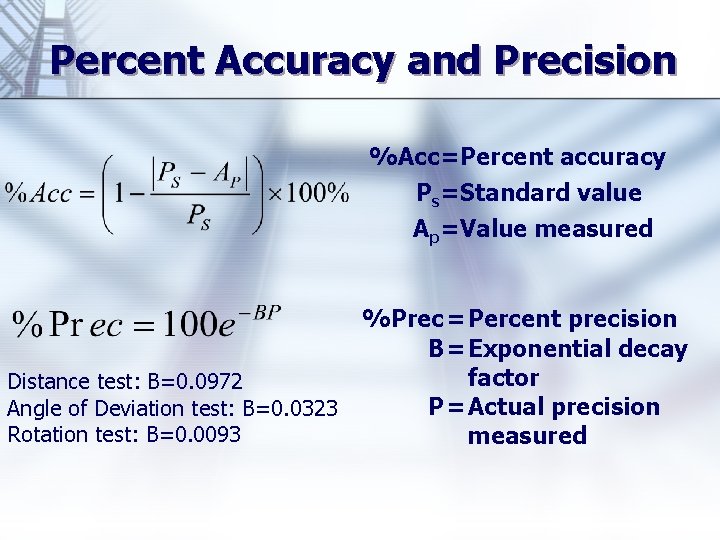
Percent Accuracy and Precision %Acc=Percent accuracy Ps=Standard value Ap=Value measured Distance test: B=0. 0972 Angle of Deviation test: B=0. 0323 Rotation test: B=0. 0093 %Prec=Percent precision B=Exponential decay factor P=Actual precision measured
Materials ROBOLAB Kit t Robot chassis building guide t Large sheets of paper to record results t Meter stick t Protractor t
Lab Procedure: Student Tasks t Assemble robot according to chassis handout t Program robot to perform three tests: t t t Distance Angle of Deviation Rotation t Perform tests, taking appropriate measurements t Determine whether or not robot meets 80% EG Standard
Procedure: Distance Test Distance Angle Rotation t DONE AT SAME TIME AS ANGLE TEST t Assemble chassis according to handout Handout instructions do not include wheels Create distance/angle test program in ROBOLAB Download distance program to RCX Mark start point on the sheet of paper …[continued] t t t
Procedure: Distance Test (continued) Distance Angle Rotation t t t Place robot at start point Run the program for 5 seconds and measure the distance traveled by robot Determine standard for this test by dividing distance traveled by 5 and then multiplying by 4 Go back to ROBOLAB program and change time from 5 seconds to 4 seconds Measure distance traversed Repeat testing ten times
Procedure: Angle of Deviation Test Distance Angle Rotation t DONE AT SAME TIME AS DISTANCE TEST t Draw a straight line (0° line) on the sheet of paper Identify a reference point and align robot on line Run program Draw a line from start point to endpoint Measure angle of deviation Repeat test 10 times t t t
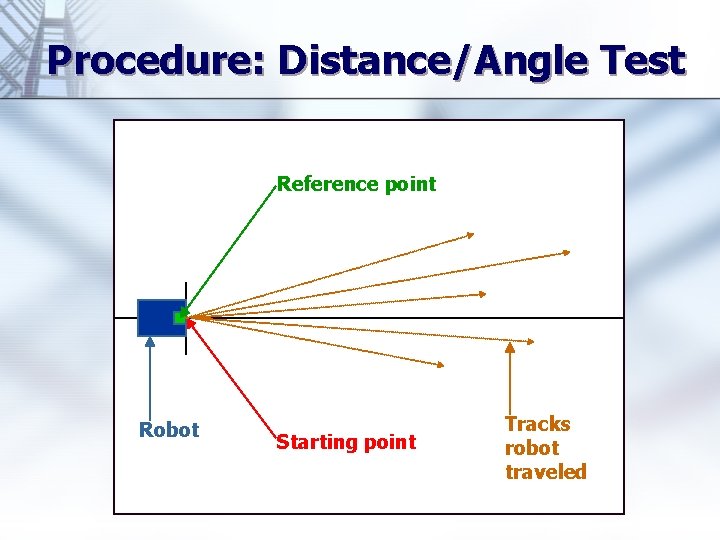
Procedure: Distance/Angle Test Reference point Robot Starting point Tracks robot traveled
Procedure: Rotation Test Distance Angle Rotation Create rotation program in ROBOLAB t Download rotation program to RCX t Mark a center point on the paper t Place the robot on the paper and set a reference point t Run program for 5 seconds t Measure angle of rotation of robot t Divide value by 5 to determine angle of rotation per second t …[continued] t
Procedure: Rotation Test Distance Angle Rotation Multiply by 4 to determine standard rotation for 4 seconds t Go back to ROBOLAB program and change time from 5 seconds to 4 seconds t Download program to RCX t Run program and measure rotation of robot t Repeat test 10 times t
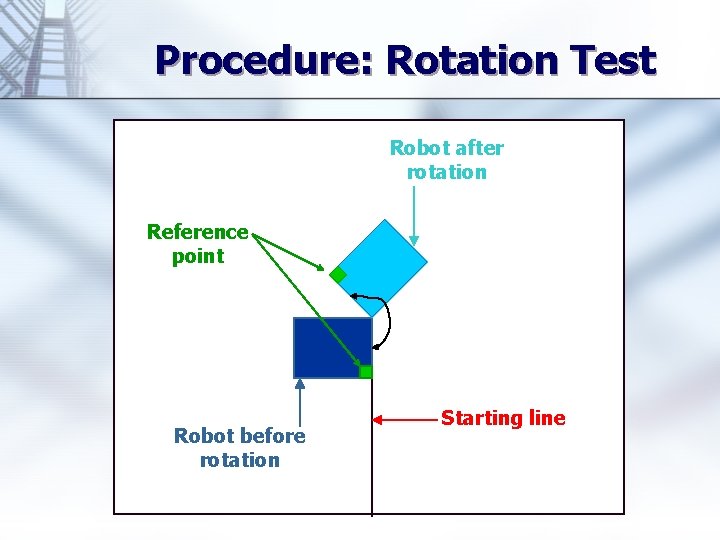
Procedure: Rotation Test Robot after rotation Reference point Robot before rotation Starting line
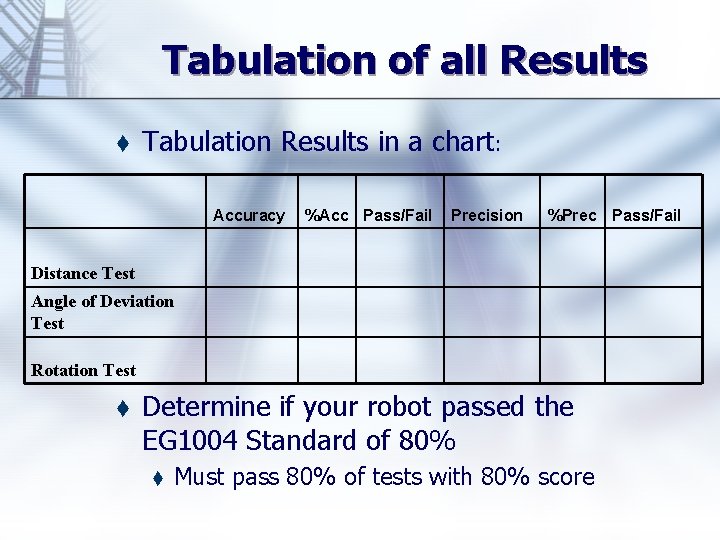
Tabulation of all Results t Tabulation Results in a chart: Accuracy %Acc Pass/Fail Precision %Prec Pass/Fail Distance Test Angle of Deviation Test Rotation Test t Determine if your robot passed the EG 1004 Standard of 80% t Must pass 80% of tests with 80% score
Report Independent report t Title page t Discussion topics in the manual t Include original data with TA’s signature t MUST include spreadsheet with test results, standard, average, accuracy, and precision of each test t
Report (continued) t Remember to hand in original data electronically, as part of report t Include photos of robot in Word document t TA will assist with digital camera
Presentation t t Team presentation Include photos of robot t t TA will assist with digital camera Refer to the presentation on Creating Power. Point Presentations found on the EG website
Closing Team members share tasks– i. e. one to program, another to build t Have testing paper signed by TA t Remember to submit all work electronically t t t Submit testing paper to TA at beginning of Lab 3 Robots must remain assembled ü To be used for Lab 3 t Return all unused materials to TAs
- Slides: 21