
Laboratory 10 Electronic Filters Overview Objectives Background Materials

Laboratory 10: Electronic Filters
Overview ØObjectives ØBackground ØMaterials ØProcedure ØReport / Presentation ØClosing
Objectives Ø Learn about electrical filters ØDifferent types ØUses Ø What is the -3 d. B point? Ø Create filters and a crystal set radio using multiple circuit elements Ø Identify filters based on generated graphs
Frequency Response Graph Ø Gain (in d. B) Ø Ratio of output against input Ø 20*log (Vout/Vin) Ø Always negative value Ø -3 d. B Point Ø 3 d. B drop of signal power from highest point on gain Ø Signal power is half of original value Ø Cutoff Frequency (in Hz) Ø Frequency at -3 d. B Point
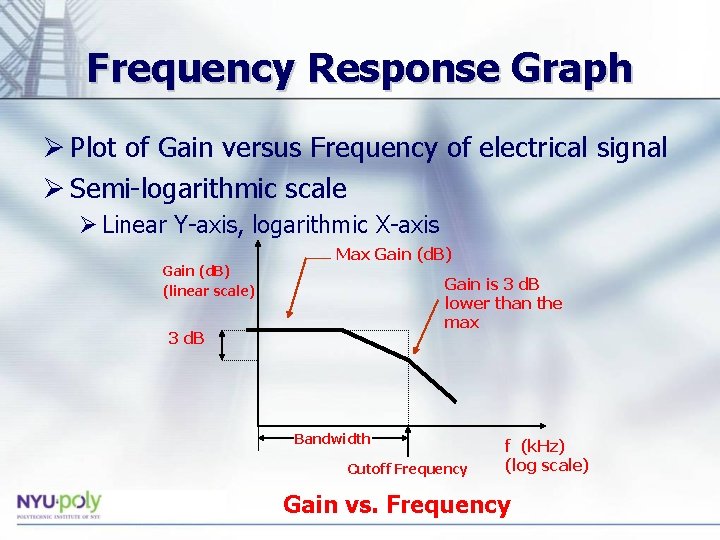
Frequency Response Graph Ø Plot of Gain versus Frequency of electrical signal Ø Semi-logarithmic scale Ø Linear Y-axis, logarithmic X-axis Gain (d. B) (linear scale) Max Gain (d. B) Gain is 3 d. B lower than the max 3 d. B Bandwidth Cutoff Frequency f (k. Hz) (log scale) Gain vs. Frequency

What are Filters? Ø Eliminate unwanted frequencies ØHigh-pass or low-pass Ø Favor desired frequencies ØBand-pass ØBandwidth: frequency range filter allows to pass Ø Example ØRadio tunes in to particular station
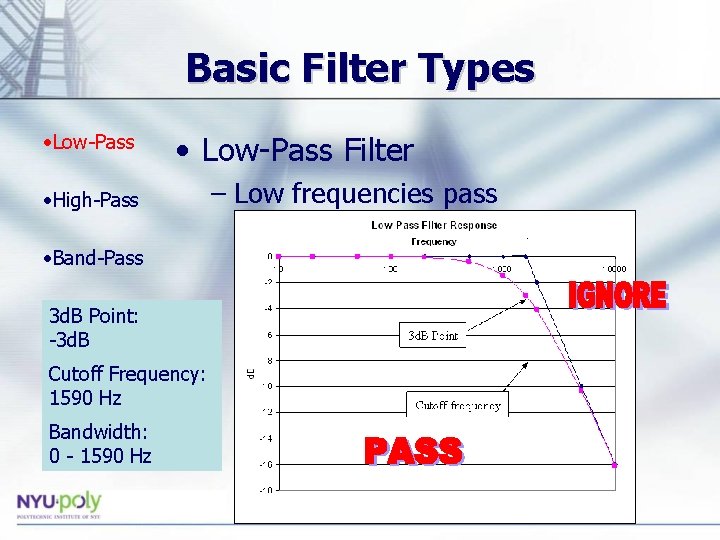
Basic Filter Types • Low-Pass Filter • High-Pass • Band-Pass 3 d. B Point: -3 d. B Cutoff Frequency: 1590 Hz Bandwidth: 0 - 1590 Hz – Low frequencies pass
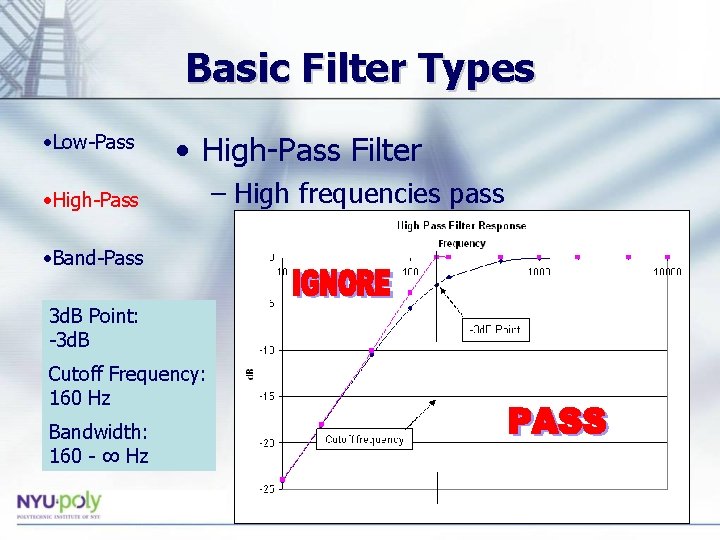
Basic Filter Types • Low-Pass • High-Pass Filter • High-Pass • Band-Pass 3 d. B Point: -3 d. B Cutoff Frequency: 160 Hz Bandwidth: 160 - ∞ Hz – High frequencies pass
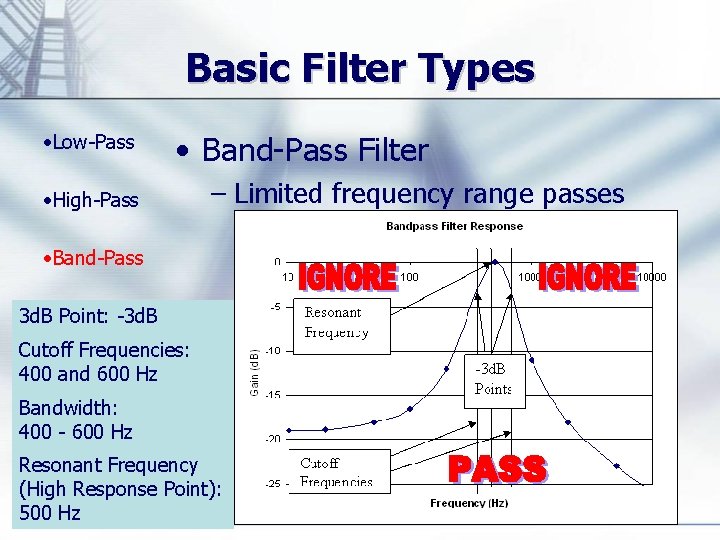
Basic Filter Types • Low-Pass • Band-Pass Filter • High-Pass – Limited frequency range passes • Band-Pass 3 d. B Point: -3 d. B Cutoff Frequencies: 400 and 600 Hz Bandwidth: 400 - 600 Hz Resonant Frequency (High Response Point): 500 Hz
Electrical Terminology • Terms • Elements • Wiring Ø Voltage (V) [unit = V for Volts] ØPotential difference in electrical energy Ø Current (I) [unit = A for Amperes] ØCharge flow rate ØCan be positive or negative
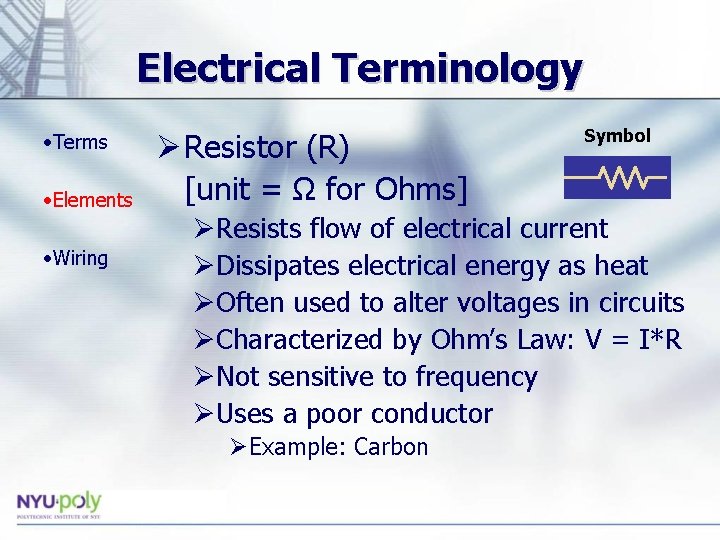
Electrical Terminology • Terms • Elements • Wiring Ø Resistor (R) [unit = Ω for Ohms] Symbol ØResists flow of electrical current ØDissipates electrical energy as heat ØOften used to alter voltages in circuits ØCharacterized by Ohm’s Law: V = I*R ØNot sensitive to frequency ØUses a poor conductor ØExample: Carbon
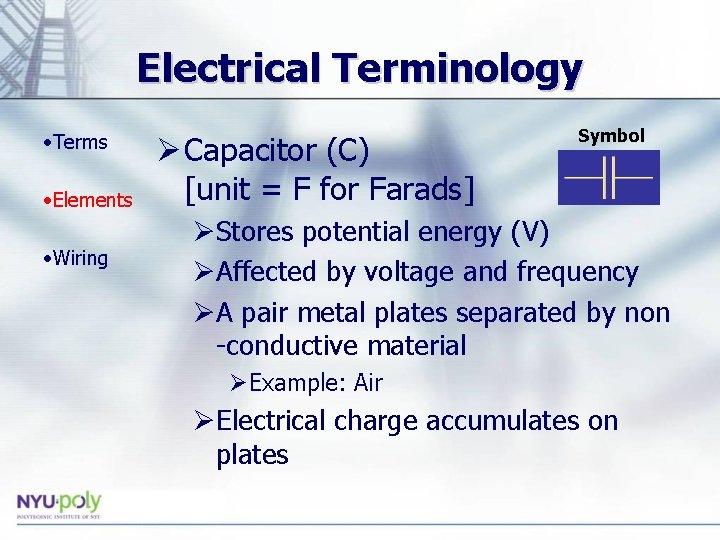
Electrical Terminology • Terms • Elements • Wiring Ø Capacitor (C) [unit = F for Farads] Symbol ØStores potential energy (V) ØAffected by voltage and frequency ØA pair metal plates separated by non -conductive material ØExample: Air ØElectrical charge accumulates on plates
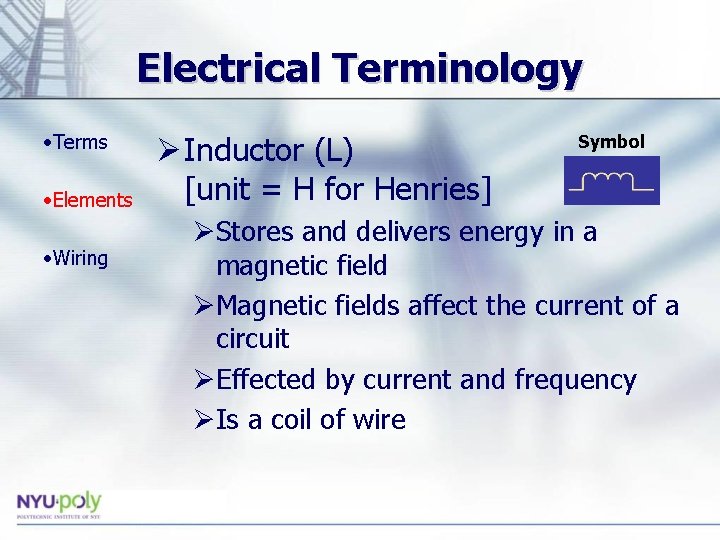
Electrical Terminology • Terms • Elements • Wiring Ø Inductor (L) [unit = H for Henries] Symbol ØStores and delivers energy in a magnetic field ØMagnetic fields affect the current of a circuit ØEffected by current and frequency ØIs a coil of wire
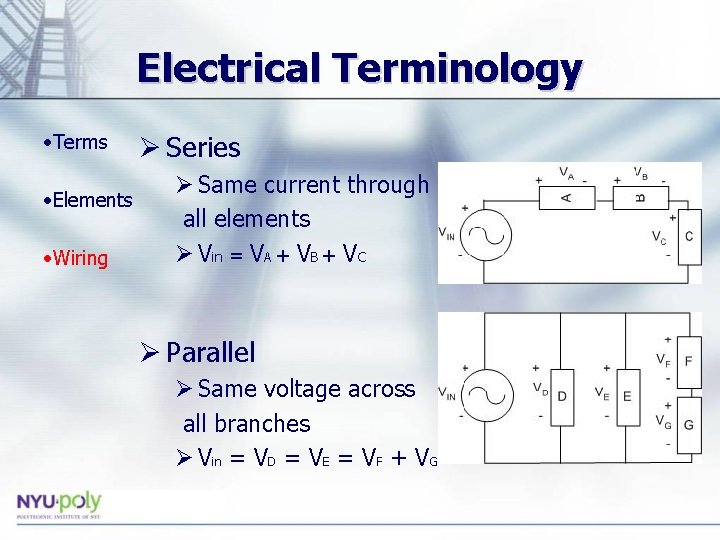
Electrical Terminology • Terms • Elements • Wiring Ø Series Ø Same current through all elements Ø Vin = VA + VB + VC Ø Parallel Ø Same voltage across all branches Ø Vin = VD = VE = VF + VG
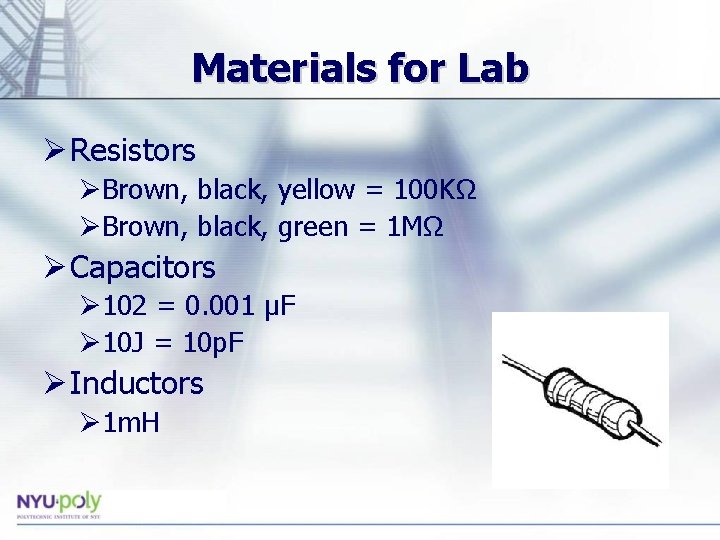
Materials for Lab Ø Resistors ØBrown, black, yellow = 100 KΩ ØBrown, black, green = 1 MΩ Ø Capacitors Ø 102 = 0. 001 µF Ø 10 J = 10 p. F Ø Inductors Ø 1 m. H
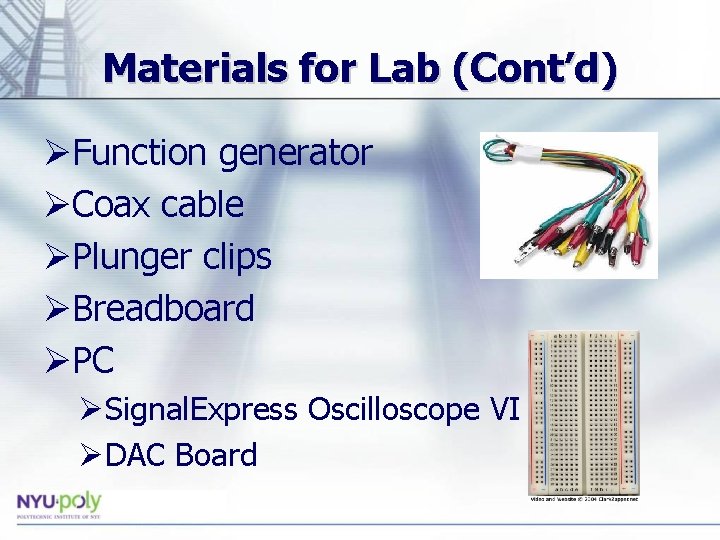
Materials for Lab (Cont’d) ØFunction generator ØCoax cable ØPlunger clips ØBreadboard ØPC ØSignal. Express Oscilloscope VI ØDAC Board
Procedure -Calibrate Function Generator Ø Insert coaxial end of connecting cable into 50Ω output on function generator Ø Connect alligator clips ØRed to pin 33 wire of DAC board ØBlack to pin 66 wire of DAC board Ø Set function generator range to 1 k. Hz Ø Set mode to Sine Wave (~) Ø Tune output frequency to 1 k. Hz ØDisplay must read 1. 000 k. Hz
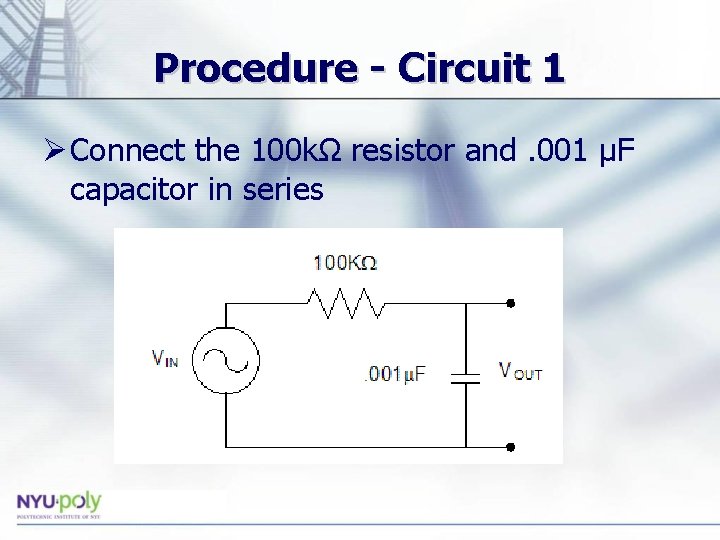
Procedure - Circuit 1 Ø Connect the 100 kΩ resistor and. 001 µF capacitor in series
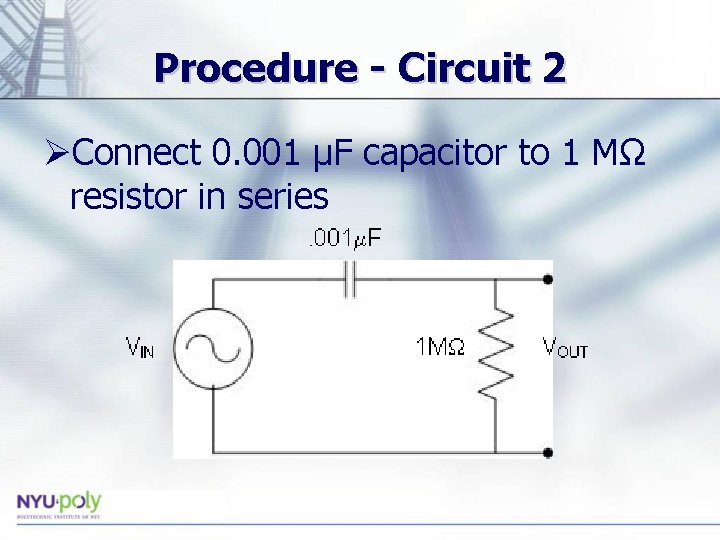
Procedure - Circuit 2 ØConnect 0. 001 µF capacitor to 1 MΩ resistor in series
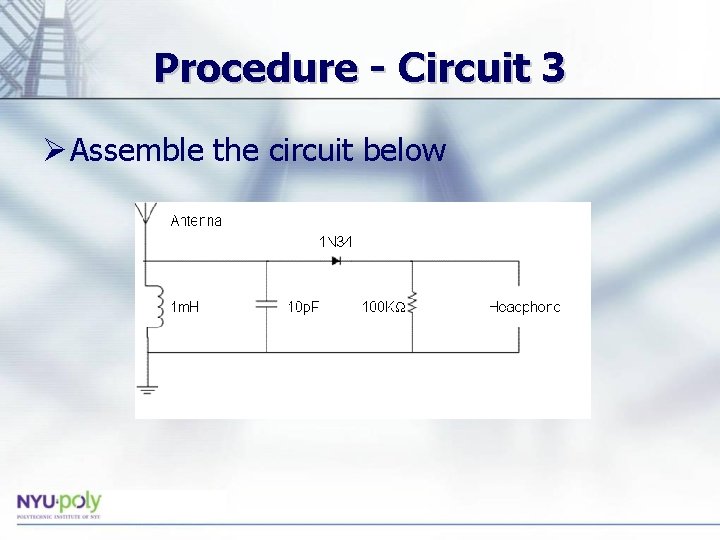
Procedure - Circuit 3 Ø Assemble the circuit below
Procedure - Testing 1. Connect function generator to circuit (function generator is VIN in schematics) 2. Connect DAC board to circuit as VOUT 3. Set function generator to 10 Hz 4. Record Vp-p reading on data view chart • Appears below wave 5. Repeat steps 1 -3 for frequencies of 20, 50, 100, 200, 500, 1000, 2000, 5000, 10000 Hz
Procedure – Data Analysis Ø For first two circuits, generate a graph ØPlot of 20*log(Vout/Vin) vs. Frequency ØSemi-log scale ØY-axis must be linear ØX-axis must be log scale ØProperly label each graph and all axes Ø TA must sign lab notes to verify data
Assignment: Report Ø Individual Report (one report per student) Ø Title page Ø Discussion topics in the manual Ø For first two circuits Ø Include Excel tables and Gain vs. Frequency graphs Ø Determine filter type Ø Label each graph with determined filter type Ø Have TA scan in signed lab notes Ø OPTIONAL- Include photos of circuits and setup
Closing Ø TA will assign which circuit you start with Ø Have all original data signed by your TA Ø All team members must actively participate in experiment Ø Submit all work electronically Ø Return all materials to your TA
- Slides: 24