
LABORATORIO Phylum Mollusca Goals for today Learn to
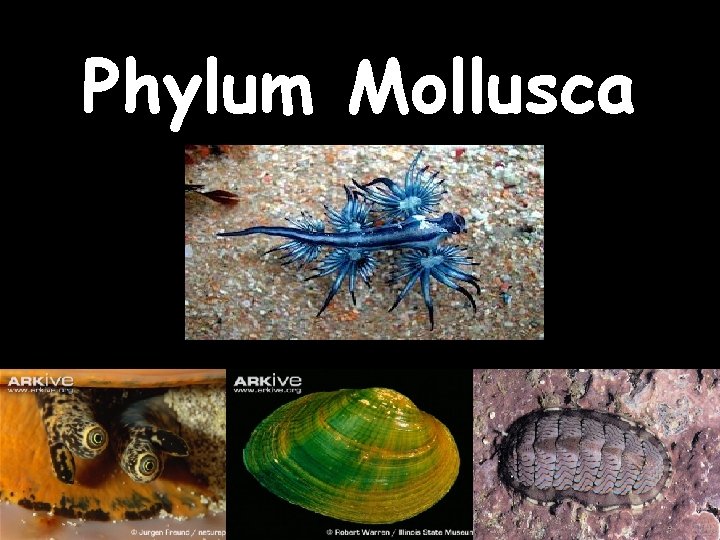
LABORATORIO Phylum Mollusca
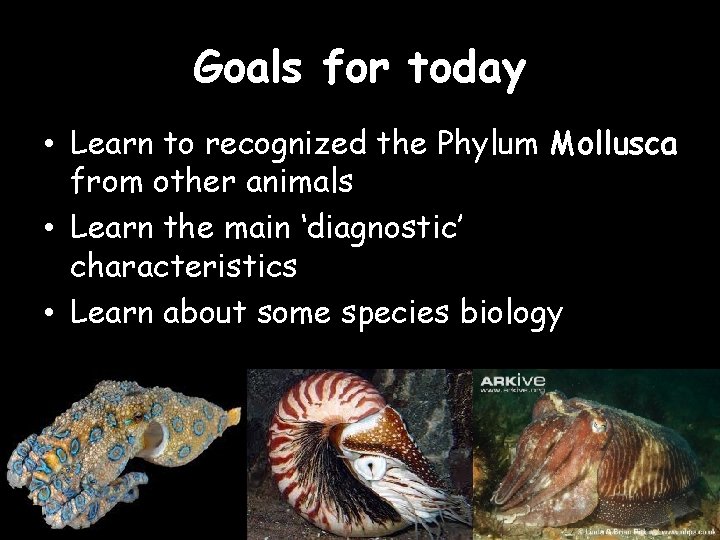
Goals for today • Learn to recognized the Phylum Mollusca from other animals • Learn the main ‘diagnostic’ characteristics • Learn about some species biology
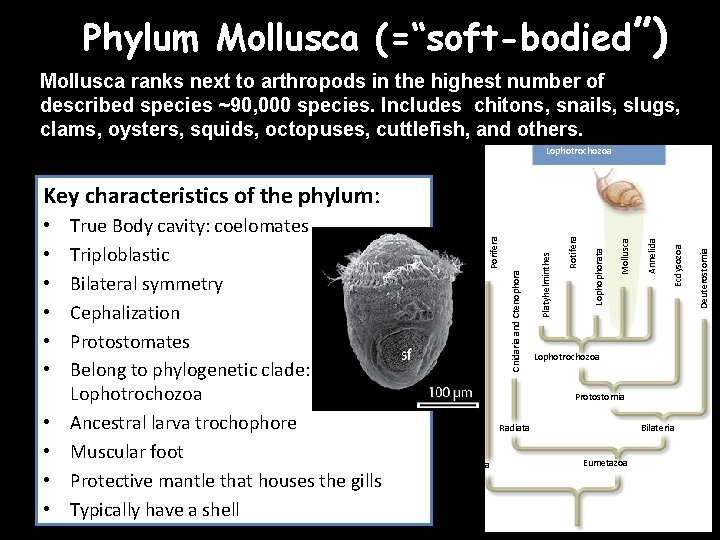
Phylum Mollusca (=“soft-bodied”) Mollusca ranks next to arthropods in the highest number of described species ~90, 000 species. Includes chitons, snails, slugs, clams, oysters, squids, octopuses, cuttlefish, and others. Lophotrochozoa • • Lophotrochozoa Protostomia Radiata Parazoa Bilateria Eumetazoa Deuterostomia Ecdysozoa Annelida Mollusca Lophophorata Rotifera Platyhelminthes True Body cavity: coelomates Triploblastic Bilateral symmetry Cephalization Protostomates Belong to phylogenetic clade: Lophotrochozoa Ancestral larva trochophore Muscular foot Protective mantle that houses the gills Typically have a shell Cnidaria and Ctenophora • • • Porifera Key characteristics of the phylum:
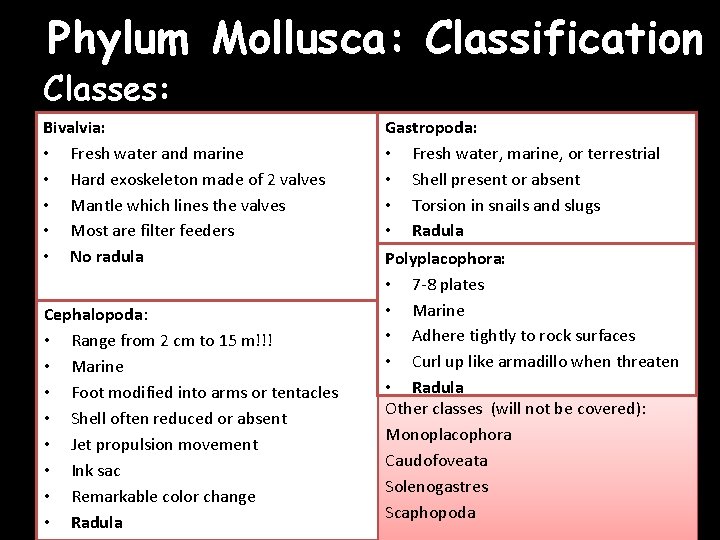
Phylum Mollusca: Classification Classes: Bivalvia: • Fresh water and marine • Hard exoskeleton made of 2 valves • Mantle which lines the valves • Most are filter feeders • No radula Cephalopoda: • Range from 2 cm to 15 m!!! • Marine • Foot modified into arms or tentacles • Shell often reduced or absent • Jet propulsion movement • Ink sac • Remarkable color change • Radula Gastropoda: • Fresh water, marine, or terrestrial • Shell present or absent • Torsion in snails and slugs • Radula Polyplacophora: • 7 -8 plates • Marine • Adhere tightly to rock surfaces • Curl up like armadillo when threaten • Radula Other classes (will not be covered): Monoplacophora Caudofoveata Solenogastres Scaphopoda
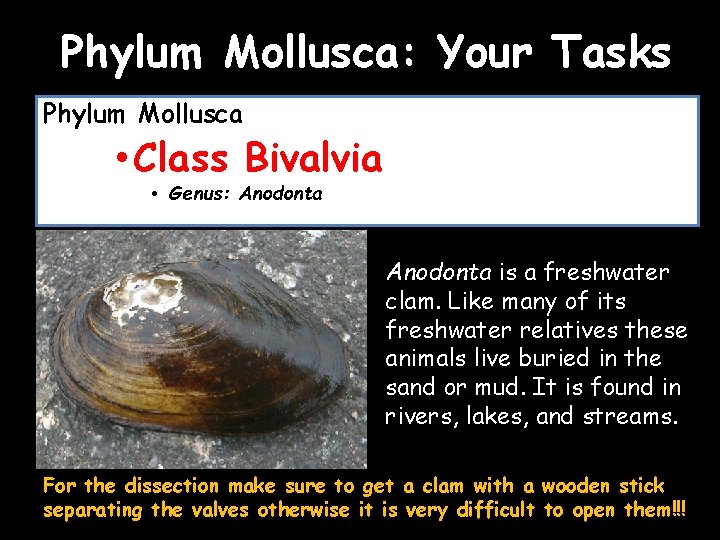
Phylum Mollusca: Your Tasks Phylum Mollusca • Class Bivalvia • Genus: Anodonta is a freshwater clam. Like many of its freshwater relatives these animals live buried in the sand or mud. It is found in rivers, lakes, and streams. For the dissection make sure to get a clam with a wooden stick separating the valves otherwise it is very difficult to open them!!!
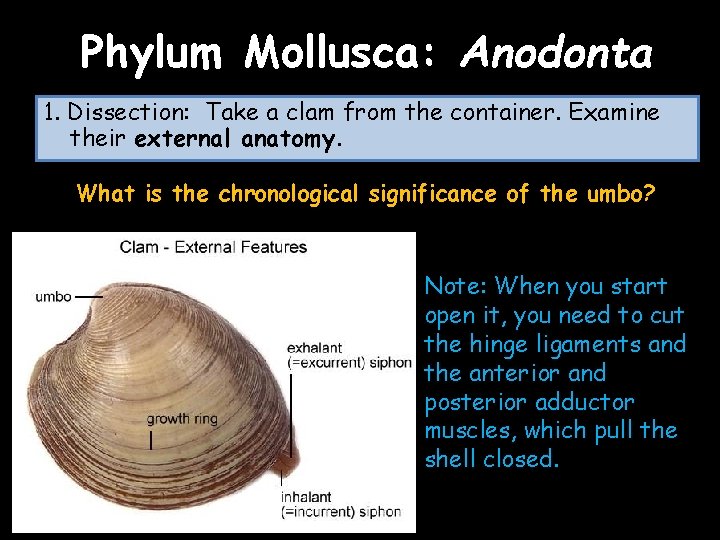
Phylum Mollusca: Anodonta 1. Dissection: Take a clam from the container. Examine their external anatomy. What is the chronological significance of the umbo? Note: When you start open it, you need to cut the hinge ligaments and the anterior and posterior adductor muscles, which pull the shell closed.
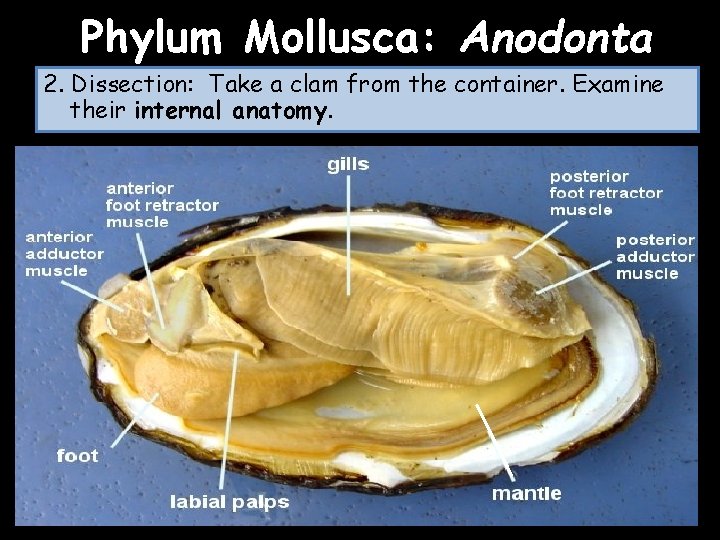
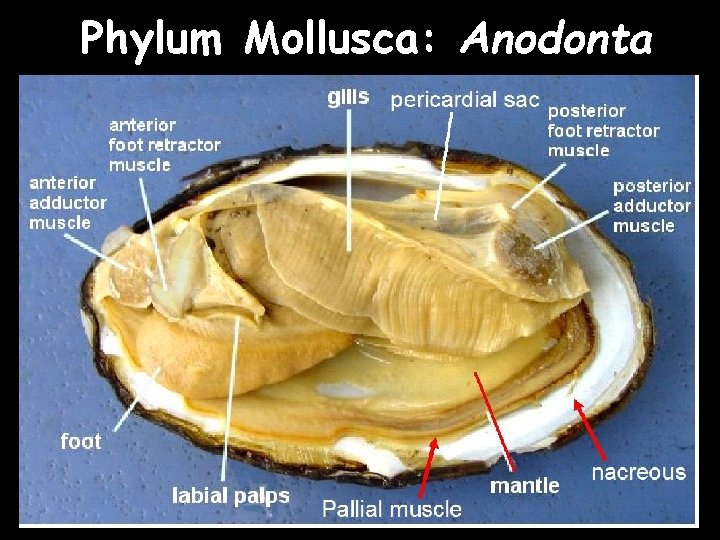
Phylum Mollusca: Anodonta 2. Dissection: Take a clam from the container. Examine their internal anatomy.
Phylum Mollusca: Anodonta
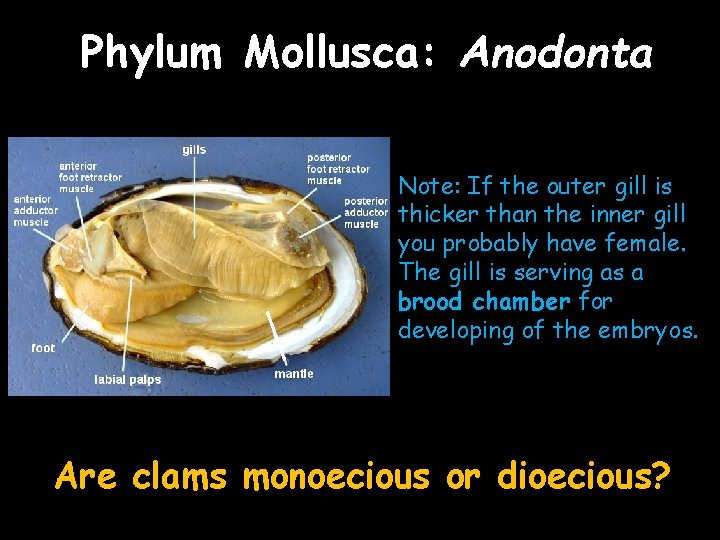
Phylum Mollusca: Anodonta Note: If the outer gill is thicker than the inner gill you probably have female. The gill is serving as a brood chamber for developing of the embryos. Are clams monoecious or dioecious?
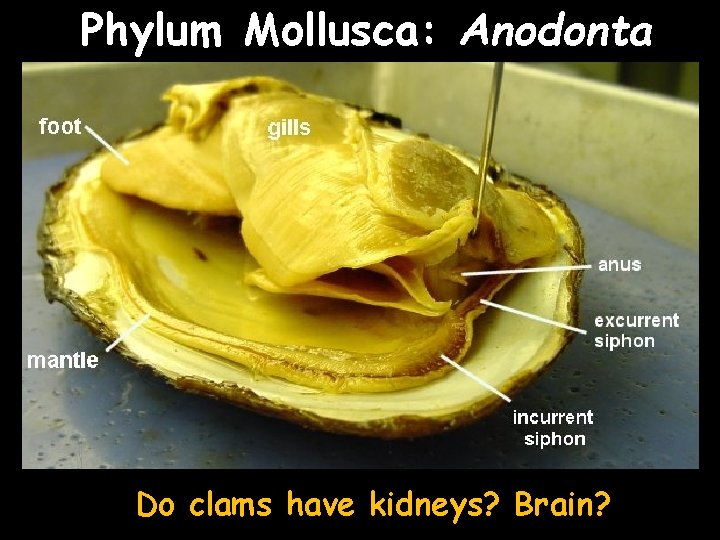
Phylum Mollusca: Anodonta Do clams have kidneys? Brain?
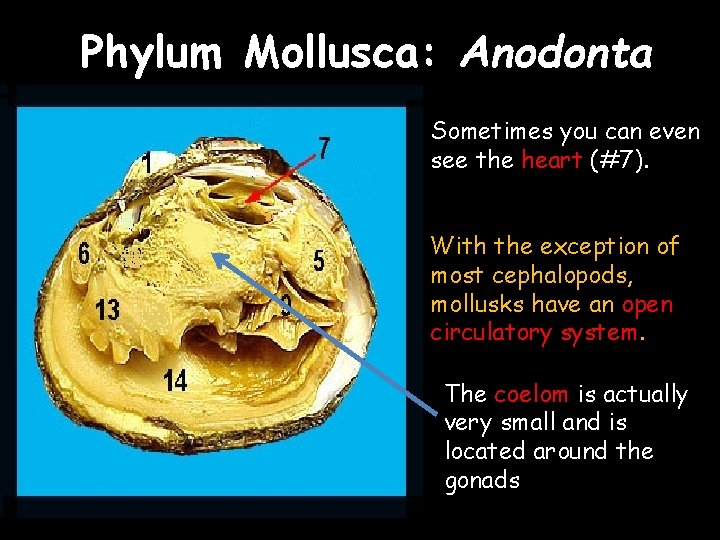
Phylum Mollusca: Anodonta Sometimes you can even see the heart (#7). With the exception of most cephalopods, mollusks have an open circulatory system. The coelom is actually very small and is located around the gonads
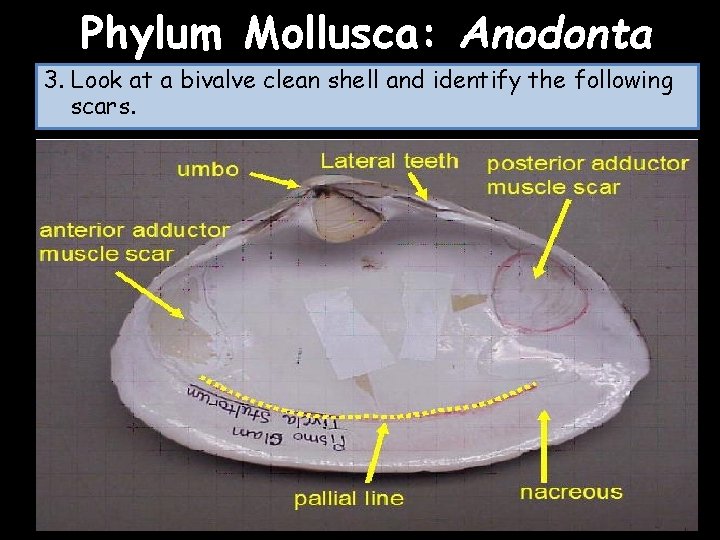
Phylum Mollusca: Anodonta 3. Look at a bivalve clean shell and identify the following scars.
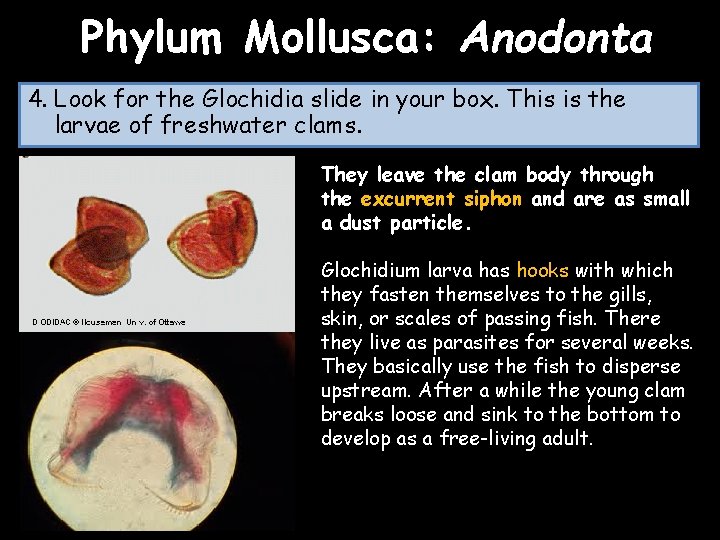
Phylum Mollusca: Anodonta 4. Look for the Glochidia slide in your box. This is the larvae of freshwater clams. They leave the clam body through the excurrent siphon and are as small a dust particle. Glochidium larva has hooks with which they fasten themselves to the gills, skin, or scales of passing fish. There they live as parasites for several weeks. They basically use the fish to disperse upstream. After a while the young clam breaks loose and sink to the bottom to develop as a free-living adult.
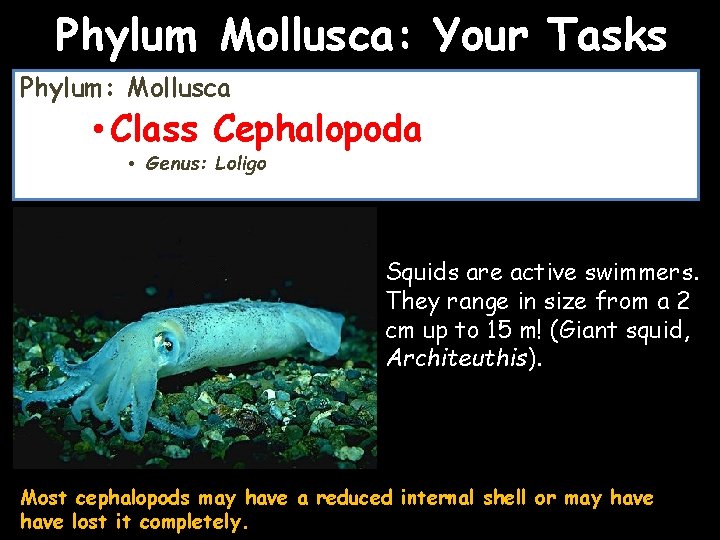
Phylum Mollusca: Your Tasks Phylum: Mollusca • Class Cephalopoda • Genus: Loligo Squids are active swimmers. They range in size from a 2 cm up to 15 m! (Giant squid, Architeuthis). Most cephalopods may have a reduced internal shell or may have lost it completely.
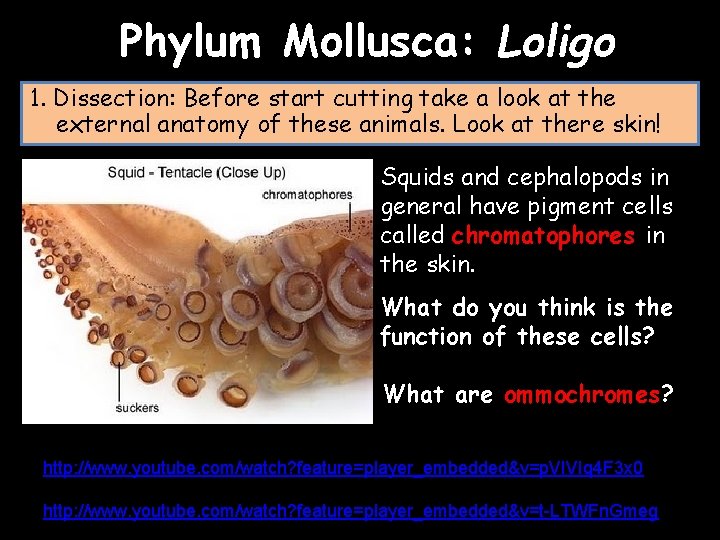
Phylum Mollusca: Loligo 1. Dissection: Before start cutting take a look at the external anatomy of these animals. Look at there skin! Squids and cephalopods in general have pigment cells called chromatophores in the skin. What do you think is the function of these cells? What are ommochromes? http: //www. youtube. com/watch? feature=player_embedded&v=p. VIVIq 4 F 3 x 0 http: //www. youtube. com/watch? feature=player_embedded&v=t-LTWFn. Gmeg
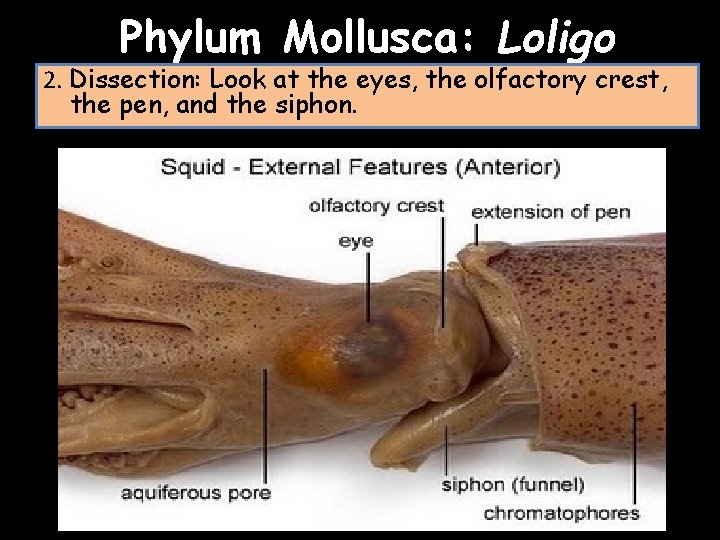
Phylum Mollusca: Loligo 2. Dissection: Look at the eyes, the olfactory crest, the pen, and the siphon.
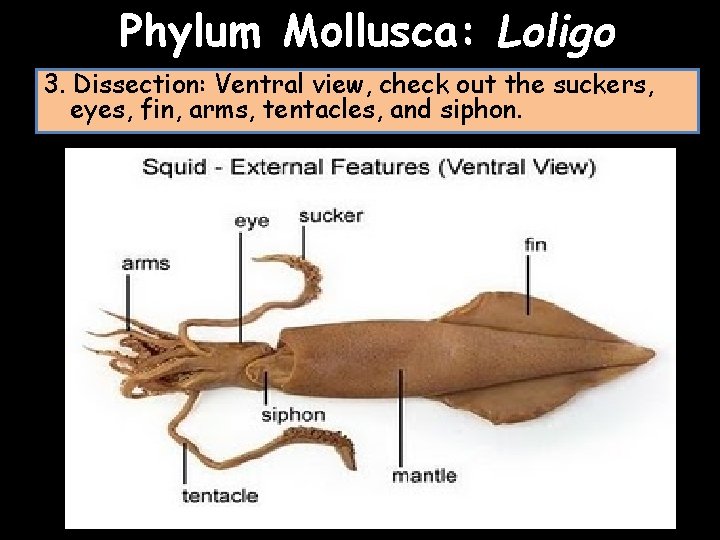
Phylum Mollusca: Loligo 3. Dissection: Ventral view, check out the suckers, eyes, fin, arms, tentacles, and siphon.
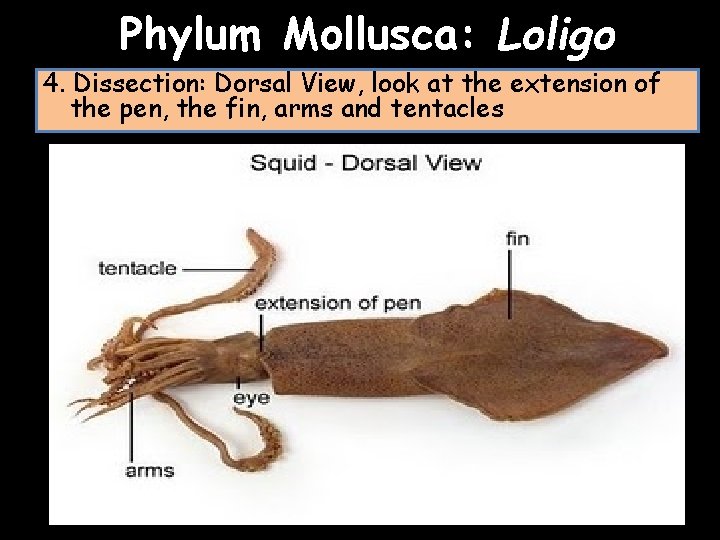
Phylum Mollusca: Loligo 4. Dissection: Dorsal View, look at the extension of the pen, the fin, arms and tentacles
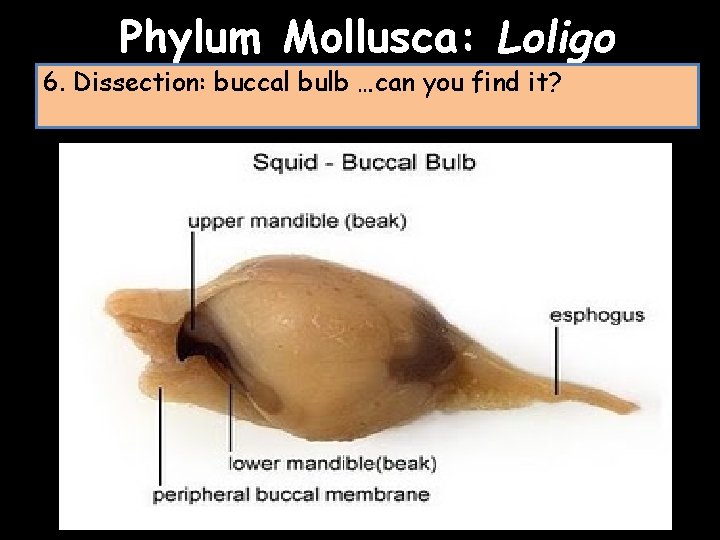
Phylum Mollusca: Loligo 6. Dissection: buccal bulb …can you find it?
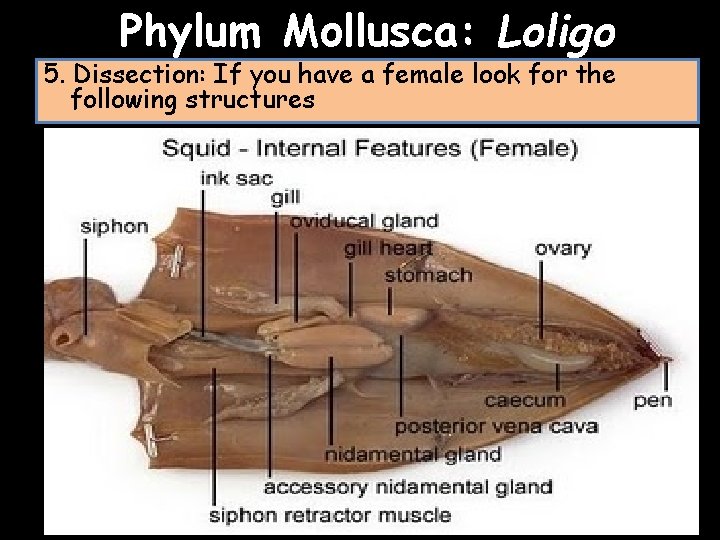
Phylum Mollusca: Loligo 5. Dissection: If you have a female look for the following structures
Phylum Mollusca: Loligo Female Squid – In females, • the ovaries containing the eggs are light yellow in color; they look and feel like Jell-O. • Females also have a pair of egg shell production glands called nidamental glands; they are the large, oval, white organs located at about the midpoint of the mantle cavity. • Females also have an accessory nidamental gland located near the top of the main glands. They are close to the ink sac and pinkish in color, do not confuse them with the heart.
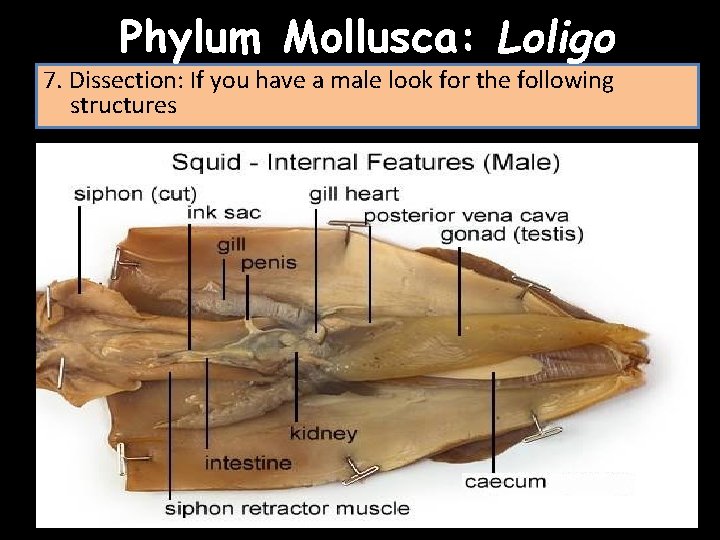
Phylum Mollusca: Loligo 7. Dissection: If you have a male look for the following structures
Phylum Mollusca: Loligo Male Squid • In males, – The sperm pass through the small coiled tube called the vas deferens and into the spermatophoric gland which looks like a small sac with many intertwining circles within it. – This gland adds substances to the sperm to make it into a sperm packet (spermatophore).
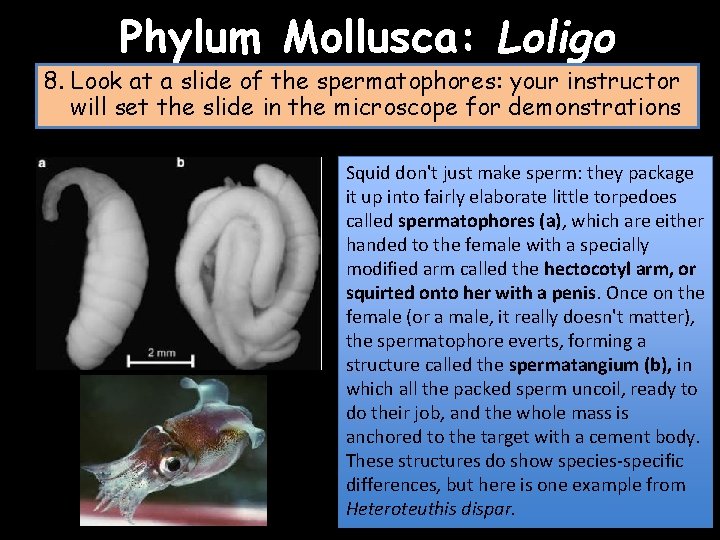
Phylum Mollusca: Loligo 8. Look at a slide of the spermatophores: your instructor will set the slide in the microscope for demonstrations Squid don't just make sperm: they package it up into fairly elaborate little torpedoes called spermatophores (a), which are either handed to the female with a specially modified arm called the hectocotyl arm, or squirted onto her with a penis. Once on the female (or a male, it really doesn't matter), the spermatophore everts, forming a structure called the spermatangium (b), in which all the packed sperm uncoil, ready to do their job, and the whole mass is anchored to the target with a cement body. These structures do show species-specific differences, but here is one example from Heteroteuthis dispar.
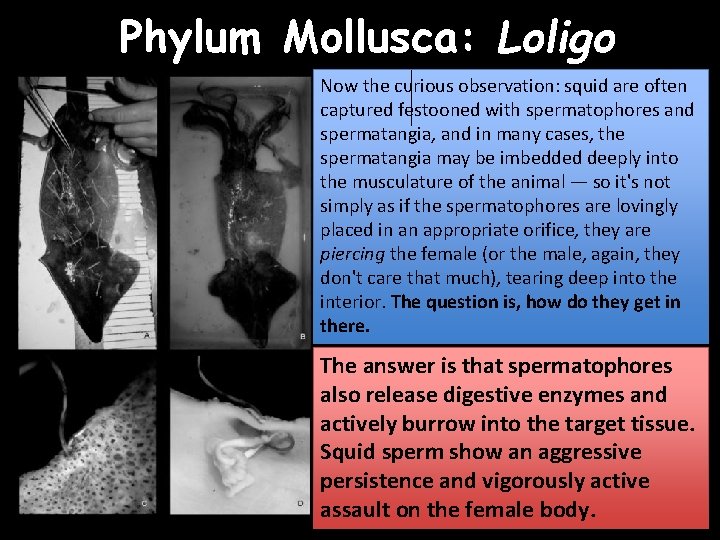
Phylum Mollusca: Loligo Now the curious observation: squid are often captured festooned with spermatophores and spermatangia, and in many cases, the spermatangia may be imbedded deeply into the musculature of the animal — so it's not simply as if the spermatophores are lovingly placed in an appropriate orifice, they are piercing the female (or the male, again, they don't care that much), tearing deep into the interior. The question is, how do they get in there. The answer is that spermatophores also release digestive enzymes and actively burrow into the target tissue. Squid sperm show an aggressive persistence and vigorously active assault on the female body.

Nautilus http: //www. youtube. com/watch? feature=player_embedded&v=QMFq. V 4 SJLWg
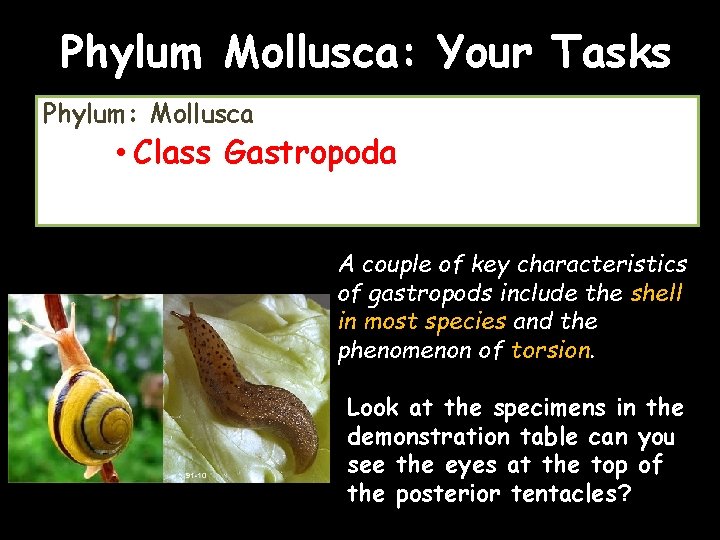
Phylum Mollusca: Your Tasks Phylum: Mollusca • Class Gastropoda A couple of key characteristics of gastropods include the shell in most species and the phenomenon of torsion. Look at the specimens in the demonstration table can you see the eyes at the top of the posterior tentacles?
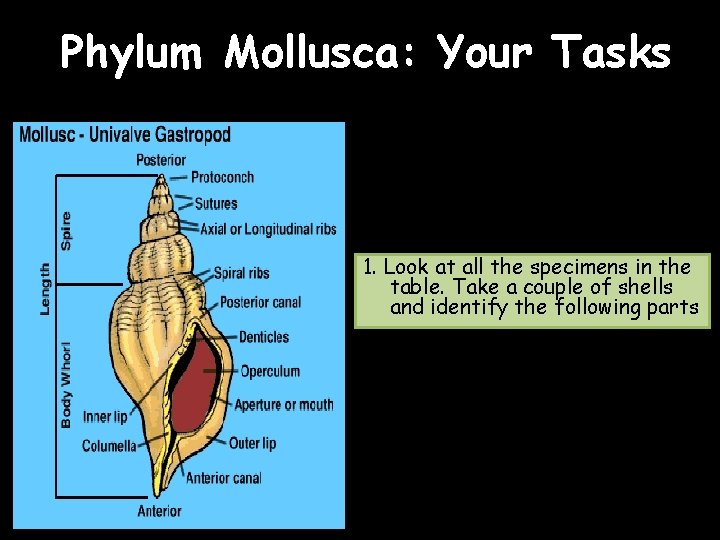
Phylum Mollusca: Your Tasks 1. Look at all the specimens in the table. Take a couple of shells and identify the following parts
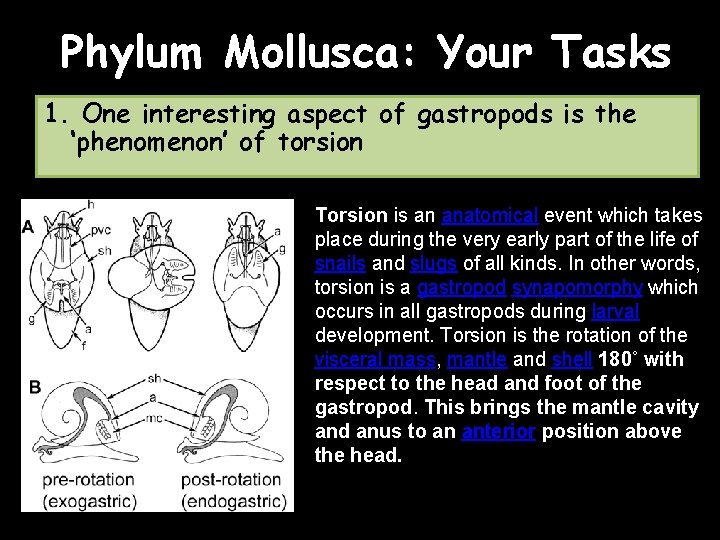
Phylum Mollusca: Your Tasks 1. One interesting aspect of gastropods is the ‘phenomenon’ of torsion Torsion is an anatomical event which takes place during the very early part of the life of snails and slugs of all kinds. In other words, torsion is a gastropod synapomorphy which occurs in all gastropods during larval development. Torsion is the rotation of the visceral mass, mantle and shell 180˚ with respect to the head and foot of the gastropod. This brings the mantle cavity and anus to an anterior position above the head.
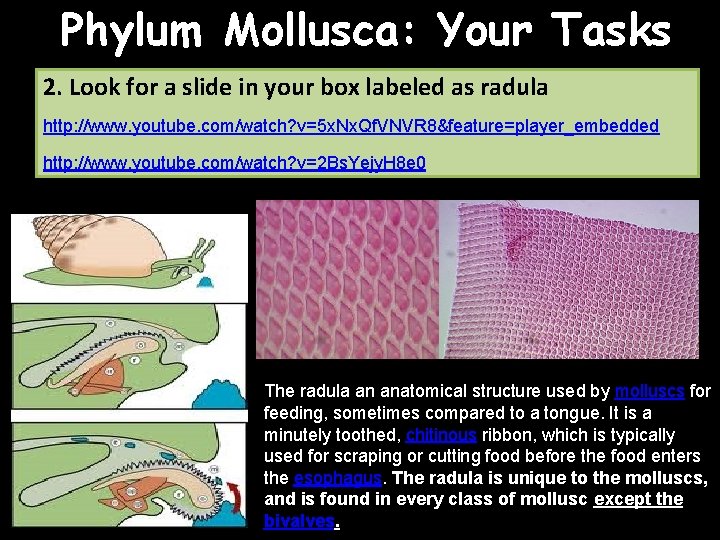
Phylum Mollusca: Your Tasks 2. Look for a slide in your box labeled as radula http: //www. youtube. com/watch? v=5 x. Nx. Qf. VNVR 8&feature=player_embedded http: //www. youtube. com/watch? v=2 Bs. Yejy. H 8 e 0 The radula an anatomical structure used by molluscs for feeding, sometimes compared to a tongue. It is a minutely toothed, chitinous ribbon, which is typically used for scraping or cutting food before the food enters the esophagus. The radula is unique to the molluscs, and is found in every class of mollusc except the bivalves.
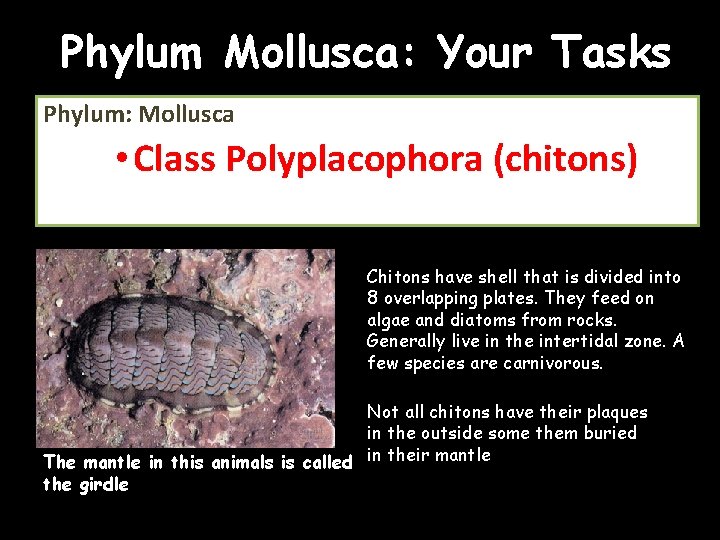
Phylum Mollusca: Your Tasks Phylum: Mollusca • Class Polyplacophora (chitons) Chitons have shell that is divided into 8 overlapping plates. They feed on algae and diatoms from rocks. Generally live in the intertidal zone. A few species are carnivorous. Not all chitons have their plaques in the outside some them buried The mantle in this animals is called in their mantle the girdle
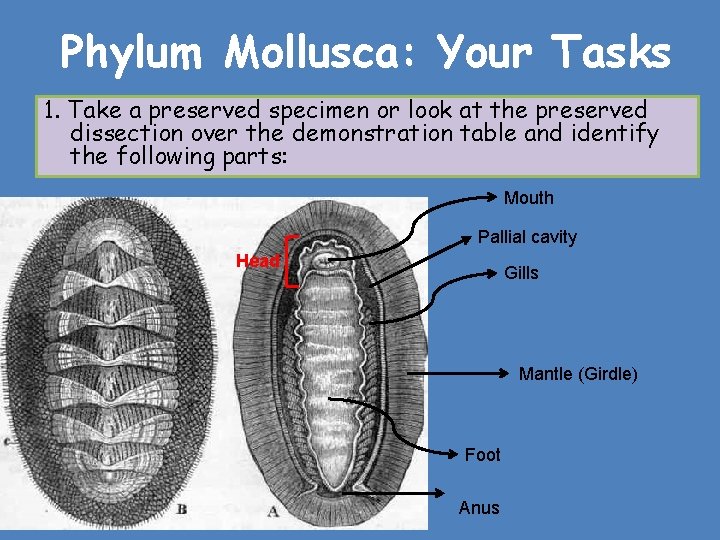
Phylum Mollusca: Your Tasks 1. Take a preserved specimen or look at the preserved dissection over the demonstration table and identify the following parts: Mouth Pallial cavity Head Gills Mantle (Girdle) Foot Anus
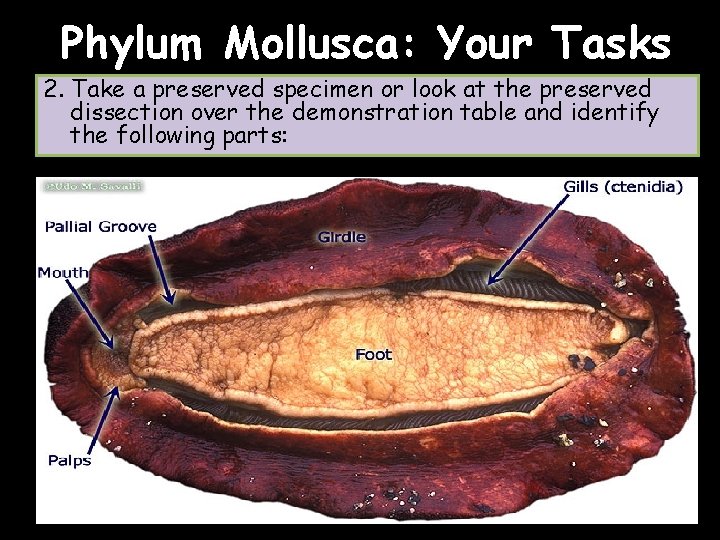
Phylum Mollusca: Your Tasks 2. Take a preserved specimen or look at the preserved dissection over the demonstration table and identify the following parts:

END
- Slides: 34