
LABORATORI NAZIONALI DI FRASCATI www lnf infn it
LABORATORI NAZIONALI DI FRASCATI www. lnf. infn. it The µ-RWELL in RD_FA G. Bencivenni 1, G. Cibinetto 2, P. Giacomelli 3 1. LNF – INFN , 2. INFN – Ferrara, 3. INFN – Bologna
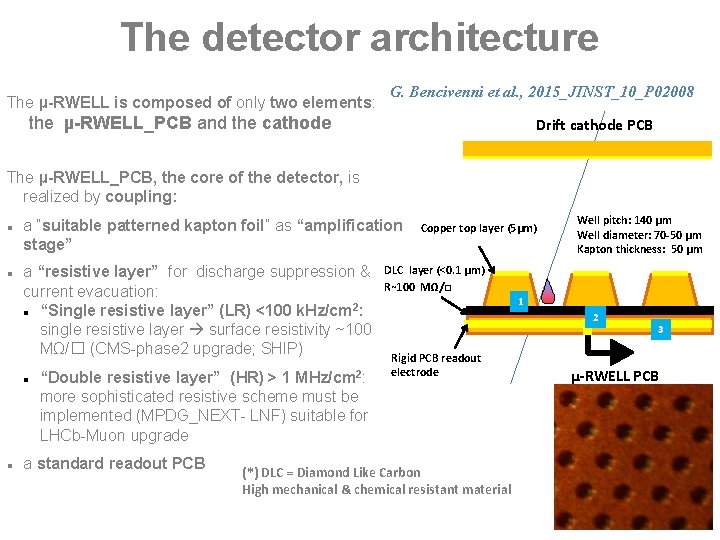
The detector architecture The µ-RWELL is composed of only two elements: G. Bencivenni et al. , 2015_JINST_10_P 02008 the µ-RWELL_PCB and the cathode Drift cathode PCB The µ-RWELL_PCB, the core of the detector, is realized by coupling: a “suitable patterned kapton foil” as “amplification stage” a “resistive layer” for discharge suppression & current evacuation: 2 “Single resistive layer” (LR) <100 k. Hz/cm : single resistive layer surface resistivity ~100 MΩ/☐ (CMS-phase 2 upgrade; SHIP) “Double resistive layer” (HR) > 1 MHz/cm 2: more sophisticated resistive scheme must be implemented (MPDG_NEXT- LNF) suitable for LHCb-Muon upgrade a standard readout PCB Well pitch: 140 µm Well diameter: 70 -50 µm Kapton thickness: 50 µm Copper top layer (5µm) DLC layer (<0. 1 µm) R 100 MΩ/□ 1 2 Rigid PCB readout electrode 3 µ-RWELL PCB (*) DLC = Diamond Like Carbon High mechanical & chemical resistant material 2
2017 R&D Program I. Technology Transfer to ELTOS for single-resistive layer (large area – collaboration w/CMS) PCB-RWELL manufacturing: in progress (final kapton etching still at CERN) II. Technology Transfer to Techtra for the etching of the amplification-stage (kapton etching): in progress III. Ageing Test @ GIF++ (in collaboration w/CMS) of large area single-layer RWELL + small area double-layer (v 1. 0) RWELL: in progress (until end 2017) IV. Construction of NEW prototypes based on double-resistive layer layout with pad readout: 10 x 10 cm 2 with pad size of 0. 6 x 0. 8 cm 2 V. Test Beam @ H 4 -SPS (5 – 19 Jul) : efficiency, cluster-size, rate capability (up to ~1 MHz/cm 2) VI. Test Beam @ PSI (4 – 18 Dec) with high intensity hadron beam in current mode (waiting for funding by Commissione I – 10 k€): - rate capability with a particle flux up to 20 MHz/cm 2 - discharge probability - integrating a charge equivalent to several years of operation @ HL-LHC VII. Presentato progetto MAECI: “Design, Industrialization and Production of an innovative Micro Pattern Gas Detector (MPGD) based on the micro-RWELL technology“
2018 R&D program The main goal of 2018: integrate the skills of both ELTOS/TECHTRA Companies to reach a fully operational single-resistive-layer (SRL) detector completely manufactured outside of CERN as a product on the shelf of the two Companies. To fulfil this milestone an intense fine tuning of all manufacturing steps must be scheduled, requiring several iterations and strict interactions with both Companies. The 2018 program will develop with the following scheme and task sharing: I. SRL micro-RWELL prototypes design with strips and pad readout: LNF II. optimization and industrialization of the production processes (for SRL scheme) at ELTOS/TECHTRA: LNF III. prototype construction and QC/QA with X-rays (gain, uniformity, rate capability): LNF IV. integration of the front-end electronics and DAQ: INFN-Fe V. DAQ and reconstruction software INFN-Fe VI. prototype characterization with pion/muon beam at H 4/H 8 -SPS-CERN (efficiency, spatial resolution): INFN-Bo, INFN-Fe, LNF
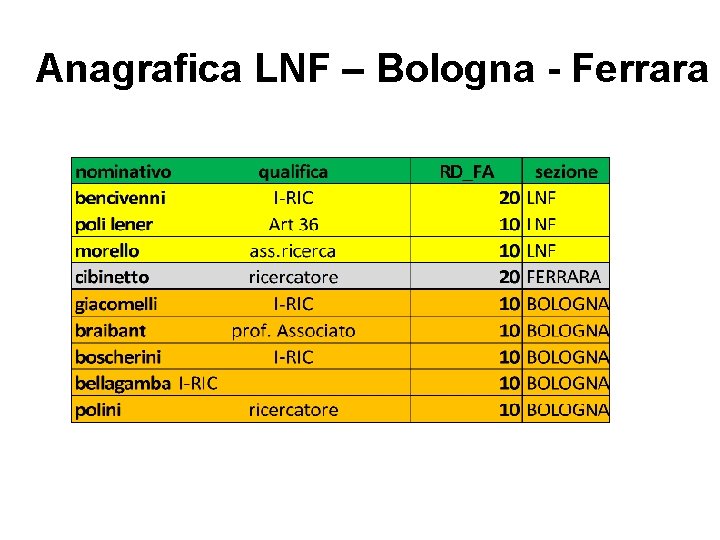
Anagrafica LNF – Bologna - Ferrara
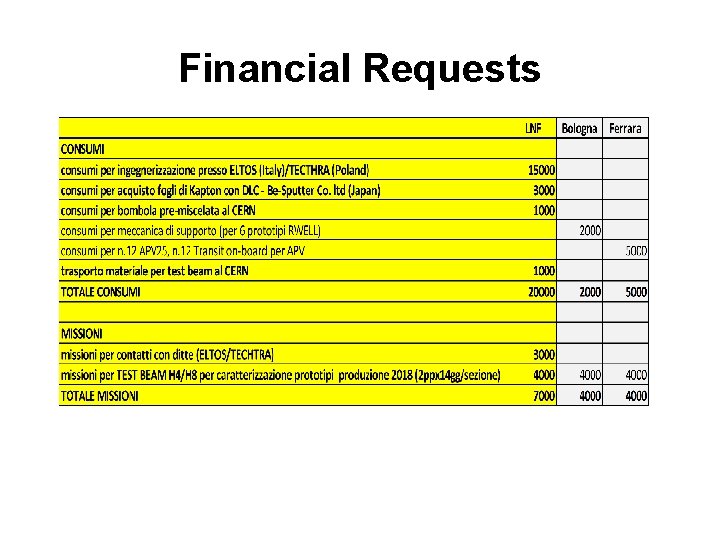
Financial Requests
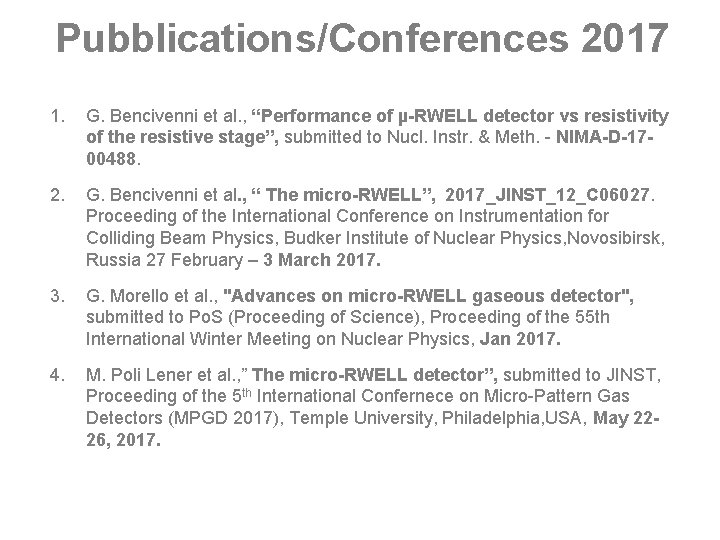
Pubblications/Conferences 2017 1. G. Bencivenni et al. , “Performance of µ-RWELL detector vs resistivity of the resistive stage”, submitted to Nucl. Instr. & Meth. - NIMA-D-1700488. 2. G. Bencivenni et al. , “ The micro-RWELL”, 2017_JINST_12_C 06027. Proceeding of the International Conference on Instrumentation for Colliding Beam Physics, Budker Institute of Nuclear Physics, Novosibirsk, Russia 27 February – 3 March 2017. 3. G. Morello et al. , "Advances on micro-RWELL gaseous detector", submitted to Po. S (Proceeding of Science), Proceeding of the 55 th International Winter Meeting on Nuclear Physics, Jan 2017. 4. M. Poli Lener et al. , ” The micro-RWELL detector”, submitted to JINST, Proceeding of the 5 th International Confernece on Micro-Pattern Gas Detectors (MPGD 2017), Temple University, Philadelphia, USA, May 2226, 2017.
- Slides: 7