
Laboratoire LeprinceRinguet Ecole Polytechnique Palaiseau Groupe dAcclration par
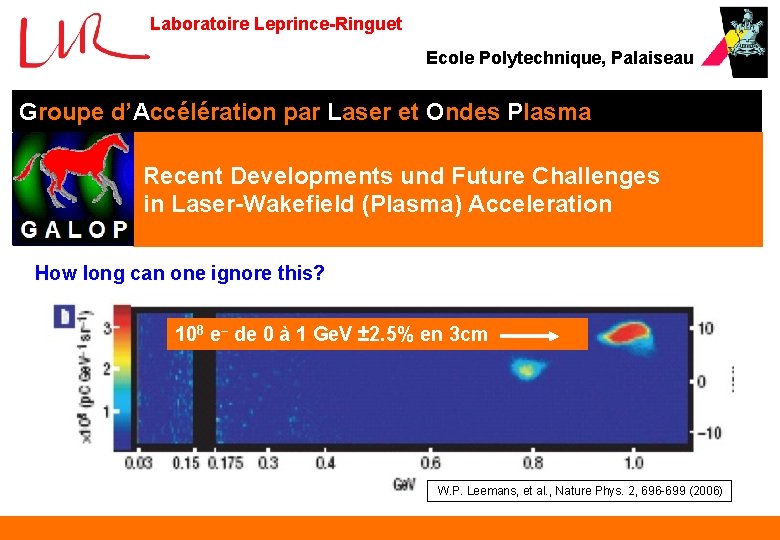
Laboratoire Leprince-Ringuet Ecole Polytechnique, Palaiseau Groupe d’Accélération par Laser et Ondes Plasma Recent Developments und Future Challenges in Laser-Wakefield (Plasma) Acceleration How long can one ignore this? 108 e– de 0 à 1 Ge. V ± 2. 5% en 3 cm W. P. Leemans, et al. , Nature Phys. 2, 696 -699 (2006)
introduction and basic concepts present and future challenges for plasma accelerators recent developments in laser plasma accelerators present and future plans
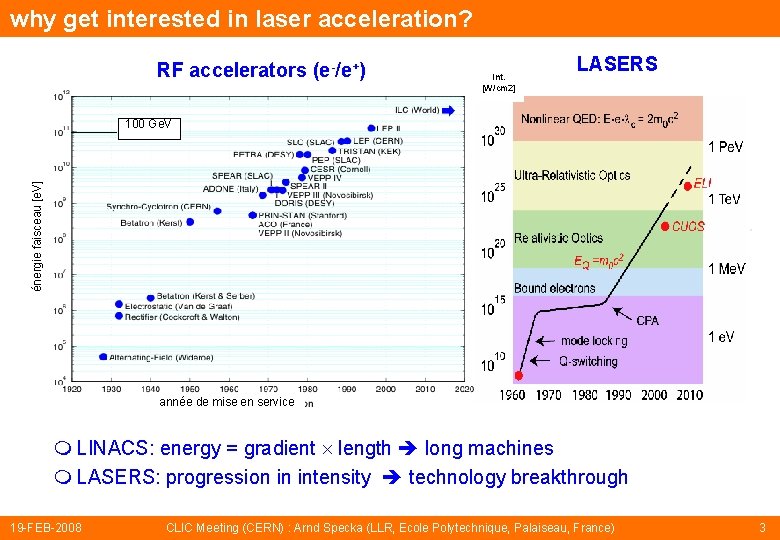
why get interested in laser acceleration? RF accelerators (e-/e+) Int. [W/cm 2] LASERS énergie faisceau [e. V] 100 Ge. V année de mise en service LINACS: energy = gradient length long machines LASERS: progression in intensity technology breakthrough 19 -FEB-2008 CLIC Meeting (CERN) : Arnd Specka (LLR, Ecole Polytechnique, Palaiseau, France) 3
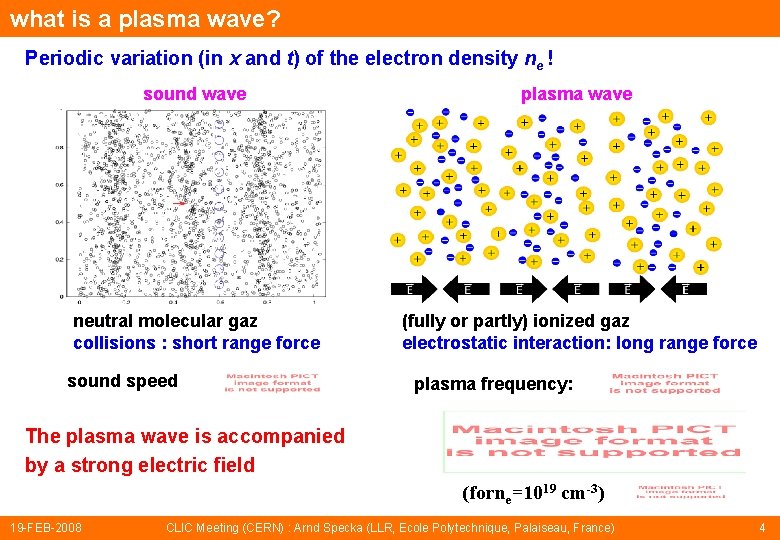
what is a plasma wave? Periodic variation (in x and t) of the electron density ne ! sound wave plasma wave neutral molecular gaz collisions : short range force (fully or partly) ionized gaz electrostatic interaction: long range force sound speed plasma frequency: The plasma wave is accompanied by a strong electric field (forne=1019 cm-3) 19 -FEB-2008 CLIC Meeting (CERN) : Arnd Specka (LLR, Ecole Polytechnique, Palaiseau, France) 4
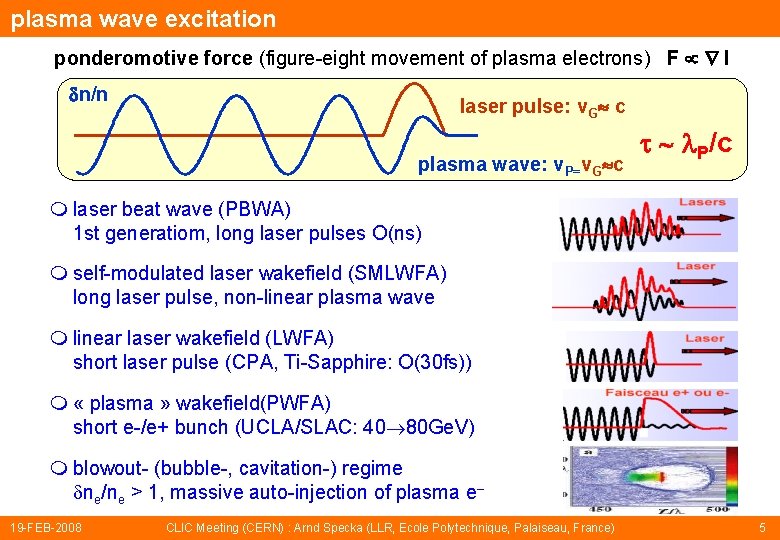
plasma wave excitation ponderomotive force (figure-eight movement of plasma electrons) F I dn/n laser pulse: v. G c plasma wave: v. P=v. G c t l. P/c laser beat wave (PBWA) 1 st generatiom, long laser pulses O(ns) self-modulated laser wakefield (SMLWFA) long laser pulse, non-linear plasma wave linear laser wakefield (LWFA) short laser pulse (CPA, Ti-Sapphire: O(30 fs)) « plasma » wakefield(PWFA) short e-/e+ bunch (UCLA/SLAC: 40 80 Ge. V) blowout- (bubble-, cavitation-) regime ne/ne > 1, massive auto-injection of plasma e– 19 -FEB-2008 CLIC Meeting (CERN) : Arnd Specka (LLR, Ecole Polytechnique, Palaiseau, France) 5
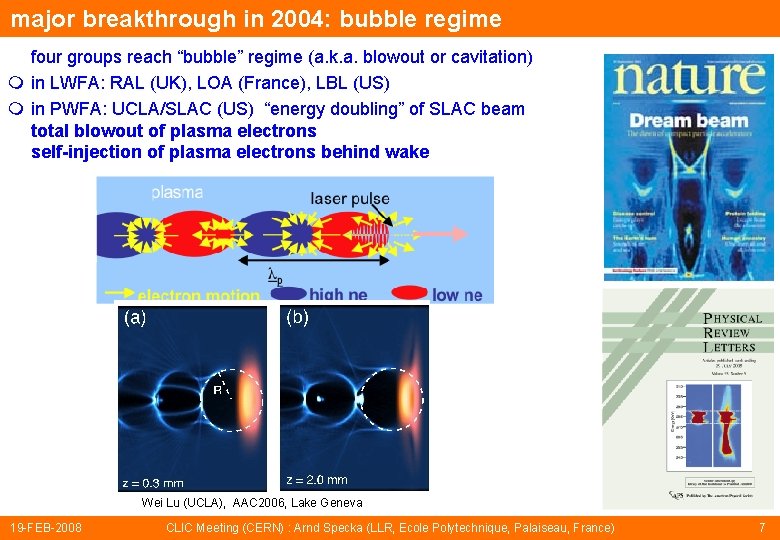
major breakthrough in 2004: bubble regime four groups reach “bubble” regime (a. k. a. blowout or cavitation) in LWFA: RAL (UK), LOA (France), LBL (US) in PWFA: UCLA/SLAC (US) “energy doubling” of SLAC beam total blowout of plasma electrons self-injection of plasma electrons behind wake Wei Lu (UCLA), AAC 2006, Lake Geneva 19 -FEB-2008 CLIC Meeting (CERN) : Arnd Specka (LLR, Ecole Polytechnique, Palaiseau, France) 7
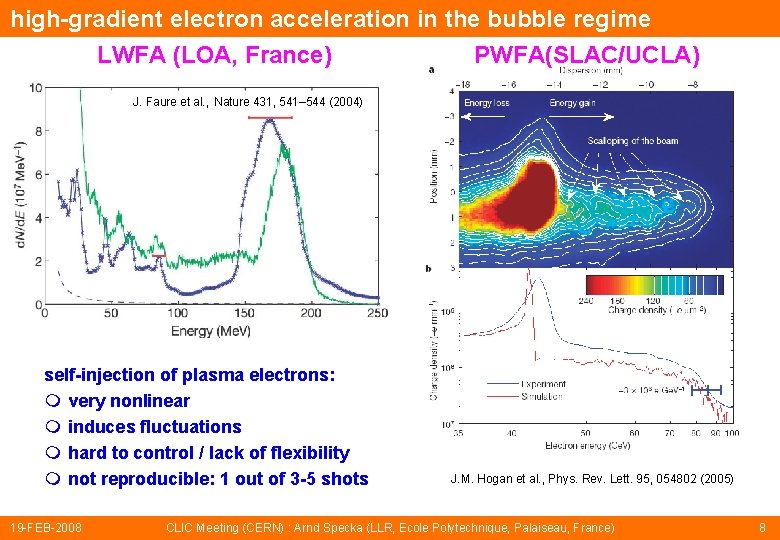
high-gradient electron acceleration in the bubble regime LWFA (LOA, France) PWFA(SLAC/UCLA) J. Faure et al. , Nature 431, 541– 544 (2004) self-injection of plasma electrons: very nonlinear induces fluctuations hard to control / lack of flexibility not reproducible: 1 out of 3 -5 shots 19 -FEB-2008 J. M. Hogan et al. , Phys. Rev. Lett. 95, 054802 (2005) CLIC Meeting (CERN) : Arnd Specka (LLR, Ecole Polytechnique, Palaiseau, France) 8
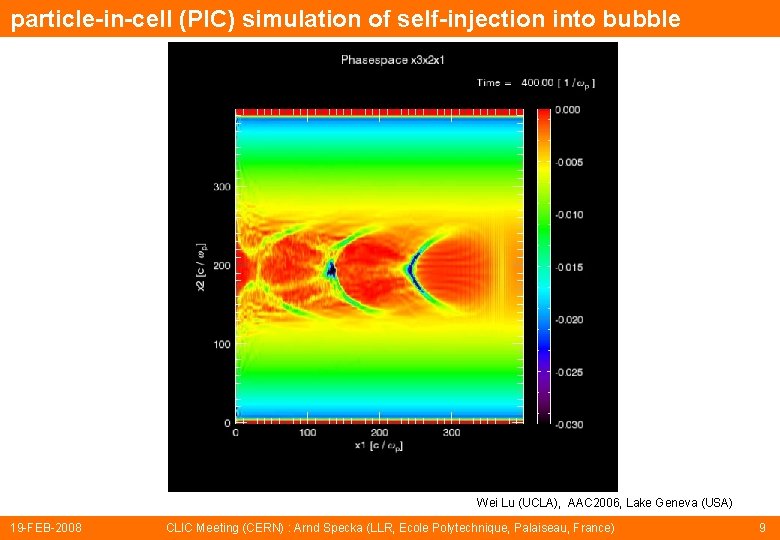
particle-in-cell (PIC) simulation of self-injection into bubble Wei Lu (UCLA), AAC 2006, Lake Geneva (USA) 19 -FEB-2008 CLIC Meeting (CERN) : Arnd Specka (LLR, Ecole Polytechnique, Palaiseau, France) 9
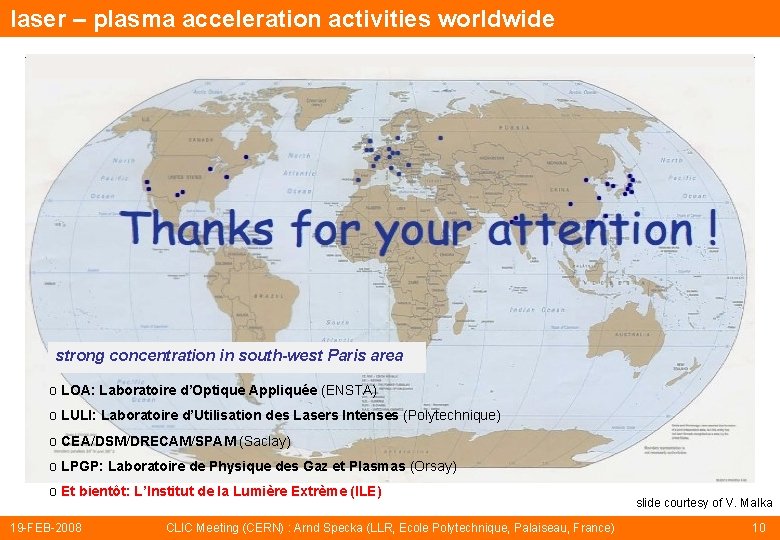
laser – plasma acceleration activities worldwide strong concentration in south-west Paris area o LOA: Laboratoire d’Optique Appliquée (ENSTA) o LULI: Laboratoire d’Utilisation des Lasers Intenses (Polytechnique) o CEA/DSM/DRECAM/SPAM (Saclay) o LPGP: Laboratoire de Physique des Gaz et Plasmas (Orsay) o Et bientôt: L’Institut de la Lumière Extrème (ILE) 19 -FEB-2008 CLIC Meeting (CERN) : Arnd Specka (LLR, Ecole Polytechnique, Palaiseau, France) slide courtesy of V. Malka 10
introduction and basic concepts present and future challenges for plasma accelerators recent developments in laser plasma accelerators present and future plans
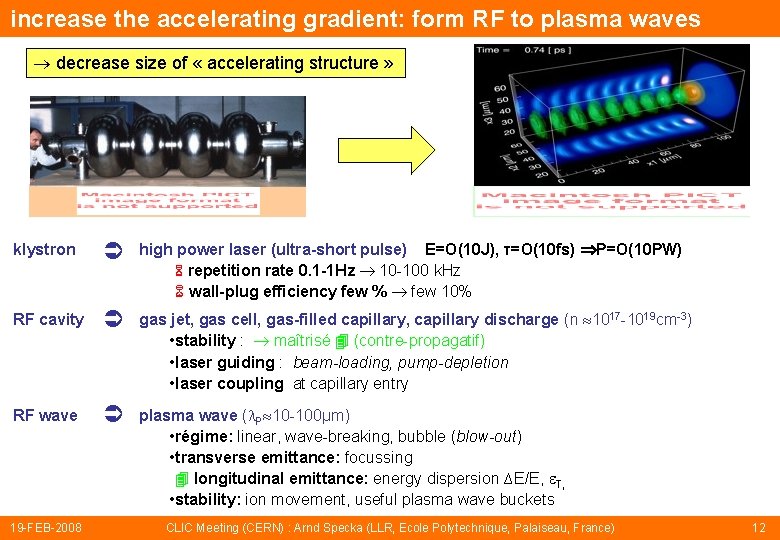
increase the accelerating gradient: form RF to plasma waves decrease size of « accelerating structure » klystron high power laser (ultra-short pulse) E=O(10 J), τ=O(10 fs) P=O(10 PW) repetition rate 0. 1 -1 Hz 10 -100 k. Hz wall-plug efficiency few % few 10% RF cavity gas jet, gas cell, gas-filled capillary, capillary discharge (n 1017 -1019 cm-3) • stability : maîtrisé (contre-propagatif) • laser guiding : beam-loading, pump-depletion • laser coupling at capillary entry RF wave plasma wave ( P 10 -100µm) • régime: linear, wave-breaking, bubble (blow-out) • transverse emittance: focussing longitudinal emittance: energy dispersion ∆E/E, T, • stability: ion movement, useful plasma wave buckets 19 -FEB-2008 CLIC Meeting (CERN) : Arnd Specka (LLR, Ecole Polytechnique, Palaiseau, France) 12
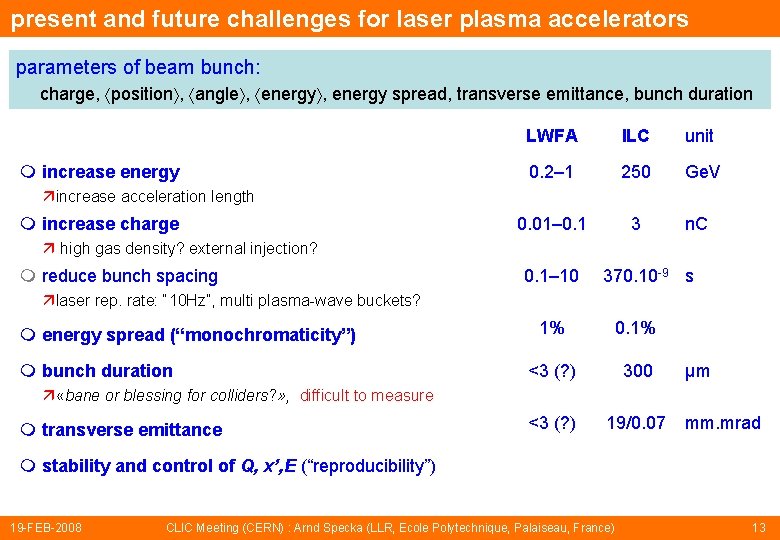
present and future challenges for laser plasma accelerators parameters of beam bunch: charge, position , angle , energy , energy spread, transverse emittance, bunch duration increase energy LWFA ILC unit 0. 2– 1 250 Ge. V 0. 01– 0. 1 3 increase acceleration length increase charge n. C high gas density? external injection? reduce bunch spacing 0. 1– 10 370. 10 -9 s laser rep. rate: “ 10 Hz”, multi plasma-wave buckets? energy spread (“monochromaticity”) bunch duration 1% 0. 1% <3 (? ) 300 <3 (? ) 19/0. 07 µm «bane or blessing for colliders? » , difficult to measure transverse emittance mm. mrad stability and control of Q, x’, E (“reproducibility”) 19 -FEB-2008 CLIC Meeting (CERN) : Arnd Specka (LLR, Ecole Polytechnique, Palaiseau, France) 13
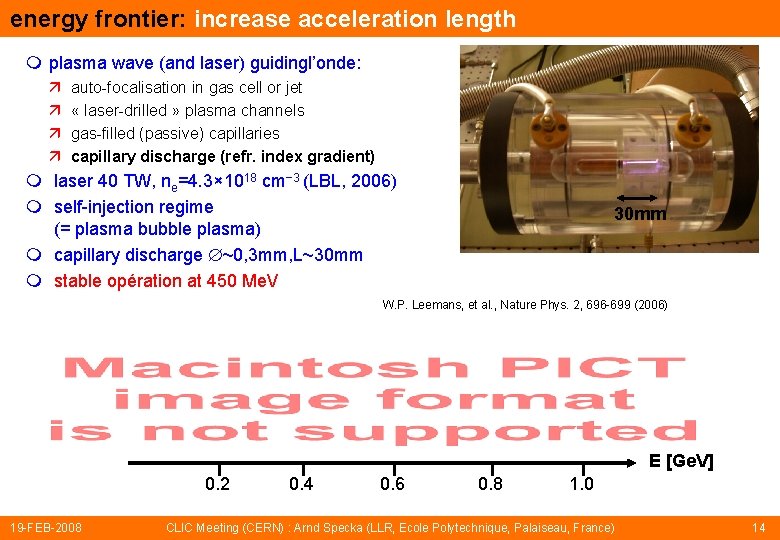
energy frontier: increase acceleration length plasma wave (and laser) guidingl’onde: auto-focalisation in gas cell or jet « laser-drilled » plasma channels gas-filled (passive) capillaries capillary discharge (refr. index gradient) laser 40 TW, ne=4. 3× 1018 cm− 3 (LBL, 2006) self-injection regime (= plasma bubble plasma) capillary discharge ~0, 3 mm, L~30 mm stable opération at 450 Me. V 30 mm W. P. Leemans, et al. , Nature Phys. 2, 696 -699 (2006) E [Ge. V] 0. 2 19 -FEB-2008 0. 4 0. 6 0. 8 1. 0 CLIC Meeting (CERN) : Arnd Specka (LLR, Ecole Polytechnique, Palaiseau, France) 14
introduction and basic concepts present and future challenges for plasma accelerators recent developments in laser plasma accelerators present and future plans
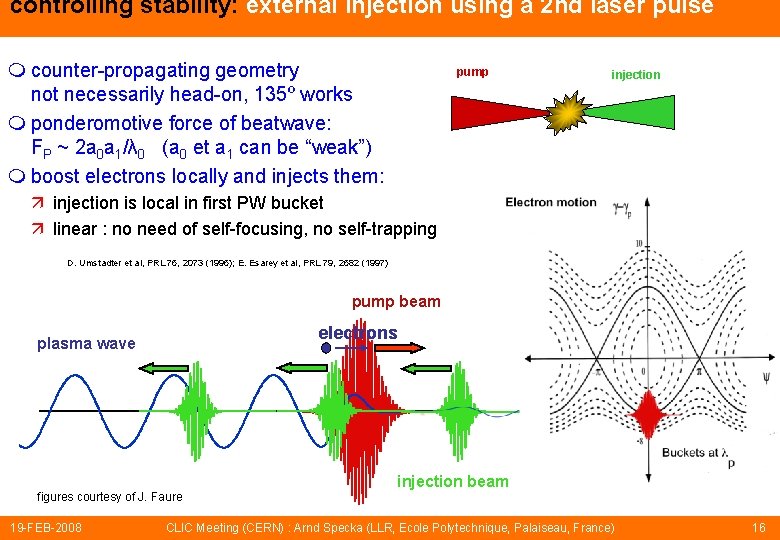
controlling stability: external injection using a 2 nd laser pulse counter-propagating geometry not necessarily head-on, 135º works ponderomotive force of beatwave: FP ~ 2 a 0 a 1/λ 0 (a 0 et a 1 can be “weak”) boost electrons locally and injects them: pump injection is local in first PW bucket linear : no need of self-focusing, no self-trapping D. Umstadter et al, PRL 76, 2073 (1996); E. Esarey et al, PRL 79, 2682 (1997) pump beam electrons plasma wave figures courtesy of J. Faure 19 -FEB-2008 injection beam CLIC Meeting (CERN) : Arnd Specka (LLR, Ecole Polytechnique, Palaiseau, France) 16
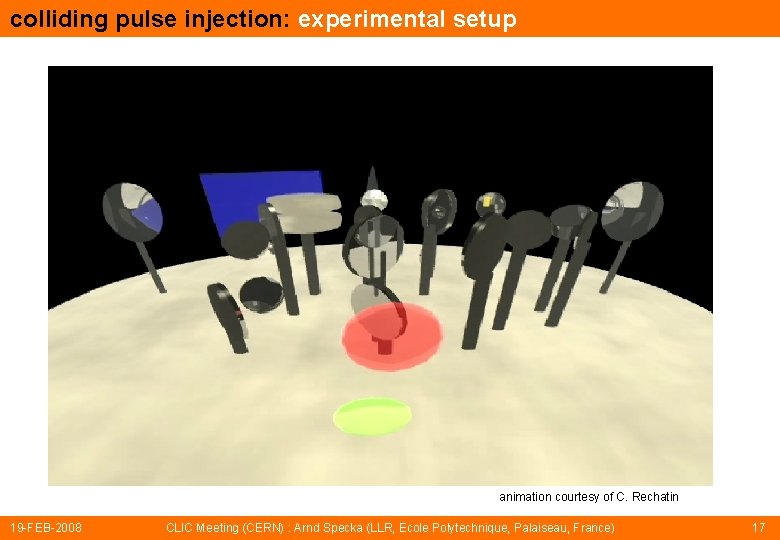
colliding pulse injection: experimental setup animation courtesy of C. Rechatin 19 -FEB-2008 CLIC Meeting (CERN) : Arnd Specka (LLR, Ecole Polytechnique, Palaiseau, France) 17
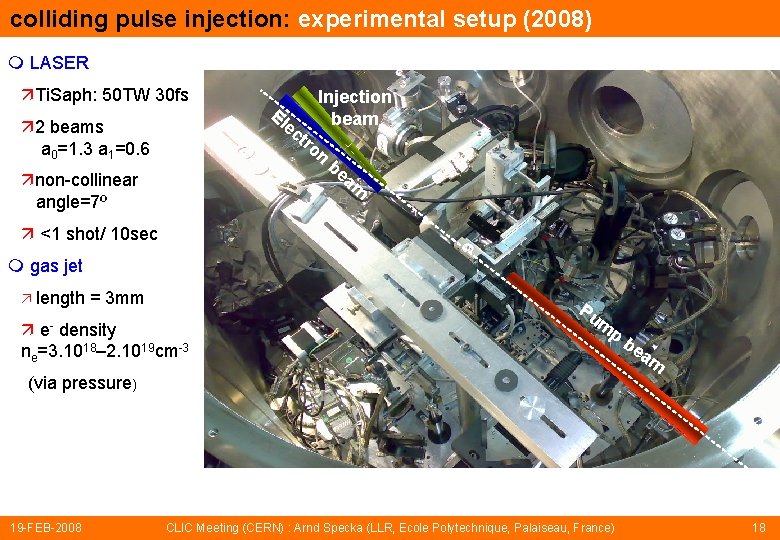
colliding pulse injection: experimental setup (2008) LASER Ti. Saph: 50 TW 30 fs El ec tro Injection beam 2 beams a 0=1. 3 a 1=0. 6 n non-collinear angle=7º be am <1 shot/ 10 sec gas jet length = 3 mm e- density ne=3. 1018– 2. 1019 cm-3 Pu m p be am (via pressure) 19 -FEB-2008 CLIC Meeting (CERN) : Arnd Specka (LLR, Ecole Polytechnique, Palaiseau, France) 18
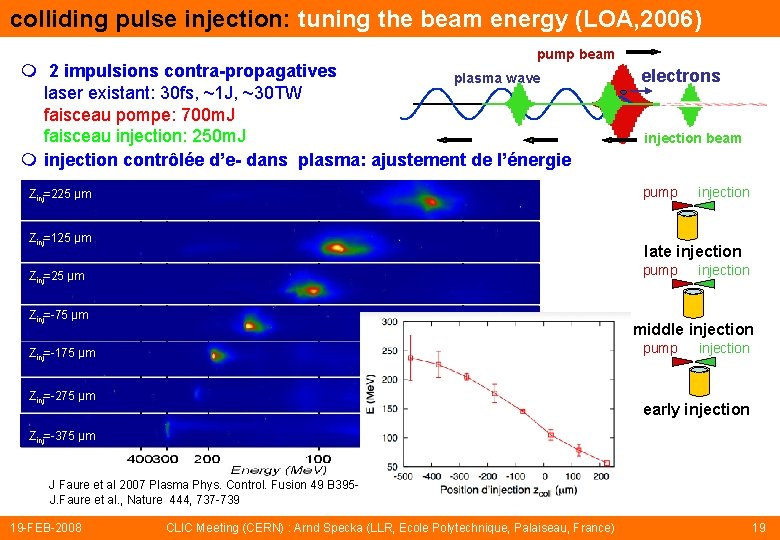
colliding pulse injection: tuning the beam energy (LOA, 2006) pump beam 2 impulsions contra-propagatives plasma wave laser existant: 30 fs, ~1 J, ~30 TW faisceau pompe: 700 m. J faisceau injection: 250 m. J injection contrôlée d’e- dans plasma: ajustement de l’énergie electrons injection beam pump Zinj=225 μm Zinj=125 μm injection late injection pump Zinj=25 μm Zinj=-75 μm injection middle injection pump Zinj=-175 μm Zinj=-275 μm injection early injection Zinj=-375 μm J Faure et al 2007 Plasma Phys. Control. Fusion 49 B 395 -B 402 J. Faure et al. , Nature 444, 737 -739 19 -FEB-2008 CLIC Meeting (CERN) : Arnd Specka (LLR, Ecole Polytechnique, Palaiseau, France) 19
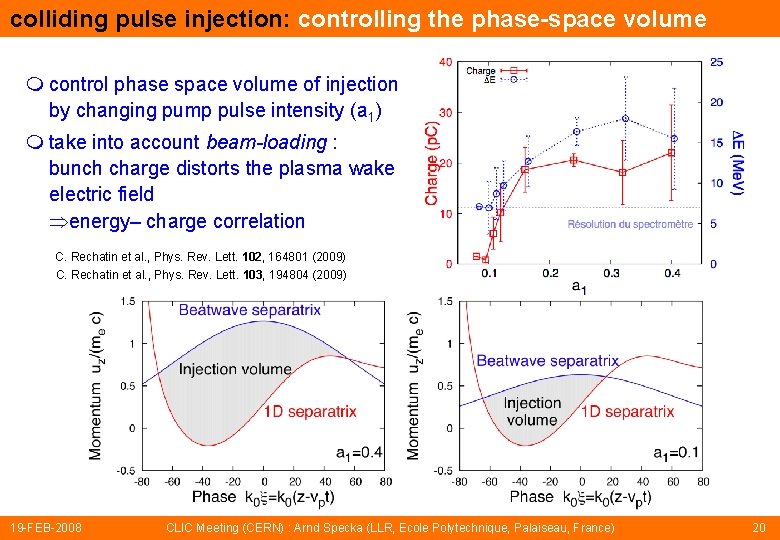
colliding pulse injection: controlling the phase-space volume control phase space volume of injection by changing pump pulse intensity (a 1) take into account beam-loading : bunch charge distorts the plasma wake electric field energy– charge correlation C. Rechatin et al. , Phys. Rev. Lett. 102, 164801 (2009) C. Rechatin et al. , Phys. Rev. Lett. 103, 194804 (2009) 19 -FEB-2008 CLIC Meeting (CERN) : Arnd Specka (LLR, Ecole Polytechnique, Palaiseau, France) 20
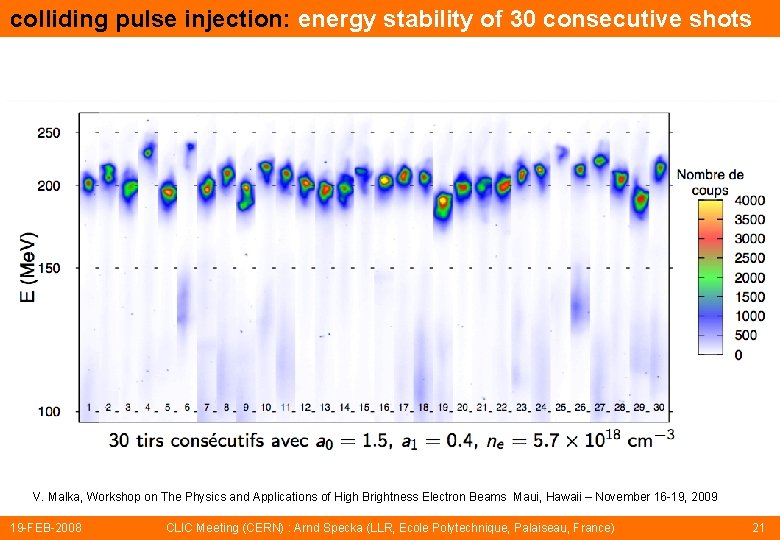
colliding pulse injection: energy stability of 30 consecutive shots V. Malka, Workshop on The Physics and Applications of High Brightness Electron Beams Maui, Hawaii – November 16 -19, 2009 19 -FEB-2008 CLIC Meeting (CERN) : Arnd Specka (LLR, Ecole Polytechnique, Palaiseau, France) 21
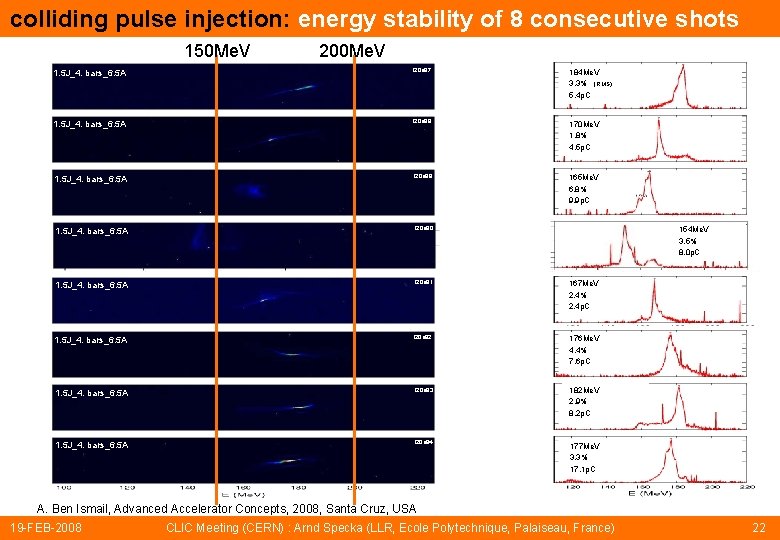
colliding pulse injection: energy stability of 8 consecutive shots 150 Me. V 200 Me. V 1. 5 J_4. bars_6. 5 A l 20 n 87 184 Me. V 3. 3% (RMS) 5. 4 p. C 1. 5 J_4. bars_6. 5 A l 20 n 88 170 Me. V 1. 8% 4. 5 p. C 1. 5 J_4. bars_6. 5 A l 20 n 89 165 Me. V 6. 8% 9. 9 p. C 1. 5 J_4. bars_6. 5 A l 20 n 90 1. 5 J_4. bars_6. 5 A l 20 n 91 167 Me. V 2. 4% 2. 4 p. C 1. 5 J_4. bars_6. 5 A l 20 n 92 176 Me. V 4. 4% 7. 6 p. C 1. 5 J_4. bars_6. 5 A l 20 n 93 182 Me. V 2. 9% 8. 2 p. C 1. 5 J_4. bars_6. 5 A l 20 n 94 177 Me. V 3. 3% 17. 1 p. C 154 Me. V 3. 5% 8. 0 p. C A. Ben Ismail, Advanced Accelerator Concepts, 2008, Santa Cruz, USA 19 -FEB-2008 CLIC Meeting (CERN) : Arnd Specka (LLR, Ecole Polytechnique, Palaiseau, France) 22
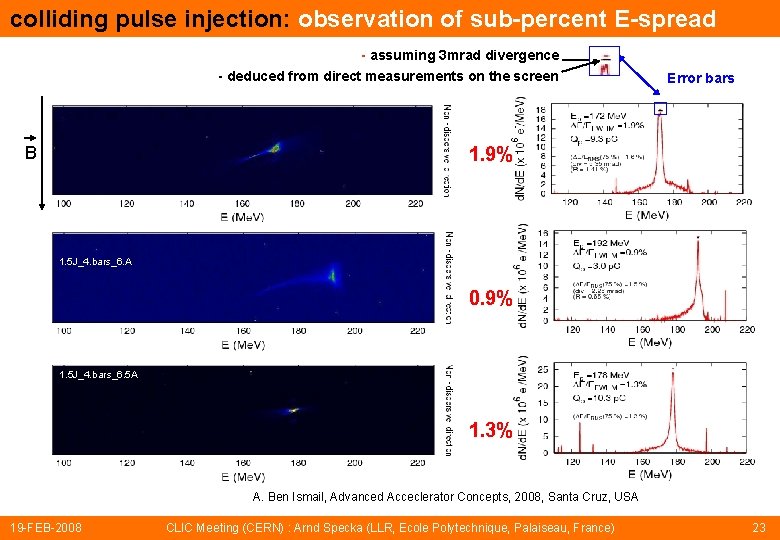
colliding pulse injection: observation of sub-percent E-spread - assuming 3 mrad divergence. - deduced from direct measurements on the screen 1. 5 J_4. bars_6. A l 20 n 277 i 4 B Error bars 1. 9% 1. 5 J_4. bars_6. A l 20 n 223 i 6 1. 5 J_4. bars_6. A 0. 9% 1. 5 J_4. bars_6. 5 A l 20 n 97 i 6 1. 3% A. Ben Ismail, Advanced Acceclerator Concepts, 2008, Santa Cruz, USA 19 -FEB-2008 CLIC Meeting (CERN) : Arnd Specka (LLR, Ecole Polytechnique, Palaiseau, France) 23
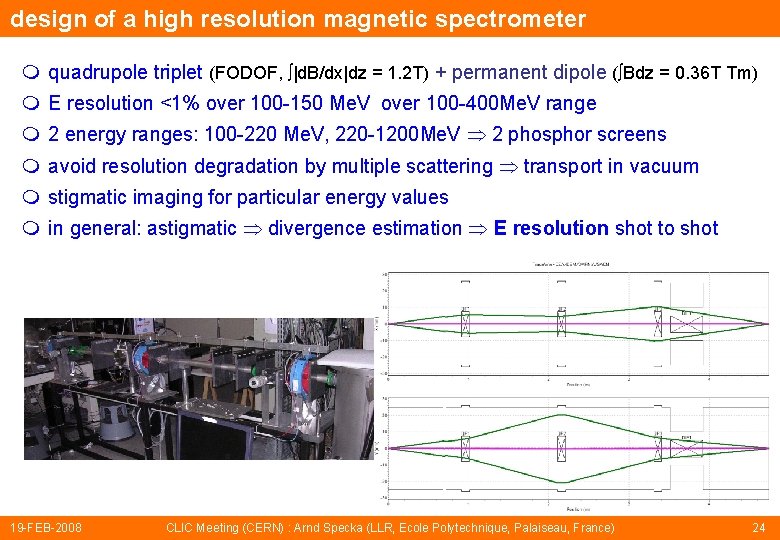
design of a high resolution magnetic spectrometer quadrupole triplet (FODOF, |d. B/dx|dz = 1. 2 T) + permanent dipole ( Bdz = 0. 36 T Tm) E resolution <1% over 100 -150 Me. V over 100 -400 Me. V range 2 energy ranges: 100 -220 Me. V, 220 -1200 Me. V 2 phosphor screens avoid resolution degradation by multiple scattering transport in vacuum stigmatic imaging for particular energy values in general: astigmatic divergence estimation E resolution shot to shot 19 -FEB-2008 CLIC Meeting (CERN) : Arnd Specka (LLR, Ecole Polytechnique, Palaiseau, France) 24
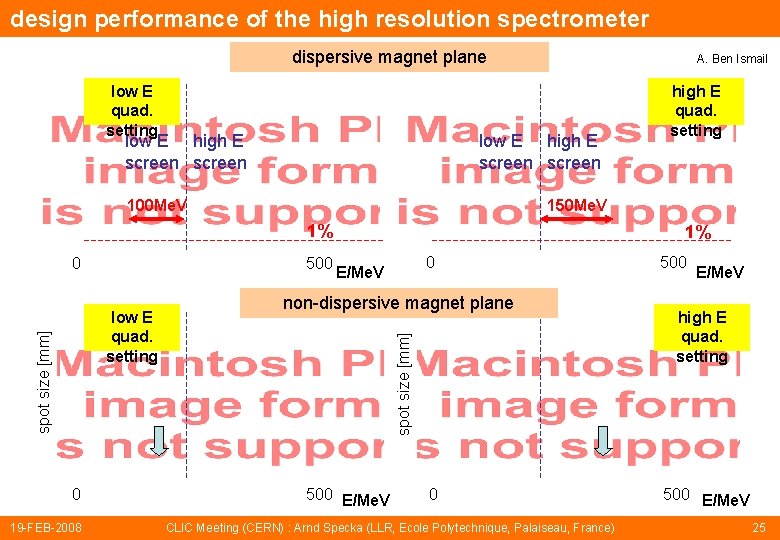
design performance of the high resolution spectrometer dispersive magnet plane low E quad. setting low E high E screen A. Ben Ismail low E high E screen 100 Me. V 150 Me. V 1% 500 spot size [mm] low E quad. setting 0 19 -FEB-2008 1% 0 E/Me. V non-dispersive magnet plane spot size [mm] 0 high E quad. setting 500 E/Me. V 0 CLIC Meeting (CERN) : Arnd Specka (LLR, Ecole Polytechnique, Palaiseau, France) 500 E/Me. V high E quad. setting 500 E/Me. V 25
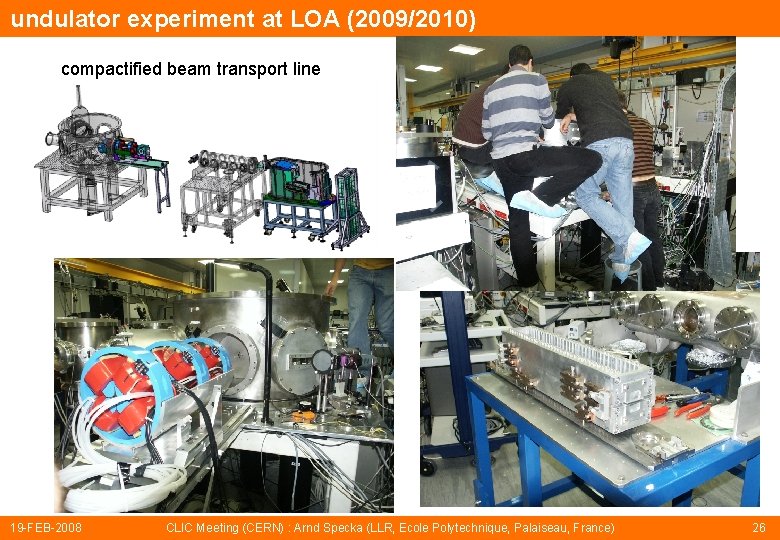
undulator experiment at LOA (2009/2010) compactified beam transport line 19 -FEB-2008 CLIC Meeting (CERN) : Arnd Specka (LLR, Ecole Polytechnique, Palaiseau, France) 26
introduction and basic concepts present and future challenges for plasma accelerators recent developments in laser plasma accelerators present and future plans
Near term plans injection of plasma generated beam into an undulator (under way) also: caracterisation of the modified beam transport line increase accélération length capillary discharge, acceleration length 20 mm E 1 Ge. V single laser pulse and colliding pulse injection further improvement of high resolution spectrometer prepare transverse emittance measurement (at ~ 100– 200 Me. V) motivation: emittance supposed to be small high luminosity (one day) transverse size of accelerating zone << laser spot (plasma simulations) N, x x x 20 m/10 3 mrad 350 2 mm. mrad what physics determines the transverse emittance? can one efficiently control the phase space volume at injection? small repetition rate & strong shot-to-shot fluctuations of beam parameters need single-shot measurement (phase-space sampling, MS / PP) 19 -FEB-2008 CLIC Meeting (CERN) : Arnd Specka (LLR, Ecole Polytechnique, Palaiseau, France) 28
present et future context LOA : «salle jaune» laser 40 TW, 30 fs improvements in 2011, dedicated experimental zones CEA (SPAM) : IRAMIS UHI 100 TW 30 fs, 2 salles ILE (Institut de la Lumière Extrême) located in south-west Paris area two lasers: LUIRE: 1 PW, 15 fs, 0. 1 Hz, 1 st light 2012? APOLLON: 10 PW, 15 fs, 0. 01 Hz, 2014? applications: e-. p, XFEL GALOP contributes to « systems control » workpackage, management, experiments ELI (Extreme Light Infrastructure) international installation 10 fois ILE (100 PW) on roadmap de ESFRI 19 -FEB-2008 CLIC Meeting (CERN) : Arnd Specka (LLR, Ecole Polytechnique, Palaiseau, France) 29
- Slides: 28