
Labor Positions Support in 1 st Stage Rhythmic
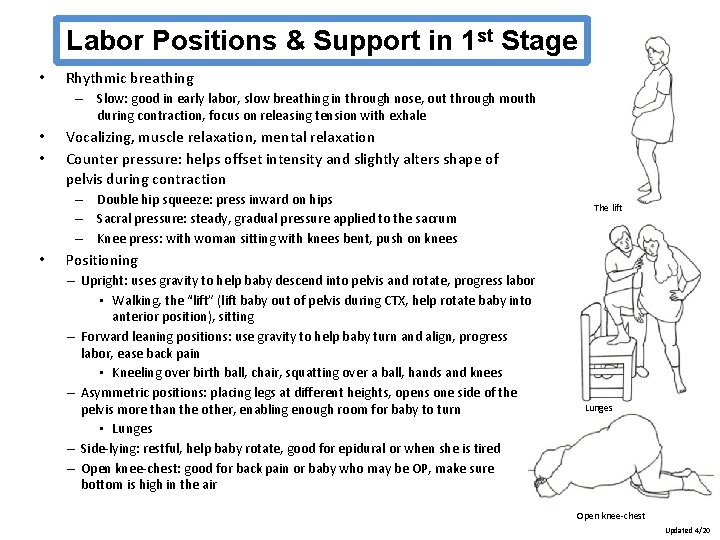
Labor Positions & Support in 1 st Stage • Rhythmic breathing – • • Vocalizing, muscle relaxation, mental relaxation Counter pressure: helps offset intensity and slightly alters shape of pelvis during contraction – – – • Slow: good in early labor, slow breathing in through nose, out through mouth during contraction, focus on releasing tension with exhale Double hip squeeze: press inward on hips Sacral pressure: steady, gradual pressure applied to the sacrum Knee press: with woman sitting with knees bent, push on knees The lift Positioning – Upright: uses gravity to help baby descend into pelvis and rotate, progress labor • Walking, the “lift” (lift baby out of pelvis during CTX, help rotate baby into anterior position), sitting – Forward leaning positions: use gravity to help baby turn and align, progress labor, ease back pain • Kneeling over birth ball, chair, squatting over a ball, hands and knees – Asymmetric positions: placing legs at different heights, opens one side of the pelvis more than the other, enabling enough room for baby to turn • Lunges – Side-lying: restful, help baby rotate, good for epidural or when she is tired – Open knee-chest: good for back pain or baby who may be OP, make sure bottom is high in the air Lunges Open knee-chest Updated 4/20
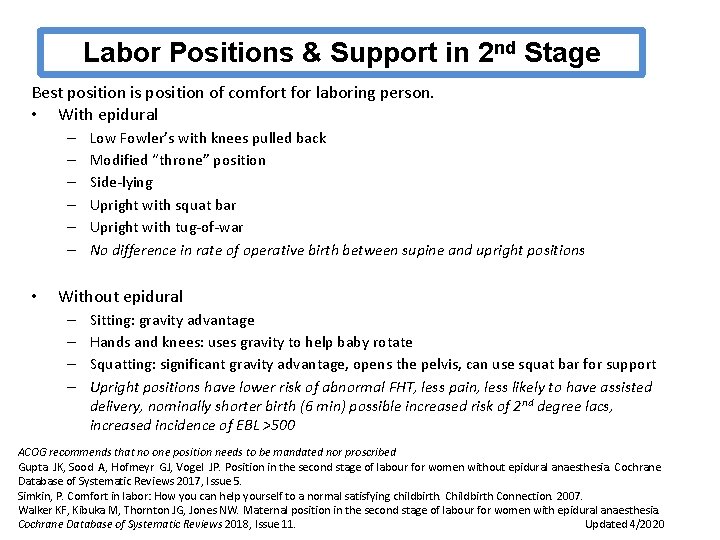
Labor Positions & Support in 2 nd Stage Best position is position of comfort for laboring person. • With epidural – – – • Low Fowler’s with knees pulled back Modified “throne” position Side-lying Upright with squat bar Upright with tug-of-war No difference in rate of operative birth between supine and upright positions Without epidural – – Sitting: gravity advantage Hands and knees: uses gravity to help baby rotate Squatting: significant gravity advantage, opens the pelvis, can use squat bar for support Upright positions have lower risk of abnormal FHT, less pain, less likely to have assisted delivery, nominally shorter birth (6 min) possible increased risk of 2 nd degree lacs, increased incidence of EBL >500 ACOG recommends that no one position needs to be mandated nor proscribed Gupta JK, Sood A, Hofmeyr GJ, Vogel JP. Position in the second stage of labour for women without epidural anaesthesia. Cochrane Database of Systematic Reviews 2017, Issue 5. Simkin, P. Comfort in labor: How you can help yourself to a normal satisfying childbirth. Childbirth Connection. 2007. Walker KF, Kibuka M, Thornton JG, Jones NW. Maternal position in the second stage of labour for women with epidural anaesthesia. Cochrane Database of Systematic Reviews 2018, Issue 11. Updated 4/2020
- Slides: 2