
Labor Markets and Labor Unions CHAPTER 12 2003
Labor Markets and Labor Unions CHAPTER 12 © 2003 South-Western/Thomson Learning 1
Labor Supply As a resource supplier, a person has a labor supply curve for each of the many possible uses of their labor To some markets, the quantity supplied is zero over the realistic range of wages An individual’s labor supply to each market depends, among other things, on their ability, their taste for the job in question, and the opportunity cost of their time, assuming wages in other markets remain constant 2
Labor Supply and Utility Maximization Individuals attempt to use their scarce resources so as to maximize their utility Two sources of utility are of special interest to us here The consumption of goods and services The enjoyment of leisure The utility derived from consuming goods and services is obvious and serves as the basis for consumer demand 3

Labor Supply and Utility Maximization Another valuable source of utility is leisure Leisure is a normal good that, like other goods, is subject to the law of diminishing marginal utility Therefore, the more leisure time a person has, the less they value an additional unit of it 4
Three Uses of Time Individuals can use their time in three ways They can undertake market work selling your time in the labor market in return for income They can undertake nonmarket work using their time to produce their own goods and services They can spend time as leisure all nonwork uses of their time 5

Work and Utility Work is not a pure source of utility, rather it is a source of disutility the opposite of utility Work is also subject to increasing marginal disutility the more a person works, the greater the marginal disutility of working another hour 6
Work and Utility Net utility of work -- the utility of consumption made possible through work minus the disutility of the work itself – usually makes some amount of work an attractive use of some of an individual’s time In the case of market work, the individual’s income buys goods and services 7
Utility Maximization Within the limits of a 24 -hour day, seven days a week, individuals can balance their time among market work, nonmarket work, and leisure to maximize utility The rational consumer will attempt to maximize utility by allocating their time so that the expected utility of the last unit of time spent in each activity is identical MUMW = MUL = MUNMW 8
Implications First, consider the choice among market work, nonmarket work, and leisure The higher your market wage, other things constant, the higher your opportunity cost of leisure and nonmarket work Among those earning the same market wage, people who are handy around the house will do more work for themselves The higher the expected earnings right out of high school, other things constant, the higher the opportunity cost of attending college 9
Wages and Individual Labor Supply To explain why an individual will initially increase the quantity of labor supplied and then eventually reduce the quantity of labor supplied, we need to consider the impact of wage increases on the allocation of time An increase in the wage affects an individual’s choice between market work and other uses of time in two ways Substitution Effect Income Effect 10
Substitution Effect A higher wage provides an individual with an incentive to work more, since each hour of work now buys more goods and services As the wage increases, you substitute market work for other activities substitution effect of a wage increase 11
Income Effect A higher wage also means a higher income for the same number of hours the demand for all normal goods increases Since leisure is a normal good, a higher income increases the demand for leisure the allocation of time to market work declines The income effect of a wage increase tends to reduce the quantity of labor supplied to market work 12
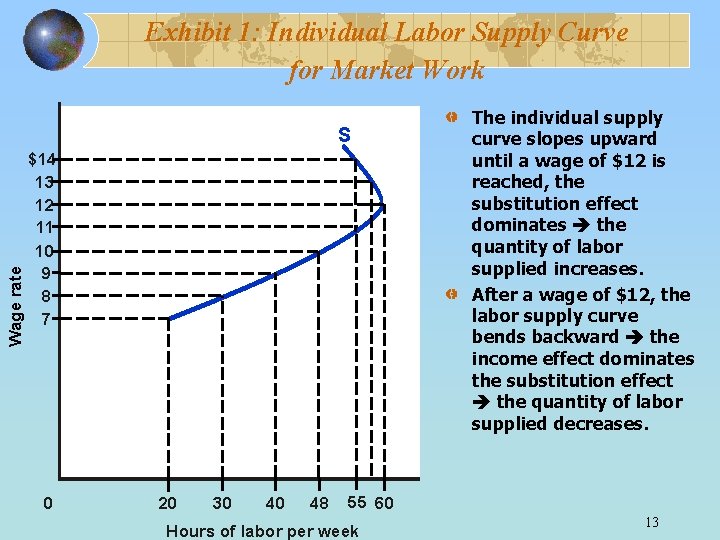
Exhibit 1: Individual Labor Supply Curve for Market Work Wage rate S $14 13 12 11 10 9 8 7 0 20 30 40 48 The individual supply curve slopes upward until a wage of $12 is reached, the substitution effect dominates the quantity of labor supplied increases. After a wage of $12, the labor supply curve bends backward the income effect dominates the substitution effect the quantity of labor supplied decreases. 55 60 Hours of labor per week 13
Flexibility of Hours Worked The model constructed previously assumes that workers have some control over the number of hours they work All of the following factors support this assumption Opportunities for part time work and overtime Control over timing and length of vacations How long a person stays in school and when they retire 14
Nonwage Determinants of Labor Supply The supply of labor to a particular market depends on a variety of factors other than the wage Other sources of income Nonmonetary factors Value of job experience Taste for work 15
Other Sources of Income The willingness to supply time to a labor market depends on income on other sources, including prior savings, borrowing, family support, and similar sources More generally, wealthy people have less incentive to work 16

Nonmonetary Factors Labor is a special kind of resource Unlike capital and land, which can be supplied regardless of the whereabouts of the resource owner, the supplier of labor must be in the same place where the work is performed Because the individual must be physically present to supply labor, such nonmonetary factors become important 17
Nonmonetary Factors Nonmonetary factors Difficulty of the job the more difficult the job, the higher the wage must be, all other things being equal Quality of the work environment the more attractive the working conditions, the more labor an individual will supply to that particular market, other things constant Status of the position the higher the status, the more labor an individual will supply to that market, other things constant 18
Value of Job Experience All else equal, the individual is more inclined to take a job that provides valuable experience Some are willing to accept relatively low wages now because of the promise of higher wages later Generally speaking, the more a job enhances future earning possibilities, the greater the supply of labor to that occupation, other things constant 19
Taste for Work Just as the tastes for goods and services differ among consumers, the tastes for work also differ among labor suppliers Some prefer physical labor while others prefer desk job Economists argue that tastes are relatively stable and individuals will supply more labor to jobs they like 20
Market Supply of Labor The supply of labor to a particular market is the horizontal sum of all the individual supply curves adds the quantities supplied by each worker at each particular wage Since individuals have different opportunity costs and tastes for work, and some individual labor supply curves may not bend backward at all, the market supply curve in Exhibit 2 slopes upward 21
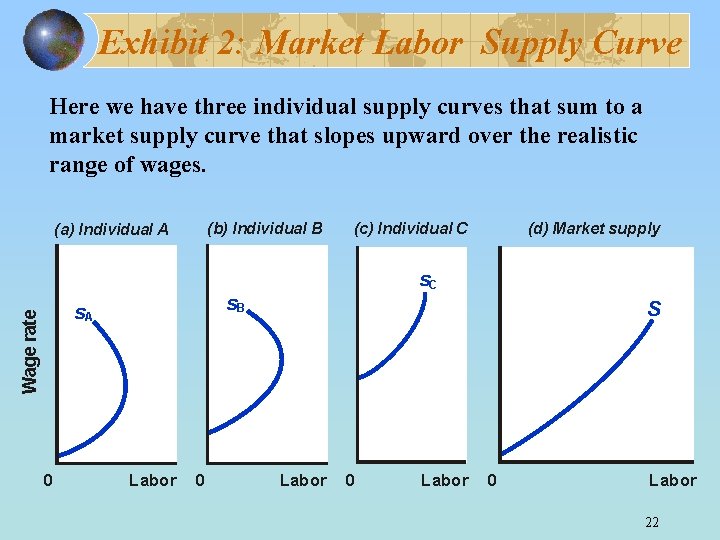
Exhibit 2: Market Labor Supply Curve Here we have three individual supply curves that sum to a market supply curve that slopes upward over the realistic range of wages. (b) Individual B (a) Individual A Labor 0 Wage rate (d) Market supply s. C s. B s. A 0 (c) Individual C S Labor 0 Labor 22
Why Wages Differ Wage differences across markets trace to differences in a number of factors Differences in training, education, age, and experience Differences in ability Differences in risk Geographic differences Job discrimination Union membership 23
Training, Education, Age, and Experience Some jobs pay more because they require a long and costly training period fewer individuals are willing to incur the time and expense required smaller market supply However, extensive training increases the productivity of labor increased demand for these skills Exhibit 3 shows how education and experience affect earnings based on education and age 24
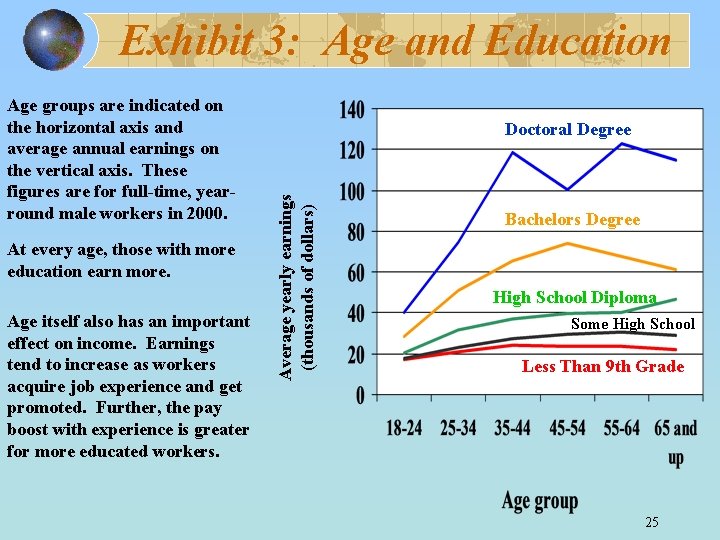
Exhibit 3: Age and Education At every age, those with more education earn more. Age itself also has an important effect on income. Earnings tend to increase as workers acquire job experience and get promoted. Further, the pay boost with experience is greater for more educated workers. Doctoral Degree Average yearly earnings (thousands of dollars) Age groups are indicated on the horizontal axis and average annual earnings on the vertical axis. These figures are for full-time, yearround male workers in 2000. Bachelors Degree High School Diploma Some High School Less Than 9 th Grade 25

Differences in Ability Because they are more able and talented, some individuals earn more than others with the same training and education From lawyers, to executives, to professional athletes, pay differences often reflect differing abilities 26
Differences in Risk Research indicates that jobs with a high probability of injury or death pay more, other things constant Workers also earn more, other things constant, in seasonal jobs such as construction, where the risks of unemployment are greater 27
Geographic Differences People have a strong incentive to sell their resources in the market where they earn the most, other things constant As a result, they tend to migrate to areas, regions, or countries where the pay is higher wage differences 28
Job Discrimination and Union Membership Some individuals earn different wages because of racial or gender discrimination in the job market Other things equal, members of organized labor tend to earn more than nonmembers 29
Unions Despite media attention, only about one in seven U. S. workers belongs to a labor union The overwhelming share of union agreements are reached without a strike We need to examine the tools that unions employ to seek higher pay for their members 30
Types of Unions A labor union is a group of workers who join together to improve their terms of employment Craft unions are confined to those with a particular skill, or craft American Federation of Labor was a national organization of craft unions founded in 1886 under Samuel Gompers Is not a union itself but rather an organization of national unions, with each retaining its autonomy 31
Types of Unions The Clayton Act of 1914 exempted labor unions from antitrust laws unions at competing companies could legally join forces in an attempt to raise wages Unions were also tax exempt Membership jumped during World War I but dropped in half between 1920 and 1933, as the government retreated from its support of union efforts 32
Types of Unions The Congress of Industrial Organizations (CIO) was formed in 1935 to serve as a national organization of unions in mass production industries The CIO consists of unions whose membership embraced all workers in a particular industry These industrial unions included all types of workers in an industry 33
Collective Bargaining Collective bargaining is the process by which representatives of union and management negotiate a mutually agreeable contract specifying wages, employee benefits, and working conditions Mediator is an impartial observer who listens to both sides separately and then suggests how each side could adjust its position to resolve differences 34
Collective Bargaining Mediator has no power to impose a settlement on either party Binding arbitration is a process whereby a neutral third party evaluates both sides of the dispute and issues a ruling that both parties must accept 35
The Strike A major source of union power in the bargaining relationship is the threat of a strike, which is the union’s attempt to withhold labor from the firm The purpose of a strike is to stop production, thereby forcing the firm to accept the union’s position However, strikes also impose significant costs on union members 36
Union Wages and Employment A menu of union desires includes higher wages, more benefits, greater job security, better working conditions, and so on To keep the analysis manageable, suppose we look at the three ways that a union can try to increase wages By forming an inclusive, or industrial union By forming an exclusive, or craft union By increasing the demand for union labor 37
Inclusive, or Industrial Unions With the inclusive, or industrial approach, the union tries to negotiate an industry-wide wage for each class of labor Exhibit 4 shows the market demand supply for a particular type of labor 38
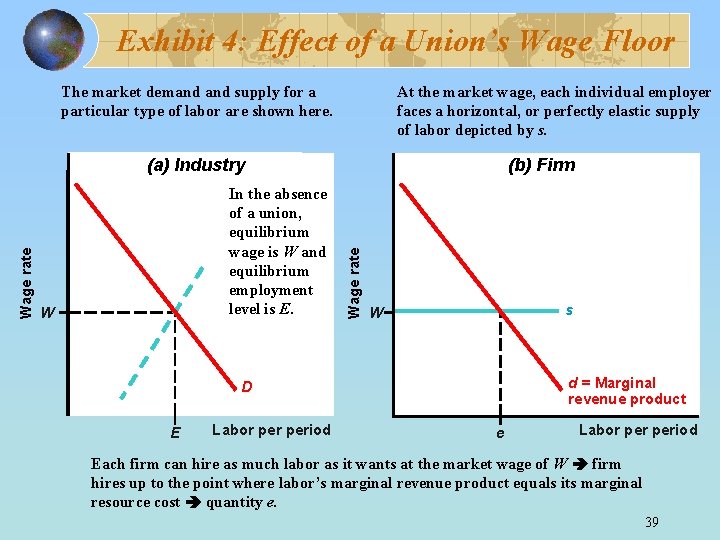
Exhibit 4: Effect of a Union’s Wage Floor The market demand supply for a particular type of labor are shown here. At the market wage, each individual employer faces a horizontal, or perfectly elastic supply of labor depicted by s. In the absence of a union, equilibrium wage is W and equilibrium employment level is E. W (b) Firm Wage rate (a) Industry s W d = Marginal revenue product D E Labor period e Labor period Each firm can hire as much labor as it wants at the market wage of W firm hires up to the point where labor’s marginal revenue product equals its marginal resource cost quantity e. 39
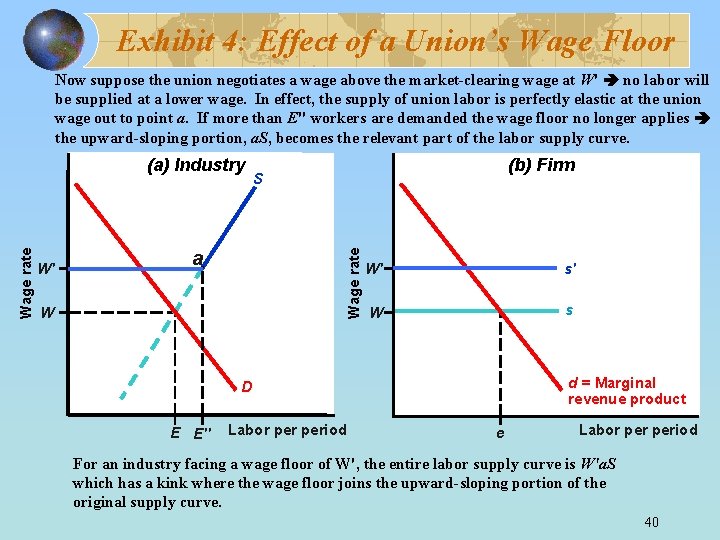
Exhibit 4: Effect of a Union’s Wage Floor Now suppose the union negotiates a wage above the market-clearing wage at W' no labor will be supplied at a lower wage. In effect, the supply of union labor is perfectly elastic at the union wage out to point a. If more than E" workers are demanded the wage floor no longer applies the upward-sloping portion, a. S, becomes the relevant part of the labor supply curve. W' a (b) Firm S Wage rate (a) Industry W W' s' W s d = Marginal revenue product D E E'' Labor period e Labor period For an industry facing a wage floor of W', the entire labor supply curve is W'a. S which has a kink where the wage floor joins the upward-sloping portion of the original supply curve. 40
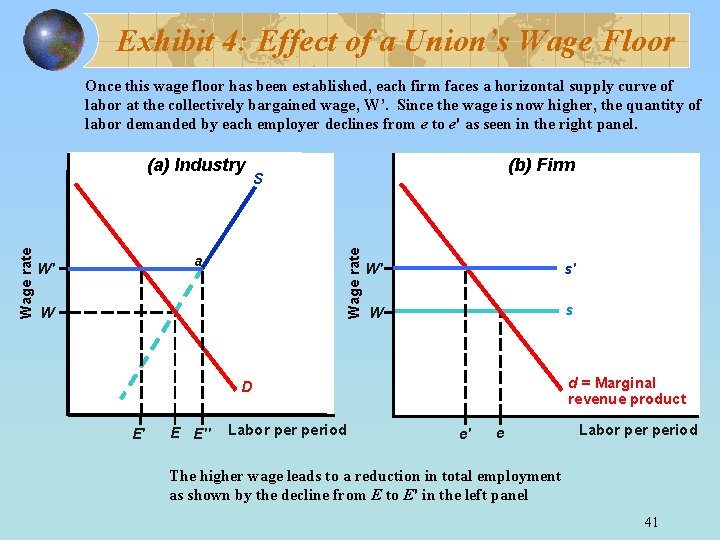
Exhibit 4: Effect of a Union’s Wage Floor Once this wage floor has been established, each firm faces a horizontal supply curve of labor at the collectively bargained wage, W’. Since the wage is now higher, the quantity of labor demanded by each employer declines from e to e' as seen in the right panel. a W' (b) Firm S Wage rate (a) Industry W W' s' W s d = Marginal revenue product D E' E E'' Labor period e' e Labor period The higher wage leads to a reduction in total employment as shown by the decline from E to E' in the left panel 41
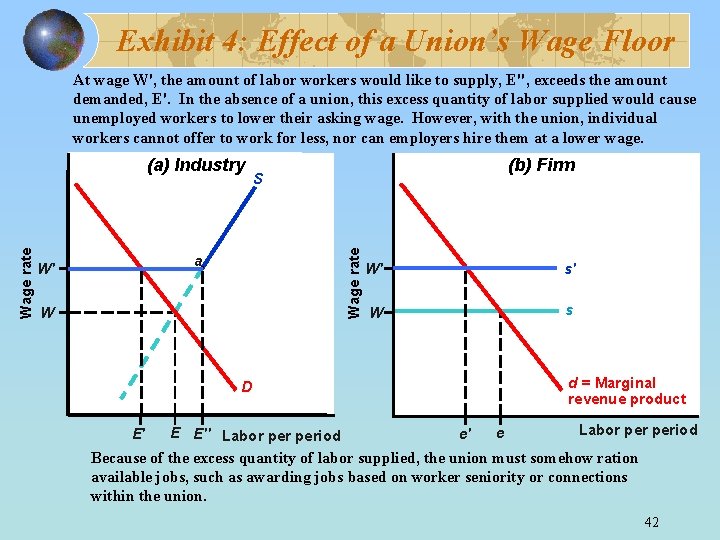
Exhibit 4: Effect of a Union’s Wage Floor At wage W', the amount of labor workers would like to supply, E", exceeds the amount demanded, E'. In the absence of a union, this excess quantity of labor supplied would cause unemployed workers to lower their asking wage. However, with the union, individual workers cannot offer to work for less, nor can employers hire them at a lower wage. S a W' (b) Firm Wage rate (a) Industry W W' s' W s d = Marginal revenue product D E' E E'' Labor period e' e Labor period Because of the excess quantity of labor supplied, the union must somehow ration available jobs, such as awarding jobs based on worker seniority or connections within the union. 42
Effect of Union Wage Floor With the inclusive, or industrial union, which negotiates with the entire industry, the wage rate is higher and total employment lower than would be in the absence of a union Those who cannot find union employment will look for jobs in the nonunion sector the nonunion wage will be driven downward 43
Effect of Union Wage Floor Wages are relatively higher in the union sector for two reasons First, because unions bargain for a wage that exceeds the market-clearing wage Second, because those unable to find employment in the union sector crowd into the nonunion sector Unions are most successful at raising wages in less-competitive industries 44
Exclusive, or Craft, Unions One way to increase wages while avoiding an excess quantity of labor supplied is for the union to somehow reduce the supply of labor This situation is shown in the Exhibit 5 45
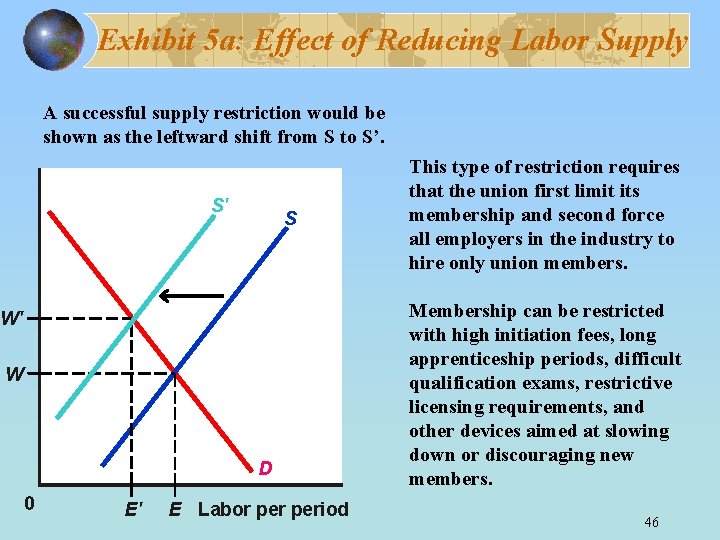
Exhibit 5 a: Effect of Reducing Labor Supply A successful supply restriction would be shown as the leftward shift from S to S’. S' Wage rate S W' W D 0 E' E Labor period This type of restriction requires that the union first limit its membership and second force all employers in the industry to hire only union members. Membership can be restricted with high initiation fees, long apprenticeship periods, difficult qualification exams, restrictive licensing requirements, and other devices aimed at slowing down or discouraging new members. 46

Exclusive, or Craft Unions Whereas wage setting is more typical of the industrial union, restricting supply is more typical of craft unions The restrictions used are usually defended on the grounds that they protect the public In reality, the are little more than selfserving attempts to increase wages and incomes 47
Increasing the Demand for Labor A third way to increase the wage is to increase the demand for union labor by somehow shifting the labor demand curve outward This case is presented in the other panel of Exhibit 5 48
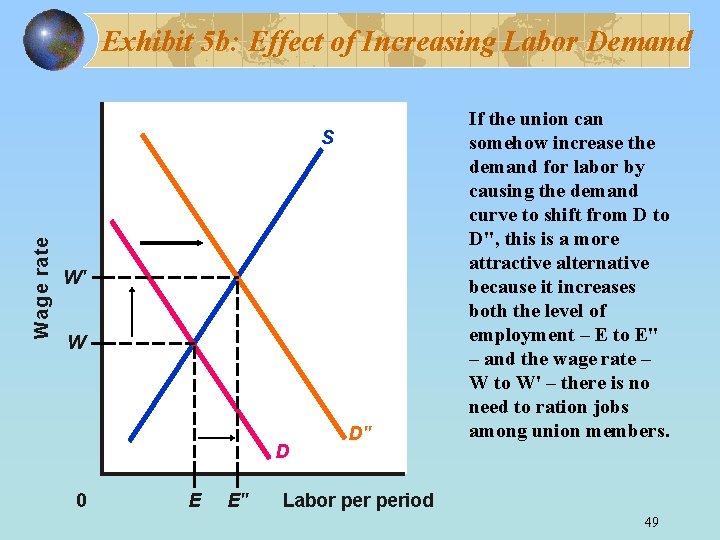
Exhibit 5 b: Effect of Increasing Labor Demand Wage rate S W' W D 0 E E" D" If the union can somehow increase the demand for labor by causing the demand curve to shift from D to D", this is a more attractive alternative because it increases both the level of employment – E to E" – and the wage rate – W to W' – there is no need to ration jobs among union members. Labor period 49
Increasing the Demand for Labor Ways in which unions try to increase the demand for union labor Increase demand for union-made goods Restrict supply of nonunion-made goods Increase productivity of union labor • Some claim that the efficiency with which unions structure and monitor the labor-management relationship increases the demand for union labor • According to this theory, unions increase worker productivity by minimizing conflicts, resolving differences, and monitoring workers • If this is indeed true, the demand for union labor should increase Featherbedding 50
Featherbedding is an attempt to ensure that more union labor is hired than producers would prefer For example, union rules require that each Broadway theater have a permanent “house” carpenter, electrician, and property manager Once the show run begins, these workers appear only on payday 51
Featherbedding does not create a true increase in the demand, in the sense of shifting the demand curve to the right Instead, it forces firms to hire more labor than they really want or need, thus moving the firm to a point to the right of its true labor demand curve The union tries to limit a firm to an allor-none choice, either hire the number of workers the union requires, or none 52
Recent Trends in Union Membership In 1955, about one-third of wage and salary workers belonged to unions Since then, union membership as a fraction of the work force has declined now only one in seven belongs to a union Government workers make up nearly half of all union members typical union member is a schoolteacher 53

Recent Trends in Union Membership Compared with other industrialized countries, the United States ranks relatively low in the extent of unionization Exhibit 6 illustrates U. S. union membership rates by age and gender in 2000 54
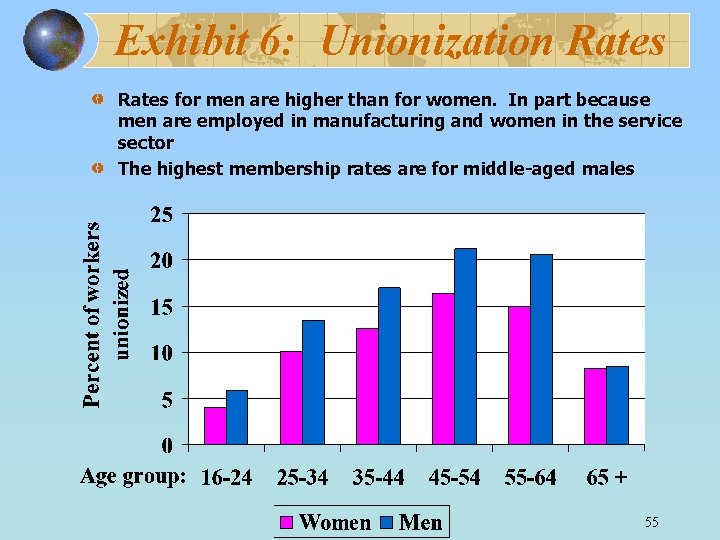
Exhibit 6: Unionization Rates for men are higher than for women. In part because men are employed in manufacturing and women in the service sector The highest membership rates are for middle-aged males 55
Recent Trends in Union Membership Union membership rates vary greatly across states Rates tend to be highest in the Northeast United States and lowest in the South Decline in union membership is due partly to structural changes in the U. S. economy Employment in the industrial sector has been declining while increasing in the service sector Another factor contributing to the decline has been the growth in foreign competition The near disappearance of strikes 56
- Slides: 56