
Labor Law Update December 1 2020 PRESENTED BY
Labor Law Update December 1, 2020 PRESENTED BY: L. Brent Garrett, Partner Cerritos • Fresno • Irvine • Marin • Pasadena • Pleasanton • Riverside • Sacramento • San Diego
Disclaimer | Housekeeping This AALRR webinar is intended for informational purposes only and should not be relied upon in reaching a conclusion in a particular area of law. Applicability of the legal principles discussed may differ substantially in individual situations. Receipt of this or any other AALRR presentation does not create an attorney-client relationship. The Firm is not responsible for inadvertent errors that may occur in the publishing process. Our webinars frequently prompt questions from the viewing audience. However, given the format of our presentations, time constraints do not allow us to answer those questions during the sessions. We will make efforts to provide answers your inquiries during subsequent webinars and through our blog posts, alerts and individual emails. Please keep in mind that responses to individual questions and specific situations will require us to have a client agreement in place in order to protect attorney/client privilege. © 2020 Atkinson, Andelson, Loya, Ruud & Romo Cerritos • Fresno • Irvine • Marin • Pasadena • Pleasanton • Riverside • Sacramento • San Diego 1
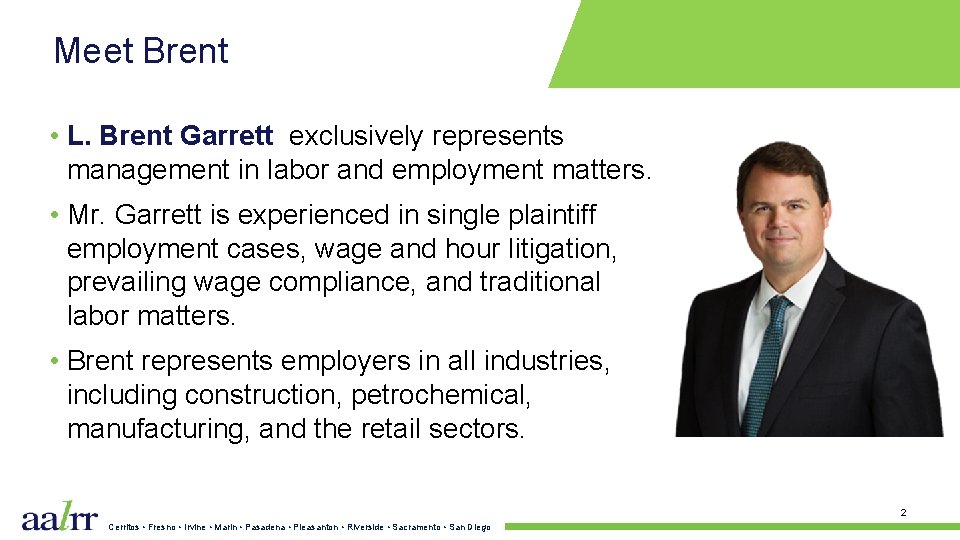
Meet Brent • L. Brent Garrett exclusively represents management in labor and employment matters. • Mr. Garrett is experienced in single plaintiff employment cases, wage and hour litigation, prevailing wage compliance, and traditional labor matters. • Brent represents employers in all industries, including construction, petrochemical, manufacturing, and the retail sectors. 2 Cerritos • Fresno • Irvine • Marin • Pasadena • Pleasanton • Riverside • Sacramento • San Diego
Agenda • Introduction • New Legislation • Cal-OSHA Regulation on COVID Prevention 3

CFRA Expansion (SB 1383) Two Big Changes for January 2021 1. CFRA now applies to employers with 5 or more employees. • Bye, NPLA! 2. CFRA is now available for more reasons. Result: 1. More employers need to learn CFRA obligations. 2. CFRA and FMLA will not always run concurrently. 4
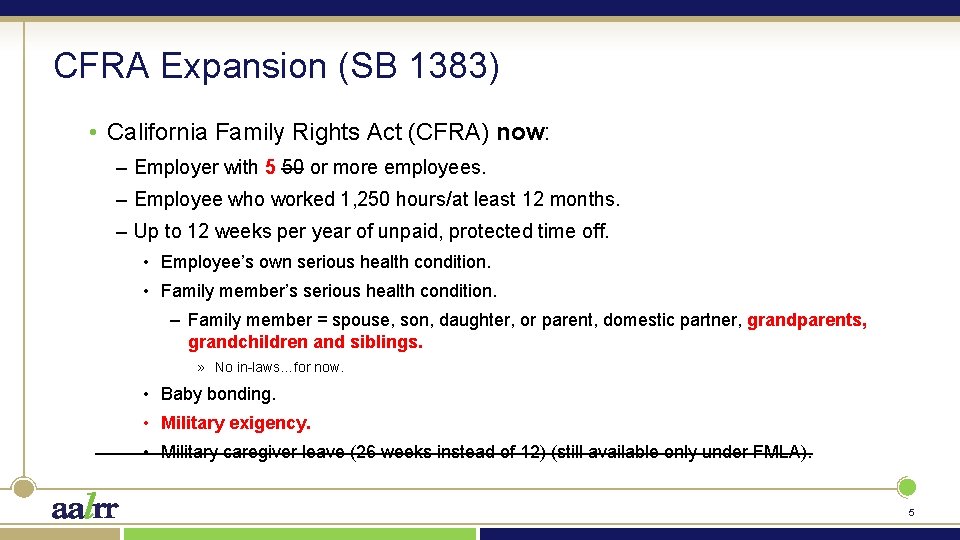
CFRA Expansion (SB 1383) • California Family Rights Act (CFRA) now: – Employer with 5 50 or more employees. – Employee who worked 1, 250 hours/at least 12 months. – Up to 12 weeks per year of unpaid, protected time off. • Employee’s own serious health condition. • Family member’s serious health condition. – Family member = spouse, son, daughter, or parent, domestic partner, grandparents, grandchildren and siblings. » No in-laws…for now. • Baby bonding. • Military exigency. • Military caregiver leave (26 weeks instead of 12) (still available only under FMLA). 5
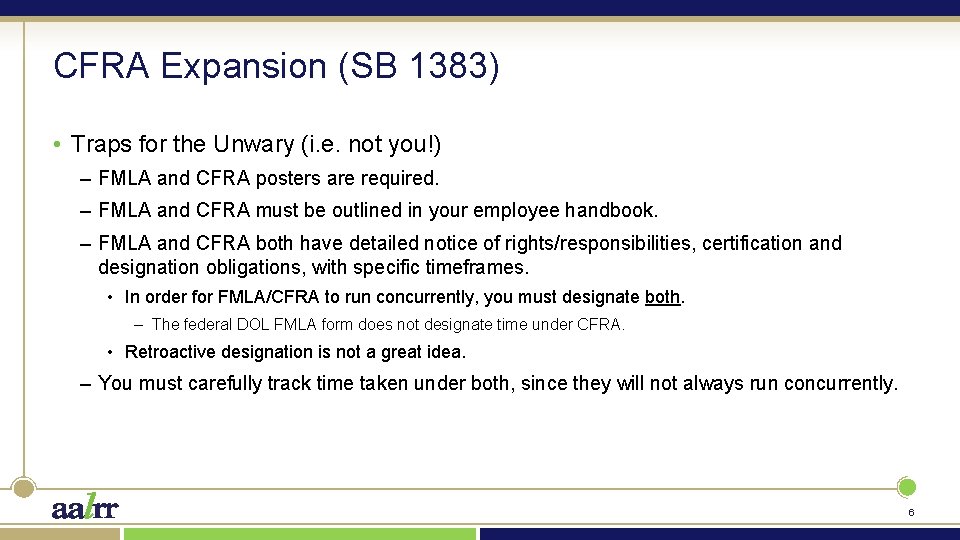
CFRA Expansion (SB 1383) • Traps for the Unwary (i. e. not you!) – FMLA and CFRA posters are required. – FMLA and CFRA must be outlined in your employee handbook. – FMLA and CFRA both have detailed notice of rights/responsibilities, certification and designation obligations, with specific timeframes. • In order for FMLA/CFRA to run concurrently, you must designate both. – The federal DOL FMLA form does not designate time under CFRA. • Retroactive designation is not a great idea. – You must carefully track time taken under both, since they will not always run concurrently. 6
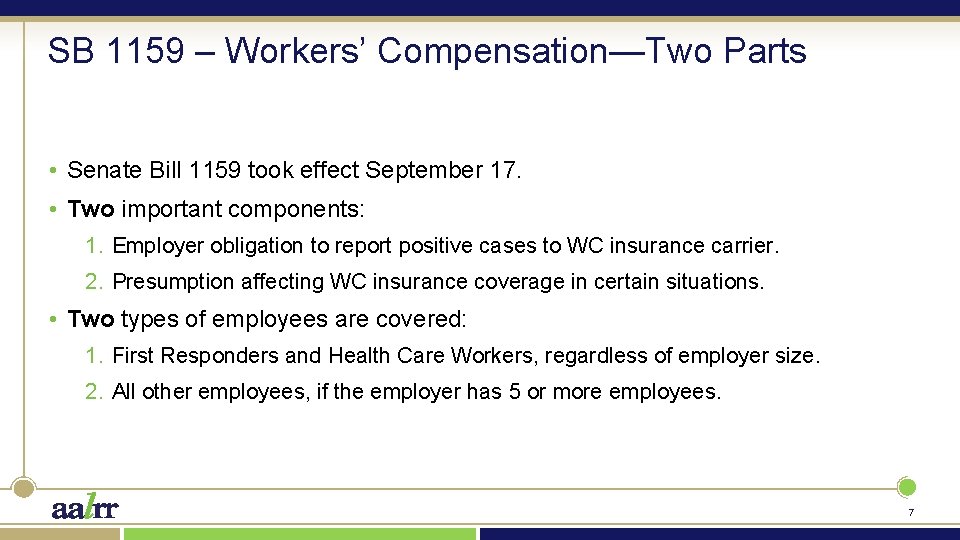
SB 1159 – Workers’ Compensation—Two Parts • Senate Bill 1159 took effect September 17. • Two important components: 1. Employer obligation to report positive cases to WC insurance carrier. 2. Presumption affecting WC insurance coverage in certain situations. • Two types of employees are covered: 1. First Responders and Health Care Workers, regardless of employer size. 2. All other employees, if the employer has 5 or more employees. 7
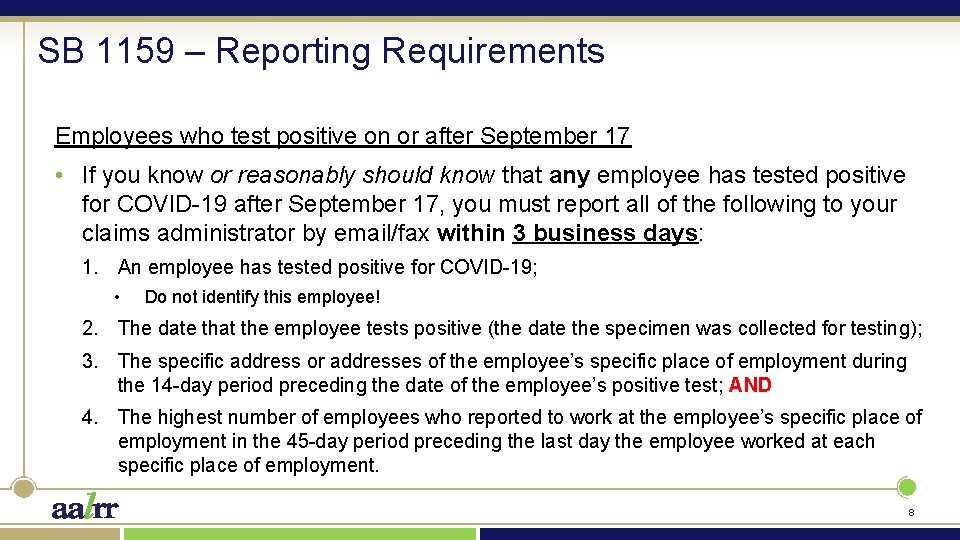
SB 1159 – Reporting Requirements Employees who test positive on or after September 17 • If you know or reasonably should know that any employee has tested positive for COVID-19 after September 17, you must report all of the following to your claims administrator by email/fax within 3 business days: 1. An employee has tested positive for COVID-19; • Do not identify this employee! 2. The date that the employee tests positive (the date the specimen was collected for testing); 3. The specific address or addresses of the employee’s specific place of employment during the 14 -day period preceding the date of the employee’s positive test; AND 4. The highest number of employees who reported to work at the employee’s specific place of employment in the 45 -day period preceding the last day the employee worked at each specific place of employment. 8
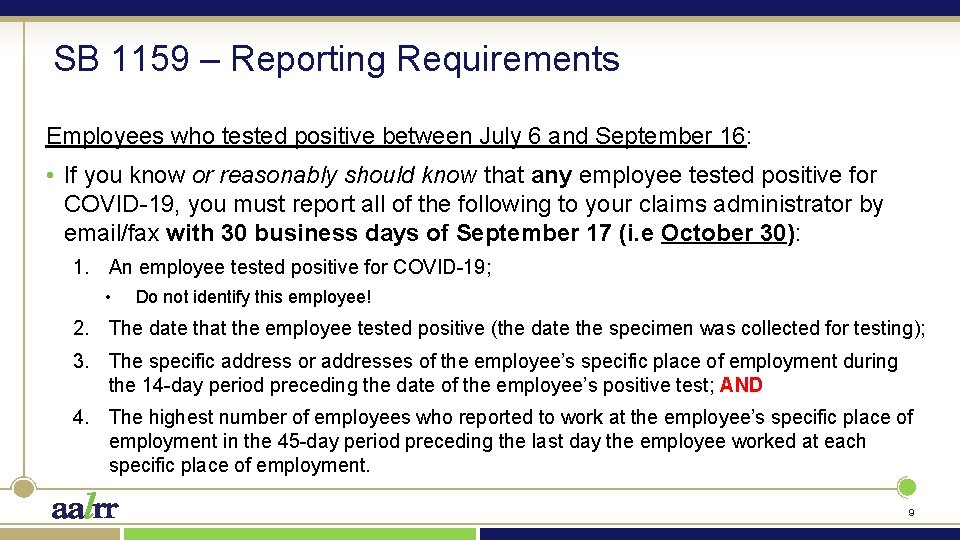
SB 1159 – Reporting Requirements Employees who tested positive between July 6 and September 16: • If you know or reasonably should know that any employee tested positive for COVID-19, you must report all of the following to your claims administrator by email/fax with 30 business days of September 17 (i. e October 30): 1. An employee tested positive for COVID-19; • Do not identify this employee! 2. The date that the employee tested positive (the date the specimen was collected for testing); 3. The specific address or addresses of the employee’s specific place of employment during the 14 -day period preceding the date of the employee’s positive test; AND 4. The highest number of employees who reported to work at the employee’s specific place of employment in the 45 -day period preceding the last day the employee worked at each specific place of employment. 9
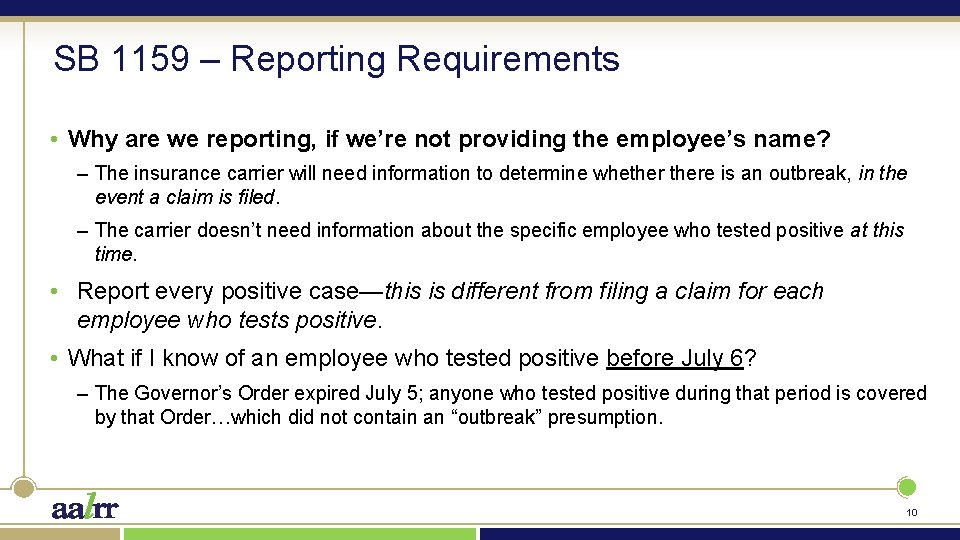
SB 1159 – Reporting Requirements • Why are we reporting, if we’re not providing the employee’s name? – The insurance carrier will need information to determine whethere is an outbreak, in the event a claim is filed. – The carrier doesn’t need information about the specific employee who tested positive at this time. • Report every positive case—this is different from filing a claim for each employee who tests positive. • What if I know of an employee who tested positive before July 6? – The Governor’s Order expired July 5; anyone who tested positive during that period is covered by that Order…which did not contain an “outbreak” presumption. 10
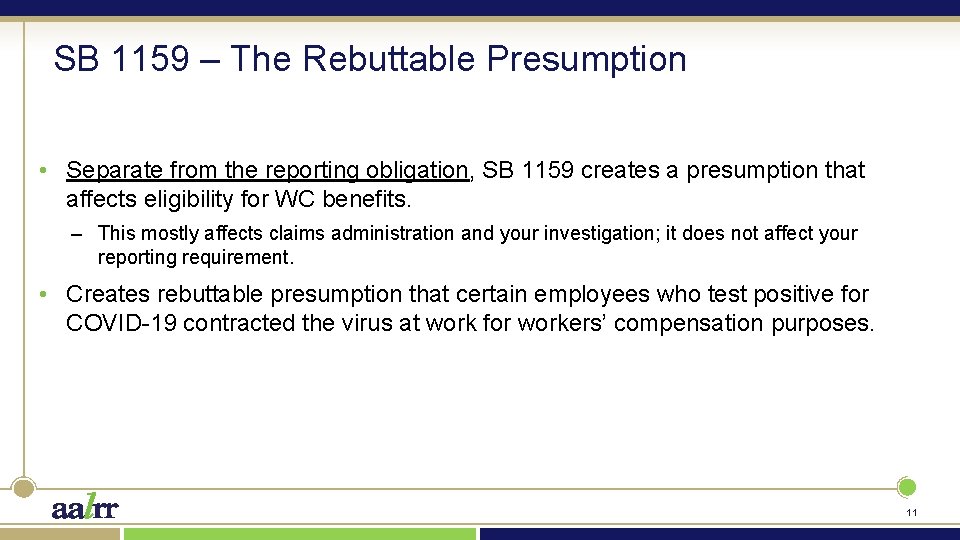
SB 1159 – The Rebuttable Presumption • Separate from the reporting obligation, SB 1159 creates a presumption that affects eligibility for WC benefits. – This mostly affects claims administration and your investigation; it does not affect your reporting requirement. • Creates rebuttable presumption that certain employees who test positive for COVID-19 contracted the virus at work for workers’ compensation purposes. 11
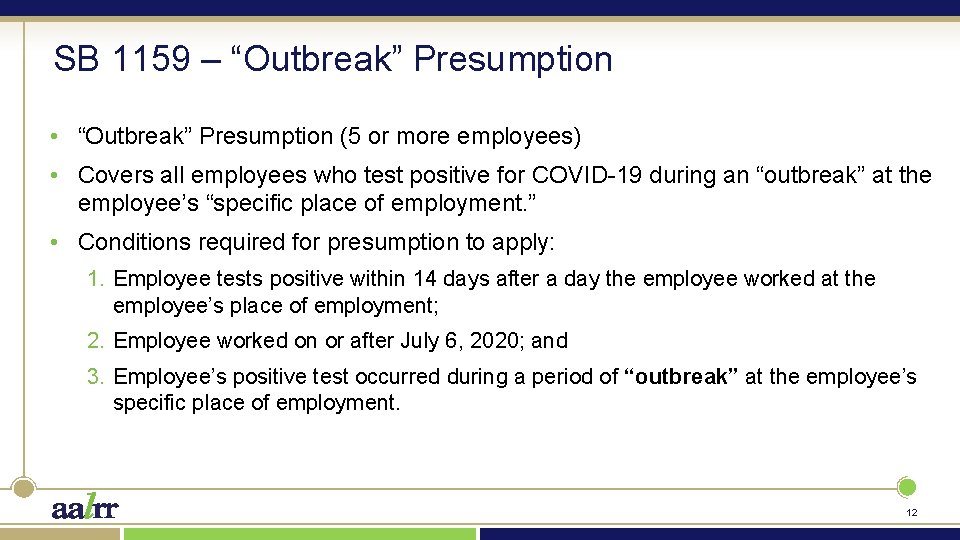
SB 1159 – “Outbreak” Presumption • “Outbreak” Presumption (5 or more employees) • Covers all employees who test positive for COVID-19 during an “outbreak” at the employee’s “specific place of employment. ” • Conditions required for presumption to apply: 1. Employee tests positive within 14 days after a day the employee worked at the employee’s place of employment; 2. Employee worked on or after July 6, 2020; and 3. Employee’s positive test occurred during a period of “outbreak” at the employee’s specific place of employment. 12
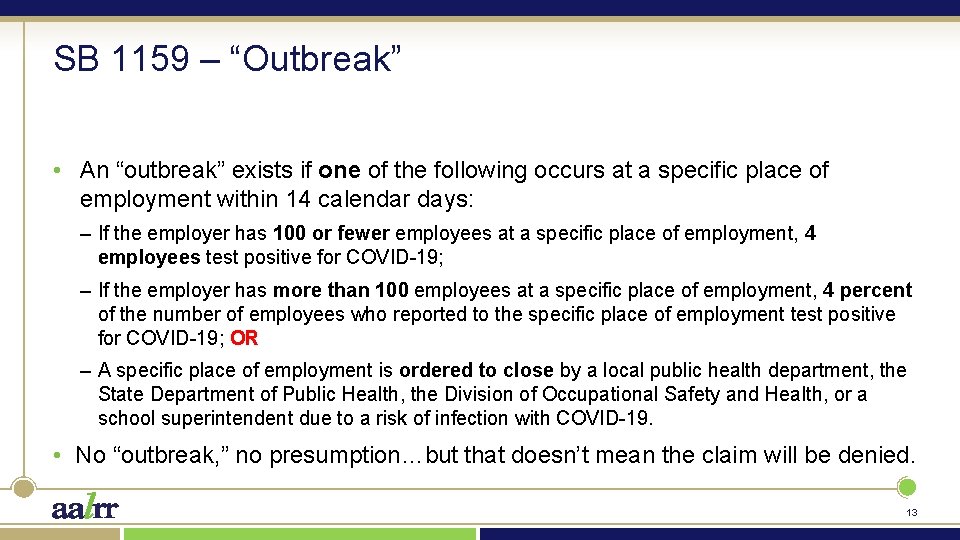
SB 1159 – “Outbreak” • An “outbreak” exists if one of the following occurs at a specific place of employment within 14 calendar days: – If the employer has 100 or fewer employees at a specific place of employment, 4 employees test positive for COVID-19; – If the employer has more than 100 employees at a specific place of employment, 4 percent of the number of employees who reported to the specific place of employment test positive for COVID-19; OR – A specific place of employment is ordered to close by a local public health department, the State Department of Public Health, the Division of Occupational Safety and Health, or a school superintendent due to a risk of infection with COVID-19. • No “outbreak, ” no presumption…but that doesn’t mean the claim will be denied. 13
SB 1159 – “Specific Place of Employment” • A “specific place of employment” means the building, store, facility, or agricultural field where an employee performs work at the employer’s direction. • It does not include the employee’s home or residence, unless the employee provides home health care services to another individual at the employee’s home or residence. 14
SB 1159 – Disputing the Presumption • An employer may dispute the presumption with evidence such as: – Measures in place to reduce potential transmission of COVID-19 in the employee’s place of employment; – Statements made by the employee; and – Evidence of an employee’s non-occupational risks of COVID-19 infection. • Attended a large gathering, flew in an airplane, etc. 15
SB 1159 – Claims Administration • If the date of injury falls before July 6, 2020, the claim administrator has 30 days to deny the claim. • If the date of injury falls on or after July 6, 2020, the claim administrator has 45 days to deny the claim, or the injury is presumed compensable. – Note: If the injured employee is an “essential employee” as specified under Labor Code Section 3212. 87, the claim administrator has 30 days to deny the claim regardless of the date of injury. • This presumption is rebuttable, but only with evidence discovered subsequent to the applicable investigation period (i. e. you waive the right to use evidence within the applicable investigation period). 16
SB 1159 – What Benefits Are Employees Entitled To? • If the presumption applies, compensation includes full hospital, surgical, medical treatment, disability indemnity, and death benefits. • Employee must use COVID-19 Paid Sick Leave benefits before WC wage replacement will be available: – FFCRA. – California COVID-19 Supplemental Paid Sick Leave. – COVID-19 Paid Sick Leave per local ordinance. • If an employee does not have COVID-19 Paid Sick Leave benefits, temporary disability will start the date of disability (i. e. no 3 -day waiting period). 17
AB 1867 – Supplemental Paid Sick Leave • Creates 80 Hours of Supplemental Paid Sick Leave. • Applies to employers with 500 or more employees. • Can be used: – Employee subject to a federal, state, or local quarantine or isolation order related to COVID 19; – Advised by a health care provider to self-quarantine or self-isolate due to concerns related to COVID-19; or – prohibited from working by the hiring entity due to health concerns related to the potential transmission of COVID-19. • There is a DIR poster on the new law. • Employer can take credit for previously granted supplemental paid sick leave. • Amount of available sick leave must show up on pay stub. 18

Cal-OSHA Regulation on COVID Prevention
Cal-OSHA Regulation on COVID Prevention (Reg. 3205) • Emergency Regulation Adopted by Cal-OSHA Board on November 19, 2020 • Vigorously contested by the employer community • Now in a final one-week comment period in the Office of Administrative Law • Likely to be effective on or about December 1, 2020 20
Reg. 3205 • Covers all employees, except: – Employees working from home – Places of employment with only one employee and where there is no person to person contact – Employees covered by section 5199 (aerosol transmittable diseases) 21
Reg. 3205 • Adopts recent CDC guidance on COVID exposure, which means – Being within six feet of a case for a cumulative of 15 minutes or greater in any 24 hour period – During the “high risk” exposure period – Applies regardless of the use of a face covering 22
Reg. 3205 • High risk exposure period: – Symptomatic cases: • 2 days before developing symptoms • Until 10 days since symptoms first appeared • 24 hours passed with no symptoms – Asymptomatic cases • 2 days before positive test • 10 days after specimen for test was collected 23
Reg 3205 • All employers must have a COVID Prevention Plan – It must be in writing – May be part of the Injury & Illness Prevention Program 24
Identification & Evaluation of COVID Hazards • Employer shall conduct a workplace-specific identification of all interactions, areas, activities, processes, equipment, and materials that could potentially expose employees to COVID hazards. • Must include: – Identification of places and times when people may congregate or come into contact regardless of whether employees are performing an assigned task. – Evaluation of employees’ potential exposure to all persons who may enter the workplace 25
Identification & Evaluation of COVID Hazards • For indoor locations: – The employer shall evaluate how to maximize the quantity of outdoor air – Whether it is possible to increase filtration efficiency to the highest level compatible with the HVAC system 26
Investigating & Responding to COVID • Take the following steps when there is a COVID case: – Determine the day/time the test was take, date of positive diagnosis, date of first symptoms – Determine who had COVID exposure – Give notice, within 1 business day, to: • All employees who may have had exposure & their representative • Independent contractors & other employers present in the workplace – Offer testing at no cost to employees during their working hours – Investigate whether any workplace conditions contributed to the risk of exposure 27
Face Coverings • Employers must provide face coverings • Employer must ensure they are worn: – Over the nose and mouth when indoors – When outdoors and less than six feet apart • Face shields are not a replacement for face coverings • Exceptions: – Employee is alone in a room – When eating and drinking, provided more than six feet apart – Employees who cannot wear face coverings due to a medical or mental health condition, or who are hearing impaired – No employer shall prevent an employee from wearing a face covering unless wearing one would create a safety hazard 28
Other Engineering Controls • Where social distancing ia not possible, install cleanable solid partitions that effectively reduce aerosol transmissions • Maximize the quantity of outside air to the extent feasible, except where doing so would cause excessive heat or cold or high pollution days • Implement cleaning and disinfecting procedures • Assess handwashing facilities and evaluate the need for additional facilities 29
Exclusion of cases from the workplace • Employers must ensure that all cases are excluded from the workplace until they can return to work • Exclude all exposed employees from the workplace for 14 days after the last known exposure • Maintain the employee’s earnings, seniority, and benefits, as if the employee not removed the job. Employer may use employer provided sick leave benefits for this purpose and may consider benefit payments from public sources in determining how to maintain earnings 30
Exclusion of cases from the workplace • Earnings obligation does not apply where: – Employee is unable to work for any reason other than protecting persons at workplace from COVID exposure; or – Employer demonstrates that the exposure is not work related 31
Return to work criteria • Symptomatic cases cannot return until: – 24 hours have passed since a fever of 100. 4 has resolved without use of medications – Symptoms have improved; and – 10 days since symptoms first appeared • Asymptomatic cases: – 10 days since the collection of the specimen yielding the positive result • A negative test is not required for return to work 32
Outbreaks • Three or more cases in a 14 day period • Employer shall provide testing to all exposed employees at no cost and during working time. Employer shall provide a second test one week later. • Provide continuous weekly testing to employees at the workplace until the period of outbreak is over. • Exclude all exposed workers from the workplace • Process of hazard investigation, review & correction • Notify the local health department within 48 hours of three or more COVID cases. Continue to give subsequent notice of additional cases. 33
Major Outbreaks • 20 or more cases in a thirty day period. • Testing – Twice a week to all employees present at the exposed workplace – At no cost and on employees’ working time • Exclude all cases and exposed employees from workplace • Investigation of causes and hazard correction. – Implement MERV 13 filters (if possible) – Evaluate whether to halt some or all of operatios 34
Thank You For questions or comments, please contact: L. Brent Garrett bgarrett@aalrr. com (562) 653 -3200 35
- Slides: 36