
Labels in Special Education Whats in a Diagnosis
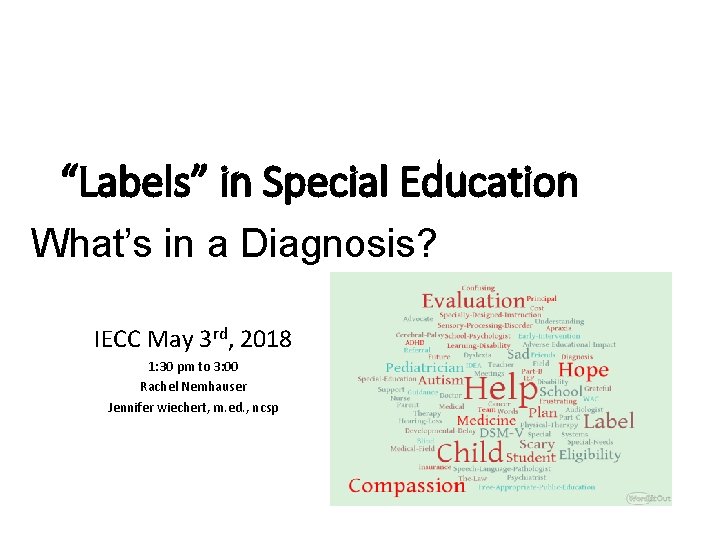
“Labels” in Special Education What’s in a Diagnosis? IECC May 3 rd, 2018 1: 30 pm to 3: 00 Rachel Nemhauser Jennifer wiechert, m. ed. , ncsp
Presenter Information Jennifer Wiechert, M. Ed. , NCSP • • jmwiecher@comcast. net Educational Consultant - School Psychologist - ECE Specialist - Mother • Rachel Nemhauser • Parent to Parent Program Supervisor - Disabilities Advocate - Mother • Rnemhauser@arcofkingcounty. org Participant Information Who is in the room & what role(s) do you play in the world of Infant & Early Childhood
Target Audience & Learning Objectives • Early Intervention Providers, Parents/Guardians, Medical or Community Providers, and School Practitioners • Learning Objectives: 1. Understand the Special Education Laws around Evaluation & Eligibility 2. Learn about the ways that Diagnostic information from private practitioners is assimilated into the public school setting and vice versa 3. Understand the experience of seeking and receiving a "Diagnosis" from a parent perspective ØNote: This is primarily addressing Special Education Part B Services (ages-3 -21), with some cross-over into Part B Early Intervention

Through the Eyes of a Parent Rachel Nemhauser - Informing Families Blog – A Case Study • In the Beginning: • The Early Intervention – • Early Childhood – Elementary Years and “Labels”
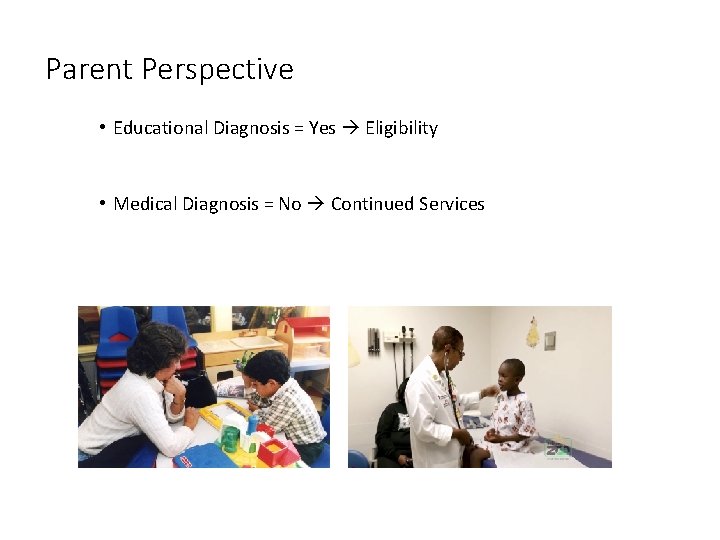
Parent Perspective • Educational Diagnosis = Yes Eligibility • Medical Diagnosis = No Continued Services
In the Beginning: “Something is wrong …” • … words spoken by a parent – to a friend, a colleague, a pediatrician, a daycare teacher, a family member • … or words spoken to a parent -- by a friend, a colleague, a pediatrician, a daycare teacher, a family member • What’s next? • • Medical / Clinician? School? Both? Cultural?
“Is this normal? ” • The Intent … assessment label • Why a Label? • Access to … • Resources • Information • A direction - A road map • The Impact… the positive and the negative • Labels in the Medical Community • Insurance benefits, medical intervention, differential diagnosis, etc. • Labels in the School Community • Resources, planning
Medical Diagnosis vs. Educational Eligibility Are Medical Diagnoses and Educational Eligibility the Same? Fundamental distinction between a Medical Diagnosis and Special Education Eligibility: The impact the condition has on student learning Let’s look at Special Education Part B – The Legal Part … • Quick look at IDEA Part B & Part C • 14 Eligibility Categories
Individuals with Disabilities Education Act (IDEA) 2004 IDEA Federal Law reauthorized in 2004 Federal Regulations updated 2006 Every Student Succeeds Amendments 2015 US Department of Education IDEA Resource ed. gov/idea
Washington Administrative Codes (WACs) – State Law • Each State has guidelines interpreting IDEA • WACs Revised in October 2013 • Office of Superintendent of Public Instruction-WA • www. k 12. wa. us
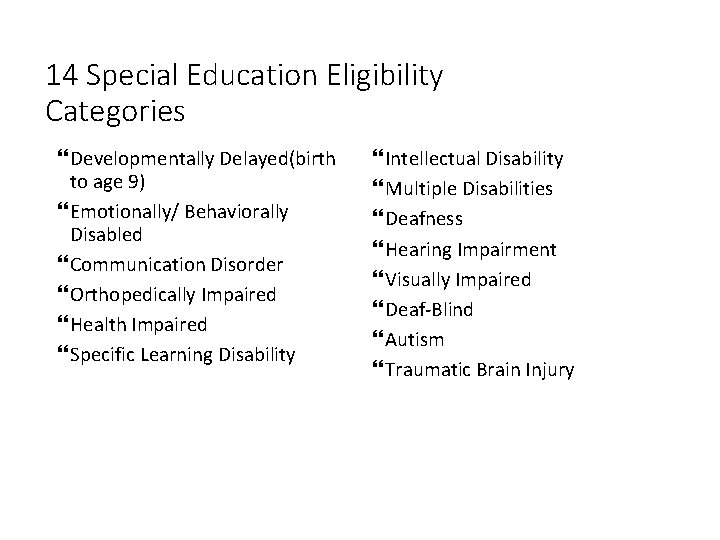
14 Special Education Eligibility Categories Developmentally Delayed(birth to age 9) Emotionally/ Behaviorally Disabled Communication Disorder Orthopedically Impaired Health Impaired Specific Learning Disability Intellectual Disability Multiple Disabilities Deafness Hearing Impairment Visually Impaired Deaf-Blind Autism Traumatic Brain Injury
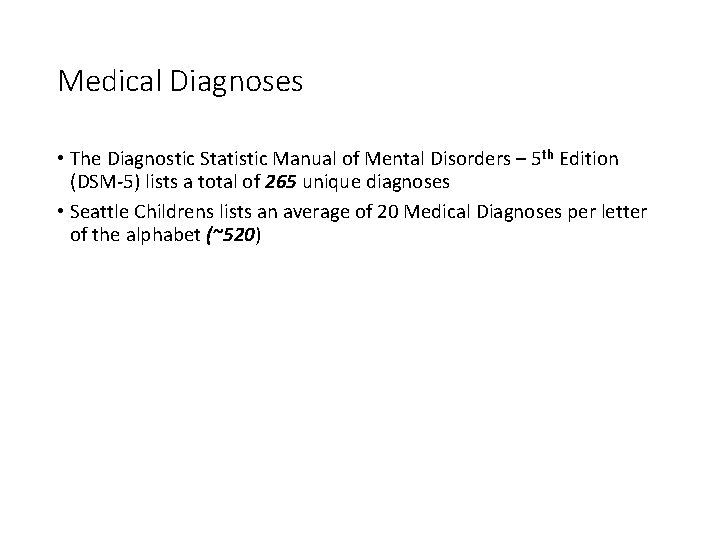
Medical Diagnoses • The Diagnostic Statistic Manual of Mental Disorders – 5 th Edition (DSM-5) lists a total of 265 unique diagnoses • Seattle Childrens lists an average of 20 Medical Diagnoses per letter of the alphabet (~520)
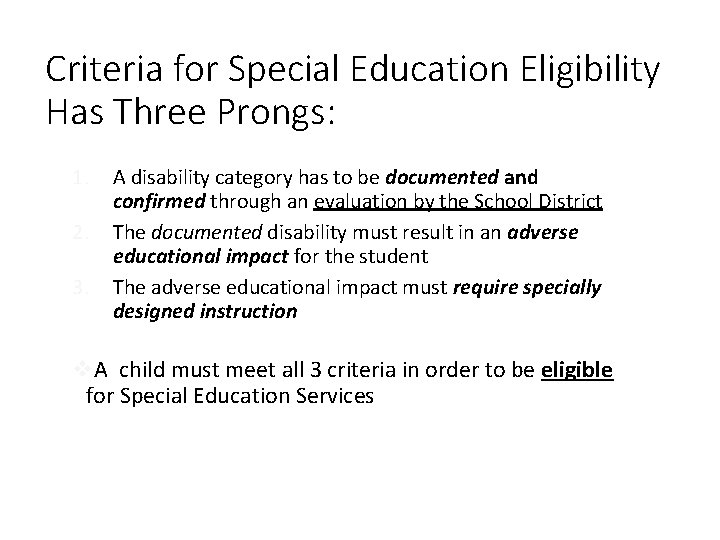
Criteria for Special Education Eligibility Has Three Prongs: 1. 2. 3. A disability category has to be documented and confirmed through an evaluation by the School District The documented disability must result in an adverse educational impact for the student The adverse educational impact must require specially designed instruction v. A child must meet all 3 criteria in order to be eligible for Special Education Services
Steps to Eligibility – Begins with a “Referral” • What if a referral comes from a Medical/Private Diagnostician to the School? – Additional Data is collected through Childfind Screening or other method – The Referral & relevant information is discussed with parents & staff – A decision is made to continue other interventions or initiate a Special Education Evaluation (Isaac story)
Steps to Eligibility - Evaluation • If an Evaluation is recommended from a Referral/ Childfind Screening, then Parent Consent is required – Consent for all evaluation methods and timelines – All areas of suspected disability are evaluated • Evaluation results shared with staff and parents; report copy given to parents
Steps to Eligibility - Evaluation SPECIAL EDUCATION SERVICES: • Must meet IDEA/WAC Eligibility Criteria – including meeting the 3 -Prongs to Eligibility OR Consider Section 504 of ADA for specific Accommodations or Modifications
The IEP Individual Education Program • Annual Plan (ages 3 -21) • Describes the nature and extent of special education and related services • Describes the Annual Goals & Objectives for student progress Section 504 Plan For students who: 1. Have a diagnosed disability or medical diagnosis, 2. Where this IS an adverse educational impact (substantial limitation of a life activity which impacts life at school) 3. However, there is NO need for Specially Designed Instruction in order to access and progress in a general education setting
Special Education Re-evaluation • Conducted at least every 3 years • To determine the following: • Continued eligibility for special education and related services • Continued need for specially designed instruction or identify changing needs • Additional needs for special education and related services Section 504 Re-evaluation • Plans are to be reviewed annually • Reevaluations are to be conducted “periodically, ” or when there is a major change in placement, such as school exclusion for more than 10 days
Parent Perspective • Rachel Nemhauser - Informing Families Blog – • The Middle Years: Middle School & “Labels” • Educational Eligibility Yes Eligibility • Medical Diagnosis Yes Increased Services
Parent Perspective • Parent Panel / Parent Participation • What was your experience during early childhood for you child with special needs? • Did you go through a Medical or Educational route or both? • What was your understanding of the process? • Small Group Sharing • What is something new your learned today, or a key take-away or ah-ha moment? • What will this new learning impact as you move forward as a practitioner or as a parent?
Communication is Key The Human Experience is Complex and Ever-Changing ØChildren are NOT defined by their “Label” or “Diagnosis” ØWhat is understood as one “Label” or Diagnosis at age 2, may be completely different by age 6 • As new information is gathered in the educational setting, it is shared with parents and outside providers and medical professionals so that new information is continually considered • The diagnosis or eligibility may or may not change, but the services should continually reflect each child’s unique strengths, weaknesses, and needs within an educational setting • Avoid diagnosis as a predictor … (examples)
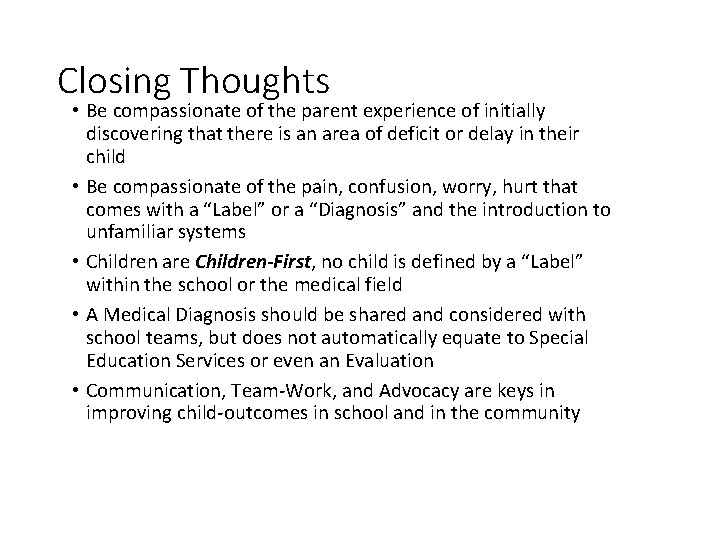
Closing Thoughts • Be compassionate of the parent experience of initially discovering that there is an area of deficit or delay in their child • Be compassionate of the pain, confusion, worry, hurt that comes with a “Label” or a “Diagnosis” and the introduction to unfamiliar systems • Children are Children-First, no child is defined by a “Label” within the school or the medical field • A Medical Diagnosis should be shared and considered with school teams, but does not automatically equate to Special Education Services or even an Evaluation • Communication, Team-Work, and Advocacy are keys in improving child-outcomes in school and in the community
Question & Answer
- Slides: 23