
Labelling Theory Dr Boran A Mercan Phenomenology Hermeneutics
Labelling Theory Dr. Boran A. Mercan
�Phenomenology �Hermeneutics �Alfred Schutz (1899– 1959) - Making sense of the world - How to subjectively make sense of the word - Weber (verstehen) - Interpretivism
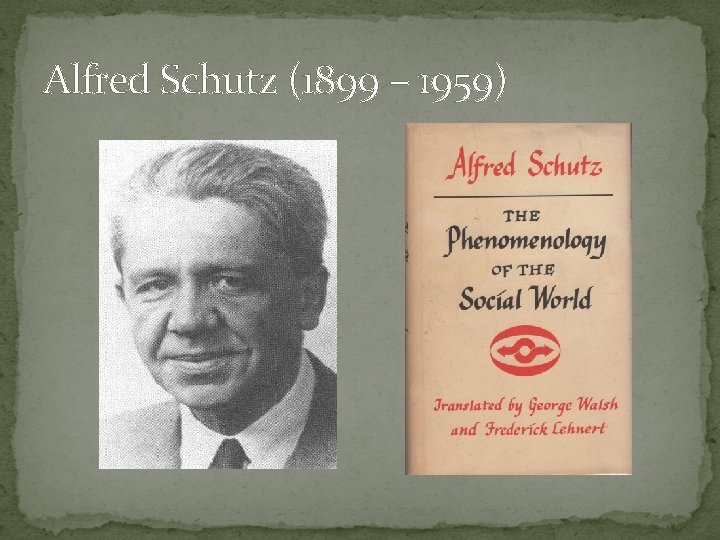
Alfred Schutz (1899 – 1959)
� “The world of nature as explored by the natural scientist does not ‘mean’ anything to molecules, atoms and electrons. But the observational field of the social scientist —social reality—has a specific meaning and relevance structure for the beings living, acting, and thinking within it. By a series of common-sense constructs they have preselected and pre-interpreted this world which they experience as the reality of their daily lives. It is these thought objects of theirs which determine their behaviour by motivating it. The thought objects constructed by the social scientist, in order to grasp this social reality, have to be founded upon the thought objects constructed by the common-sense thinking of men [and women!], living their daily life within the social world. ” (Schutz 1962: 59)
�The way that social scientists understand the world is radically different from that of the natural scientists �hermeneutics drawn from theology �the theory and method of the interpretation of human action �the explanation of human vs. the understanding of human behaviour.
�Phenomenology: the matter of how the subject makes sense of the world and refers to how the philosopher leaves aside biases about the world s/he tries to understand.
�“Interpretivism is a term that usually denotes an alternative to the positivist orthodoxy that has held sway for decades. It is predicated upon the view that a strategy is required that respects the differences between people and the objects of the natural sciences and therefore requires the social scientist to grasp the subjective meaning of social action. Its intellectual heritage includes: Weber’s notion of Verstehen; the hermeneutic– phenomenological tradition; and symbolic interactionism. ” (Bryman, 2012: 30)
�Symbolic Interactionism �George Herbert Mead - Self - Recognizing ourselves in our actions - Thinking of others as they think of us - Interpreting of other people’s interpretation
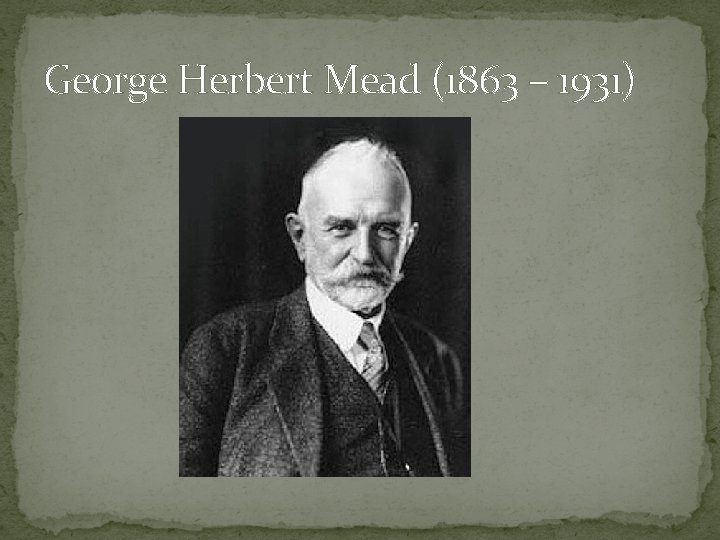
George Herbert Mead (1863 – 1931)
�Mead’s argument points out the way in which the notion of self stems from an evaluation of how other people (selves) view us. � the Iowa School, heavily influenced by Mead’s thoughts, yet studied the social world in a quite positivist way �Herbert Blumer, the student of Mead, coined the term symbolic interactionism and placed it alongside the hermeneutic–phenomenological and largely interpretative in approach.
�‘the position of symbolic interaction requires the student to catch the process of interpretation through which [actors] construct their actions’ (Blumer, 1962: 188). �Symbolic interaction “takes place in such a way that the individual is continually interpreting the symbolic meaning of his or her environment (which includes the actions of others) and acts on the basis of this imputed meaning. ” (Bryman, 2012: 31).
Applying Symbolic Interactionism to Criminology: Labelling �What is called crime comes after a law-breaking act, not before it takes place. �Deviance is not inherently embedded in the act, but it comes true by the reaction to it (the interpretation of the act). �Labelling theory is concerned with how the reaction may take the form of attributing some labels and the social impact that those labels may well have on people labelled �There is not only negative impact of labelling but also one can mention some positive impact of ‘shaming’.
�laws, rules, illegal, immoral, deviant and delinquent action and behaviour –social construction �Criminology should focus on understanding the meaningful social action and social interaction between agents. � Criminology benefits the dramaturgical analogy �The focus is on actors, roles and audiences.
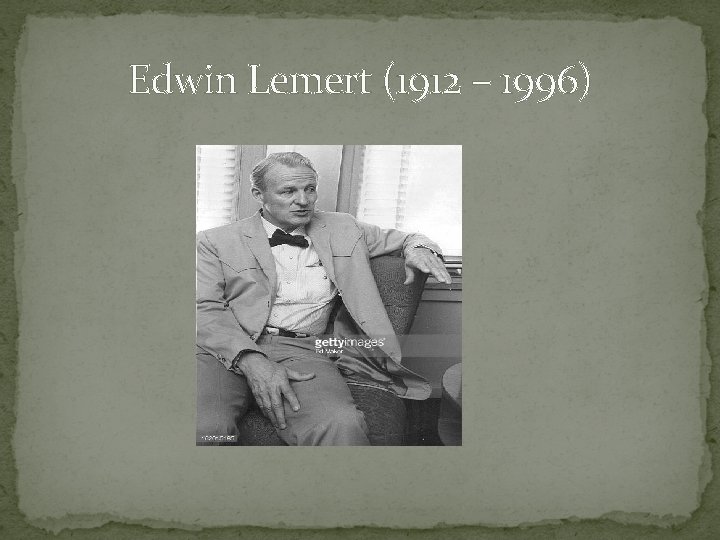
Edwin Lemert (1912 – 1996)
�“Older sociology. . . tended to rest heavily upon the idea that deviance leads to social control. I have come to believe that the reverse idea, i. e. social control leads to deviance, is equally tenable and the potentially richer premise for studying deviance in modern society. ” (Lemert, 1967: v)
� For Frank Tannenbaum (in the 1930 s): delinquents are not inherently different from non-delinquents. � Defining someone as a juvenile delinquent is a critical process and raises the conflict of over the definition of specific activities or states concerning the actions of young people � This influences people’s attitude and opinions about youth defined as delinquent. � The change of opinion and thoughts ends up with the change of behaviour � The interaction between the community and youth get under the effect of this change in opinion and attitudes
Lemert: - Primary deviance - Secondary deviance: (reaction to social response, acceptance of criminal identity) Becker: - Criminal identity - Criminal career
� “Primary deviance is assumed to arise in a wide variety of social, cultural, and psychological contexts, and at best [it] has only marginal implications for the psychic structure of the individual; it does not lead to symbolic reorganization at the level of self-regarding attitudes and social roles. Secondary deviation is deviant behaviour or social roles based upon it, which becomes a means of defense, attack, or adaptation to the overt and covert problems created by the societal reaction to primary deviation. In effect, the original ‘ causes’ of the deviation recede and give way to the central importance of the disapproving, degradational, and isolating reactions of society. ” (Lemert, 1967: 17)
Primary and secondary deviance � Edwin Lemert splits the effect of societal reaction into primary and secondary aspects. � He argues that reactions that generate a societal response should be taken into account � The societal reaction may cause the ‘ offender’ to change the conception of the self; the way of appreciating and perceiving themselves can change. � After the social reaction/response to the law-breaking act, people may start seeing themselves as deviant and continue acting according to this definition � Depending on people’s labelling, people can undertake others’ definition. � The latter is what Lemert calls secondary deviance
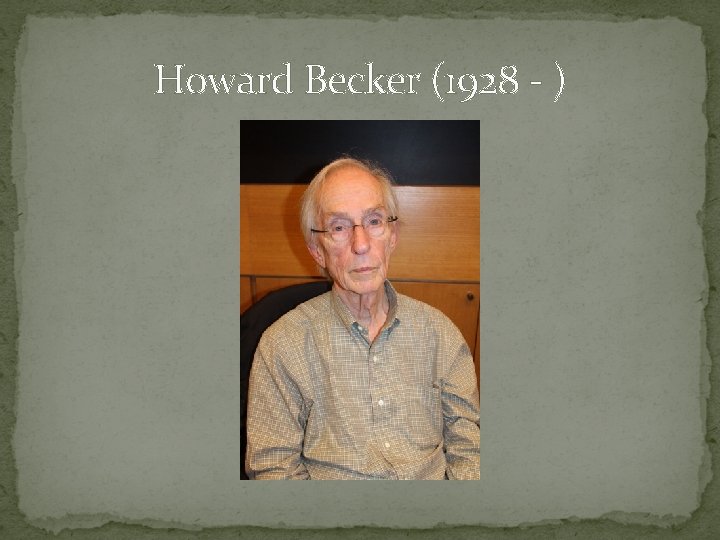
Howard Becker (1928 - )
� Becker studied how deviancy was created and understood � He focused on the concept of “career” --- particularly criminal career � the criminal justice and law enforcement agencies’ labelling some people as criminal decreases the likelihood that those with a criminal record will find a legitimate job, � thus the law enforcement and criminal court further pushes them to seek their livelihood in crime � Criminal justice procedure restrict legitimate employment opportunities and strengthen illegitimate pathways
�“Social groups create deviance by making the rules whose infraction constitutes deviance, and by applying those rules to particular people and labelling them as outsiders. From this point of view, deviance is not a quality of the act the person commits, but rather a consequence of the application by others of rules and sanctions to an ‘offender’. The deviant is one to whom that label has been successfully applied; deviant behaviour is behaviour that people so label. ”(Becker, 1963: 9)
�Becker argues that not rule-breaking but the application of labels creates deviancy. This relies on three-stage process: 1) Social groups generate rules and once these rules have been violated, then deviancy occurs. 2) Particular people and groups come to the target of the rules; those rules are only applied to them 3) Those to whom the rules are applied become “outsider” Like Marijuana users.
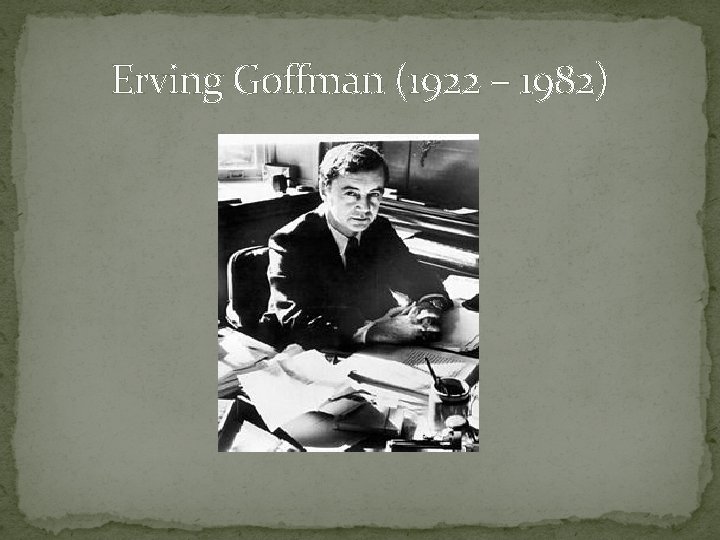
Erving Goffman (1922 – 1982)
Stigma �In ancient Greece, Goffman argues that stigma refers to: “bodily signs designed to expose something unusual and bad about the moral status of the signifier. The signs were cut or burnt into the body and advertised that the bearer was a slave, a criminal or a traitor – a blemished person, ritually polluted, to be avoided, especially in public places. ” Goffman (1963: 1)
�Stigmatisation stands salient within criminal justice system and prisons �Convicts wear uniforms and their records are registered �Penalties in the form of community work point out that negative symbols are well beyond the prison in contemporary society.
- Slides: 26