
LABELLING THEORY AND CRIME AND DEVIANCE RAPID RECALL
LABELLING THEORY AND CRIME AND DEVIANCE
RAPID RECALL 1. Identify a key labelling theorist. 2. What is the self fulfilling prophecy? 3. Give an example of a case study (ecucation? ) which demonstrates labelling. 4. Identify a criticism of labelling theory.
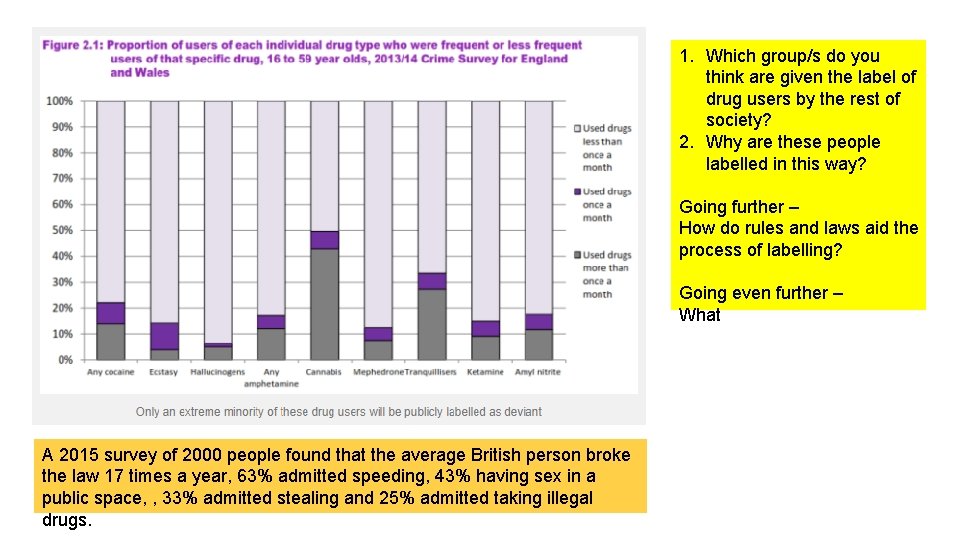
1. Which group/s do you think are given the label of drug users by the rest of society? 2. Why are these people labelled in this way? Going further – How do rules and laws aid the process of labelling? Going even further – What A 2015 survey of 2000 people found that the average British person broke the law 17 times a year, 63% admitted speeding, 43% having sex in a public space, , 33% admitted stealing and 25% admitted taking illegal drugs.
KEY FACTS ABOUT THEORY §LABELLING Emerged in the 1950 s. Key thinker= Howard Becker §Labels are usually negative §They are simplified descriptions which often draw upon stereotypes. § Labelled individuals often live up to their labels – the self fulfilling prophecy. KEY FACTS ABOUT LABELLING THEORY + C+D § Suggests that most people commit criminal and deviant acts but that only some get caught and stigmatised for it. So law breakers aren’t different to other people. §Due to the above labelling theorists think that it’s pointless trying to search for the difference between deviants and non-deviants. §Labelling theorists instead think it makes sense to focus on the reaction to and definition of deviance. §Labelling theory has been incorporated into many other approaches e. g. Marxism and postmodernism.
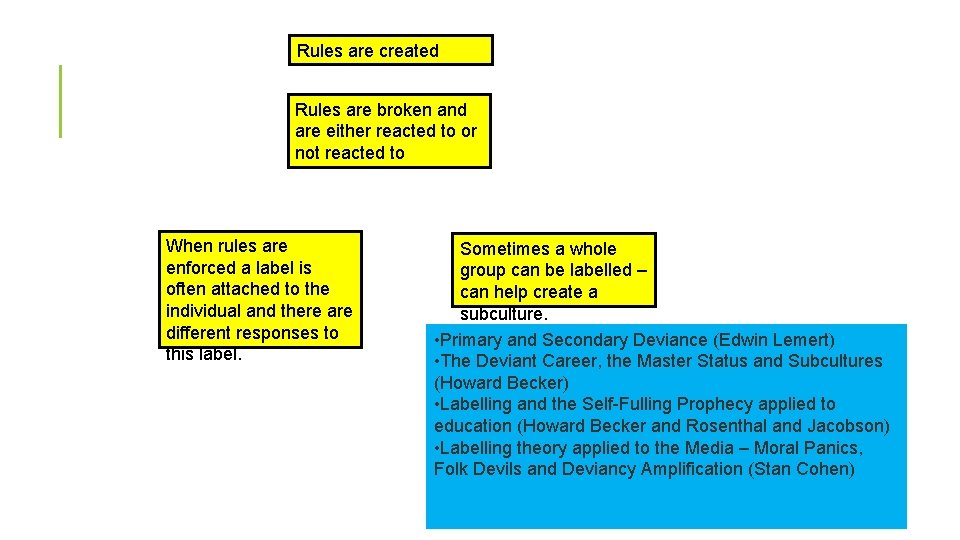
Rules are created Rules are broken and are either reacted to or not reacted to When rules are enforced a label is often attached to the individual and there are different responses to this label. Sometimes a whole group can be labelled – can help create a subculture. • Primary and Secondary Deviance (Edwin Lemert) • The Deviant Career, the Master Status and Subcultures (Howard Becker) • Labelling and the Self-Fulling Prophecy applied to education (Howard Becker and Rosenthal and Jacobson) • Labelling theory applied to the Media – Moral Panics, Folk Devils and Deviancy Amplification (Stan Cohen)
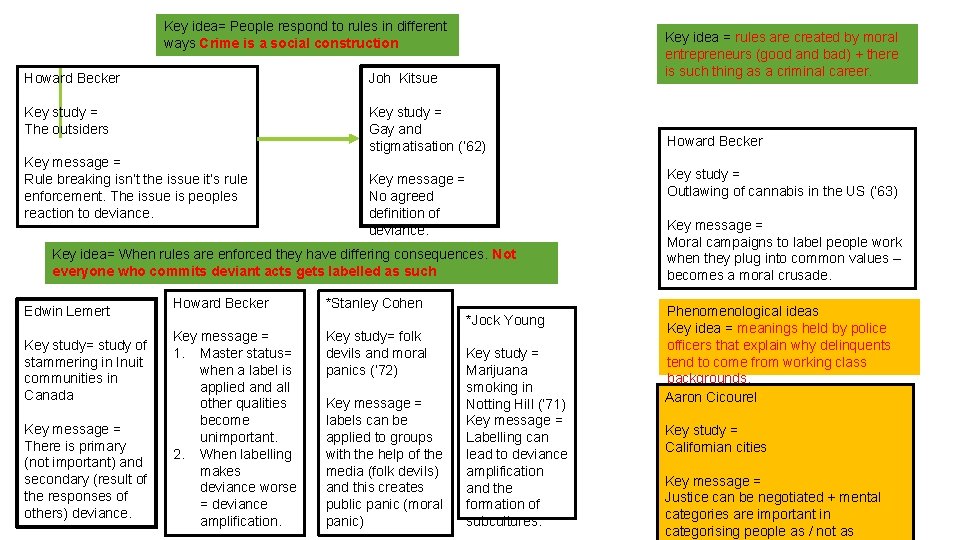
Key idea= People respond to rules in different ways Crime is a social construction Key idea = rules are created by moral entrepreneurs (good and bad) + there is such thing as a criminal career. Howard Becker Joh Kitsue Key study = The outsiders Key study = Gay and stigmatisation (‘ 62) Key message = Rule breaking isn’t the issue it’s rule enforcement. The issue is peoples reaction to deviance. Key study = Outlawing of cannabis in the US (‘ 63) Key message = No agreed definition of deviance. Key idea= When rules are enforced they have differing consequences. Not everyone who commits deviant acts gets labelled as such Edwin Lemert Key study= study of stammering in Inuit communities in Canada Key message = There is primary (not important) and secondary (result of the responses of others) deviance. Howard Becker *Stanley Cohen *Jock Young Key message = 1. Master status= when a label is applied and all other qualities become unimportant. 2. When labelling makes deviance worse = deviance amplification. Key study= folk devils and moral panics (‘ 72) Key message = labels can be applied to groups with the help of the media (folk devils) and this creates public panic (moral panic) Howard Becker Key study = Marijuana smoking in Notting Hill (‘ 71) Key message = Labelling can lead to deviance amplification and the formation of subcultures. Key message = Moral campaigns to label people work when they plug into common values – becomes a moral crusade. Phenomenological ideas Key idea = meanings held by police officers that explain why delinquents tend to come from working class backgrounds. Aaron Cicourel Key study = Californian cities Key message = Justice can be negotiated + mental categories are important in categorising people as / not as
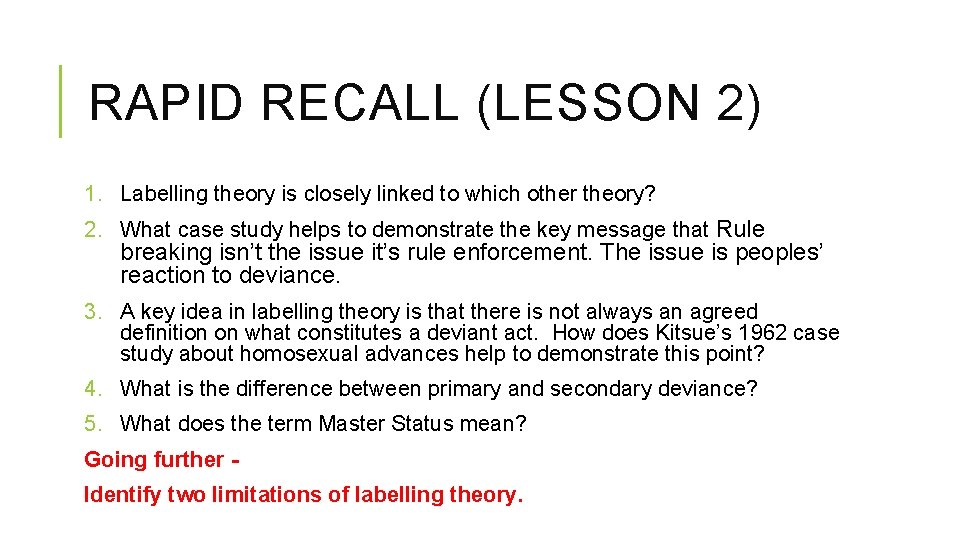
RAPID RECALL (LESSON 2) 1. Labelling theory is closely linked to which other theory? 2. What case study helps to demonstrate the key message that Rule breaking isn’t the issue it’s rule enforcement. The issue is peoples’ reaction to deviance. 3. A key idea in labelling theory is that there is not always an agreed definition on what constitutes a deviant act. How does Kitsue’s 1962 case study about homosexual advances help to demonstrate this point? 4. What is the difference between primary and secondary deviance? 5. What does the term Master Status mean? Going further Identify two limitations of labelling theory.
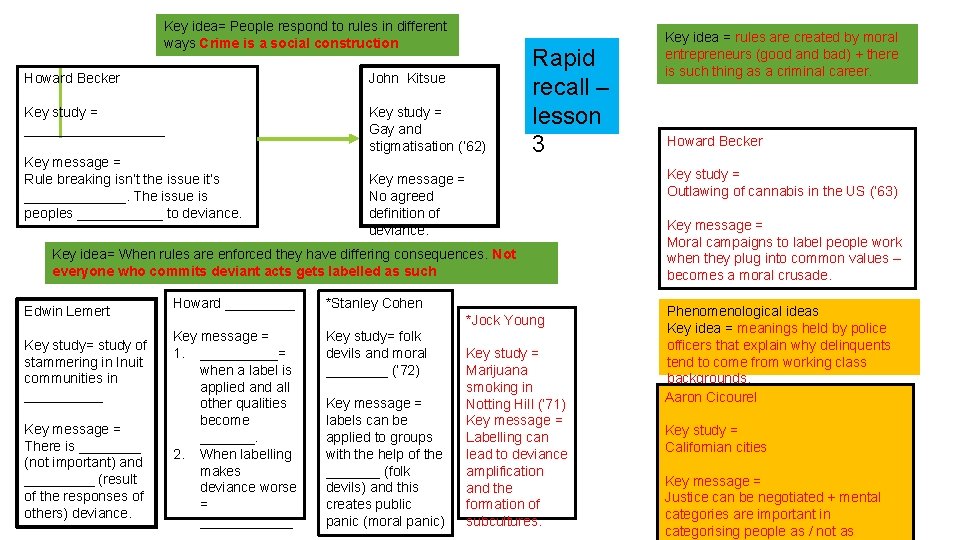
Key idea= People respond to rules in different ways Crime is a social construction Howard Becker John Kitsue Key study = _________ Key study = Gay and stigmatisation (‘ 62) Key message = Rule breaking isn’t the issue it’s _______. The issue is peoples ______ to deviance. Rapid recall – lesson 3 Key study= study of stammering in Inuit communities in _____ Key message = There is ____ (not important) and _____ (result of the responses of others) deviance. Howard _____ *Stanley Cohen *Jock Young Key message = 1. _____= when a label is applied and all other qualities become _______. 2. When labelling makes deviance worse = ______ Key study= folk devils and moral ____ (‘ 72) Key message = labels can be applied to groups with the help of the _______ (folk devils) and this creates public panic (moral panic) Howard Becker Key study = Outlawing of cannabis in the US (‘ 63) Key message = No agreed definition of deviance. Key idea= When rules are enforced they have differing consequences. Not everyone who commits deviant acts gets labelled as such Edwin Lemert Key idea = rules are created by moral entrepreneurs (good and bad) + there is such thing as a criminal career. Key study = Marijuana smoking in Notting Hill (‘ 71) Key message = Labelling can lead to deviance amplification and the formation of subcultures. Key message = Moral campaigns to label people work when they plug into common values – becomes a moral crusade. Phenomenological ideas Key idea = meanings held by police officers that explain why delinquents tend to come from working class backgrounds. Aaron Cicourel Key study = Californian cities Key message = Justice can be negotiated + mental categories are important in categorising people as / not as
Do you agree with the idea that there is no such thing as an inherently deviance act? Work your way through the list of deviance acts below and try to think of contexts in which they would not be regarded as deviant. Key message = law enforcement – Violence – Theft – Fraud – Drug taking – Public nudity – Paedophilia – Vandalism
DISCUSSION – PHENOMENOLOGICAL APPROACHES – CICOUREL Q 1 – Do you agree that the whole criminal justice system is basically biased against the working classes, and towards to middle classes? Q 2 – From a research methods point of view, what research methods could you use to test this theory?
- Slides: 10