
Labeling and Linguistic Ability in an Executive Function
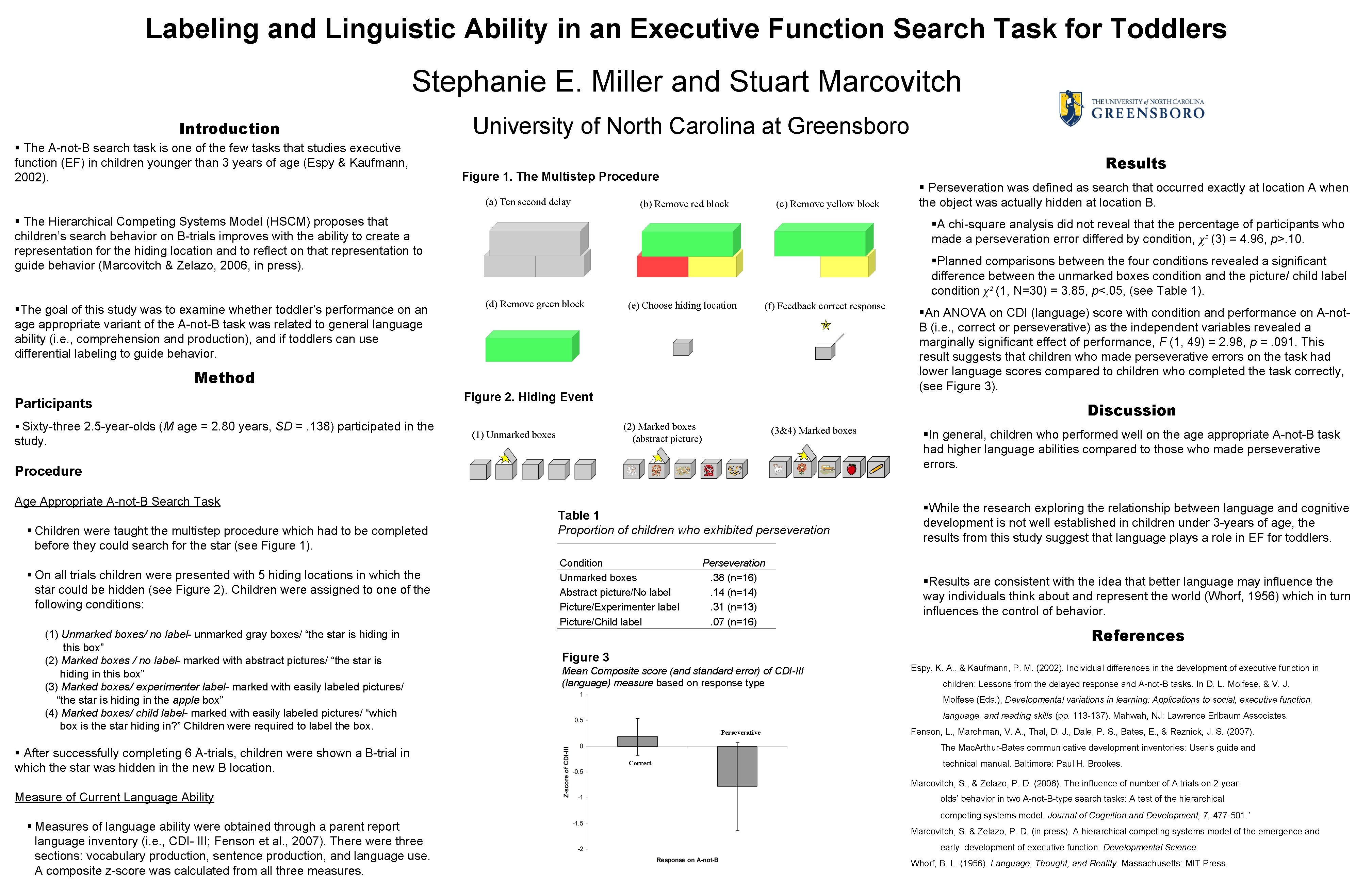
Labeling and Linguistic Ability in an Executive Function Search Task for Toddlers Stephanie E. Miller and Stuart Marcovitch Introduction § The A-not-B search task is one of the few tasks that studies executive function (EF) in children younger than 3 years of age (Espy & Kaufmann, 2002). University of North Carolina at Greensboro Results Figure 1. The Multistep Procedure (a) Ten second delay (b) Remove red block (c) Remove yellow block § The Hierarchical Competing Systems Model (HSCM) proposes that children’s search behavior on B-trials improves with the ability to create a representation for the hiding location and to reflect on that representation to guide behavior (Marcovitch & Zelazo, 2006, in press). §The goal of this study was to examine whether toddler’s performance on an age appropriate variant of the A-not-B task was related to general language ability (i. e. , comprehension and production), and if toddlers can use differential labeling to guide behavior. §A chi-square analysis did not reveal that the percentage of participants who made a perseveration error differed by condition, χ² (3) = 4. 96, p>. 10. §Planned comparisons between the four conditions revealed a significant difference between the unmarked boxes condition and the picture/ child label condition χ² (1, N=30) = 3. 85, p<. 05, (see Table 1). (d) Remove green block (e) Choose hiding location (f) Feedback correct response Method Participants § Sixty-three 2. 5 -year-olds (M age = 2. 80 years, SD =. 138) participated in the study. Figure 2. Hiding Event (2) Marked boxes (abstract picture) (1) Unmarked boxes (3&4) Marked boxes Age Appropriate A-not-B Search Task § On all trials children were presented with 5 hiding locations in which the star could be hidden (see Figure 2). Children were assigned to one of the following conditions: (1) Unmarked boxes/ no label- unmarked gray boxes/ “the star is hiding in this box” (2) Marked boxes / no label- marked with abstract pictures/ “the star is hiding in this box” (3) Marked boxes/ experimenter label- marked with easily labeled pictures/ “the star is hiding in the apple box” (4) Marked boxes/ child label- marked with easily labeled pictures/ “which box is the star hiding in? ” Children were required to label the box. § After successfully completing 6 A-trials, children were shown a B-trial in which the star was hidden in the new B location. §An ANOVA on CDI (language) score with condition and performance on A-not. B (i. e. , correct or perseverative) as the independent variables revealed a marginally significant effect of performance, F (1, 49) = 2. 98, p =. 091. This result suggests that children who made perseverative errors on the task had lower language scores compared to children who completed the task correctly, (see Figure 3). Discussion Procedure § Children were taught the multistep procedure which had to be completed before they could search for the star (see Figure 1). § Perseveration was defined as search that occurred exactly at location A when the object was actually hidden at location B. §In general, children who performed well on the age appropriate A-not-B task had higher language abilities compared to those who made perseverative errors. Table 1 Proportion of children who exhibited perseveration §While the research exploring the relationship between language and cognitive development is not well established in children under 3 -years of age, the results from this study suggest that language plays a role in EF for toddlers. Condition Unmarked boxes Abstract picture/No label Picture/Experimenter label Picture/Child label §Results are consistent with the idea that better language may influence the way individuals think about and represent the world (Whorf, 1956) which in turn influences the control of behavior. Perseveration. 38 (n=16). 14 (n=14). 31 (n=13). 07 (n=16) Figure 3 Mean Composite score (and standard error) of CDI-III (language) measure based on response type References Espy, K. A. , & Kaufmann, P. M. (2002). Individual differences in the development of executive function in children: Lessons from the delayed response and A-not-B tasks. In D. L. Molfese, & V. J. Molfese (Eds. ), Developmental variations in learning: Applications to social, executive function, language, and reading skills (pp. 113 -137). Mahwah, NJ: Lawrence Erlbaum Associates. Perseverative Fenson, L. , Marchman, V. A. , Thal, D. J. , Dale, P. S. , Bates, E. , & Reznick, J. S. (2007). The Mac. Arthur-Bates communicative development inventories: User’s guide and Correct technical manual. Baltimore: Paul H. Brookes. Marcovitch, S. , & Zelazo, P. D. (2006). The influence of number of A trials on 2 -year- Measure of Current Language Ability § Measures of language ability were obtained through a parent report language inventory (i. e. , CDI- III; Fenson et al. , 2007). There were three sections: vocabulary production, sentence production, and language use. A composite z-score was calculated from all three measures. olds’ behavior in two A-not-B-type search tasks: A test of the hierarchical competing systems model. Journal of Cognition and Development, 7, 477 -501. ’ Marcovitch, S. & Zelazo, P. D. (in press). A hierarchical competing systems model of the emergence and early development of executive function. Developmental Science. Whorf, B. L. (1956). Language, Thought, and Reality. Massachusetts: MIT Press.
- Slides: 1